Saturday, July 31, 2010

La Biennale Architecture 2010 - People Meet in Architecture

Frank Gehry installation of ‘ungapatchket’ in progress image © designboom

(Venice, Italy) La Biennale sent over a press release about the collateral events at this year's Architecture Exhibition, the 12th edition, and it sounds so innovative that I am going to share it with you in its entirety. This year's Director is Kazuyo Sejima, who is not only an actual architect, she is also an actual woman -- the first female Director ever -- so I am really looking forward to seeing life from her point of view. 

When the architects were here two years ago, all of Venice came to life. They flooded the streets, bars, restaurants and hotels of the city with their particular brand of creative energy, unique and refreshing. (That image you see is Frank Gehry's project back in 2008 from the very cool site designboom.com.) I just loved the architects, and listening to the way their minds work. You can read that Venetian Cat Blog post by clicking here:

One particular group of students and I had an interesting discussion when we shared a table at lunch. I asked them what type of project they would create in Venice, and they said they wouldn't create a building, they would create a space. 

I told them I had always dreamed of creating a Baby Park like they have in New York City along the Hudson River down by the West Village. The architects completely transformed the river, which used to be filled with dead bodies and drugs, so dangerous you could not go past Washington Street, into one of the most desirable areas in NYC. Using housing and design, the entire river came to life. And when they put in the Baby Park -- no one over twelve-years-old allowed to enter unless accompanied by a child -- guess what happened? Right! The West Village became full of babies! (I wrote about this phenomenon in my second novel, HARLEY'S NINTH.) Since the Forces of Evil continue to chip away at Venice's fragile infrastructure, and the resident population continues to decline, in my opinion a new Baby Park, say, over in Campo San Polo, would be the perfect solution to counteract that energy.

By the way, I piece I wrote entitled "Conversation With a Gondolier" that focuses on this situation has just been published by Gadling/AOL after Red Room, a writer's website I belong to, hooked me up with them. Under the terms of our agreement, Gadling/AOL has exclusive rights for six months so I can't give you an excerpt. I can, however, provide you with the links:

Click to go to my article on Gadling: 
http://www.gadling.com/2010/07/29/conversations-with-a-gondolier/

Click to go to my Red Room blog:
http://www.redroom.com/blog/cat-bauer/conversations-a-gondolier


Here is the La Biennale press release:
 
la Biennale di Venezia
12th International Architecture Exhibition
People meet in Architecture

Collateral events


Venice, July 30 – 20 Collateral Events will be presented at the 12th International Architecture Exhibition, with the title of People meet in Architecture, directed by Kazuyo Sejima and organized by la Biennale di Venezia under the presidency of Paolo Baratta (Preview August, 26th-27th-28th 2010) that will be open to the public from Sunday 29th August to Sunday 21st November 2010.

The Collateral Events are proposed by international organizations and institutions which organize their own exhibitions and initiatives in Venice. With their proposals and initiatives, the Collateral Events represent an original and significant enrichment of the program of the International Exhibition.


A Park dedicated to Giuseppe Ungaretti
Castello, 6113 (Borgoloco P. Molmenti)
from August 29 to September 26
Organization: Associazione Amici di Castelnuovo

Asian View of Life
Ex Magazzini del Sale, Salone del Sale, Dorsoduro
from August 29 to October 15
Organization: Centro Italiano per le Arti e la Cultura

Beyond Entropy : when Energy becomes Form
Fondazione Giorgio Cini, San Giorgio Maggiore Island
from August 27 to September 19
Organization: Architectural Association School of Architecture


Culture_Nature

green ethics – habitat - environment
Arsenale Novissimo – Spazio Thetis
from August 26 to November 21
Organization: Politecnico di Torino

De l’Objet à la Ville avec l’École nationale supérieure des Arts Décoratifs
Istituto Veneto di Scienze Lettere ed Arti, Palazzo Loredan, San Marco 2495 (Campo Santo Stefano)
from August 29 to November 21
Organization: École nationale supérieure des Arts Décoratifs

E-picentrum
"On site" considerations on the future of vulnerable cities
Arsenale Novissimo – Spazio Thetis – Padiglione “Modelli”
from August 29 to November 21
Organization: Università degli Studi di Roma “Sapienza”, Facoltà “Ludovico Quaroni”, Dipartimento Architettura e Progetto, with Technische Universität Darmstadt, Fachbereich Entwerfen und Wohnungsbau

Il vuoto e le forme 2010
Metropoli//Antimetropoli
Arsenale, Castello, 2126/A (Campo della Tana)
from August 29 to November 21
Organization: DIET Dipartimento di Ingegneria Edile e del Territorio dell’Università degli Studi di Pavia

Immaterial spaces
San Servolo Island, Edificio 17
from August 26 to September 30
Organization: Art Experience

Le cattedrali del vino. The meeting of two cultures
Hotel Danieli – Saloni Marco Polo, Castello, 4196 (Riva Schiavoni)
from August 28 to September 9
Organization: O.A.R. - Ordine degli Architetti Pianificatori, Paesaggisti e Conservatori di Roma e Provincia and IN/ARCH - Istituto Nazionale di Architettura

LONGING FOR… Score #1
Arsenale Novissimo – Nappa 89
from August 27 to August 29
Organization: ARTIMAGE CONTEMPORARY informe


M9 - A New Museum for a New City. The International Architectural Competition
Via Alessandro Poerio, 24, Venezia - Mestre
from August 28 to November 21
Organization: Fondazione di Venezia

Mapping Contemporary Venice
from the city of today to the Venice of the future
Venice International University - VIU, San Servolo Island
from August 26 to September 20
Organization: Venice International University – VIU

Ca’ASI, Cannaregio, 6024 (Campiello Santa Maria Nova)
from September 25 to November 21
Organization: Ca’ASI Association

Paris La Défense Seine Arche, Alex MacLean Given a Free Hand
Ca’ASI, Cannaregio, 6024 (Campiello Santa Maria Nova)
from August 29 to September 19
Organization: Public Development Authorities of La Défense Seine Arche

Provincia italiana – The Italian Provinces

Different venues in the towns of Bassano del Grappa, Caldogno, Montorso Vicentino, Possagno, Schio, Valdagno, Venezia, Vicenza, and those of the Camposampierese area.
from September 2  to November 19
Organization: Fuoribiennale and C4-Centro Cultura Contemporaneo Caldogno  with Centro Studi Usine

Quotidian Architectures: Hong Kong in Venice
Arsenale, Castello, 2126 (Campo della Tana)
from August 27 to November 21
Organization: The Hong Kong Institute of Architects and Hong Kong Arts Development Council


SISMYCITY
Palazzo Ducale, Loggia Foscara
from August 29 to October 30
Organization: fuori_vista

Take A Break: Spatial Variability in Contemporary Taiwan
Palazzo delle Prigioni, San Marco, Castello, 4209
from August 26 to November 21
Organization: The National Taiwan Museum of Fine Arts (NTMOFA)

The Bearable Lightness of Being – The Metaphor of the Space 2
Arsenale Novissimo – Tesa di San Cristoforo 94
from August 28 to October 7
Organization: Fondazione Mudima

The Garden and Beyond: A Global Garden
ESU Venezia – sala polivalente “Nardocci”, Dorsoduro, 3861 (Calle larga Foscari); VELA-Actv – info point “Hellovenezia”, Isola Nova del Tronchetto, 21
from August 29 to November 21
Organization: Associazione Culturale Gruppo Giovani Pittori Spilimberghesi

Ciao from Venice,
Cat

Tuesday, July 20, 2010

Festa del Redentore - Feast of the Redeemer in Venice 2010


(Venice, Italy)
This past weekend, July 17th and 18th, we celebrated Venice's greatest festival, the Feast of the Redeemer. I have written about this holiday before, back on July 19, 2008:

The Church of Redentore was built in honor of Christ the Redeemer to save Venice from the plague, which wiped out ONE THIRD of the population, including Titian himself. Now, what, exactly, were the sins from which the Venetians thought they needed redemption?

One was that they did a lot of trading with the Muslim countries. (I can think of several others:) The Venetians had tried everything, and as we know, when all else fails, the only thing left to do is to pray. 

In any event, it WORKED! The end of the plague on July 13,1577 is what we are celebrating tonight with what is usually the best fireworks in the entire world exploding over the lagoon. Venetians from all over the Veneto arrive in their boats to watch the show. The fondamenta 
on the Giudecca is lined with tables and Venetians eating traditional food. Terraces and balconies are filled with revelers. The Lido has their own party going on over there. It's a big Venetian party, and deserves its own blog, which perhaps I will give it in the future.

Click here to read the entire post:

500 Years of Andrea Palladio - Palladian Gala - Save Venice, Inc.


Well, the future is now:) I have seen Redentore fireworks every year for the past eleven years from many different angles and venues -- in boats, on rooftops, terraces and balconies, at Cipriani's, on the island of San Giorgio -- this year I walked across the floating bridge that links Venice proper to the island of Giudecca where the Church of Redentore is located FIVE times!

More background about the origins of the festival:

The Plague of 1576 is the plague that inspired one of Venice's most beloved holidays and famous churches -- Redentore. From the Comune's website:
In the three years between 1575 and 1577 the Serenissima was tormented by the plague: aided by the high density of the population, the disease spread through the city, causing terrible losses. Almost 50,000 died, which was more than a third of the city's inhabitants.


THE PLAGUE DOCTOR: The doctor wore a bird-like mask stuffed with medicinal herbs, etc. to prevent him from catching the plague.

On September 4, 1576, the Senate decided that the Doge should announce the vow to erect a church dedicated to the Redentore (Redeemer), in return for help in ending the plague.

The end of the plague 
On July 13, 1577, the plague was declared definitively over and it was decided that the city's liberation from the terrible disease should be celebrated on the third Sunday in July. 

The Feast of Redentore Celebrates the End of the Plague of 1577
 
Recap: The Venetian Senate vowed on September 4, 1576, in the midst of the plague, to build a church. On May 3, 1577, just eight months later, the cornerstone was laid. 
 
Miraculously, the plague was declared officially over two months after that, on July 13, 1577. The church was then consecrated only 15 years later in 1592, and put in the care of the Capuchin order of friars, who protect the Church of Redentore to this day.

From Wikipedia:
Il Redentore was built as a votive church in thanksgiving for deliverance from a major outbreak of the plague that decimated Venice between 1575 and 1576, in which some 46,000 people (25-30 per cent of the population) died. 
 
The Senate of the Republic of Venice commissioned the architect Andrea Palladio to design the votive church. Though the Senate wished the Church to be square plan, Palladio designed a single nave church with three chapels on either side. Its prominent position on the Canale della Giudecca gave Palladio the opportunity to design a facade inspired by the Parthenon of Athens and enhanced by being placed on a wide plinth. 15 steps were required to reach the church's entrance, a direct reference to the Temple of Jerusalem and complicit with Palladio's own requirement that "the ascent (of the faithful) will be gradual, so that the climbing will bring more devotion".
Church of Redentore - Photo: Cat Bauer
The corner-stone was laid by the Patriarch of Venice Giovanni Trevisano on May 3, 1577 and the building was consecrated in 1592. At the urgent solicitations of Pope Gregory XIII, after consecration the church was placed in charge of the Order of Friars Minor Capuchin. A small number of Friars reside in the monastery attached to the church.
Every year the doge and senators walked across a specially constructed pontoon bridge from the Zattere to Giudecca to attend Mass in the church. The Festa del Redentore remains a major festival in the Venetian calendar, celebrated on the third Sunday in July. A huge firework display on the previous evening is followed by a mass procession across the pontoon bridge.
Have you calculated all that? It means that Venice has been re-enacting the original Redentore scene for 433 years. (Do any of you scholars out there know if the ceremony was suppressed by Napoleon?) This year was especially poignant for me -- more religious, less "festive" -- this year I spent most of my time hanging out in the church, or rather, churches. 
To watch the fireworks on Saturday night, I sat on the ledge at the top of those awesome stairs of the Church of Redentore, dangling my legs over the  edge, as I often have done on the ledge of my own balcony. I counted twelve people, including a nun, who, too, were sitting on the ledge. It gave a good view of the lagoon and the sky, and raised us above the crowd below. Nature, too, got in on the act -- a dark cloud flashed lightning bolts at the other end of the lagoon -- a great build-up to a spectacular thunderstorm that finally arrived very early Sunday morning.

Church of Sant'Eufemia
Later on Sunday, the morning of Redentore, the air was fresh and clear. I had the great honor of having the Mass in the Church of Sant' Eufemia, (located closer to the Hilton on Giudecca) dedicated to me; the service was performed by a Capuchin friar. Sant' Eufemia is a sweet, ancient church whose Venetian-Byzantine foundation dates back to the ninth century; it was a beautiful ceremony that I appreciated very much. Later that evening it was standing-room-only back at the Church of Redentore, with our Patriarch, Angelo Scola, performing the ancient rite that has been celebrated by Patriarchs of Venice for centuries.
Ciao from Venice,
Cat

Tuesday, July 13, 2010

Cat Rides the New People Mover

(Venice, Italy) This morning I took a ride on our nifty new People Mover which boasts that it can take you from Piazzale Roma to Tronchetto in 3 minutes -- give or take. In fact, the entire boast is that it runs every 7 minutes, from 7 to 23:00, (11:00pm) and gets you there in 3. And you know what? It really does, give or take a minute, depending on the ride. It took 4 minutes to get back, but that's still pretty good. The track it rides on looks cool, sort of Neo Art Deco. (That image you see is by Luke Band (C) Copyright Reserved)

Tronchetto is basically a huge parking terminal, and before the People Mover, you had to take a boat, bus or walk to get to Piazzale Roma, which is the final place you can arrive by car to reach Venice proper before you are stopped by the water. Scoring a parking space in Piazzale Roma was always difficult and expensive.

With this new People Mover, however, you can park your car at Tronchetto, where it is cheaper (plus you can shave off some drive-time, which often consists of a bumper-to-bumper line of cars ) and then spend one euro to reach Piazzale Roma, or 15 euro for a monthly pass. It makes one stop at Stazione Marittima, or the port, where, apparently they are going to build yet another parking lot.

To experience more of the New World Venice, when you arrive at Piazzale Roma, you can walk over the new Fourth Bridge, officially known as the Ponte della Costituzione (even though Wikipedia says everyone calls it the Calatrava Bridge, I, and many other people still call it the Fourth Bridge.) From Wikipedia:

The Ponte della Costituzione (English: Constitution Bridge) is the fourth bridge over the Grand Canal in Venice, Italy. It was designed by Santiago Calatrava, and was moved into place in 2007 (connecting Stazione di Santa Lucia to Piazzale Roma), amid protest by politicians and the general public. The bridge was installed in 2008 and opened to the public on the night of September 11, 2008. The bridge was known as Quarto Ponte sul Canal Grande before the official name was adopted to celebrate the 60th anniversary of the Italian constitution in 2008.[2] Tourists and locals in Venice now refer to it as the Calatrava Bridge (Italian: Ponte di Calatrava a Venezia).[3]  


(The Fourth Bridge looks kind of Neo Art Deco, too:)


We even have new vaporetto terminals popping up all over town, also in the same style. There is one on The Lido, one over by Harry's Bar and one down by Arsenale. They are huge compared to the old vaporetto stops, and again, sort of sleek Neo Art Deco. I can't find a good photo of the new terminals, that is how new they are:)


Here in Venice, change is usually regarded with suspicion. We have a saying, "Com' era, Dov' era," which means"As it was, where it was." So, if a building goes down, as it did when La Fenice burned, the rule is that it must go back as closely as possible to how it was before. 


None of these new projects are breaking that rule because they are going up in places where nothing existed before. HHHhhhhmmmm. I wonder if, in the future, they will be concerned about duplicating the old People Mover "as it was, where it was," or restoring the Old Fourth Bridge built way back in 2009.


Ciao from Venice,
Cat
Venetian Cat - The Venice Blog


Friday, July 2, 2010

da Sandro - Funeral at San Giovanni & Paolo

(Venice, Italy) On Friday, June 11, 2010, I went to the funeral of Sandro the owner of da Sandro, a trattoria close to Campo San Polo (I borrowed that image you see from the blog of Market Manila; you can read about his da Sandro experience by clicking the link: http://www.marketmanila.com/archives/da-sandro-venice) 


Sandro was so beloved, he was one of those people who are known only by their first name, like Madonna, or Cher or Bruce. I met him long ago, when I first started writing for the IHT-Italy Daily: 

"Sandro was one of those people that if you were homesick, he would make you feel like family. If you broke up with your boyfriend, he would give you a pizza on the house. In a town famous for its fish, da Sandro is one of the few places where you can find a really great steak. Many times when I passed by, I stopped to just to hang out and drink red wine with Sandro. He was a real gentleman."


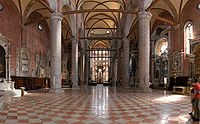
To illustrate the esteem in which Sandro was held by the locals, his funeral took place at one of Venice's most prestigious churches, the Basilica di San Giovanni e Paolo, where the Doges are buried. (In fact, I am looking at the awesome bricked side of San Giovanni e Paolo, with its towering Gothic windows, right now as I type this! I am sitting in Rosa Salva, a gelateria, a place for sweets and ice cream and drinks -- and another Venetian landmark that has been around since 1879.) A bit about San Giovanni e Paolo from Wikipedia:


The Basilica di San Giovanni e Paolo, known in the Venetian dialect as San Zanipolo, is a church in Venice, northern Italy. One of the largest churches in the city, it has the status of aminor basilica. After the 15th century the funeral services of all of Venice's doges were held here, and twenty-five doges are buried in the church.


A huge brick edifice built in the Italian Gothic style, it is the principal Dominican church of Venice, and as such was built for preaching to large congregations. It is dedicated to John and Paul, not the Biblical Apostles of the same names, but two obscure martyrs of the Early Christian church in Rome, whose names were recorded in the 3rd century but whose legend is of a later date. Click here to read the entire article:


The enormous church was filled with people who came to honor Sandro. In true Venetian synchronicity, I found myself seated in the row behind our former mayor, Massimo Cacciari, who turned and shook my hand when it was time to wish each other "Peace," part of the Christian ceremony. 


Leonardo, Sandro's son, has been carrying on the business as usual over at da Sandro, so if you are in the area, stop by and have a meal in honor of Sandro. 


Rest in Peace, Sandro. 


Ciao from Venice,
Cat
Venetian Cat - The Venice Blog