Wednesday, October 27, 2010

Italy, Defend Your Heart - FAI Hosts Oddballs in Venice Between 1800 & 1900


(Venice, Italy) The Fondo Ambiente Italiano (FAI), or the Italian Environmental Foundation was established in 1975 to "emulate the English National Trust." (For Americans, a similar organization would be the National Trust for Historic Preservation.) 

Several years ago, I was in a location in Wales managed by the National Trust where I purchased some very fine furniture wax, the old-fashioned kind that you must rub hard into the real wood to keep it alive. To me, that is symbolic of the kind of work these type of foundations do. 

In fact, FAI declares that it bases its work on seven principles: 

  • Knowledge & Expertise
  • Concreteness
  • Consistency
  • Independence 
  • Quality
  • Curiosity
  • Busy Idleness 
Since FAI is a foundation, we can agree those are principles upon which any solid foundation should be built. FAI safeguards the heritage of art, nature and the Italian landscape.

The Venice Chapter of FAI is putting their unique imprint on fundraising by hosting a series of events with the theme Personaggi stravaganti a Venezia tra '800 e '900 , which Google Translate amusingly interprets as "Oddballs in Venice between 1800 and 1900." Let's call them "unique personalities" or "extravagant characters."

The series kicked off on October 15 at Ca' d'Oro, featuring Concetta Lo Iacono reporting on the famous ballerina, Maria Taglioni (1804-1884) who lived for a time at the palazzo. Taglioni's claim to notoriety was shortening her skirts so the audience could see her excellent en pointe.

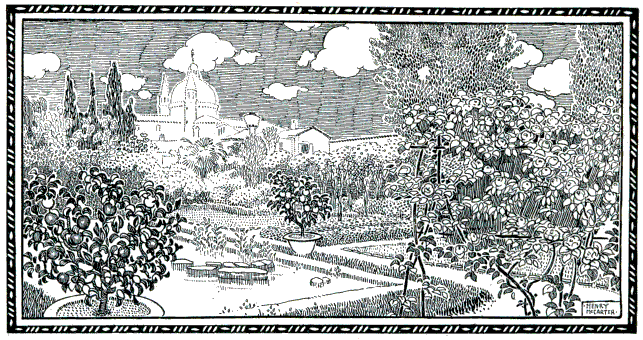
On October 21st, Ida Tonini and Guido Zucconi spoke at the Hotel Palladio on Giudecca about Fredric Eden (1828-1916) and the colorful and controversial Austrian artist and architect, Friedensreich Hundertwasser (1928-2000) owners of the most mysterious garden in Venice, The Garden of Eden, an event I am sorry to have missed. Visited in the past by the likes of Proust, Rilke, Cocteau, Henry James, Thomas Hardy and D'Annunzio, the enormous walled garden is a source of unending curiosity to this day. Click HERE to read an excellent post from British librarian Jeff Cotten's blog, Fictional Cities.

Here is an excerpt:

Henry McCarter
"Eden and his wife Caroline bought the artichoke garden on the, then semi-rural, island of Giudecca in 1884. They transformed the six acres into an English-style paradise, complete with roaming cattle, statues, and rose trellises. It's tempting to think of Gertrude Jekyll helping out her elder sister, but Jekyll's fascination with gardening did not, it seems, develop until years after the creation of the Eden's garden. It was then, and remains, the largest private garden in Venice (although its exact size is the subject of argument). ...

...The sociable Edens made the garden into the social centre of the British ex-pat society and attracted visitors like Proust, Rilke and Henry James in it's turn-of-the-century heyday. Gabriele d'Annunzio has an episode set in the garden in his novel Il fuoco. Frederick Rolfe, Baron Corvo, author of The desire and pursuit of the whole (and something of a side-thorn for the ex-pat society of the time which gathered in the garden) even offered his services to the Edens as poultry manager during a period of skintness. ..."

Next up, on October 28 at 5:30PM at the Archivio di Stato in Campo dei Frari, Mariachiara Mazzariol will discuss one of the greatest publishers of his time, Ferdinando Ongania (1842 -1911). 

The Disquieting Muses
by Giorgio De Chirico
On November 11th at 5:30PM at Ca' Giustinian, La Biennale headquarters, in the beautifully restored Sala delle ColonneGiorgio Colombo will shed light on the surrealist artist, Giorgio De Chirico (1888-1978), founder of the scuola metafisica, and who was an annual visitor to Venice.

On November 15 at 6:00pm at the Istituto Italo-Britannico over at Palazzo Pesaro Papafava, Maria Stella Florio will speak about Rawdon Brown, a historical scholar who came to Venice for a two week vacation in 1833 and never left -- he died in Venice in 1883. A great friend of John Ruskin, Rawdon Brown managed to explore the Venetian State Archives and uncover volumes concerning England and its relationship with Venice which were published as "Calendar of State Papers in the Archives of Venice." He also bought the mysterious palazzo Ca' Dario in 1838.

On November 18 at 5:30PM at Palazzo Pisani, the Conservatorio Benedetto Marcello in Santo Stefano, Venice's music conservatory -- the same palace where  Don Giovanni and The Man of Stone was held -- the spectacularly rich American, Winnaretta Singer de Polignac (1865-1943), an heir to the Singer fortune and wife of the Prince Edmond de Polignac, will be honored by Vitale Fano. FAI has decided to make the restoration of Palazzo Pisani one of their projects, sure to attract international music students from around the globe. 
 
From Wikipedia:

"In 1894 the Prince and Princess de Polignac established a salon in Paris in the music room of their mansion on Avenue Henri-Martin (today, Avenue Georges-Mandel). The Polignac salon came to be known as a haven for avant-garde music. First performances of Chabrierd'IndyDebussyFauré, and Ravel took place in the Polignac salon. The young Ravel dedicated his celebrated piano work, "Pavane pour une infante défunte", to the Princesse de Polignac. Many of Proust's memorable evocations of salon culture were born during his attendance at concerts in the Polignac living room."

On November 25 at 5:30 at the Tribunale di Venezia - Aula di Corte d'Assise, Franca Zanchi and Antonio Franchini will reveal information about one of Venice's most shocking scandals, The Russian Affair -- the trial of Russian Maria Tarnowska (1877-149), which made front page headlines all over Europe. The setting was yet another palace, Palazzo Maurogonato, which today is the Hotel Ala. There is even an unproduced film script. 
 
From Wikipedia:

"In 1907, one of her lovers, Nicholas Naumov (also spelled Naumoff), killed another one of Maria's lovers, Count Pavel Kamarovsky, in Venice, allegedly upon her instigation. The Countess Tarnowska, as she was commonly called, was arrested that same year in Vienna and transferred to La Giudecca penitentiary in Venice, where the trial was to be held. The trial, locally called the Russian affair (l'affare dei Russi), began on March 14, 1910, and ended on May 20 of the same year, with the conviction of both defendants. Maria Tarnowska was found guilty but was sentenced to serve a relatively mild term of only eight years in prison, thanks to an ingenious defence (it was one of the first to include Freudian analysis of the defendant's personality and motives) – and, possibly, due to the leniency of the presiding judge.[2]"

Finally, on December 14 at 5:30PM at Palazzo Fortuny, Enric Bou will entertain with tales about the great designer, Mariano Fortuny y Madrazo (1871-1949). 
 
From Wikipedia:

"Nowadays the Museum Fortuny is housed in the Venezian-Gothic Palazzo, the former home, studio, showroom and "Think-Tank" of Mariano Fortuny (1871–1949) who acquired it at the beginning of the century. Fortuny invented in his Palazzo the Delphos gown, a gown based on the ancient Grecian style; and the Knossos Scarf, a silk scarf also inspired by this civilization. Fortuny also created new methods of dying textiles and well as ways of printing on fabrics. He created the Fortuny cyclorama dome, a stage lighting innovation that could be used to create lighting effects such as a bright sky or a faint dusk; and the Fortuny lamp, for indoor lighting."

For those of you fortunate enough to be in Venice, attending these events will be like stepping into the pages of Marcel Proust. For those of you in other parts of the world, I suggest putting on some Wagner and getting your copy of Proust's À la recherche du temps perdu down off the shelf. If you would like to support FAI, please click HERE.

For further information:
Studio Systema
Tel. +39 041 5201959
Fax +39 041 5201960
e-mail systema@studiosystema.it

Ciao from Venice,
Cat

Sunday, October 10, 2010

Sir Peter Blake, The Butterflyman, alights in Venice

The Butterflyman in Venice
(Venice, Italy) Sir Peter Blake is called the Founding Father of Pop Art. Born on June 25, 1932, he is now seventy-eight-years old and in better form than ever. He has created a fanciful character called "The Butterflyman," a stately gentleman who travels from town to town with a magic butterfly wand and an open book, releasing butterflies that float gently in the air, spreading happiness and charm. 

Last night, October 9, 2010, the Butterflyman alighted at the Galleria Michela Rizzo here in Venice to present "Venice Suite," a show curated by Valerio Dehò in collaboration with the Paul Stolper Gallery in London -- where, by the way, you can see Peter Blake chum Damien Hirst's butterflies in "The Souls." Above you see the Butterflyman and his winged companions in front of the Palazzo Ducale.

I think the Butterflyman lives in the forest, and, indeed, there was a inkjet on canvas showing him in that environment. Then, after he gets fully charged with enchantment, off he trots to places like Paris and Venice and Holland, sprinkling gaiety into the atmosphere.

Now, that is just my opinion since I did not think to ask Sir Peter where the Butterflyman lives. I did, however, ask Sir Peter if he deliberately planned to open the exhibit on October 9th to coincide with what would have been John Lennon's seventieth birthday, and he said, no, and that I was the first one to remind him of the significance of the date. 

In any event, there was a picture of The Beatles on display, and, of course, Sir Peter Blake will be tied to them forever as the artist who created the cover of Sgt. Pepper's Lonely Hearts Club Band.

Butterflies

In addition to the Butterflyman, the Venice Suite exhibition consists of a series of 20 screen prints set in Venice that are also available as a box of  postcards. My favorite, that lovely girl flying over Rialto on a ball, was not there; perhaps she is sold out. 

Peter Blake said that he created the exhibition specifically to fit into Michela Rizzo's gallery. He knew the dimensions of the space and planned accordingly. He also remarked that his life had sped up considerably. In fact, he has a major exhibition at The Museum of Everything in London opening next week on Wednesday, October 13th.

Some of the screen prints were rather dark with airplanes about to crash over Rialto and wild beasts. Moira Jeffries wrote an interesting piece for The Scotsman last year entitled Peter Blake interview: Cut out and keep that sheds some light:

Crash
In 2007, he went back there for only the second time in his life, to support his much younger friend Tracey Emin, who was showing at the Venice Biennale. " 
As it happens it was a total disaster," says Blake. "We arrived at the airport and they had lost our luggage. After three hours of tracing it, we went into Venice with an Italian critic who was meeting us. We went to get on a water taxi and it moved… and I fell about four feet on to my knee. I was in agony the whole time, taking painkillers."
In the prints the city's tourist spots have been transformed by all kinds of surreal mischief and disaster. There are ice and penguins, boat races and parades. "I think what happened is that they started to become a bit surrealist and I started to push it. What wouldn't you see if you visited Venice? You would never see the Aurora Borealis for example and it seemed unlikely that Venice would freeze over."
In contrast, a new series of works set in Paris are all butterflies and charm. "It may well refer to the fact that I was in pain all the time in Venice, there are aeroplanes about to crash and wild animals. They are nightmares whereas the Paris ones are dreams."
Click HERE to read the entire article.

There was also a wonderful diamond dust Marilyn inkjet print, among other delights. After the opening, Stephen and Joanita Green hosted a magical, mystical Paint it Blake! party at their home in Palazzo Mocenigo with colorful balloons bouncing around the dance floor, colorful nibbles to eat -- including genuine cotton candy -- and colorful vinyl music from 1965 to 1967 with the artist Luca Cabot doing a great job as the DJ for the evening; he even had an original Sgt. Pepper album spinning on the turntable. 

As I watched what is perhaps the most famous album cover in history spin round and round, the Beatles in their satin day-glo military outfits surrounded by iconic characters and flowers, it made me long for the days when an album was a work of art with lyrics like librettos, new technology allowing harmonies never before possible, classical mixed with pop and sitars, electric mixed with wood, brass and strings, and melodies everyone could sing; melodies that became part of the atmosphere itself, pouring out of car windows and homes and into the schools and streets. 

The world was filled with color, color, color everywhere, color in clothes, color in sound, colorful tastes and smells, food coming over from India and the East, a barrage of color that stimulated the eyes and nudged everyone awake.


As John Lennon sang in Being for the Benefit of Mr. Kite! "Having been some days in preparation a splendid time is guaranteed for all…´ I thought having Sir Peter Blake in the palace was even better than having Mr. Kite himself, his fanciful energy inspiring everyone. 

And, indeed, a splendid time was had by all. 

Ciao from Venice,
Cat
Venetian Cat - The Venice Blog

Wednesday, October 6, 2010

Don Giovanni and The Man of Stone in Venice - La Biennale Music 2010


This post was updated July, 2026.

(Venice, Italy) 
"Don Giovanni and The Man of Stone" -- Dongiovanni e l'uom di sasso -- was the title of La Biennale's 54th International Festival of Contemporary Music, which concluded on October 2, 2010. So, that was the theme running through the entire program directed by Luca Francesconi, which consisted of 27 world premieres (18 commissioned by La Biennale), 15 Italian premieres, 77 composers, 31 events including concerts, installations, audio-visual performances, choral music, workshops, seminars and meetings.

Here is the Don Giovanni synopsis from Wikipedia:
"Don Giovanni, a young, arrogant, sexually prolific nobleman, abuses and outrages everyone else in the cast, until he encounters something he cannot kill, beat up, dodge, or outwit."
The full title of the opera by Wolfgang Amadeus Mozart, libretto by Lorenzo Da Ponte is Il Dissoluto Punito ossia il Don Giovanni Dramma giocoso in due atti. The English translation of this varies, and is seen as "The Dissolute Punished," "The Punishment of the Libertine" etc. What is the most difficult to translate, however, is dramma giocoso, which is translated in La Biennale's program as "playful drama." 

From Wikipedia:
"Dramma giocoso (Italian, literally: jocular drama; plural: drammi giocosi) is the name of a genre of opera common in the mid-18th century. The term is a contraction of "dramma giocoso per musica" and is essentially a description of the text rather than the opera as a whole. The genre developed in the Neapolitan opera tradition, mainly through the work of the playwright Carlo Goldoni in Venice. Characteristic of drammi giocosi is the technique of a grand buffo scene as a dramatic climax at the end of an act. ...

...the only works of this genre that are still frequently staged are Wolfgang Amadeus Mozart's and Lorenzo da Ponte's operas Don Giovanni from 1787 and Così fan tutte 1790. However, Mozart entered these works in his catalogue as "opera buffa"."
To me, what was missing in Don Giovanni and The Man of Stone was that feeling of playfulness, reflected in the works produced in the mid to latter part of the 1700s -- the same time the United States of America was being created and the Republic of Venice was being destroyed. 

I longed for more of that marvelous Venetian sense of humor, something I found lacking in the present production. 
Whenever we start to lose sight of the fact that it is The Divine Comedy, not The Divine Tragedy, mankind always gets itself in trouble. 

The Venice Effect permeates the original composition of Mozart's Don Giovanni through men like Goldoni, Salieri, and Da Ponte himself, who was friends with none other than Casanova -- that Venetian master of seduction. Both Da Ponte and Casanova have the notorious claim to fame of being banished from Venice by the authorities.
 
Thanks to Peter Schaffer's brilliant play and film, Amadeus, (which won 7 Tony Awards and 8 Academy Awards) most of us are familiar with the life of Mozart. 

From 
Wikipedia:
"Amadeus is a stage play written in 1979 by the English dramatist Peter Shaffer, based on the lives of the composers Wolfgang Amadeus Mozart and Antonio SalieriAmadeus was inspired by Mozart and Salieri, a short play by Aleksandr Pushkin which was later adapted into an opera of the same name by Nikolai Rimsky-Korsakov. Shaffer then adapted Amadeus for a film released in 1984."
And what about Antonio Salieri?
"Antonio Salieri (18 August 1750 - 7 May 1825) was an Italian classical composerconductor and teacher born in the Republic of Venice, but who spent his adult life and career as a faithful subject of the Habsburg Monarchy."
The Venetian Da Ponte had already written the text for two operas with the Venetian Salieri by the time he hooked up with the Bavarian Mozart to write Le Nozze di Figaro in 1786, and then Don Giovanni in 1787. Also in 1786, Da Ponte had written the libretto for Il burbero di buon cuore  based on a play by the Venetian Carlo Goldoni. 

Lorenzo Da Ponte was born a Jew named Emanuele Conegliano, became a Roman Catholic priest, and was later thought to be an Anglican. He ended up in the United States as the first professor of Italian literature at Columbia College, and used to tell tales about how he had insisted to Mozart that 
Don Giovanni have a comedic flair to make the subject more palatable to audiences. 

From Wikipedia:
"Lorenzo Da Ponte (10 March 1749 - 17 August 1838) was a Venetian opera librettist and poet. He wrote the librettos for 28 operas by 11 composers, including Mozart. [His] widowed father converted himself and his three sons to Roman Catholicism in order to marry eighteen-year-old Orsola Pasqua Paietta. She was only four years older than Da Ponte, then 14 years old."
"He was born Emanuele Conegliano in a Jewish ghetto near Venice in 1749. When he was fourteen, his widowed father remarried, this time to a Catholic, requiring the family to convert to Catholicism, whereupon Emanuele took the name of the officiating bishop. He eventually entered a seminary, mastered Hebrew and the classical languages (in which he wrote poetry), and soon was promoted to professor, then vice rector -- all the while carrying on several love affairs.

He was ordained at age 24 and assigned to a church in Venice, where he caroused with the likes of Casanova and Gozzi for six years. Though he arranged entertainment for a brothel and got a married woman twice pregnant, among other forgivable unclerical escapades, the authorities found some of his poetry unforgivably seditious. He was brought to trial -- in absentia, for he had already fled to Vienna -- and banished."
Click HERE to read the entire article, which I strongly recommend you do.

The story of Da Ponte is the humor I am talking about. I think it is very amusing that the very first professor of Italian literature in the United States was a Venetian Jewish Roman Catholic priest thought to be an Anglican, who carried on numerous love affairs, was married with children and died at the age of 89.

So, what happened to poor Don Giovanni at this year's Biennale to make everything so dark and depressed, the female broken down into body parts? 

To me, it was the influence of the Father of Existentialism itself, 
Søren Kierkegaard. According to the La Biennale's program notes "...three key scenes of the 'old' opera and eight 'new' works commissioned by La Biennale, will correspond to the three stages of seduction laid down by Kierkegaard in Either/Or..." 

With Mozart dead and Da Ponte having himself a grand time over on the other side of the Atlantic, Kierkegaard, a depressed Dane who went to his death at age 42 as a celibate bachelor, got his hands on Don Giovanni and flipped the story on its head. This is the man who is going to give us advice about the three stages of seduction??? 

Kierkegaard - Man of Stone
Dr. David Naugle has written a paper entitled Søren Kierkegaard’s Interpretation of Mozart’s Opera Don Giovanni : An Appraisal and Theological Response which can be found by clicking HERE. In it, Naugle remarks
"In Kierkegaard’s 1839 journal, this rather disturbing entry is found which speaks of the influence the play Don Juan had on his own life. 'In a sense I can say of Don Juan what Donna Elvira says to him: "Thou murderer of my happiness." For in truth: this play has so diabolically enraptured me that I can never forget it. It is this play that has driven me, like Elvira, out of the calm night of the cloister.'" 
No wonder Elvira has become such a tragic character over the years! The thing I find interesting about Kierkegaard is that he never married, though apparently he was deeply in love with Regine Olson, and she with him. 

He proposed to her on September 8, 1840, and then, in one of the world's most famous break-ups, suddenly ended the relationship on August 11, 1841 -- the dates are important because he had already become obsessed with 
Don Giovanni, which seemed to make him go mad. He wrote Regine cold letters pretending that he didn't love her, even though he would cry himself to sleep over her. 

From Wikipedia:

Regine Olson
"Kierkegaard seems to have genuinely loved Regine but was unable to reconcile the prospect of marriage with his vocation as a writer and his passionate and introspective Christianity. Regine was shattered by his rejection of her, and was unwilling to accept Kierkegaard's breaking of their engagement, threatening to kill herself if he did not take her back.[4] Kierkegaard attempted to quell this through actions which made it appear that he did not care for her at all and make it seem that Regine had broken it off. ...
... Regine was crushed by the whole affair, as was Kierkegaard, who described spending his nights crying in his bed without her.[5] The story of the engagement became a source of gossip in Copenhagen, with Kierkegaard's flippant dismissal and apparently cruel seduction of Regine becoming wildly exaggerated. Regine's family reacted with a mixture of confusion, finding Kierkegaard's actions incomprehensible, to outright hatred for causing Regine such pain...." 
Over the years, there are many theories as to why Kierkegaard did such a thing, but I think it is nothing more complicated than the fact that his father had married the maid after knocking her up, then ran around hollering that he had earned God's wrath and that none of his seven children would outlive him. 

Sure enough, five of the kids died before Dad did, all except Soren and his brother Peter, who became a bishop. Knowing your siblings have dropped dead because your father has earned the Wrath of God Himself is enough to make any kid go crazy. 

Soren Kierkegaard seemed to have inherited his father's wrath -- the wrath of God -- which he could not focus on his own children, because he had none. Instead, Kierkegaard punished the only woman he ever loved (look God, no kids!), became celibate (look God, no kids!) and then turned his wrath on the Danish National Church, putting God's wrath right back where it belonged. 


From 
Wikipedia:
"During the ten issues of Øjeblikket the aggressiveness of Keirkegaard's language increased; the “thousand danish priests“ “playing Christianity“ were eventually called “man-eaters“ after having been “liars“, “hypocrites“ and “destroyers of christianity" in the first issues. This verbal violence caused a sensation in Denmark, but today Kierkegaard is often considered to have lost control of himself during this campaign.
Before the tenth issue of his periodical The Moment could be published, Kierkegaard collapsed on the street and was taken to a hospital. He stayed in the hospital for over a month and refused to receive communion from a pastor. ... Kierkegaard died in Frederik's Hospital after being there for over a month, possibly from complications from a fall he had taken from a tree in his youth."

 ***

After watching what Julie Taymor did with Shakespeare's The Tempest, I would love to see her take on Don Giovanni, and inject some light back into the darkness. 

Or, perhaps, someone should make an opera out of the life of Lou Andreas-Salomé, novelist, poet, and psychoanalyst, friend to Sigmund Freud and mistress to both Rainer Maria Rilke and Friedrich Nietzsche, and someone who could teach Don Giovanni a thing or two. 

From Irving Stone's 
The Passions of the Mind, about the life of Sigmund Freud:
One of the more interesting visitors to the Congress was a woman whom Sigmund had long know about. Lou Andreas-Salomé, who had been given an intensive course in psychoanalysis by her then lover, the Swedish psychotherapist, Dr. Poul Bjerre, who had brought her to the Congress as a guest. Lou Andreas-Salomé was Russian-born, from a prosperous and cultivated family. She had married Andreas because he threatened to commit suicide if she did not. Her one condition was that she would never be obliged to have intercourse with him, a condition which Andreas accepted. A young serving girl had been brought in to take care of his needs, and had by now given him two sons. This freed Lou Andreas-Salomé to wander the world. She was a published novelist, poet, essayist, friend of the literati of a good many countries. She had been Rainer Maria Rilke's mistress during the years in which he produced his most creative poetry; and had been Friedrich Nietzsche's last and most desperate love. 
Nietzsche had said about her:
     "She was prepared like none other for that part of my philosophy that has hardly yet been uttered."

     Dr. Bjerre told Sigmund:

     "Lou's grasp of psychoanalysis is instantaneous and profound."
Lou Andreas-Salomé was now fifty. She had never been a beautiful woman, but remained enormously attractive, with an intelligence and spontaneity, an outgoing charm which attracted all men and most women, except Nietzsche's sister, who had jealously called her "an arch fiend," even though Lou Andreas-Salomé had refused Nietzsche's importuning to marry him. She rejected contemptuously the idea that she was a femme fatale; she simply claimed to be a free spirit, with money of her own and the liberty to travel; an "independent human being." She never fell in love except with men of talent, and usually great talent, and never gave herself completely to her love affairs. When the bloom wore off, and she met another interesting man, she terminated one affair and commenced another. No one knew how many of these affairs she had had in the past thirty years, but neither did anyone think of her as promiscuous. She reserved her inner core for herself, moving on  to the next man and to a higher stage of her own intellectual and artistic development. Sigmund was struck by the grasp and clarity of her mind. There was nothing coy or flirtatious in her manner. She asked if she might write to him in Vienna and come to see him. He agreed.

*** 

Whoever reaches into a rosebush may seize a handful of flowers; but no matter how many one holds, it's only a small portion of the whole. Nevertheless, a handful is enough to experience the nature of the flowers. Only if we refuse to reach into the bush, because we can't possibly seize all the flowers at once, or if we spread out our handful of roses as if it were the whole of the bush itself -- only then does it bloom apart from us, unknown to us, and we are left alone. 
Lou Andreas-Salomé.[7] 
Kirkegaard never reached into the bush, and the rose bloomed apart, and unknown to him, and he was left alone. 
 
Don Giovanni refused to repent for all the deliberate cruelty he inflicted on others, and the Man of Stone took him down to dinner in Hell. 
 
Lou Andreas-Salomé did not repent because she did not have to -- perhaps she's dining at a table somewhere in the ether along with Mozart and Da Ponte.

Ciao from Venice,
Cat Bauer
Venetian Cat- The Venice Blog
The Venice Gazette

Wednesday, September 29, 2010

New Sponsor - Primo Piano Venice Art Gallery

La Trilogia del Dollare by Manuela Sain
(Venice, Italy) At the Primo Piano Venice Art Gallery opening for Manuela Sain's My Holly-view on September 1 -- the same day the Venice Film Festival opened -- the artist told me that her greatest wish was that one day Quentin Tarantino would own the painting you see above, La Trilogia del Dollare. Sain had been influenced by Tarantino and Sergio Leone to such an extent that last year she presented an entire show inspired by the directors' films entitled C'era una volta (Once upon a time)...PULP Sergio Leone & Quentin Tarantino, fratelli di sangue (Blood Brothers). Hollywood icons such as Marilyn Monroe and Audrey Hepburn have also inspired the Novara-born artist, so Sain was especially pleased that Primo Piano was showing her work during the film festival. And that the President of the jury of the 67th Venice International Film Festival this year just happened to be Quentin Tarantino -- it seemed that Manuela Sain's stars were in alignment.

Kill Bill by Manuela Sain
Thanks to the efforts of Elisabetta Cudicio and Ioulia Doudina, owners of new Primo Piano Venice Art Gallery located about a minute away from the renowned Palazzo Grassi, Manuela Sain's wish came doubly true. Tarantino not only bought La Trilogia del Dollare, he also bought the acrylic on canvas painting Kill Bill. Timing, hard work, marketing, location and collaboration between the gallery and the artist paid off -- that, together with a dash of luck.

Lavagna a Terezin by Giorgio Celiberti
Elisabetta Cudicio hails from Friuli and has been in the business of promoting and selling art throughout Italy since 1996. Her passion for her work is evident the moment you enter Primo Piano. She doesn't believe a gallery should be silent and intimidating like a mausoleum, but filled with life and the search for truth. "We have to look for the truth every day. It is not something you discover over night. One of my greatest satisfactions is promoting an artist like Giorgi Celiberti, who is 81-years-old and working 365 days a year, with forty projects going at once. Art should make you feel something -- the most rewarding transactions are when people tell me they want to buy a particular piece of art because it fills them with emotion." Please click HERE to continue reading.

Saturday, September 11, 2010

THE TEMPEST - The Stuff of Dreams - Venice World Premiere

(Venice, Italy) We are such stuff that dreams are made on...

After 400 years, The Tempest by William Shakespeare has metamorphosized into an electric new creation. Changing the gender of the protagonist and casting the masterful Helen Mirren as the female sorceress, Prospera, who has been banished as the ruler of Milan, instead of the traditionally male sorcerer Prospero, was a stroke of genius by Julie Taymor. It feels right, as though Shakespeare should have written it that way from the start. It makes the unseen character of Sycorax, a powerful sorceress who has died before the story begins, much more dynamic. The pregnant Sycorax was banished from Algiers, just as Prospera was banished from Milan with her three-year-old daughter -- that they both ended up on the same bewitched island seems destined, as if the island itself provides the chessboard for the game that must be played.

In fact, in an example of real-life synchronicity, it turns out that both Julie Taymor and Helen Mirren were already on the same wavelength before either of them had met each other -- they both had thought about Prospera as a woman. They met at a party and were talking Shakespeare when Mirren said to Taymor, "You know, I could play Prospero -- as a woman." Taymor said, "Do you want to? Because I've been preparing a film version of The Tempest with exactly that in mind."

The tempest that shipwrecks the royal court, however, is no accident. The King of Naples (David Strathairn) is on the boat, together with Prospera's own dastardly brother, Antonio (Chris Cooper), who was the cause of Prospera's banishment -- he accused her of using witchcraft to kill her husband, the Duke of Milan, so Antonio could steal the title. Prospera conjures up a violent storm and wrecks the royal court on her mysterious island, and then uses magic to lure them to her lair.

During the press conference, Helen Mirren was asked if she felt Prospera represented women who had been victimized because they had knowledge. Mirren said that for many centuries women of knowledge have been punished for their knowledge, and that an educated female is considered a dangerous thing -- even to this day. In the production notes, she says: "The gender switch...alters the political slant of the play, making it obvious that Prospera's banishment has to do with her being a woman in control of a male-dominated court in Milan."

The Big Island of Hawaii and Lanai was the landscape for the mysterious island: black volcanic rock, red earth canyons, white coral bones and a deep blue sea. When Lynn Hendee, one of the film's producers, contacted the Lanai film commissioner, she was told, "No, you can't film here. It's privately owned and the owner doesn't allow filming." (If there is no filming allowed on Lanai, then why do they have a film commissioner??? I want that job!)

In any event, that did not stop Lynn Hendee. She contacted the island's owner, Dole pineapple's David Murdock, and had dinner. "We had a lovely evening and it turns out Mr. Murdock is a huge Shakespeare fan. He liked the idea of this project and thought it would be a tribute to the island that he loved. And, as the audience will see, the island is a character in the film."

Caliban, the dead sorceress Sycorax's son, is played by Djimon Hounsou as a force of nature, barely contained, the volcanic island personified. Hounsou said his only complaint was that he had to spend five hours every day in make-up. The result is stupendous -- caked mud, black and white, one blue eye, strange markings.

When asked how it was to work with Russell Brand (Trinculo), who apparently has an.... interesting... reputation, Helen Mirren raved about him, saying he used language in an inventive way and that he was utterly sweet-natured and a genius. Julie Taymor said she didn't know who he was when she cast him, and spoke highly of him, too, and said he could basically have whatever career he wanted to have. Of course this made me curious about him because I have no idea who he is, either. From Wikipedia:

Brand achieved fame in the UK for presenting a Big Brother spin-off, Big Brother's Big Mouth, and for his radio show, among other television series and award ceremonies. He has also appeared in a number of films, including the romantic comedy Forgetting Sarah Marshall, Bedtime Stories, St Trinian's, Get Him to the Greek, and most recently, Despicable Me. He is noted for various controversies that have surrounded him in the British media, such as the 2008 prank calls that led to his resignation from the BBC. He is engaged to Katy Perry.

Click HERE to read the entire article.

The spirit Ariel is played by Ben Winshaw, who literally was not there for most of the shoot, so Helen Mirren had to act to the air, imagining where he would be. Taymor said it actually worked out for the better because it allowed them to really get creative. Taymor said, "Ariel is not human, does not walk on the ground and is constantly transforming. This limitation was an invitation to Kyle Cooper, the visual effects designer, and myself to invent an entirely new way of combining a live actor's performance with CGI (computer generated imagery)." Personally, I think they came up with some very cool effects, and I would have even liked more of them.

Casting Helen Mirren as Prospera also changes the most important relationship in the play, the one between parent and child. Prospera's young daughter, Miranda, is played by the beautiful Felicity Jones. The relationship becomes matriarchal, which adds many different elements and colors without changing a word of dialogue. When Prospera decides to return to Milan so that Miranda can have her rightful place, she puts on a corset, symbolizing the constricted life she is returning to for the sake of her daughter.

I loved the film, but I love Shakespeare and can never get enough of his work. All the performances are terrific, Sandy Powell's costumes are cool, and the original score by the composer, Elliot Goldenthal, is hauntingly beautiful, as full of magic as the play. Be sure to stick around until the the credits roll for the final song, "Coda," a totally original way to incorporate one of Shakespeare's most famous speeches, the epilogue to The Tempest.

Ciao from Venice,
Cat
Venetian Cat - The Venice Blog