Sunday, November 28, 2010

Thanksgiving Week - Salute, bbcc EXPO-Restaura & Bobo

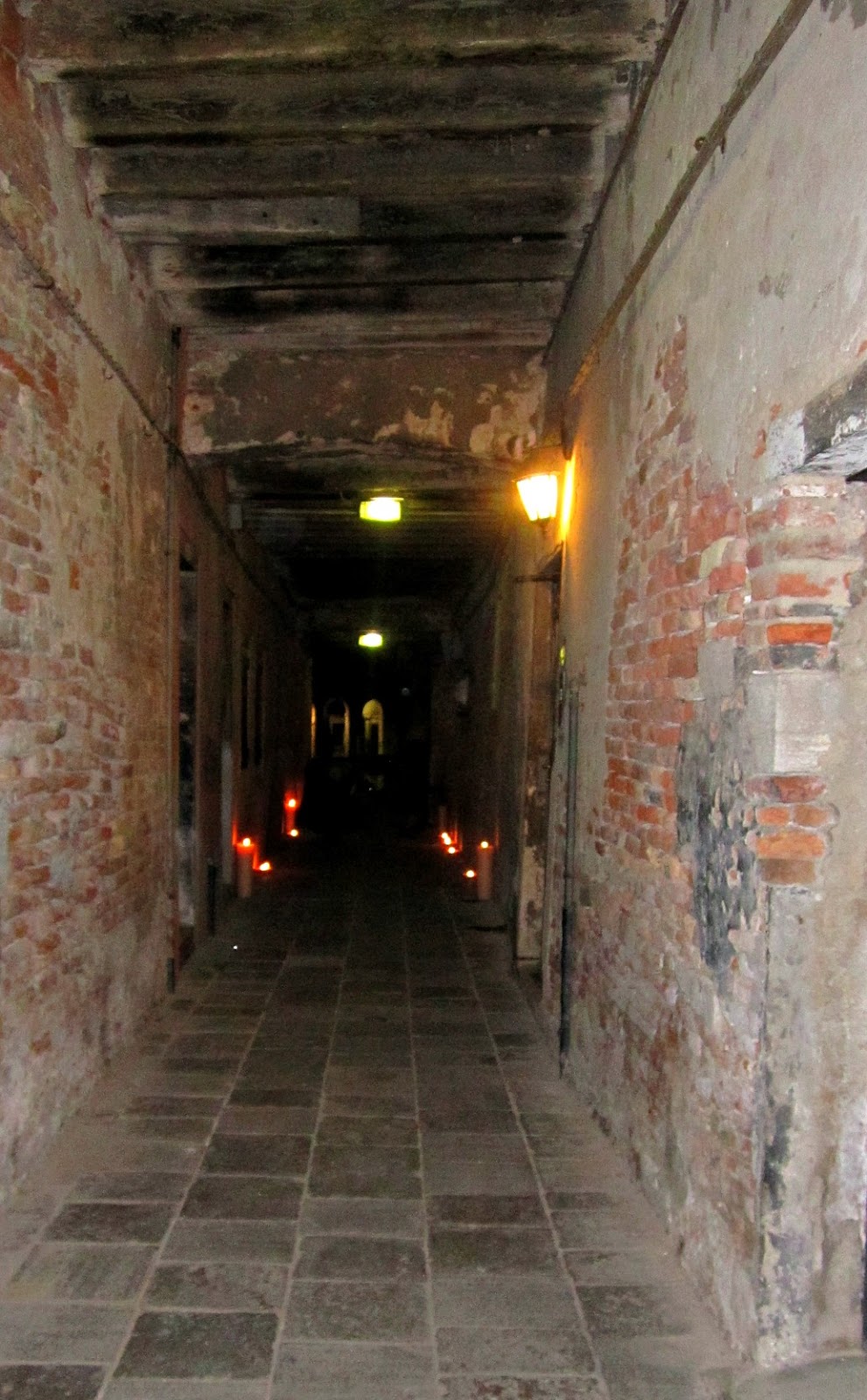
Candles at the Festa della Salute
(Venice, Italy) The American festival of Thanksgiving falls on the fourth Thursday of November. The Venetian Festa della Salute falls on November 21. The holidays are so close together that sometimes they even fall on the same day. This year, the Festa della Salute was on Sunday, so the entire week has felt like a week of thanks to me, and it's been bustling despite the rain and acqua alta.


Bobo Ivancich & Mary De Rachewiltz
daughter of Ezra Pound
Friday evening was the vernissage of the aristocratic artist, Bobo Ivancich de la Torriente, and many heavyweights managed to make their way across the weather and into the Primo Piano Venice Art Gallery, which you regular readers will know is one of my sponsors. To give you an idea of how small a town Venice is, I had also mentioned Bobo's aunt, Adriana Ivancich, when I wrote about another sponsor, the Hotel Gritti Palace -- Adriana was the young aristocrat who had inspired Ernest Hemingway's novel Across the River and Into the Trees; the last time the couple had met was on the Gritti Terrace. Bobo's exhibit, New York - Venezia - Cuba - Between Myth & Legend is presented in collaboration with Arte Communications; Paolo de Grandis, the owner, was there in all his splendor. Inspired by the great personalities Bobo grew up with -- as a child, he played chess with the American poet, Ezra Pound, and Peggy Guggenheim was often at his house -- Bobo has paid homage to many of them in his work. (Please click HERE to view the paintings and price list.) In the image you see, Bobo Ivancich is standing in front of a portrait he created of Ezra Pound with Pound's daughter, Mary De Rachewiltz. Which brings me to another strange synchronicity story.

Brunnenburg Castle
You will notice that on October 31, I wrote a blog about Halloween, All Saints Day and the Day of the Dead, starting with a little story about Ezra Pound. Well, the next day, All Saints Day, I went out to the cemetery to tend to some tombs. I've had tea a couple of times up at Brunnenburg Castle, where Mary De Rachewiltz lives in Merano, and I told Mary I would sort of keep my eye on her mother's side of the tomb. Mary's mother, the violinist Olga Rudge, was Pound's lover, and is buried next to him, and doesn't draw as much attention as Pound. I got Olga a purple iris, and went to the tomb. When I arrived, a group of people were standing in front of it. A voice said, "Look. Someone has given my mother a rose." I turned, stunned. I said, "Mary? It's Cat Bauer!" Mary smiled and said, "Well, who else should I meet in Venice but Cat Bauer?" I said, I figured that her father would have plenty of flowers, and had gotten one for her mother, and was happy to see that someone else had had the same idea. And that, dear readers, is the absolute truth. There is no way encounters like that can be planned, and it happens all the time in Venice.

Earlier on Friday morning, I had splashed through the water and over to Palazzo Balbi for a press conference organized by Veneziafiere about the huge bbcc EXPO (il Salone dei Beni e delle Attività Culturali) and Restaura convention that takes place next week on December 2, 3 and 4 at the Venice Passenger Terminal, or Venezia Terminal Passeggeri. For three days you can wander around the terminal and be inspired by a panorama of projects, round tables and conversations that examine new horizons and technologies, all with the theme of encouraging CULTURE. As the speakers were talking, it struck me how I have gotten so used to living immersed in culture, art, music, food, history, etc., and what a rare environment that is these days in other parts of the world. There is so much precious art in Italy; it is a huge national resource which must be developed wisely, with an eye towards the future, and protected, with an eye on the past. Admittance to the Expo is free, and what is even better, if you go over there, you can also get a voucher that will allow you to go inside all of Venice's municipal museums on December 2, 3 & 4 FOR FREE. And another other great thing is that you get to ride the new People Mover to get there! After the press conference, the journalists were given a mysterious burlap bag upon departure. I opened it while waiting for the vaporetto, and discovered it contained coffee, a coffee spoon and sweet coffee beans. This gift from the Venetian company Torrefazione Marchi worked very well with me because I made some coffee immediately, and on such a wet day, it was excellent and they deserve a plug.

On Thanksgiving Eve, I stopped by yet another one of my sponsors, Le Bistrot, for the vernissage of one of my favorite Venetian artists, Fernanda Facciolla. Since I know both the owner of Le Bistrot, Sergio Fragiacomo, and Fernanda, I didn't know which one had invited me, but it turned out to be Fernanda, who didn't know I knew Sergio, and Sergio didn't know I knew Fernanda. The exhibit is entitled, Dioniso e il vino, or Dionysus and Wine, and Fernanda definitely knows her myths. The synchronicity can get overwhelming sometimes, because the next thing I said was, "Fernanda. I have written about this very same topic when Sergio had the wine people here from InOLTRE called Those Who Drink Our Wine Know They Will Never be Betrayed." So, there I was in Le Bistrot back with Dionysus again!

Later that evening, some Venetians gave me a proper Thanksgiving dinner, just like the American Indians gave the pilgrims -- only I was the only American there -- complete with a 6.2 kilo female turkey and some good red wine. I made the stuffing, and found two tiny jars of Ocean Spray cranberry sauce for 3 euro each over at Antica Drogheria Mascari. There were even roasted chestnuts afterwards, roasted right on the spot!

http://www.nonsolocinema.com
On Tuesday, I dashed to Jolefilm in Padua for a press conference for a film-in-progress called Shun Li e il Poeta, or Shun Li and the Poet, directed by Andrea Segre, a co-production between Jolefilm and Aeternam Films in Paris. Here's the synopsis:

SYNOPSIS

"Shun Li and the Poet" relates the romantic and difficult friendship between a Chinese illegal immigrant and an old Italian fisherman, on an island of the Venetian lagoon facing economic changes.

After working in a textile factory in the suburbs of Rome, Shun Li, a woman in her forties, moves to the small provincial town of Chioggia; she works as a waitress in an "osteria" to pay for her freedom. Bepi, also called "the Poet" by his friends, has been coming to the little bar for years...

The film tells the encounter between two worlds in a crisis: the world of Shun Li who has been forced to abandon her own roots and the world of Bepi who sees his roots transforming deeply because of the social changes of the region.

Both exiled in their own ways, Shun Li and Bepi try to save each other trusting on poetry more than on reality. But their unexpected dreamlike salvation will be hampered by the conflict between the local Italian community and the local Chinese people.


I haven't spent time in Chioggia for a very long time, but the fishermen there are so tough that when NATO denied dropping bombs into the Adriatic Sea back in 1999 during the war in the Balkans -- NATO scoffed at the accusation and fabricated a story that the bombs were left over from WWII -- the Chioggia fishermen actually fished up the bombs, proving they were real, severely injuring themselves. Click HERE to read the Washington Post story from long ago.

Now, to start back at the beginning: on Sunday, again through the wind, rain and acqua alta, I went to the Salute Church for the Festa della Salute to light my candles of gratitude for health for the year and get a dose of high energy from the Black Madonna. I couldn't find a single photo of her dressed in all her finery on the net, and I began to think that no photos of her are allowed. Someone did take a photo, however, of the postcard that you can buy at the Salute Church; that is the image you see.

From Italy Heaven:


This is a very busy day, and is very important to local people. Fur-wrapped and scarf-muffled, they walk through the lanes of Venice towards the bridge and the church, shepherded at times by 'traffic' police enforcing one-way routes. In front of the church is an array of little stalls selling candles for the worshippers: it's mildly amusing to see the solemn Venetians, heirs of traders, shopping around for the best deal ("Three for five euros"). After their stately progress through the church, where masses are said throughout the day, they re-emerge with more greeting of friends, to the sound of the ringing church bells.

Click HERE to read the entire article.

Theories about Black Madonnas from Wikipedia:

Interest in studying Black Madonnas revived in the late 20th century. Some scholars of comparative religion, particularly those with Afrocentristfeminist, or neo-pagan backgrounds, have suggested that Black Madonnas are descendants of pre-Christian mother or earth goddesses (Moss, Benko), often highlighting Isis as the key ancestor-goddess (Redd, McKinney-Johnson). Some psychologists have discussed maternal and female archetypes, often from a Jungian perspective, as well as themes of feminine power, as they find them expressed in the Black Madonnas (Gustafson, Begg). 

Whatever the Black Madonna stands for, I always find her inspiring, and joining the throngs and the ceremony and celebration of the Festa della Salute, always fills me with gratitude and joy.

Ciao from Venice,
Cat
Venetian Cat - The Venice Blog


SHUN LI THE POET 
Andrea Segre
Directed by : Andrea Segre
Screenplay : Andrea Segre and Marco Pettenello
Cinematographer : Luca Bigazzi
Sound : Alessandro Zanon
Production Design : Leonardo Scarpa
Costumes : Maria Rita Barbera
Produced by Francis Bonsembiante, JOLEFILM (Italy)
co-produced by Francesca Feder, æternam FILMS (France)
in collaboration with Rai Cinema and Arte France
with the support of Eurimages and the Veneto Region

With
Zhao Tao, Rade Serbedzija 
Marco Paolini, Roberto Citran, Giuseppe Battiston


JOLEFILM srl
via Quarto, 16 
35138 Padova
+39 049 8718175
production@jolefilm.it
www.jolefilm.it


AETERNAM FILMS
63, Rue des Vinaigriers
75010 Paris
+33 1 44 54 02 48
contact@aefilms.fr
www.aefilms.fr

Sunday, November 14, 2010

Friends of The Phoenix - Amici della Fenice - Premio Venezia


(Venice, Italy) Last night I had the great honor to attend the concert of the final competition for the Premio Venezia, or Venice Award, at the renowned opera house, La Fenice. It is a very prestigious annual award for young pianists, and 2010 was the 27th Edition.

Produced by the Amici della Fenice, or Friends of La Fenice, in collaboration with La Fenice Theatre Foundation, the national competition has received the patronage of the President of the Italian Republic with the contribution of the Veneto Region. It is open to all pianists who graduated with honors in 2008/2009 from properly accredited schools.

Most of you know that La Fenice has burned down more than once, the last time on January 29, 1996. La Fenice means, of course, The Phoenix, the fabulous bird that rises from the ashes. From Wikipedia:

"Its name reflects its role in permitting an opera company to "rise from the ashes" despite losing the use of three theatres to fire, the first in 1774 after the city's leading house was destroyed and rebuilt but not opened until 1792; the second fire came in 1836, but rebuilding was completed within a year. However, the third fire was the result of arson. It destroyed the house in 1996 leaving only the exterior walls, but it was rebuilt and re-opened in November 2004."

Orchestra e Coro del Teatro La Fenice
Photo © Michele Crosera
For me, La Fenice is a beloved jewel, and just to sit inside fills me with wonder. I got teary-eyed before the competition even started gazing at the miraculous reconstruction -- I can never see it too much. And that La Fenice sponsors this national talent contest for young pianists filled me with joy. The prizes total about 65,000 euro, with the winner having the opportunity to perform in esteemed venues throughout Italy -- there is even a performance in London.

Inside the program there was a special thanks:

The Friends of La Fenice Foundation thanks the Azienda Agricola Conte di Collalto for attending the evening of the Concert Finalists for the Premio Venezia 2010

The top two finalists were 19-year-old Giuseppe Guarrera, who was born in 1991 in Enna, which is an ancient town in the center of Sicily located so high that it is the highest Italian province capital. His competitor was 17-year-old Beatrice Rana, who was born in 1993 in Copertino, located down in the heel of the boot that is Italy. There were five finalists in all (out of thirty competitors) who were awarded a cornucopia of prizes. The three who had already competed were André Gallo, born in 1989 in Cosenza, located down in the front of the boot; Yumi Palleschi, born in 1991 in Terni in central Italy; and Alberto Tessarotto, born in 1994 in Motta di Livenza, a small town in Treviso, which is north of Venice. So, it was truly a national competition.

Giueseppe Guarrera played first. When he entered the stage, I tried to imagine how he felt, his talent delivering him inside the grand La Fenice opera house in front of so many important people. To perform under such intense pressure at a young age! He was tall and handsome, and looked a bit like John F. Kennedy, Jr., and I thought his parents must be very proud. He sat confidently at the piano, and wiped his hands with a handkerchief, the only visible sign that he might be nervous. He played three pieces by Frederick Chopin, Notturno in fa diesis minor op.48 n.2; Improvviso n.2 in fa diesis maggiore op.36; Scherzo n.4 in mi maggiore op.54 and then performed Sergej Prokofiev's Sonata n.7 in si bemolle maggiore op.83. I had an excellent seat in the plateau, and was fortunate to see every key his elegant fingers struck.

La Fenice Ceiling Clock
Next came Beatrice Rana, who wore a bubbly black dress. When she finished playing her first selection, Scherzo n.3 in do diesis minore op.39, also by Chopin, she made a strong gesture with her hand after the last note -- Done! Next she played Maurice Ravel's Gaspard de la nuit, and her graceful hands seemed to scoop the music out of the air and press it into the keys -- it seemed that she had notes coming out of her fingertips. She finished with Sergej Rachmaninov's da étude-tableaux op.39, and I will confess that n.6 in la minore is one of my favorite pieces.

Then we had a break in foyer, sipping prosecco and chatting while the jury made their selections. During the break, I'll list just what the first prize consists of so you can have a better idea what is at stake:

Scholarship for 6,000 euro offered by Giulio Olivotto.
Scholarship for 5,000 euro offered by Fondazione Compagnia of San Paolo of Torino.
Scholarship for 5,000 euro offered by Cristiana Brandolini d'Adda.
Scholarship "Anna Botta" for 4,500 euro offered by Paolo Jucker.
Scholarship for 3,000 euro offered by Assicurazioni Generali.
Scholarship for 3,000 euro offered by Sacaim SpA Venezia.
Scholarship "Eugenio Bagnoli" for 2,500 euro offered by the Bagnoli family.
Upon acceptance, a scholarship to the advanced summer course at the Salzburg Mozarteum, offered by Gabriella Flaibani Gamberini.
A six-day Mediterranean cruise for two offered by Costa Cruises.
Three concerts offered by La Fenice Foundation, including one with their own orchestra, and one promoted by the Prefettura of Venezia to celebrate the Festival of the Republic on June 2, 2011.
Two concerts promoted by the Veneto Region in different local area, a concert offered by Teatri S.p.A of Treviso, a concert given by the Friends of Music in Padova, one from the Philharmonic Academy of Verona, one at the "New Interpreters" Bologna Festival, one by the Friends of Teatro Massimo in Palermo.  A concert in London offered by Marina Atwater Gelmi di Caporiacco in support of the Venice in Peril Fund, one by the Veneta Association of Music in Padova, one offered by the Pure Music Association of Pordenone, one at the "Settimane Musicali" Festival at Teatro Olimpico in Vicenza.
Together with the runner-up, a concert offered by the Comune of Venezia, the Department of Cultural Production (sponsored in collaboration with the Friends of Music of Mestre), one by Ateneo Veneto, and one by Euterpe Venezia.
Plus all five finalists will get a personal computer with the "Sibelius" program, offered by Consorzio Venezia Nuova.

Whew!

After the pause, we shuffled back into the theater to await the winners, which were announced by Barbara di Valmarana, President of the Amici della Fenice. 

Fifth Place: Yumi Palleschi
Fourth Place: André Gallo
Third Place: Alberto Tessarotto

During the break, my section of the audience had expressed the hope that Beatrice Rana would win, and honestly, she was my favorite, too, a real Star is Born evening. When her name was called for Second Place, there were audible protests from the audience. Beatrice walked out and accepted all her award scholarships, which were also very substantial -- a quick add totals 19,000 euro -- with dignity and poise.

Then the winner, Giuseppe Guarrera was announced, and this fine young man did such a noble thing -- he bowed to Beatrice Rana! He was not only a talented pianist, he was a real gentleman.

I was grateful for the opportunity to share such a special Venetian evening, and was very impressed by the comportment of the young pianists, in addition to their playing. I am certain that they both have very successful careers ahead of them!

 
Ciao from Venice,
Cat 

Sunday, October 31, 2010

The Island of the Dead - Venice, Italy & Spirits from the Otherworld

San Michele Cemetery - Venice, Italy

Gods' aid, let not my bones lie in a public location
With crowds too assiduous in their crossing of it;
For thus are tombs of lovers most desecrated.
May a woody and sequestered place cover me with its foliage
Or may I inter beneath the hummock
of some as yet uncatalogued sand;
At any rate I shall not have my epitaph in a high road. 
---from Homage to Sextus Propertius by Ezra Pound

(Venice, Italy) That is the monumental entrance of the Island of San Michele, where Venice buries her dead. November 1 is All Saints' Day and November 2 is All Souls' Day, or the Day of the Dead, here in Italy. There is a free shuttle vaporetto out to San Michele and back so everyone can tend to the tombs.

The American poet Ezra Pound is buried here in Venice on the Island of the Dead, and also happened to die here in Venice, most remarkably, on All Saints' Day, two days after his 87th birthday on October 30, 1972.


Today is October 31, or Halloween, which has been one of my favorite holidays ever since I was a child. When I lived in Los Angeles, I would spend a good week decorating my house with dead bodies and skeletons, and setting up a proper graveyard under the white birch tree. I attracted kids from miles around, and some adults, too.

Disneyland Haunted Mansion
In fact, the first year that I and my former husband moved into our house in Los Feliz, back in 1988 before it was properly furnished, my sister and I decorated every room with a different spooky theme: the coffin room, the fortune teller room, etc. and threw a huge Halloween party complete with sound effects and lighting -- I even got the Frankenstein monster from Universal Studios to come, since he was a friend of ours.

It was all in good fun, and there was certainly nothing religious about it, more like a Disneyland Haunted Mansion theme. To me, any holiday that can inspire Serious White Men to get creative, dress up in costumes and loosen up a bit is providing a service to mankind. One of my favorite costumes was worn by a fellow who was normally very... uptight. He dressed all in white and carried a big black felt marker, calling himself "Graffiti Man," and had people sign his clothes all night. To me, Halloween in the States reflects Carnival in Venice more than the Day of the Dead. 

When I solidly arrived in Venice in 1998, after deciding to make it my home (I had been here several times before, but that is another story), I had one of the few carved pumpkins around, and there were no celebrations except a small one in Campo Santa Margherita with the students. Halloween has been slowly growing more popular, with shop windows filled with cobwebs and witches.

This is what the Catholics think about that:

Halloween 'pagan' says Church group


'Don't trample on our culture,' bishop says


(ANSA) - Vatican City, October 29 - Halloween is pagan and against the spirit of Christianity, an influential Catholic Church group said Friday. Chiming in with the Vatican's annual warnings on the festival, the (Pope) John XXIII Association said: "Halloween was born as the perpetuation of a pagan cult which evolved over time and linked up with esoteric and occult practices". "We are faced with a sort of revival of neopaganism which, as such, is in open contrast with the spirit of Christianity". 

"Does our society really need all these messages exalting horror," asked the association's head, Giovanni Paolo Ramonda.

"At a time which should be devoted to the holy memory of our saints and souls, people unthinkingly set up 'noir' banquets, crime dinners and afternoons for children in macabre masks. "Everyone should be reminded that Halloween comes from an ancient pagan ritual in the British Isles practised by the Druids, the Celts' ferocious priestly caste".
The Northern League also disapproves:
The Northern League party, which jealously guards northern Italy's Celtic past, also came out against the feast this year, accusing it of being "inauthentic". "Halloween is not part of our identity," said the Northern League's mayor of the town of Calalzo di Cadore, Luca De Carlo.
Click HERE to read the entire ANSA article.

It may surprise some of you to learn how fierce the Northern League is about their Celtic roots, but if we take a quick look at a map, you will see that the Celts were here in Northern Italy and Austria before the Romans came along and started started conquering everyone. 

Overview of the Hallstatt and La Tène cultures.     The core Hallstatt territory (HaC, 800 BC) is shown in solid yellow,     the eventual area of Hallstatt influence (by 500 BC, HaD) in light yellow.     The core territory of the La Tène culture (450 BC) is shown in solid green,     the eventual area of La Tène influence (by 250 BC) in light green.The territories of some major Celtic tribes of the late La Tène period are labeled.

The ancient Celts celebrated Samhain, which was a festival to welcome the dark part of the year. 
 
From Wikipedia:
Samhain is a Gaelic festival held on October 31–November 1. The Irish name Samhain is derived from Old Irish and means roughly "summer's end".harvest festival with ancient roots in Celtic polytheism, it was linked to festivals held around the same time in other Celtic cultures, and continued to be celebrated in late medieval times. Due to its date it became associated with the Christian festival All Saints' Day, and greatly influenced modern celebration of Halloween.


It also had a dark element. From Wikipedia:
"The ancient Celts believed that the border between this world and the Otherworld became thin on Samhain, allowing spirits (both harmless and harmful) to pass through. The family's ancestors were honoured and invited home while harmful spirits were warded off.

It is believed that the need to ward off harmful spirits led to the wearing of costumes and masks. Their purpose was to disguise oneself as a harmful spirit and thus avoid harm.

In Scotland the spirits were impersonated by young men dressed in white with masked, veiled or blackened faces. Samhain was also a time to take stock of food supplies and slaughter livestock for winter stores. 

Bonfires
 played a large part in the festivities. All other fires were doused and each home lit their hearth from the bonfire. The bones of slaughtered livestock were cast into its flames. Sometimes two bonfires would be built side-by-side, and people and their livestock would walk between them as a cleansing ritual."
I don't know what goes on in other parts of Italy, but in Venice, the Day of the Dead is still a big holiday. There are special colorful treats called fave or "beans" in the shop windows. I found an interesting article that appears to be from the early 1900s called "All Soul's Day - Venice" from a website called "Old and Sold."

"There is one old custom connected with this festival of the dead which still survives in Venice, and recalls a Latin, or even an earlier superstition. The pious man in Ovid's " Fast [sic] (should be Ovid's "Fausti") rises at midnight to fling black beans behind his shoulder. Nine times he flung his beans, and then the ghost was laid. 

The Venetian does not fling away his beans; he eats them. In Venice this custom of eating beans through the octave of All Souls' is extremely ancient. The monks of every cloister in the city used to make a gratuitous distribution of beans on All Souls' Day to any of the poor who chose to come for them. A huge caldron was placed in the middle of the courtyard and the food ladled out to the crowd. 

The gondoliers did not come with the rest, but had their portion sent down to them at their ferries. This grace was granted to them in consideration of the fact that all the year round they rowed the brothers across the canals for nothing. In-deed, though the custom is almost extinct, they still do so you may sometimes see a brown-cowled friar crossing a ferry with no other payment than a pinch of snuff or a benediction. 

As the Venetians grew more wealthy true beans became distasteful to the palates of the luxurious, who were yet unwilling to break through the custom of eating them on All Souls' Day. The pastry cooks saw their opportunity, and invented a small round puff, coloured blue or red or yellow, and hollow inside; these they called fave, or beans; and these are to be seen at this time of the year in all the bakers' windows. 

If a man should happen to be courting at this season it is customary for him to make a present of a boxful of these fave to his lady. But the pious mind has never been quite at ease under the gastronomic deception; and so, though you may hate beans and keep your hands from them as scrupulously as any pupil of Pythagoras, should your cook chance to be a good Catholic you will assuredly, about the month of November, have beans set before you for dinner in Venice."

Funeral gondola on way to the cemetery- Venice, Italy - Alfred Eisenstaedt (1947) © Time Inc.

For me, there is a way to celebrate each holiday, Halloween, All Saint's Day and the Day of the Dead, though I do share the Church's concern that the commercialism of Halloween could consume the other two days entirely as it seems to have done in the United States -- though I really don't see that happening in Venice since mass at the Basilica was standing-room-only this morning, and the cemetery is always full with people tending tombs every single day of the week, holiday or not. It would be interesting to know how the Day of the Dead was celebrated by the ancient Venetians, and whether masks were involved. 


Also buried on the Island of the Dead:  Igor Stravinsky, Joseph Brodsky, Olga Rudge, Emilio Vedova, Franco Gasaglia, Zoran Mušič, Jean Schlumberger, Sergei Diaghilev, Luigi Nono

Ciao from Venice,
Cat

Wednesday, October 27, 2010

Italy, Defend Your Heart - FAI Hosts Oddballs in Venice Between 1800 & 1900


(Venice, Italy) The Fondo Ambiente Italiano (FAI), or the Italian Environmental Foundation was established in 1975 to "emulate the English National Trust." (For Americans, a similar organization would be the National Trust for Historic Preservation.) 

Several years ago, I was in a location in Wales managed by the National Trust where I purchased some very fine furniture wax, the old-fashioned kind that you must rub hard into the real wood to keep it alive. To me, that is symbolic of the kind of work these type of foundations do. 

In fact, FAI declares that it bases its work on seven principles: 

  • Knowledge & Expertise
  • Concreteness
  • Consistency
  • Independence 
  • Quality
  • Curiosity
  • Busy Idleness 
Since FAI is a foundation, we can agree those are principles upon which any solid foundation should be built. FAI safeguards the heritage of art, nature and the Italian landscape.

The Venice Chapter of FAI is putting their unique imprint on fundraising by hosting a series of events with the theme Personaggi stravaganti a Venezia tra '800 e '900 , which Google Translate amusingly interprets as "Oddballs in Venice between 1800 and 1900." Let's call them "unique personalities" or "extravagant characters."

The series kicked off on October 15 at Ca' d'Oro, featuring Concetta Lo Iacono reporting on the famous ballerina, Maria Taglioni (1804-1884) who lived for a time at the palazzo. Taglioni's claim to notoriety was shortening her skirts so the audience could see her excellent en pointe.

On October 21st, Ida Tonini and Guido Zucconi spoke at the Hotel Palladio on Giudecca about Fredric Eden (1828-1916) and the colorful and controversial Austrian artist and architect, Friedensreich Hundertwasser (1928-2000) owners of the most mysterious garden in Venice, The Garden of Eden, an event I am sorry to have missed. Visited in the past by the likes of Proust, Rilke, Cocteau, Henry James, Thomas Hardy and D'Annunzio, the enormous walled garden is a source of unending curiosity to this day. Click HERE to read an excellent post from British librarian Jeff Cotten's blog, Fictional Cities.

Here is an excerpt:

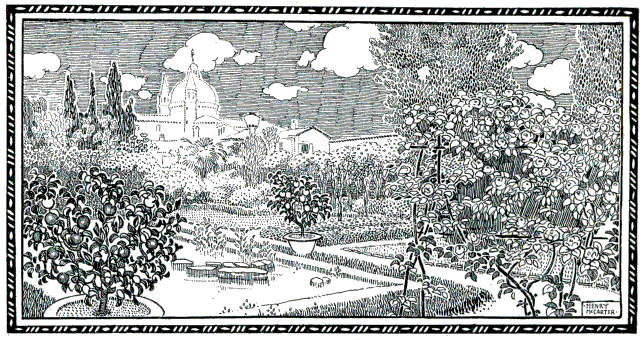
Henry McCarter
"Eden and his wife Caroline bought the artichoke garden on the, then semi-rural, island of Giudecca in 1884. They transformed the six acres into an English-style paradise, complete with roaming cattle, statues, and rose trellises. It's tempting to think of Gertrude Jekyll helping out her elder sister, but Jekyll's fascination with gardening did not, it seems, develop until years after the creation of the Eden's garden. It was then, and remains, the largest private garden in Venice (although its exact size is the subject of argument). ...

...The sociable Edens made the garden into the social centre of the British ex-pat society and attracted visitors like Proust, Rilke and Henry James in it's turn-of-the-century heyday. Gabriele d'Annunzio has an episode set in the garden in his novel Il fuoco. Frederick Rolfe, Baron Corvo, author of The desire and pursuit of the whole (and something of a side-thorn for the ex-pat society of the time which gathered in the garden) even offered his services to the Edens as poultry manager during a period of skintness. ..."

Next up, on October 28 at 5:30PM at the Archivio di Stato in Campo dei Frari, Mariachiara Mazzariol will discuss one of the greatest publishers of his time, Ferdinando Ongania (1842 -1911). 

The Disquieting Muses
by Giorgio De Chirico
On November 11th at 5:30PM at Ca' Giustinian, La Biennale headquarters, in the beautifully restored Sala delle ColonneGiorgio Colombo will shed light on the surrealist artist, Giorgio De Chirico (1888-1978), founder of the scuola metafisica, and who was an annual visitor to Venice.

On November 15 at 6:00pm at the Istituto Italo-Britannico over at Palazzo Pesaro Papafava, Maria Stella Florio will speak about Rawdon Brown, a historical scholar who came to Venice for a two week vacation in 1833 and never left -- he died in Venice in 1883. A great friend of John Ruskin, Rawdon Brown managed to explore the Venetian State Archives and uncover volumes concerning England and its relationship with Venice which were published as "Calendar of State Papers in the Archives of Venice." He also bought the mysterious palazzo Ca' Dario in 1838.

On November 18 at 5:30PM at Palazzo Pisani, the Conservatorio Benedetto Marcello in Santo Stefano, Venice's music conservatory -- the same palace where  Don Giovanni and The Man of Stone was held -- the spectacularly rich American, Winnaretta Singer de Polignac (1865-1943), an heir to the Singer fortune and wife of the Prince Edmond de Polignac, will be honored by Vitale Fano. FAI has decided to make the restoration of Palazzo Pisani one of their projects, sure to attract international music students from around the globe. 
 
From Wikipedia:

"In 1894 the Prince and Princess de Polignac established a salon in Paris in the music room of their mansion on Avenue Henri-Martin (today, Avenue Georges-Mandel). The Polignac salon came to be known as a haven for avant-garde music. First performances of Chabrierd'IndyDebussyFauré, and Ravel took place in the Polignac salon. The young Ravel dedicated his celebrated piano work, "Pavane pour une infante défunte", to the Princesse de Polignac. Many of Proust's memorable evocations of salon culture were born during his attendance at concerts in the Polignac living room."

On November 25 at 5:30 at the Tribunale di Venezia - Aula di Corte d'Assise, Franca Zanchi and Antonio Franchini will reveal information about one of Venice's most shocking scandals, The Russian Affair -- the trial of Russian Maria Tarnowska (1877-149), which made front page headlines all over Europe. The setting was yet another palace, Palazzo Maurogonato, which today is the Hotel Ala. There is even an unproduced film script. 
 
From Wikipedia:

"In 1907, one of her lovers, Nicholas Naumov (also spelled Naumoff), killed another one of Maria's lovers, Count Pavel Kamarovsky, in Venice, allegedly upon her instigation. The Countess Tarnowska, as she was commonly called, was arrested that same year in Vienna and transferred to La Giudecca penitentiary in Venice, where the trial was to be held. The trial, locally called the Russian affair (l'affare dei Russi), began on March 14, 1910, and ended on May 20 of the same year, with the conviction of both defendants. Maria Tarnowska was found guilty but was sentenced to serve a relatively mild term of only eight years in prison, thanks to an ingenious defence (it was one of the first to include Freudian analysis of the defendant's personality and motives) – and, possibly, due to the leniency of the presiding judge.[2]"

Finally, on December 14 at 5:30PM at Palazzo Fortuny, Enric Bou will entertain with tales about the great designer, Mariano Fortuny y Madrazo (1871-1949). 
 
From Wikipedia:

"Nowadays the Museum Fortuny is housed in the Venezian-Gothic Palazzo, the former home, studio, showroom and "Think-Tank" of Mariano Fortuny (1871–1949) who acquired it at the beginning of the century. Fortuny invented in his Palazzo the Delphos gown, a gown based on the ancient Grecian style; and the Knossos Scarf, a silk scarf also inspired by this civilization. Fortuny also created new methods of dying textiles and well as ways of printing on fabrics. He created the Fortuny cyclorama dome, a stage lighting innovation that could be used to create lighting effects such as a bright sky or a faint dusk; and the Fortuny lamp, for indoor lighting."

For those of you fortunate enough to be in Venice, attending these events will be like stepping into the pages of Marcel Proust. For those of you in other parts of the world, I suggest putting on some Wagner and getting your copy of Proust's À la recherche du temps perdu down off the shelf. If you would like to support FAI, please click HERE.

For further information:
Studio Systema
Tel. +39 041 5201959
Fax +39 041 5201960
e-mail systema@studiosystema.it

Ciao from Venice,
Cat

Sunday, October 10, 2010

Sir Peter Blake, The Butterflyman, alights in Venice

The Butterflyman in Venice
(Venice, Italy) Sir Peter Blake is called the Founding Father of Pop Art. Born on June 25, 1932, he is now seventy-eight-years old and in better form than ever. He has created a fanciful character called "The Butterflyman," a stately gentleman who travels from town to town with a magic butterfly wand and an open book, releasing butterflies that float gently in the air, spreading happiness and charm. 

Last night, October 9, 2010, the Butterflyman alighted at the Galleria Michela Rizzo here in Venice to present "Venice Suite," a show curated by Valerio Dehò in collaboration with the Paul Stolper Gallery in London -- where, by the way, you can see Peter Blake chum Damien Hirst's butterflies in "The Souls." Above you see the Butterflyman and his winged companions in front of the Palazzo Ducale.

I think the Butterflyman lives in the forest, and, indeed, there was a inkjet on canvas showing him in that environment. Then, after he gets fully charged with enchantment, off he trots to places like Paris and Venice and Holland, sprinkling gaiety into the atmosphere.

Now, that is just my opinion since I did not think to ask Sir Peter where the Butterflyman lives. I did, however, ask Sir Peter if he deliberately planned to open the exhibit on October 9th to coincide with what would have been John Lennon's seventieth birthday, and he said, no, and that I was the first one to remind him of the significance of the date. 

In any event, there was a picture of The Beatles on display, and, of course, Sir Peter Blake will be tied to them forever as the artist who created the cover of Sgt. Pepper's Lonely Hearts Club Band.

Butterflies

In addition to the Butterflyman, the Venice Suite exhibition consists of a series of 20 screen prints set in Venice that are also available as a box of  postcards. My favorite, that lovely girl flying over Rialto on a ball, was not there; perhaps she is sold out. 

Peter Blake said that he created the exhibition specifically to fit into Michela Rizzo's gallery. He knew the dimensions of the space and planned accordingly. He also remarked that his life had sped up considerably. In fact, he has a major exhibition at The Museum of Everything in London opening next week on Wednesday, October 13th.

Some of the screen prints were rather dark with airplanes about to crash over Rialto and wild beasts. Moira Jeffries wrote an interesting piece for The Scotsman last year entitled Peter Blake interview: Cut out and keep that sheds some light:

Crash
In 2007, he went back there for only the second time in his life, to support his much younger friend Tracey Emin, who was showing at the Venice Biennale. " 
As it happens it was a total disaster," says Blake. "We arrived at the airport and they had lost our luggage. After three hours of tracing it, we went into Venice with an Italian critic who was meeting us. We went to get on a water taxi and it moved… and I fell about four feet on to my knee. I was in agony the whole time, taking painkillers."
In the prints the city's tourist spots have been transformed by all kinds of surreal mischief and disaster. There are ice and penguins, boat races and parades. "I think what happened is that they started to become a bit surrealist and I started to push it. What wouldn't you see if you visited Venice? You would never see the Aurora Borealis for example and it seemed unlikely that Venice would freeze over."
In contrast, a new series of works set in Paris are all butterflies and charm. "It may well refer to the fact that I was in pain all the time in Venice, there are aeroplanes about to crash and wild animals. They are nightmares whereas the Paris ones are dreams."
Click HERE to read the entire article.

There was also a wonderful diamond dust Marilyn inkjet print, among other delights. After the opening, Stephen and Joanita Green hosted a magical, mystical Paint it Blake! party at their home in Palazzo Mocenigo with colorful balloons bouncing around the dance floor, colorful nibbles to eat -- including genuine cotton candy -- and colorful vinyl music from 1965 to 1967 with the artist Luca Cabot doing a great job as the DJ for the evening; he even had an original Sgt. Pepper album spinning on the turntable. 

As I watched what is perhaps the most famous album cover in history spin round and round, the Beatles in their satin day-glo military outfits surrounded by iconic characters and flowers, it made me long for the days when an album was a work of art with lyrics like librettos, new technology allowing harmonies never before possible, classical mixed with pop and sitars, electric mixed with wood, brass and strings, and melodies everyone could sing; melodies that became part of the atmosphere itself, pouring out of car windows and homes and into the schools and streets. 

The world was filled with color, color, color everywhere, color in clothes, color in sound, colorful tastes and smells, food coming over from India and the East, a barrage of color that stimulated the eyes and nudged everyone awake.


As John Lennon sang in Being for the Benefit of Mr. Kite! "Having been some days in preparation a splendid time is guaranteed for all…´ I thought having Sir Peter Blake in the palace was even better than having Mr. Kite himself, his fanciful energy inspiring everyone. 

And, indeed, a splendid time was had by all. 

Ciao from Venice,
Cat
Venetian Cat - The Venice Blog