Saturday, February 4, 2012

La Biennale's 3rd Venice International Carnival for Kids


(Venice, Italy) Children of Other Lands was the first book I ever wrote at age six. It was inspired by a deck of playing cards I had been given, embellished with images of children from all over the world in their native dress. It was a non-fiction book, complete with illustrations, well-researched, very thick -- about ten pages -- and cost five cents. 

Even at age six, to me, writing was a business, although I have no idea how I arrived at that concept since there were no writers in my middle-class/working-class childhood world. I organized a neighborhood book sale. An older girl named Cookie who lived down the block scribbled a couple of pages, stuck two lollipops on the cover, and charged six cents. Everybody wanted her book and nobody wanted mine. It was my first lesson in marketing.

I have always been fascinated by foreign lands -- perhaps because of that deck of playing cards -- which is one of the reasons I live in Venice. Another is La Biennale, an organization that is a hub of international creative activity. 

One of the newer activities of the Venice Biennale is the Carnevale Internazionale dei Ragazzi, or The Venice International Carnival for Kids, and if you are planning to come to Venice for Carnevale this year with your munchkins, you have got to go. This is what I wrote about it last year in a post entitled:

OTTOCENTO - From Senso to Sissi - The City of Women - Venice Carnival 2011

Photo La Biennale
For the second year, La Biennale presents Carnevale dei ragazzi, or the Kid's Carnival down at Giardini. Unfortunately, I went with a dog, not a kid, who was not allowed inside, so I didn't spend as much time as I would have liked. 

I loved it! The kids were creating things the old-fashioned way -- with their own hands -- just like real children, and they seemed perfectly content not to have a computer in front of them. Different rooms inside the Italian pavilion with names like "The enchanted forest" "The prarie of sounds" "The painted desert" "The city of visions" "The fluorescent depths" were bursting with creative activities and plenty of kids intent on the act of creation.  

The principle: "having fun by creating." Remember that? Remember how you could spend hours simply with some crayons, or some mud? 

As well as visitors to Venice, schools from all over the Veneto arrived. Paolo Baretta, the President of La Biennaleg, wrote: "I would like to thank the teachers of all the schools at every grade and level, from Venice and the Veneto region, our intelligent ambassadors and precious partners. I would like to thank the parents who will accompany their children, and those will allow themselves to be accompanied by their children." This year's edition was the first time there was international participation, with Austria, Great Britain, Holland and Poland contributing to the fun.

The theme of this year's Carnevale is La Vita è Teatro. Tutti in Maschera, which sort of translates to Life is Theater. Everybody Wears a Mask. The official program says the preview starts today, February 4, 2012, although there are just a handful of things gearing up. 

The fountain is spewing wine in Piazza San Marco, and there are some costumed revellers posing for photos. Everyone is primed for next weekend and for the official opening, which will be Saturday, February 11, 2012 at 11:00AM in Piazza San Marco. Fat Tuesday, the last day of Carnival is February 21, 2012. Click for the official program at Venezia Marketing & Eventi.

Photo La Biennale
The theme of this year's Venice International Carnival for Kids is Favole e Pensieri, or Tales and Thoughts, and will run from February 11 to February 21, 2012, every day from 10:00AM to 6:00PM with workshops and activities galore. 

In addition, on February 11 and 18, Playground Bollywood! will feature Indian dance workshops and performances conceived by La Biennale Dance Director Ishmael Ivo with the 25 young dancers from the Arsenale della Danza. The Conservatorio Benedetto Marcello in Venice will present musical activities in their workshops Hurray for Music! UNICEF Italia will address childrens' rights with games and activities in their workshops Hurray for Children!

The Kid’s Carnival is growing ever more international with the participation of the "Magnificent 7"countries:

Photo: Stitchery Collective
1. Australia. WARM  - Thanks to Skype, Kathleen Cattoni from the Stitchery Collective in Brisbane, Australia spoke at the press conference yesterday, even though she was on the opposite side of the world. The Stitchery Collective "connects the unlikely bedfellows of fashion and social welfare," and will be at the Kid's Carnival from February 11 to the 15th. 

The stitchery will be running ‘WARM’ t-shirt upcycling workshops, where with our pint-sized helpers we will transform the pre-loved T-shirts of Brisbane into much-loved custom-made beanies, scarves and ponchos for our chilly European friends."  Click to go to The Stitchery Collective blogInitiative organized by The Collective Stitchery, with the support of Arts Queensland and the Australia Council for the Arts.
Central Pavilion from 11 to 15 February

2.  Great Britain - STORYTELLING - A family workshop to show parents how to help their children learn a foreign language (English, no doubt:) through storytelling. Conducted by an English native-language teacher, assisted by a member of the Biennale staff. February 11 and 12. Initiative made possible by the support of the British Council Italia.
Central Pavilion 11 and 12 February.

3.  Germany - THE TALES OF THE BROTHERS GRIMM - MASK AND COSTUME WORKSHOP - Two hundred years ago, in 1812, the Brothers Grimm published their first collection of fairy tales, which I read to the point of obsession when I was a kid. Sleeping Beauty, Snow White, Little Red Riding Hood, Rumpelstiltskin -- they all come from the Brothers Grimm. Two set designers from Munich are going to head the workshop, which will open the door to "fairies, witches and fairytale characters" so the kids can create their own Carnival costumes. The German contribution is a project by the Embassy of Germany in Rome and the German Centre for Venetian Studies, with the support of the Goethe Institut.
Central Pavilion from 12 to 14 February.

Photo at Soap Art
4.  Romania - BEASTS AND SUPER BEASTS - Soap Art Kollectiv (Raluca Arnautu and Suzana Dan) create stuffed animals inspired by fairy tales of their own creation. Animal Stories! will bring the imaginary Romanian beasts to life. The exhibition and workshops are organized by the Romanian Institute of Culture and Humanistic Research in Venice, with the support of the Romanian Cultural Institute in Bucarest, and in collaboration with the Anaid Art Gallery, Global Mindscape and with Australians Studying Abroad (Melbourne).
Central Pavilion every day.

5.  United States - ElettrizzARTE! - Artists who work with light - neon, lasers, LEDS, optical fibers and xenon projections -- are the focus of this workshop where the kids will get to play with light and lighting devices. The programme by the United States of America was made possible by the Peggy Guggenheim Collection.
Central Pavilion 11, 12, 18, 19,21 February.

6. Netherlands - DANCING IN RIETVELT'S PAVILION - Tweetakt is Holland's international theater and art festival for people who are not grownups. You'll get to create your own show, mix your own music and make your own animated flipbook. The programme at the Dutch Pavilion has been made possible by the contribution of the Embassy of the Netherlands in Italy, the City of Utrecht, the Province of Utrecht, the Treaty of Utrecht Foundation, and in collaboration with the Rietveldpaviljoen Foundation.
Netherlands pavilion every day

7. Belgium - ABC TOY WORKSHOP - ABC House (Art Basics for Children) is a new creativity center in Brussels. They will lead the way in making toys out of everyday and recycled materials. An initiative organized by ABC – ART BASICS for CHILDREN, a non-profit organization based in Brussels which operates in the field of arts and education to create stimulating environments and projects that encourage children and adults of all ages to experiment with their imagination and explore their creative potential.
Belgium Pavilion every day

Everything is free. Can you imagine? All that fun and creativity for free. Who knows what wonderful memories the kids will have from such an event, and what kind of future projects it might inspire. There will even be a spaghetti lunch at 1:00PM after the inauguration at 11:30 on Saturday, February 11, 2012. 

Head down to Giardini where all the action will take place. Click for more information at La Biennale website

Ciao from Venice,
Cat
Venetian Cat - The Venice Blog

Monday, January 30, 2012

Lou Salomé at La Fenice and Il Giorno della Memoria

Photo: Michele Crosera for La Fenice
(Venice, Italy) In a post entitled Don Giovanni and the Man of Stone, I wrote the following sentence on October 6, 2010:

Or, perhaps, someone should make an opera out of the life of Lou Andreas-Salomé, novelist, poet, and psychoanalyst, friend to Freud and mistress to both Rainer Maria Rilke and Friedrich Nietzsche, and someone who could teach Don Giovanni a thing or two.

Angeles Blancas Gulin as Lou Salomé
Obviously, at the time I wrote that, I had no idea that, in fact, someone had written an opera about Lou Andreas-Salomé -- and that someone was a Venetian, no less! I can just imagine the amusement the above sentence must have provoked for those in-the-know, especially since I had written a somewhat forceful critique of what I thought was wrong with the Don Giovanni and the Man of Stone production.

Not only that, but Giuseppe Sinopoli, the composer of the opera Lou Salomé, studied music at the Benedetto Marcello Conservatory here in Venice, the very venue where Don Giovanni and the Man of Stone was performed. The Lou Salomé production at La Fenice was an impressive touché, and I am chuckling as I write this. 


Giuseppe Sinopoli was born on the Day of the Dead, November 2, 1946 in Venice. He died, spectacularly, of a heart attack on April 20, 2001 at the age of 54 while on stage at the Deutsche Oper in Berlin, conducting Verdi's Aida -- the same opera with which he made his debut in Venice in 1978. In addition to being a composer and conductor, he had a degree in medicine, wrote books, and was just about to receive his Laurea in Archeology.

From Wikipedia:


Giuseppe Sinopoli
On 20 April 2001, Sinopoli died of a heart attack while conducting Giuseppe Verdi's Aida at the Deutsche Oper in Berlin. The performance was dedicated to the memory of the company's late chief director, Goetz Friedrich.

Two nights later, 
Marcello Viotti stepped in to direct Aida, and dedicated his performance to Sinopoli's memory. His funeral in Rome on 23 April was attended by the Italian President and Prime Minister, as well as a large contingent from La Scala. He was survived by his wife Silvia and two sons....


Every October since 2005, Taormina Arte has dedicated a festival to Giuseppe Sinopoli, the artistic director of the Music section of the Taormina Festival from 1989 to 1997. The Giuseppe Sinopoli Festival does not only celebrate the man as a musician and as a conductor but also as a composer, a doctor, an archaeologist and intellectual, with a variety of events from music and literature, theatre and art to conferences, exhibitions, publications and, of course, concerts.

Now that I have seen the opera, it seems obvious that someone who was raised in Venice would find the subject matter of Lou Salomé fascinating enough to create an opera based on her life. There is an intellectualism particular to Venice, which other parts of the world might find difficult to relate to. In fact, Sinopoli's obituary in the British newspaper, The Guardian, highlights just that unique quality -- although David Nice, the author, describes it as "Italian." Sinopoli was the principal conductor for the Philharmonic Orchestra in London from 1984 to 1994.
His compositions, like his later conducting, combined structural rigour with sensuous textures. Yet few of them have been heard in this country; and after the 1981 Munich premiere of his opera Lou Salome, taking as its protagonist the far-from-bluestocking colleague and muse of Nietzsche and Freud, composing took a back seat to conducting.

The players, of course, remained baffled by Sinopoli's peculiarly Italian brand of intellectualism; London musicians never like too much talk, let alone an analytic seminar on the work in question. The Philharmonia relationship, buckling under the weight of the critical opprobrium, nearly came to an end in early 1990; but Sinopoli stayed on in his ennobled capacity as music director until 1994. There was too much at stake - the ever-fruitful contract with Deutsche Grammophon and tours to countries such as Japan and Germany, which idolised the maestro as Britain never did.
Photo: Michele Crosera for La Fenice
For Lou Salomé, the current opera, helmed by the German conductor, Lothar Zagrosek, the interior of Teatro La Fenice had been utterly transformed, turned into a theatre in-the-round thanks to the Faculty of Design and Art at IUAV di Venezia (Istituto Universitario di Architettura di Venezia), which was responsible for the set, direction, lights and costumes. A tree was in the center of the theater; a sofa and desk on stage, surrounded by tumbling books. A small section of the audience was seated on the stage itself. Performers entered and exited from various locations, most interestingly, from one of the lower theater boxes.

The opera was in German with Italian subtitles, which were projected behind the orchestra, who were seated onstage -- which sometimes made it difficult to view the action in the center and the words at the same time, but that is a minor quibble. The performers were excellent; the lighting superb; when La Fenice started burning, the theater boxes slowly consumed in flame, up, up, up towards the ceiling... there was a silent gasp... even though it was a lighting trick, it brought back too many familiar memories of when La Fenice had really burned to the ground on January 29, 1996, sixteen years ago. 

Salomé, Reé & Nietzche
Lou Salomé, the opera, brought to life the Russian psychoanalyst and author, Lou Salomé, (played by Angeles Blancas Gulin), her younger self (Georgia Stahl) and a few of her distinguished lovers and companions. Salomé was born on February 12, 1861, the only daughter of a Russian army officer in a family with five additional male offspring, who grew up to be a true independent woman and original thinker. She died on February 5, 1937.

Her circle included the renowned German philosopher Friedrich Nietzche (1844-1900) (played by Claudio Puglisi); 
the German writer, Malwida von Meyensbug (1816-1903) (played by Julie Mellor), friend of Nietzche and Wagner; the German author and philosopher, Paul Kleé (1849-1901) (played by Gian Luca Pasolini), also a friend of Nietzche, who would become part of a ménage à trois; the renowned Bohemian-Austrian poet, Rainer Maria Rilke (1875-1926); and the professor Friedrich C. Andreas, whom she married with the understanding that theirs would be a platonic relationship. Salomé also had an impact on Sigmund Freud, and we all know who he was. 

To me, the opera was about a daring, intelligent woman, daughter of a General, who came together with group of profound thinkers before, during, and after great European wars -- World War I: 1914-1918 and World War II: 1939-1945 -- wars of destruction that the United States has not experienced on its own soil for a very long time. Salomé was 52-years-old when World War I broke out; she died a week before her 76th birthday, two years before World War II officially began. 

From Wikipedia:
A few days before her death the Gestapo confiscated her library (according to other sources it was an SA group who destroyed the library, and shortly after her death). The pretense for this confiscation: she had been a colleague of Sigmund Freud's, had practiced "Jewish science," and had many books by Jewish authors in her library.
What was the SA? They sound a bit like today's "Special Forces." Again, from Wikipedia
The Sturmabteilung (SA) English: Storm Detachment; or English: Stormtroopers) functioned as a paramilitary organization of the National Socialist German Workers' Party (or Nazi Party). It played a key role in Adolf Hitler's rise to power in the 1920s and 1930s. SA men were often called "brownshirts" for the colour of their uniforms (similar to Benito Mussolini's blackshirts).

Giuseppe Sinopoli's opera about Lou Salomé, to me, could only have been written by a European intellectual, and it needed a Venetian intellectual in particular to do it justice. It made me aware, once again, what a rich cultural texture is missing from the United States of America. Those great minds, all together, at the same time... loving each other, having sex with each other... operatic material... 

Lou Salomé played to packed houses here in Venice all last week, the week of the Giorno della Memoria. On January 27, 1945, the Russians liberated the survivors of Auschwitz. Later, the Americans, too, liberated more death camps. General Eisenhower and General Patton (remember when we used to have real generals?) ordered that as much as possible be documented so we would never forget what horrors human beings are capable of.  

Here is an especially poignant tale from Jewish Life entitled, 'It Was Skin and Bones: Soldiers Remember Auschwitz by Heather Robinson:

Anatoly Shapiro, 92, has never forgotten what he saw at Auschwitz on Jan. 27, 1945. That was the day Shapiro, who says he is the first Russian officer to enter the infamous concentration camp, led his battalion to liberate it.

In an interview Saturday in his apartment in the Coney Island section of Brooklyn, where he sits alongside his wife, Vita, his tall, thin form is upright and his eyes are clear as he describes, through a translator, the things he says he still sees in nightmares 60 years later.

"We saw German soldiers, and when we opened the gate, we saw one barrack, then the next, on and on for a hundred barracks," he recalled.

"When I saw the people, it was skin and bones. They had no shoes, and it was freezing. They couldn't even turn their heads, they stood like dead people."

"I told them, 'The Russian army liberates you!' They couldn't understand. Some few who could touched our arms and said, 'Is it true? Is it real?'"

I predict that Hollywood will soon get their hands on this woman, Lou Salomé, though if the film industry in Italy were clever, they would do it first. 

Never forget. Or they will soon be back. 

Ciao from Venice,
Cat
Venetian Cat - The Venice Blog

Saturday, January 21, 2012

Your Film at the Venice Film Festival!


(Venice, Italy) Ten talented storytellers will win a trip to the 69th Venice International Film Festival (August 29 to September 8, 2012) thanks to a partnership between YouTube, the Venice Biennale, Scott Free Productions -- Ridley Scott's production company -- and Emirates, the global airline. The grand prize winner, selected by a special jury, will be awarded a YouTube $500,000 production grant to work with Scott Free Films, creating an entirely new work.

From Wikipedia:

Photo at Ridleyscott.net
Sir Ridley Scott (born 30 November 1937) is an English film director and producer. His most famous films include The Duellists (1977), Alien (1979), Blade Runner (1982), Thelma & Louise(1991), Gladiator (2000), Black Hawk Down (2001), Kingdom of Heaven (2005) and American Gangster (2007).


Ridley Scott said, "Short film making is exactly where I started my career 50 years ago, so to be helping new filmmakers find an entry point like this into the industry is fantastic. It's great to be partnering with YouTube again for this global search for the next generation of exciting filmmakers." 


Anyone who has tried to break into Hollywood knows what a great opportunity this is. You need to create a 15-minute, story-driven video of any style, format and genre, and submit it to: www.youtube.com/yourfilmfestival


From La Biennale:


The competition brings together YouTube’s cutting-edge technology with the finest traditions of the world-renowned Venice Film Festival, to help discover and nurture new talent

Directors, producers and writers from around the world will be encouraged to submit their films and the voting will ultimately belong to the YouTube community at large. 

Submissions, which open February 2, 2012 and close on March 31, 2012, will be reviewed by Scott Free and narrowed down to 50 semi-finalists from around the world in the summer of 2012. The YouTube community will then vote for ten finalists who will be flown to unveil their films in a special program at the world renowned Venice Film Festival. In Venice, a jury will vote among the ten films to select one Grand Prize Winner. The winner will receive a development deal with Ridley Scott’s Scott Free Productions.


Click to go to Venice Biennale.


For more information, visit www.youtube.com/yourfilmfestival and upload your submission from February 2, 2012 through March 31, 2012. Please keep in mind that they are looking for story-driven work, so a lot of beautiful shots that don't tell a story is not the object of the competition. You don't have a lot of time, so get to work!


Best of luck.


Ciao from Venice,
Cat 
Venetian Cat - The Venice Blog

Tuesday, January 17, 2012

Ben Franklin's Wikileaks - Reading US Revolutionary Secrets While Snuggling in the Veneto

Benjamin Franklin
(Venice, Italy) During the holidays, I had the good fortune to stumble upon a two-volume set of books called Franklin in France - From Original Documents Most of Which Are Now Published for the First Time by Edward E. Hale and Edward E. Hale, Jr. The first volume was published in 1886 by the Roberts Brothers in Boston. The second volume was published in 1887.

The English-language books were on a shelf in a personal library in a villa in the Veneto. It appeared that they had not been read by anyone before because I had to slice open many of the pages.


Just think, Ben Franklin's Wikileaks had not been published until more than 100 years after they were originally written. And there I was, happily nestled in the Veneto, more than 250 years later, all snuggled up and reading about what went on behind the scenes when the United States of America was actually being created.

It was such a thrill, and surprising to learn that all the intrigues and schemes and plots and disinformation that we can read about today on Wikileaks are nothing new at all. Please forgive the formatting (once again) because I am transferring data from PDF files, occasionally with success -- that in itself is a bit of a miracle, that today we can freely share information all over the world. Here are the opening paragraphs:


FRANKLIN IN FRANCE.

CHAPTER 1

1767-1769.


THE Declaration of Independence made the United
States a nation. It was a nation which had power
to make war or peace, and to contract alliances.
The Continental Congress, which by misfortune was at
once the executive and the legislature of this nation,
addressed itself immediately to this business of making
alliance with any European power which could aid it
against England. 

By the agency of a secret committee,
of which Benjamin Franklin was the most important
member, it had opened correspondence with many persons
in Europe. Among these was Dr. Arthur Lee, — a Vir-
ginian who had been made a Doctor of Medicine by the
University of Edinburgh, had afterwards studied law, and
was at the time of the outbreak of hostilities agent in
London for Massachusetts.

The secret committee had
also recommended that Silas Deane should be sent to
France, to try if it were possible to obtain assistance for
the colonies. Almost immediately after the Declaration
of Independence, Congress named these two, with Frank-
lin, as its commissioners in Europe for making such
alliances as might be possible. Congress gave these
commissioners full powers for contracting treaties with
France and Spain.

Pierre Landis
A furious exchange of letters between Benjamin Franklin and Captain Pierre Landais, a former officer of the French Navy and the first commander of the American ship, Alliance -- and who had dreams of being the naval counterpart of General Lafayette -- are a high-point of the books.

If you like, you can first read the Wikipedia version of events at USS Alliance so you get some background. In brief, Landais simply refused to follow orders, infuriating John Paul Jones and Benjamin Franklin. Here is an excerpt from a letter to Landais, who was in Paris, from Franklin, who was in Passy, dated March 12, 1780:

No one has ever learnt from me the opinion I formed of you from the enquiry made into your conduct. I kept it entirely to myself. I have not
even hinted it in my letters to America, because I would not hazard giving any one a bias to your prejudice.

By
communicating a part of that opinion privately to you it can do you no harm, for you may burn it. I should not give you the pain of reading it if your demand did not make it necessary.

I think you, then, so imprudent, so litigious, and quarrelsome a man, even with your best friends, that peace and good order, and consequently the quiet and regular subordination so necessary to success, are, where you preside, impossible.

These are matters within my observation and comprehension; your military operations I leave to more capable judges. If, therefore, I had 20 ships-of-war in my disposition, I should not give one of them to Captain Landais. The same temper which excluded him from the French Marine would weigh equally
with me.

Of course I shall not replace him in the "Alliance." I am assur'd, however, that as captain of a merchant-ship you have two very good qualities, highly useful to your owners, viz., economy and integrity.

For these I esteem you, and have the honour to be, Sir, &c.

Benjamin Franklin.

P. S. I have passed over all the charges made or insinuated against me in your letters and angry conversations, because I would avoid continuing an altercation for which I have neither time nor inclination. You will carry them to America, where I must be accountable for my conduct towards you, and where it will be my duty, if I cannot justify myself, to submit to any censures I may have merited.

Our correspondence, which cannot be pleasant to either of us, may therefore, if you please, end here.


The Alliance eventually did set off for America with Landais commanding the ship. According to Wikipedia, here is what happened on that journey:
Alliance was allowed to leave France unmolested. Her homeward voyage proved to be anything but routine. Landais quarreled with his officers, abused his men, and made life miserable for his passengers.

The ship had hardly lost sight of land when he locked up Capt. Matthew Parke because the commanding officer of the embarked Marine Corps contingent refused to swear unconditional obedience under all possible circumstances. Any seamen who had joined the frigate after Bonhomme Richard had sunk were suspected of disloyalty, many were shackled and imprisoned in the ship's rat-infested hold. Even Arthur Lee, who had urged the Frenchman to take command, came close to being stabbed with a carving knife for taking the first slice of roast pig at dinner. In operating and navigating the ship Landais gave orders which violated the rules of safe and sensible seamanship.


The fearful and exasperated officers and passengers finally agreed that the commanding officer must be insane, and they forcibly relieved him of command on 11 August. Alliance continued on to America in a happier and more orderly fashion under the command of Lt. James A. Degge. She arrived at Boston on 19 August 1780.
Marchese de La Fayette
One of my personal favorites is a letter from Lafayette, who was in Paris, to John Adams, dated February 7, 1780. It surprised me how much passion Lafayette, a Frenchman, had for the new country he was helping to create.

I was especially heartened to learn that Lafayette was firmly against the weapons of treachery and falsehood being used by the British, and deeply believed in never deceiving the free citizens of America. Here it is in its entirety:

Dear Sir, — As I came but this morning from Versailles it was not in my power sooner to answer to the letter you have honored me with, and this duty I now perform with the more pleasure that it is of some importance to the interest of America.

Since the first day when I had the happiness of making 
myself, and of being considered in the world, as an American, 
I have always observed that among so many ways of attacking 
our liberties, and among them the most ungenerous ones, 
treachery and falsehood have ever been the first weapons on 
which the British nation have the most depended. 

I am glad it is in my power generally to assure you that the many reports propagated by them, and alluded to in your letter, are not founded upon truth. These contracts with petty German princes have not, I believe, taken place. And if any such merchandise was sent to America it would at most consist of a few recruits.

The troubles in Ireland, if there is the least common sense amongst the first patriots in that country, are not, I hope, at an end, and it seems they now begin to raise new expectations.

The Russian troops so much talked of in their gazette I take to be more recruits for the thirty thousand Russians that Mr. Rivington had three years ago ordered to embark for America.

These intelligences, my dear Sir, be counteracted by letters to our friends in America. But as the respect we owe to the free citizens of the United States makes it a point of duty for us never to deceive them, and as the most candid frankness must ever distinguish our side of the question from the cause of tyranny and falsehood, I intend paying tomorrow morning a visit to the minister of foreign affairs, and from him get so minuted intelligences as will answer your purpose.

With the most sincere Regard and friendly affection, I have the honor to be, dear Sir,
Your most obedient humble servant, Lafayette.;

P. S. On my return from Versailles, my dear Sir, where I will settle the affair of  — that I had undertaken, I will impart you a project privately, relating to one that is not inconsistent with my sentiments for our country — America. 

Abigail Adams
One of the most entertaining exchanges was between Thomas Jefferson and Abigail Adams, the wife of John Adams, the second President of the United States. She was also the mother of John Quincy Adams, the sixth President. Abigail Adams was actively involved in her husband's affairs, often advising him, and privy to all sorts of confidential information.

Mrs. Adams initiated the correspondence with Jefferson, writing to him from the Bath Hotel in London on June 6, 1785. John Adams had just been named as the first US Minister to Great Britain; it appalled many Londoners that the United States actually existed. The newspapers were full of inaccuracies and outright lies. Here are a few excerpts from Mrs. Adams to Jefferson:


I had lived so quietly in that calm retreat [Auteuil] that the noise and bustle of this proud city almost turned my brain for the first two or three days. The figure which this city
makes in respect to equipages is vastly superior to Paris, and gives one the idea of superior wealth and grandeur. I have seen few carriages in Paris, and no horses superior to what are used here for hackneys. ...
...Whilst I am writing the papers of this day are handed me. From the Publick Advertiser I extract the following.

"Yesterday morning a messenger was
sent from Mr. Pitt to Mr. Adams, the American Pleni-potentiary, with notice to suspend for the present their intended interview." (Absolutely false.)

From the
same paper. "An Ambassador from America! Good heavens, what a sound! The Gazette surely [never] announced anything so extraordinary before, nor once on a day so little expected; — this will be such a phsenomenon in the Corps Diplomatique that 'tis hard to say which can excite indignation most, the insolence of those who appoint the character, or the manners of those who receive it. Such a thing could never have happened in any former Administration, not even that of Lord North. It was reserved, like some other humiliating circumstances, to take place
Sub Jove, sed Jove noncom
Barbato—

From the Morning Post and Daily Advertiser, " It is said that Mr. Adams, the Minister Plenipotentiary from America, is extremely desirous of visiting Lord North,whom he regards as one of the best friends the Americans ever had." Thus you see, sir, the beginning
squibs. 

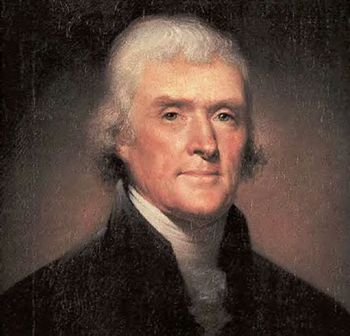
Thomas Jefferson
Thomas Jefferson appeared to be quite happy to hear from Abigail Adams, and promptly replied from Paris to London on June 21, 1785. More excerpts:

Jefferson to Mrs. Adams.
Paris, June 21 [1785].

Dear Madam, — I have received duly the honor of your letter, and am now to return you thanks for your condescension in having taken the first step for settling a correspondence which I so much desired; for I must consider it as settled and proceed accordingly.

I have always found it best to remove obstacles first. I will do so, therefore, in the present case, by telling you that I consider your boasts of the splendor of your city and of its superb hackney coaches as a flout, and declaring that I would not give the polite, self-denying, feeling,
hospitable, good-humored people of this country andtheir amiability in every point of view (tho' it must be confessed our streets are somewhat dirty and our fiacres rather indifferent) for ten such races of rich, proud, hectoring, swearing, quibbling, carnivorous animals as those among whom you are: and that I do love this people with all my heart and think that with a better religion, a better form of government, and their present governors, their condition and country would be most enviable. I pray you to observe that I haveused the noun people, and that this is a noun of the masculine as well as feminine gender. ...

...The squibs against Mr. Adams are such as I expected from the polished, mild-tempered, truth-speaking people he is sent to. It would be ill policy to attempt to answer or refute them,
but counter-squibs I think would be good policy. ...
After reading that exchange, perhaps we can understand why the State of Texas recently removed Thomas Jefferson from its history books.

From the Huffington Post:
In Texas, Thomas Jefferson is set to be removed from the textbook standards explaining how Enlightenment thinkers have influenced revolutions since 1750. Replacing him will be the French theologian John Calvin.
It has taken a lot of time to track down where you, too, can read these books, but I have managed to do it. They are in the public domain, and free online -- even though it often appears otherwise -- it took me a while to actually find them. In my opinion, the best place to get them is at the Hathi Trust.

Here is the link:

Franklin in France. From Original Documents, Most of which Are Now Published for the First Time. By Edward E. Hale and Edward E. Hale, Jr.


Happy learning.

Ciao from the Veneto,
Cat

Venetian Cat - The Venice Blog