Monday, June 16, 2014

Venetians Put on a Show(s) - Ancient Designer Sunglasses, a Playwright and a War Hero

Goldoni Glasses - 18th Century Goldoni-type Sunglasses with Mocenigo Coat of Arms (Vascellari Collection, Italy)
(Venice, Italy) Two hundred years before John Lennon made wearing round lenses all the rage, Venice was busy setting a fashion trend all its own. 

Long before the rest of the world would discover the danger of ultra-violet rays, Venetian opticians were 120 years ahead of the curve. Around the year 1750, they started producing emerald-colored sunglasses to protect the eyes of the nobility and Commanders da Mar (of the sea) from the harmful glare of reflected light as they navigated the waters that surrounded them.

SPECTACLES FIT FOR A DOGE
 
"Spectacles Fit for a Doge" examines a vital point in the development of eye-wear. For the first time in the history of spectacles, the exhibition at the majestic Sale Monumentale in the Marciana Library in Piazza San Marco gathers together eyeglasses from museums and private collections around the world to focus on the critical role that Venice played in shielding our eyes from the sun back in the 18th century.

The Doge was the ruler of the Venetian Republic. A pair of sunglasses, complete a with carrying case that bears the Coat of Arms of the aristocratic Mocenigo family are featured in the exhibition. The glasses date to the time when Doge Alvise Giovanni Mocenigo was the leader of Venice, from 1763 until his death on New Year's Eve, December 31, 1778.

Goldoni-type horn-rimmed spectacles with eyelet-shaped temple pieces and silk sun guards. Venice, 1760. (Vascellari Collection, Italy)
 
Venetian opticians were the first in Italy to produce eyeglasses with temple pieces that reached to the ear, holding the lenses more comfortably on the nose. To offer more protection, pieces of silk were attached to guard against the sun.

No one knows for sure why they were called "Goldoni" glasses, but it is assumed it's because Carlo Goldoni, the famous Venetian playwright, sported a pair of the hip glasses as he tooled about town, much like John Lennon did two centuries later.


Oval lady’s-glass painted in Venetian lacquer colors using decoupage technique already fashionable among Venetian carpenters at the end of the 17th century. (Ingrid and Werner Weismueller, Germany)

The vetri da gondola or da dama (for ladies) were mounted in a frame similar to a hand-held mirror, and probably evolved from a monocle. They were modified to be used by wealthy women and children to protect their eyes while on outings in a gondola.

The exhibition also features glasses created solely for entertainment, such as the vetri da avari (glasses for misers) with a kaleidoscope effect that turns one coin into many. The "Parisian" scissor-type lorgnettes were named after Parisian dandies who stopped people on the street and blatantly gave them the once-over through a pair of comical lenses.

"Spectacles Fit for a Doge" is curated by Roberto Vascellari.

Biblioteca Nazionale Marciana Sale Monumentali

SPECTACLES FIT FOR A DOGE
Sunglasses in Eighteenth-Century Venice
June 14 to July 13, 2014
Venice, Biblioteca Nazionale Marciana, "Sale Monumentali"
Click for more information (in Italian)

Promoters and Organizers
Comitato Venezia
Museo dell’Occhiale
Biblioteca Nazionale Marciana
Stazione Sperimentale del Vetro

THE GOLDONI EXPERIENCE

Teatro Goldoni
Meanwhile, over at the Carlo Goldoni Theatre, another all-Venetian production is getting underway. The "Goldini Experience" is an homage to the great Venetian playwright, Carlo Goldoni. Set on the last night before the scribe left for Paris, and the last night of Carnival, Giuseppe Emiliani, who directs the show, has taken chunks of Goldoni's own text and compiled the prose into a collage of comical encounters between Goldoni and people who stumble into his orb. Using the original Venetian language, the show will also have English subtitles, making it accessible to both locals and tourists alike.

The Goldoni Experience opens on June 21, Art Night Venezia, (when most of Venice's museums, churches, galleries and foundations will stay open until 11pm or midnight with free entrance!), with free two shows at 7:30 and 10:00PM, and runs throughout the summer, with additional shows in October and November. After June 21st, full price tickets are €35, with sizable reductions for residents, students and families and may be purchased at Teatro Goldoni and Hellovenezia.

Press conference for the GOLDONI EXPERIENCE

Schedule

June through September:

Every Tuesday at 7pm
Every Friday at 8pm

June 21 - 7:30pm and 10pm
June 24 - 7:00pm
June 27 - 8:00pm

July 1, 8, 15, 22 at 7:00pm
July 4, 11, 12, 18 at 8:00pm

August 5, 12, 19, 26 at 7:00pm
August 1, 8, 15, 16, 22, 29, 30 at 8:00pm

Sept. 2 at 7:00pm
Sept. 5, 6 at 8:00pm
Sept. 7 to be announced

Oct. 31 at 8:00pm
Nov. 2 to be announced

THE GOLDONI EXPERIENCE
Fresco of Venice
Scenes of Daily Venetian Life in the 18th Century
Teatro Stabile del Veneto Carlo Goldoni
Click for more information


THE RESTORATION OF THE BUST OF SEBASTIANO VERNIER
 
Bust of Sebastiano Venier by Alessandro Vittoria
"Many small things make many great things."

Sebastiano Venier (1496-1578) is one of Venice's most beloved historical figures. After defeating the Turks at the Battle of Lepanto, he became Doge. They say he died of a broken heart when a fire heavily damaged the Doge's Palace. 

Now, thanks to the efforts of the Venice Club of the International Inner Wheel, one of the world's largest women's organizations, the marble bust of the Venetian hero has been restored and stands proudly once again inside Palazzo Ducale over the Staircase of the Censors, in front of the door of the Armory.

Palazzo Ducale - Doge's Palace
 
Manuela Savoia Rizzoli, the President of the Venice Club, expressed the desire that Venetians return to their heritage and said, "It's a small thing, but, for us, it's a big thing."
 
Go to Palazzo Ducale for more information.

Ciao from Venezia,
Cat Bauer
Venetian Cat - The Venice Blog

Tuesday, June 10, 2014

2014 Venice International Architecture Festival - Rem Koolhaas Resets the World

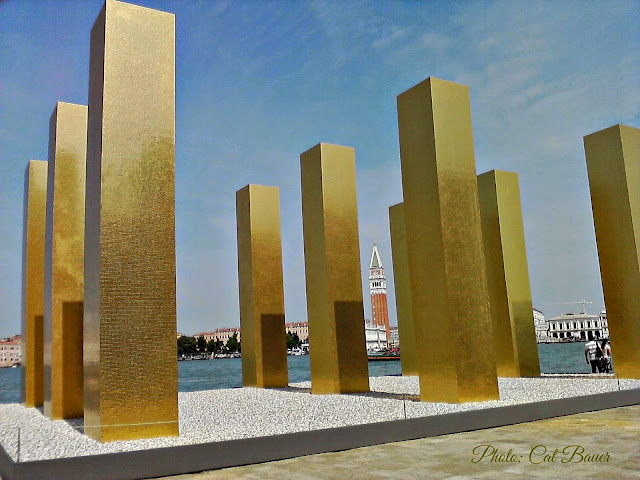
The Sky Over Nine Columns by Heinz Mack - Photo: Cat Bauer Venice Blog
The Sky Over Nine Columns by Heinz Mack - Photo: Cat Bauer
(Venice, Italy) Giorgio Orsoni, the Mayor of Venice, was arrested for corruption on June 4th, the same morning I was arrested by the golden grandeur of The Sky Over Nine Columns by Heinz Mack on the island of San Giorgio Maggiore, one day before the preview of the 14th Venice International Architecture Festival.

The divine beauty of the monumental columns was an enlightened contrast to the dark forces that constantly seek to debase Venice, the most beautiful city in the modern world. When asked to comment about the mayor's arrest during the opening press conference, Rem Koolhaas, the Director of the Architecture Exhibition, said, "It is an incident that fits perfectly in the overall picture."

Winner GOLDEN LION for Nat. Participation  - Republic of Korea Pavilion. Image © Andrea Avezzù, Courtesy of la Biennale di Venezia
This year, for the first time, the 65 nations that participated were asked to focus on a common theme: Absorbing Modernity 1914 - 2014. Koolhaas said that he wanted to take the liberty to look at subjects that are not normally examined. Each nation had complete freedom within the theme. As the research progressed, it became clear that every single nation had been destroyed and rebuilt at least once, and that absorbing modernity was more like absorbing the blows of an opponent.

South Africa Pavilion. Image © Andrea Avezzù, Courtesy of la Biennale di Venezia
I've grown to love the architecture exhibition -- over the years it has developed into something wondrous. As a lay person living in Venice who technically knows next to nothing about architecture, it is fascinating to take a glimpse into that world.

Every other year, when the architects descend upon Venice, they breathe fresh, creative life into the city -- businesses stay open late, hotels and restaurants are packed with interesting and exciting energy, the streets are filled with zippy conversations -- even the vaporetto driver popped open the front window and started singing as he zoomed across the lagoon.

From yachts to backpackers, wizened wise ones to the mini-skirted chic, the joint is jumping with openings, cocktails and parties. It is a stark contrast to the armies of zombies dumped off by the monstrous cruise ships who follow mindlessly behind a guide holding a contrivance-on-a-stick.

Winner SILVER LION for National Participation - Chile Pavilion. Image © Andrea Avezzù, Courtesy of la Biennale di Venezia
How to create an architecture exhibition that appeals to both the professional and the general public has always been a challenge. It's not like film, music, theater or dance, mediums where an audience is used to being entertained. By incorporating those elements of La Biennale -- theater, film, music and dance -- plus focusing on research and a common theme, Koolhaas and La Biennale have found a genius solution to create an exhibition that appeals to all.

Special Mention: Canada Pavilion Arctic Adaptations: Nunavut at 15
Koolhaas made an interesting remark during the press conference -- that the nations found working together on the same theme a "relief," and that it became an orchestra of different voices.

After wandering around the exhibition, I began to understand what he meant. Each nation found a way to tell their own story about the events that had occurred in the past 100 years that shaped them into what they are today, and which is reflected in the architecture -- dreams that were never completed, compromises that were built, and the occasional creation that fulfilled the original idea.

Subjects that have been taboo for decades were openly addressed. The heavy hand of war and politics upon existing cultures that, in turn, affect architecture was emphasized. I was struck by how much influence governments and their policies had upon architecture, something I've never really thought about before.

Special Mention - France Pavilion. Modernity: promise or menace?  Image © Andrea Avezzù, Courtesy of la Biennale di Venezia
The Russians were hilarious, all decked out in hot pink, mimicking an international trade show called "Fair Enough," with sales people and stalls that showcased 20 different Russian companies, such as a travel agency that organizes international tours which focus on the influence of Russia around the globe, or a company that specializes in contemporary "neo-Russian" architecture.

I loved the "Dacha Co-op," a company that believes "that all people deserve storage space that they can live in that's customizable to their own tastes and located in a relaxing atmosphere outside the city." In other words, a tiny second home.

I spoke to an architect from New York, and she said she thought Russia was the best exhibition she'd seen; in fact, everyone seemed to appreciate the sense of humor -- because, really, with Russia's critical situation in the world today, a little humor goes a long way. The jury seemed to agree, and gave Russia a Special Mention "for showcasing the contemporary language of commercialization of architecture."

Special Mention - Russian Pavilion Fair Enough: Russia’s past our Present
As as American, I was riveted by the US pavilion, OfficeUS. Its mission is to "critically reflect on the production of US architectural firms abroad, while simultaneously projecting a new model for global architectural practice open to all of us."

The pavilion is set up like an office; in fact, is an operating office, its walls lined with hundreds of folders in chronological order detailing US projects abroad during the last 100 years. The curators say it is “an active, global, experimental architecture office that researches, studies, and remakes projects from an onsite archive of 1,000 buildings and the 200 U.S. based architecture offices engaged in their construction.”

US Pavilion. Image © Nico Saieh
I was born in 1955, so I opened a folder and began to read an article from the January 1955 edition of Architectural Forum, a publication now defunct (1892-1974):

"The year 1955 finds the US building industry hard at work in almost every country of the free world. Our architects and planners are creating whole new towns from teeming India to tiny El Salvador. Our engineers and contractors are building new dams and power plants in Turkey and Afghanistan, new refineries in Sumatra and Ceylon, new highways in Columbia, new hospitals in Iran and Peru. We have opened gleaming new embassies and consulates in a dozen capitals, big luxury hotels in a dozen more. 

What is the significance of this tremendous activity?

First, it means we are building up the basic welfare of other nations, creating climates unfavorable to communism, readying countries for industrialization and democratic independence, making them prosperous enough to buy more of our products.

Second, our industry and commerce are expanding in search of new sources of raw materials, new markets for finished products. To serve increased travel and trade, hotels and stores are springing up along the new commercial routes.

Third, we are helping build defenses for ourselves and our allies.

And fourth, we are keeping up strong governmental and public relations through our official missions: new embassies, consulates, libraries, information services."

WHOA.  I could not believe that I was reading about a scheme in a publication written nearly 60 years ago that clearly and precisely outlined what the United States was doing abroad -- it seems like it would have "Confidential" marked all over it today. The sections called ECONOMIC AID and POINT FOUR were especially pertinent to current affairs in Afghanistan:

"By late 1948, thanks to the Marshall Plan, Europe fairly crawled with members of the US construction industry. Architects went abroad to advise on the planning of industrial plants and housing to give the benefit of their experience in expanding the US wartime industrial machine.

... In some instances, the various US aid programs overlap. For example, in Afghanistan, a $75 million project calling for construction of two dams was largely funded with Export-Import loans while Point Four financial assistance to the same country has been showing previously nomadic Afghans how to use the 400,000 newly irrigated acres that dams will create. 

This project, begun in 1947 by Morrison-Knudsen, is just winding up and is typical of the kind of situations that US firms find themselves in when they work on aid project. Examples: 1) M.K. used 60 local workers for every US national employed and had some unusual problems to contend with as a result. For instance, the Afghan version of the coffee break consists of two prayer periods each day on company time in addition to three prayer sessions on the workers' own time. 2) The transportation difficulties were enormous and getting 17,000 tons of equipment into the middle of this backward Asian nation accounted for about 25% of the project's cost. 3) Despite Point Four work in Afghanistan, M.K, found it necessary to start its own model farm in one area just to show local farmers how to use the new land -- certainly an unusual venture for a construction crew."


Which particular businesses were booming abroad?

"...In the field of manufacturing and assembly plants, General Motors is probably the leader of all US investors abroad with its 27 plants in 17 nations and its $191 million expansion plan for Europe alone. Other fields marked by other blue-chip investors: Pan American (through Intercontinental Hotels) with its 15 foreign hotels, Readers Digest with its publishing plants in 14 countries, E.B. Squibb (today Bristol-Myers Squibb) with 17 factories around the world and (my personal favorite) Coca Cola with its ubiquitous bottling plants."

HOW BIG THE FUTURE? pretty much sums up the Foreign Policy of the United States of America back in 1955 -- not much seems to have changed:

"Although the scope of our private operations abroad seems large, it is actually small when measured against the undeveloped state of most of the world and the prewar investments made by Britain when she occupied our present position as leader of the Western Alliance."

The curators say, “We are setting a stage for the architects and visitors to address and respond to the most pressing architectural anxieties of the last one hundred years," and I found their attitude refreshing. Looking at the policies of the United States abroad in terms of history really gave me a new perspective on why our country is in the position that it is in today.

Sonnets in Babylon by Daniel Libeskind - Venice Comune
Despite the mayor's arrest, the opening of the Venice Pavilion, Sonnets in Babylon by Daniel Libeskind went smoothly. Libeskind is a Polish Jewish architect and artist, who holds both US and Israel citizenship, and is the master plan architect for the reconstruction of the World Trade Center site in Lower Manhattan.

"Some never-before-exhibited drawings by Libeskind, created by hand from pen and sepia-toned washes of coffee, comprise the principal element of the pavilion." Libeskind said his exhibition was dedicated to the citizens of Venice, "the most fantastic city in the world," and emphasized that "cities are made out of people."

Fundamentals, the Venice Biennale 14th International Architecture Festival directed by the brilliant Rem Koolhaas runs from June 7 to November 23, 2014. Click here for more information.

Ciao from Venezia,
Cat
Venetian Cat - The Venice Blog

Saturday, May 31, 2014

From Rauschenberg to Jeff Koons - The Eye of Ileana Sonnabend at Ca' Pesaro, Venice

Nine Jackies by Andy Warhol (1964)
© The Andy Warhol Foundation for the Visual Arts Inc., by SIAE 2014 
© Sonnabend Collection, New York
(Venice, Italy) The visionary gallerist and art collector Ileana Sonnabend left behind a treasure trove of art when she died in 2007, eight days shy of her 93rd birthday. A good chunk of her collection has found a temporary "European Home" here in Venice. From today, May 31, 2014 through January 4, 2015, seventy pieces from the hundreds of works on long-term loan from the Sonnabend Collection that have been housed here in Venice since 2013 are now on show on the entire second floor at Ca' Pesaro, Venice's International Gallery for Modern Art.

Eat Death by Bruce Nauman (1972) - Photo: Cat Bauer
Ileana had a daring eye, and many artists are now household names thanks to her championship. Together with her former husband, Leo Castelli, she shaped post-war art both in Europe and North America. From Neo-Dada to Pop Art, Minimal Art to Arte Povera, Conceptual to Neo-expressionism, and up to contemporary photography, artists such as Robert Rauschenberg, Andy Warhol, Roy Lichtenstein, Jeff Koons, Jasper Johns, and Jim Dine achieved an international level of recognition due to her efforts.

Little Aloha by Roy Lichtenstein(1962)
© Estate of Roy Lichtenstein, by SIAE 2014 
© Sonnabend Collection, New York
Ileana was born into luxury in Bucharest, Romania. Her Jewish  father, Mihail Schapira, was financial adviser to the king; her mother, Marianne State-Felber was a refined, intellectual Viennese. As a child, Ileana was dropped off at museums at her own insistence to look at art while her mother and older sister, Eve, shopped for clothes. When Ileana was 17-years-old, she met Leo Castelli, who was born Leo Krausz in Trieste, Italy to a Hungarian-Jewish banker; his mother was the Italian heiress Bianca Castelli. Leo was a voracious reader who spoke many languages, who, at the time of their meeting, reluctantly worked for an insurance company, positioned there by his father. Ileana married him a year later.

Ileana remarked:
"Since I found my life rather stifling, I had only one wish: to get married. As a child, I always knew that someone would take me away. I met Leo. He wasn't like everyone else. He was going somewhere. He was going to leave Romania, and as I wanted to get out of Romania at any cost, I married him."
The young couple moved to Paris in 1935, Leo getting a job, again through his father, in banking, which he found as boring as insurance. He began womanizing. Ileana tried to keep an open mind, taking a lover of her own -- their new daughter's pediatrician. Ironically, Ileana would spend her days shopping at Elsa Schiaparelli, designer to the elite on Place Vendôme. Thanks to Ileana's father, who loaned Leo the money, he, without Ileana, opened a gallery in 1939 with his friend and partner René Drouin located in between the Hotel Ritz and Schiaparelli's boutique. The Surrealists flooded in -- as did the war. The Castellis fled to New York, where Ileana's father had bought a townhouse, and where, years later, Leo would open his first gallery in his and Ileana's apartment. 

The 62 Members of the Mickey Mouse Club in 1955 by Christian Boltanski
During the 1940s, Ileana's mother, Mariana Schapira made the leap into the world of art, divorcing Mihail Schapira and marrying the Ukranian-born artist John D. Graham -- if I have tallied correctly, she would have been his fifth wife. John Graham was born Ivan Gratianovitch Dombrowsky in Kiev, and changed his name when he became a US citizen in 1927. Graham was a mentor to artists such as Jackson Pollock, William de Kooning and Arshile Gorky, and also became a mentor to Ileana and Leo.

During the war, thanks to his many languages, Leo was employed by the OSS, the US intelligence agency, and stationed back in Bucharest, while Ileana enrolled in a French literature class at Columbia University. There, while studying Proust, she met the only other person who could speak French: Michael Sonnabend. 

Figure 8 by Jasper Johns (1959)
© Jasper Johns, by SIAE 2014
© Sonnabend Collection, New York
Leo's war contribution made him a US citizen. He returned to New York, becoming a partner in a knitwear firm -- again, thanks to his father --and  dealing art privately on the side, while continuing his womanizing, leaving Ileana depressed. But they shared a strong bond when it came to contemporary art. Together they went to visit Robert Rauschenberg's studio on Pearl Street. Rauschenberg went downstairs to get ice from a refrigerator he shared with Jasper Johns. The Castellis met Johns, and Leo exclaimed he wanted to give Johns a one-man show.

Johns' show opened at the Castelli Gallery in January, 1958 and transformed contemporary art. Rauschenberg's show opened two months later. The Castellis divorced in 1959.


Interior by Robert Rauschenberg (1956)
© Estate of Robert Rauschenberg, by SIAE 2014
© Sonnabend Collection, New York
In 1960, Ileana married Michael Sonnabend. They moved to Paris and opened a gallery, the first show again by Jasper Johns, introducing Europe to the new American art. The shows were well-attended, but the critics and dealers were harsh, resentful at having the center of the art scene moved from Paris to New York. Leo often supplied Ileana with artists, but she also had her own eye, with strong encouragement by Michael, and showed artists such as Jim Dine and Claes Oldenburg. Andy Warhol's first European show opened at Gallerie Ileana Sonnabend in January, 1964.  
 
Del Monte Boxes by Andy Warhol(1964)
© The Andy Warhol Foundation for the Visual Arts Inc., by SIAE 2014
© Sonnabend Collection, New York

When Robert Rauschenberg won the International Grand Prize at the Venice Biennale in 1964 -- the first American to do such a thing -- all hell broke lose. Leo Castelli was accused of manipulating the jury. The week before the opening, he had been holding court at Caffè Florian with his second wife. Ileana and Michael Sonnabend were seated only tables away. The United States of America had thundered into the world of contemporary art. 

Then, in the late 1960s, the Sonnabends hired Antonio Homem, a Portuguese student, as gallery director, who was said to be a kind of alter-ego to Ileana. In the early '80s, they adopted him -- something unusual as he was then in his 40s and had a son of his own, but looking toward future, it would legally make things easier to transfer.


Per Purificare le Parole by Gilberto Zorio(1969)
© Gilberto Zorio, by SIAE 2014
© Sonnabend Collection, New York
Ileana's Paris gallery stayed in operation until the mid-80s, but in 1970s, the Sonnabends made their presence known once again in New York. Ileana reversed the trend she had started in Europe, introducing Americans to Arte Povera -- European artists such as Gilberto Zorio, who used throw-away materials to create their work.

After she opened a gallery on Madison Avenue, Leo convinced Ileana to move down to SoHo at 420 West Broadway back when it was a wasteland of empty industrial space inhabited by artists who valued the high ceilings and natural light. On September 25, 1971, four galleries opened at 420 West Broadway, Ileana one floor above Leo, starting another revolution in the World of Art.


The art scene next moved to Chelsea, and in 2000, Ileana opened a gallery there with her adopted son, Antonio Homem, who is co-curator of this current exhibition, Da Rauscenberg a Jeff Koons Lo sguardo di Ileana Sonnabend, along with Gabriella Belli, Director of Venice's Musei Civici.

Wild Boy and Puppy by Jeff Koons (1988)
© Jeff Koons
© Sonnabend Collection, New York
Even though they would divorce and marry others, Eleana Sonnabend and Leo Castelli would remain lifelong friends, their respective galleries promoting American art in Europe, and European art in North America. Ileana had her own distinct eye and her own specific taste, and emerged in her own right from the shadow of her flamboyant ex-husband, and is still going strong after her death in 2007. Ileana gathered together an immense collection of precious art, while Leo was more about the deal. Together with Peggy Guggenheim, these distinct individuals helped to transform the World of Art after the Second World War.

From Rauschenberg to Jeff Koons
The Ileana Sonnabend Collection

From May 31, 2014 to January 4, 2015
Ca’ Pesaro – International Gallery of Modern Art, Venice

GO TO CA' PESARO FOR MORE INFORMATION

Ciao from Venezia,
Cat Bauer
Venetian Cat - The Venice Blog

Sunday, May 18, 2014

Miroslav Kraljević, the "Artist of the Soul" at Ca' Pesaro, Venice International Gallery of Modern Art

Self-portrait with Dog by Miroslav Kraljević (1910)
(Venice, Italy) Croatian artist Miroslav Kraljević was called "The Artist of the Soul." Perhaps it was because he lived on the edge of death, struggling with tuberculous, and died so young, at the age of 27, that he developed a profound vision that allowed him to capture the essence of things. Through June 15th over at Ca' Pesaro, Venice's International Gallery of Modern Art, this small jewel of an exhibition, Un autoritratto di Miroslav Kraljevic, modernista croato, is on display.

Ziva Kraus
Miroslav Kraljević's arrival at Ca' Pesaro is considered to be the cultural event of the year in Croatia, and many dignitaries were on hand during the opening ceremony on April 18th. Thanks to a project by Živa Kraus, the prominent Croatian artist and owner of the Ikona Gallery in the Ghetto here in Venice, Miroslav Kraljević will finally get the recognition he deserves on the European stage.

Kraljević was born on December 14, 1885 in Gospić, Croatia, a small town that would become notorious a century later for the Gospić Massacre, when 100-120 Serbian civilians were killed during the Croatian War of Independence in 1991. Kraljević grew up in Zagreb, the capital of Croatia, then finished high school back in Gospić.

Kraljević moved to Vienna in 1904 to study law as well as art, but like all great artists, after two years he dropped out of the legal world and moved firmly into the World of Art. At the beginning of the last century, the World of Art for a young Croatian was Vienna and Munich, so in 1906, Kraljević went to Munich, considered an important hub of the European art scene, and enrolled in the Academy of Fine Art, studying under Hugo von Habermann, another former law student who had turned to the arts. There Kraljević met fellow Croatians Joseph Račić, Vladimir Becić and Oscar Herman, who would later be dubbed the "Munich Circle." After his studies, he moved back to Croatia in 1910 and stayed with his family, who had moved to Požega.

Three Graces by Miroslav Kraljevic (1911)
 In 1911, Kraljević did something extraordinary that would earn him the designation, "the First Croatian Modernist Painter" -- he received a state grant to study in Paris, and off to Gay Paree he went, where a cultural revolution was under way. It is this period on which A Self-Portrait by Miroslav Kraljević, Croatian Modernist focuses, when Kraljevic became a flâneur, "someone who saunters around the city observing society" and painted what he saw -- as his tuberculosis consumed him. He was a dying man living at full speed in Paris during one of the most important times in the story of art, and he captured the souls of those around him, including his own. The twenty works on display at Ca' Pesaro are full of dark humor and insight -- street and cafe scenes, erotic sketches, theater and dance -- as well as his haunting self-portrait, smoking a pipe. 


Self-portrait with Pipe by Miroslav Kraljevic (1912)
Kraljević returned to Croatia after a year in Paris, staying again with his family. In the autumn of 1912, he went to Zagreb, where he organized his first solo exhibition, rented a studio, and painted. But his tuberculosis was unrelenting, and he died in Zagreb on April 16, 1913 at age 27. He is buried in the family grave in Požega.

Bonvivant by Miroslav Kraljevic (1912)
After his death, modern Croatian art would undergo a complex transformation, the foundations laid by the brilliant young Miroslav Kraljević, The Artist of the Soul.

Un autoritratto di Miroslav Kraljević, modernista croato
A Self-Portrait by Miroslav Kraljević, Croatian Modernist

Curated by Gabriella Belli, Biserka Rauter Plančić e Cristiano Sant
In collaboration with Moderna Galerija di Zagabria
Supported by Privredna Banka Zagreb

Ca' Pesaro International Gallery of Modern Art
THROUGH JUNE 15, 2014

Click for more information

Ciao from Venezia,
Cat
Venetian Cat - The Venice Blog

Sunday, April 27, 2014

More Venetians than Tourists in Piazza San Marco & Open Arsenale in Venice

Human Rose in Piazza San Marco, April 25, 2014
(Venice, Italy) April 25th is Italian Liberation Day, which commemorates the end of the Second World War. But in Venice, long before there was a united Italy, April 25th was the Feast of Saint Mark, Venice's patron saint. On that day, during the Festa del Bocolo, or "Festival of the Rose Blossom," men give a single rose to the women they love -- their wives, girlfriends, friends, mothers, aunts -- any woman they care about. And behind that tradition is a wonderful Venetian legend.

This year, to celebrate the day, about 1,000 residents took to Piazza San Marco to create a human rose. It was part of an ongoing project by the Venetian artist Elena Tagliapietra and the Venetian author, Alberto Toso Fei to bring alive stories and traditions of Venice's past in 13 different venues -- the rose was the sixth event. Toso Fei read the legend of the rose in three languages -- Italian, English and Venetian -- while volunteers, including yours truly, formed a magnificent rose in the center of the square after having the red rose painted on our faces.

Cat Bauer & The Rose Tattoo
Here is the story:

A noblewoman, Maria Partecipazio, and a troubadour, Tancredi, fell in love. But Maria was the daughter of the Doge, and marriage to a troubadour would never have her father's approval. In order to overcome the social class differences, Tancredi went off to war to find glory and raise himself to the higher social level of his beloved. 

He served as a valiant soldier under Charles the Great in the war against the Moors, but, unfortunately, was mortally wounded. As he lay dying in a pool of blood by a bed of red roses, he plucked a rose for Maria Partecipazio and asked his comrade, Orlando, to take the blossom to his beloved Lady in Venice, stained with his blood. 

Orlando kept his vow, and arrived in Venice the day before the Feast of Saint Mark. He gave the rose to Maria Partecipazio as the last message of love from the dying Tancredi. The next morning, Maria Partecipazio herself was found dead, the red rose lying on her heart, finally joined with her beloved in the celestial world. Since that time, Venetian lovers use the symbol of the red rose blossom to pledge their love. 


So, creating the human rose in Piazza San Marco is a symbol to remind the world how much Venetians deeply love their city. After we took the photo the people in the bell tower waved to us on the ground, and the rose people waved back. We waved and waved until everyone broke into spontaneous applause; then we clapped and clapped, and it really was an emotional, beautiful moment.


Later that afternoon, Venetians from all over the Veneto defied an order not to gather in Piazza San Marco and arrived waving their flags. On March 16th, the same day that Crimea voted to secede from the Ukraine, the Veneto had symbolically voted to secede from Italy, sending a strong message to Rome that they felt overtaxed and unappreciated. Luca Zaia, the President of the Veneto Region, gave his full support to the demonstration, saying that it was not political but a manifestation of identity. "Seeking to ban the party of the Veneto from the heart of the Veneto -- Piazza San Marco -- on the feast day of Saint Mark, is not only incomprehensible, but offensive and insensitive."


Lucio Chiavegato, a secessionist who had been released from prison last Friday for allegedly plotting to take over Piazza San Marco with a homemade tank (click to read the story in The Local), arrived with his wife to attend mass in the Basilica of San Marco with Patriarch Francis Moraglia, saying "we have invoked the protection of Saint Mark, which makes us free from the occupying State."

View from Austrian tower
Meanwhile, down at Arsenale, Rome meets Venice halfway. On February 6, 2013, Italy gave Venice back a chunk of Arsenale, the enormous area where the Venetian Republic once was able to whip out up to two ships per day. For the past three days, April 25 to 27, much of Arsenale has been open to the public. Called Arsenale Aperto alla Città or "Arsenal Open to the City," the different entities that are now based in the Arsenale decided it would be a good idea to let the residents know what was going on down there.

A collaboration between the City of Venice, ACTV (the vaporetto and bus system), VELA (part of ACTV, which distributes tickets to Venice's cultural organizations through HELLO VENEZIA) Consorzio Venezia Nuova (the State Concessionary for the protection of Venice and its Lagoon, whose head ended up imprisoned for corruption), La Biennale (Venice's international artistic organization) Magistrato alle Acque (Venice's water authority), Instituto di Studi Militari Marittimi (the Maritime Military Institute) and Thetis (a consultancy and system integrator company, controlled by Consorzio Venezia Nuova), the event included conferences, boat rides, rowing lessons, history lessons, pottery lessons for the kids, a spectacular view from the old tower built by the Austrians when they occupied Venice -- I even got to sit inside the MOSE CONTROL ROOM, headquarters for the moveable dams that are supposed to rise up and protect Venice from acqua alta, or high water, then disappear under water again when the danger has passed.

The folks who make wine out on San Michele, the cemetery island, were there; the Afghans who make food from the Orient were there; the anti-cruise ship people were there, as were bunch of other creative folks; there was live music and real life transported to Arsenale. (Let's hope it's not a ploy to distract everyone's attention from the Rialto and Piazza San Marco!)

Pottery lessons a big hit with the younger set
Today, a hodgepodge of different interests call the Arsenale their base. And now Venetians get to play down there, too. Let's hope there's no fighting!

Ciao from Venezia,
Cat
Venetian Cat - The Venice Blog 

Wednesday, April 23, 2014

People in Glass Houses Should Drink Tea - Hiroshi Sugimoto's First Architectural Project in Venice


(Venice, Italy) Le Stanze del Vetro, or The Rooms of Glass, sent over this press release about Hiroshi Sugimoto, the renowned Japanese photographer -- who also designs architecture -- and his project that will open during this year's International Architecture Exhibition. As usual, it is so clearly written that I will let them speak for themselves -- I have added the images except for the one at the top. It sounds like an impressive event!

A joint project of Fondazione Giorgio Cini
and Pentagram Stiftung


Le Stanze del Vetro

Venice, Island of San Giorgio Maggiore


Glass Tea House Mondrian
by Hiroshi Sugimoto


Japanese artist Hiroshi Sugimoto's first architectural project in Venice, designed for Le Stanze del Vetro on the Island of San Giorgio Maggiore.


On June 6th, the “Glass Tea House Mondrian” will open to the public on the Island of San Giorgio Maggiore in Venice. The “Glass Tea House” is a temporary pavilion designed by the Japanese artist and photographer Hiroshi Sugimoto as part of the activities of Le Stanze del Vetro. Hiroshi Sugimoto is known worldwide for his black-and-white photographs, and for the first time ever he is to design an architectural building in Venice.

The “Glass Tea House Mondrian” is a project by Le Stanze del Vetro which was made possible thanks to the support of Sumitomo Forestry Co. Ltd., and Fondazione Bisazza, in collaboration with Asahi Building-Wall Co. Ltd. Special thanks to Fondazione Musei Civici di Venezia for lending archaeological artefacts and to Cattaruzza Millosevich Associated Architects for having overseen each phase of the design and construction of the pavilion.

Appropriate Proportion by Hiroshi Sugimoto
Concurrent with the opening of the “Glass Tea House Mondrian”, the Fondazione Bevilacqua La Masa will host  an unprecedented retrospective exhibition of Hiroshi Sugimoto’s architectural photographs at the Palazzetto Tito: this exhibition, together with the "Glass Tea House Mondrian” at Le Stanze del Vetro, will place this world-famous artist and his commitment towards the built environment at the center of the Venice art scene this season, befitting the new expanded format of the Architecture Biennale.  

The “Glass Tea House Mondrian” is a new initiative from those organized so far by Le Stanze del Vetro, broadening its horizons, and involving internationally renowned artists to plan and design an architectural pavilion in the area in front of Le Stanze del Vetro, following the example of the “Pavilion Series” of the Serpentine Gallery in London.

The “Glass Tea House Mondrian” by Hiroshi Sugimoto is inspired by pre-modern abstraction, as perfected by Sen no Rikyû, in the Japanese tradition of the tea ceremony. The Pavilion consists of two main elements, an open-air landscape and an enclosedglass cube. The landscape (approximately 40 meters long and 12.5 meters wide) follows a path along a reflecting pool leading the visitor to a glass cube (2.5 x 2.5 meters), inside which the traditional Japanese tea ceremony will be performed regularly.


The glass cube will host two visitors at a time together with the tea master, while spectators can watch the ceremony from outside the glass cube. Original tea utensils for the “Glass Tea House Mondrian” were designed by Hiroshi Sugimoto and fabricated by traditional artisans in Kyoto.

Lightning Fields by Hiroshi Sugimoto

Useful information
Title
Glass Tea House Mondrian
Date
Opening on June 6, 2014
Times
10 am – 7 pm, closed on Wednesday
Location
gardens in front of Le Stanze del Vetro
Address
Isola di San Giorgio Maggiore, Venice
Tickets
free admission
Original tea utensils for the “Glass Tea House Mondrian” were designed by Hiroshi Sugimoto and fabricated by traditional artisans in Kyoto:
Shuji Nakagawa / Nakagawa Mokkougei Shiga Studio
Takahiro Yagi / Kaikado
Supervised by So’oku Sen/Mushakoji-Senke Tea School
In cooperation with Kyoto University of Art & Design
Ciao from Venezia,
Cat
Venetian Cat - The Venice Blog

Monday, April 7, 2014

Venice Literary Festival - Crossroads of Civilization - Incroci di Civiltà 2014 - #VeniceBooks


(Venice, Italy) Crossroads of Civilization, Incroci di Civiltà, Venice's international literary festival wrapped up its seventh edition on Saturday, April 5, 2014. Once again, the writers spoke about how we need good literature more than ever. Caryl Phillips from Great Britain nailed it when he said, "Google is not knowledge. Google is information. ...Our brains are becoming increasingly narcissistic. Literature is needed as a counter-balance."

Reading good literature encourages our brains to process information and transform it into real knowledge. Good writers impart knowledge gathered from deep within themselves, transforming it into a feast that humanity can savor. As the world twitters away, those of us who still make time to read good literature dine on satisfying sentences and sumptuous words, a meal that leaves a lasting impression.

Unfortunately, because of schedule conflicts, I was not able to see all the writers I wanted to -- especially Raja Alem from Saudi Arabia, whom I had met back in 2011, but the conversations I was able to attend left me encouraged that Venice's literary festival continues to thrive. Especially heartening was the large number of students in attendance -- the University of Ca' Foscari here in Venice is a valuable contributor to Incroci di Civiltà.


Here are the writers who attended and their countries, stimulating diverse, international conversations about how the world looks from his or her unique point of view:

Naomi Alderman - Great Britain
Raja Alem - Saudi Arabia
Salwa Al-Neimi - Syria
Massimo Carlotto - Italy
Patrizia Cavalli - Italy
Arne Dahl - Sweden
Rita Dove - United States
Abilio Estévez - Cuba
Ge Fei - China
Rhea Galanaki - Greece
Peter Greenaway - Great Britain
Jhumpa Lahiri - United States
Abdolah Kader - Iran/Holland
Daniel Mendelsohn - United States
Carlo Petrini - Italy
Caryl Phillips - Great Britain
Marc Scialom - Tunisia/Italy/France
Sergej Stratanovskij - Russia
Noémi Szécsi - Hungary
Uwe Timm - Germany
Olivier Truc - France/Sweden
Varujan Vosganian - Romania
Binyavanga Wainaina - Kenya (unable to attend)


I did manage to see David Mendelsohn over at the Teatrino di Palazzo Grassi (and bumped into Martin Bethenod, Director of the Francois Pinault Foundation, for the second time that day -- earlier in the morning he was at Le Stanze del Vetro on the Island of San Giorgio Maggiore presenting I Santillana - Works by Laura de Santillana and Alessandro Diaz de Santillana, the outstanding exhibition he conceived; everyone is talking about it; it is a MUST SEE). Mendelsohn was interviewed by Pietro Del Soldà, of Radio Rai 3, who spoke in Italian while Mendelsohn responded in English.

Mendelsohn is an American critic, author, essayist and classics professor. His 2006 memoir has a notable title -- The Lost: A Search for Six Among Six Million. With a background in Euripidean tragedy, he applied his talents to search for the phantoms that were haunting his family: six of his relatives that disappeared during the Holocaust.

Mendelsohn said his problem was how to tell a story that everyone already knew. He was a critic sitting in his pajamas, writing reviews, when he decided to delve into his family's history. He kept reminding himself to keep a narrow focus and stick to the story: "There's never been a story about my family before." His six relatives were representative of the six million Jews who disappeared during the Holocaust. Since his background was in Hellenic studies, he called upon his old friends Herodotus and Homer for help, and used Ring Composition for his structure. This fascinated me, and I knew I had to have his book. But Daniel Mendelsohn is such a riveting speaker that his book was sold out both in English and in Italian. (I will have to get my hands on a copy by other means:)


This incredibly educated, well-traveled, enlightened American man said something that struck me as an American woman who has lived in Europe for sixteen years. While doing his research, Mendelsohn realized how remote Europe was to the United States; that Americans are oblique to Europe. I have noticed the same thing. He said every American is haunted by another history... growing up in a small town in New York State, who visited his relatives in Miami for a couple weeks every year, he kept hearing about "the Old Country," "the Old Country." He said, "Even educated Americans like myself don't understand it." Now he is an American who finally has discovered what the Old Country is.

While traveling in Eastern Europe, every town he visited had a mass grave. It was a question he was repeatedly asked: "Do you want to see the mass grave?" Mendelsohn remarked, "Your whole country is a cemetery!" His relatives were from a small town called Bolekhiv in the Ukraine. In 1890, there were over 4,000 Jews living there; only 48 survived World War II.

Mendelsohn's brother, Matt, who did the photography, wanted to see Auschwitz; he did not. He was amazed when they were driving along the highway and saw the signs for "Auschwitz." "Imagine growing up in a country where the names are places of genocide!" His brother responded: "You grew up the same way." Mendolsohn said that where he grew up in New York State, everything was named after Native American tribes. After I processed the enormity of that thought, I was stunned. That is also how I grew up, surrounded by Native American names -- Pompton Lakes, my little hometown in New Jersey, was named after the Pompton tribe. Although the Indians left a deep impression on my childhood, it was a romanticized version of history -- wearing moccasins, walking toe-heel, toe-heel, gathering berries in the forest. But, in reality, it was genocide. An entire people were wiped out according to plan. The definition from Merriam-Webster:

geno·cide

noun \ˈje-nə-ˌsīd\

: the deliberate killing of people who belong to a particular racial, political, or cultural group

Mendelsohn said that 9/11 was the first chance America had to feel like Europe. If you are a regular reader of Venetian Cat - The Venice Blog, you will know I just wrote the same thing last week when I commented on the book The Hôtel on Place Vendôme:

"Here in Europe, you can still feel the echoes of the World Wars, something that only a handful of today's Americans understand. The wars touched the lives of everyone in Europe, many of whom are still alive today. The pain of 9/11 shook the world, Americans in particular, but the event itself was isolated to a section of New York. The World Wars were anguish ramped up to the umpteenth power as country after country fell under the control of the Nazis and Fascists. It is almost unimaginable that such a short time ago France was under German rule; the Nazis were bombing Great Britain, and the US and the Soviet Union were allies -- the Soviets were the first to liberate the Jews from Auschwitz."

Daniel Mendelsohn said that the ancient Greeks were alert to the terror in the world, and that Americans have an infantile desire for closure, packaging everything to feel good. He said that there is not always a redemption, and instead we should ask, "How can we heal? What if there is healing?"

Mendelsohn was inspired by Marcel Proust, and closed with these thoughts: "Without pain, life is tasteless. Pain is the salt that gives life flavor. Pain is a necessary ingredient in the soup of life."

Click for The Lost by Daniel Mandelsohn on Amazon

Click for Incroci di Civiltà on Facebook.

Ciao from Venezia,
#VeniceBooks
Cat Bauer
Venetian Cat - The Venice Blog