Thursday, May 24, 2018

Live! From La Biennale 16th International Architecture Exhibition in Venice

Dorte Mandrup A/S at La Biennale International Architecture Exhibition - Photo: Cat Bauer
 
(Venice, Italy)  Howling wind, blinding white vastness, deep purple darkness. CONDITIONS, the installation by Dorte Mandrup at the 2018 Venice Biennale Architecture Exhibition, commands attention. With founder Dorte Mandrup at the helm, her self-named Danish architectural firm declares it is a "team of die-hard over-achievers" and lives up to that claim.
 
The firm won an international competition to design the Ice Fjord Centre in Ilulissat, Greenland, a viewing center in the Artic located at one of the world's most active glaciers. The Ice Fjord Centre's goal is to attract responsible tourism.

For this year's Architecture Exhibition, Dorte Mandrup created something astonishing. In addition to a model of the viewing center, they also recreated the extreme Arctic environment. By placing the architectural structure in its natural environment, it brought a whole other perspective to the installation. I have not made it over to the Giardini yet, but of all the installations I have seen on my way to the press room, CONDITIONS is the stand out.

Entrance of rop2e - Photo: Cat Bauer
The other touch I really liked was the hanging cords of rope you had to brush aside to enter the Arsenale. During the Venetian Republic, rope was produced in the Corderie, which today is where the Art and Architectural Exhibitions are held. Curators Yvonne Farrell and Shelly McNamara of Grafton Architects intend to impress upon visitors the "heroic dimension of the Corderie with its repeated brick structure and its moody light."
 
Paolo Baratta, President of La Biennale - Photo: Cat Bauer
During the press conference this morning, there were a couple of interesting questions, which I will rapidly paraphrase, hoping to capture the gist. One journalist from Spain said, "The theme is FREESPACE. But I think something is missing. You do not address the shootings, the violence that can take place in a public space. What about the dark side of public space?" Shelley McNamara gave a detailed answer about how free space did not necessarily connote public space. Paolo Baratta then said he found the question "fascinating." He said the Biennale should also have a counter-Biennale, but he would need a couple more Arsenales to address the errors -- to make an exhibition of horrors, an exhibition of mistakes. Yvonne McNamara noted it was interesting that the question was asked by someone from Spain.


Then someone from the United States asked the same old headline that we read nearly every month about Venice in the English-language media, which is: "Due to mass tourism, Venice is not free for the Venetians." Or something to that effect. Personally, I am tired of people from the USA who do not live here trying to turn a complex situation into something black and white -- or even worse, trying to control the narrative and foment division on social media -- so I was pleased to hear the answers.

Shelley McNamara responded that they did not feel equipped to answer, and that Paolo Baratta was more qualified. Shelley said that we must also appreciate what Venice IS, and that every time one comes here one learns something. How civilizations can rise and fall and survive. That she finds huge energy in the city.

Paolo Baratta said that the problem of  Venice is not just how to manage tourists and big ships. The problem is what NEW energy to bring. It is useless to complain about tourists unless we can bring something new in its place.

Baratta said he was a great admirer of John Ruskin's Stones of Venice, but prefers the Veins of Venice. We need to find new uses for what has been left by the old Republic, the old, self-sufficient Republic. He said that the Biennale is providing an answer. Veins must be filled with blood, new blood. The Biennale is an example of how it can be done and followed by others. How are we going to FILL the spaces? Why not put a couple of drops of hope in the narrative? Why is the dialogue always conditioned by a desire for pessimism?

Shelly McNamara & Yvonne Farrell - photo courtesy of La Biennale
Another journalist asked about the problem of being female architects in a male-dominated industry. Shelly McNamara said that they were two architects. Not male, not female, just two architects. Maybe it's because they are Irish, but they have never been obstructed or discriminated against (yet). But they are sympathetic to the problem.

Paolo Baratta said he was embarrassed to answer because 75% of the people who work at La Biennale are women, and if he had to comply with a 50-50 quota, he would have to go back decades. 

Yvonne Farrell said, "Unequal pay is disgraceful. But imagination is not a gender issue."

Yvonne Farrell and Shelley McNamara are such a unit that I hope I haven't mixed up who said what. They have a quiet, powerful Irish energy whose subtle influence comes in the form of sunlight and shadows. For a professional point of view, The Architect's Journal is blogging from Biennale.

You can watch the entire unedited press conference on YouTube without all my errors, which I highly recommend:


  La Biennale di Venezia - 16th International Architecture Exhibition opens to the public on May 26, and runs through November 25. Go to La Biennale for more information.

Ciao from Venezia,
Cat Bauer
Venetian Cat - The Venice Blog

Wednesday, May 23, 2018

Too Many Events! Venice gears up for La Biennale Architecture 2018

FT Live: Alberto Galassi (Ferretti), Edoardo Caovilla (René Caovilla), Marcantonio Brandolini D’Adda (Laguna B) & Mickey Riad (Fortuny)
(Venice, Italy) These days, Venice, once the Queen of the Adriatic, is a small, provincial town of a little more than 50,000 residents with millions of global visitors. It's an odd mix. Toss the contemporary world of La Biennale into Venice's Gothic and Renaissance backdrop, and you get a surreal experience. In the lead-up to La Biennale Architecture Exhibition, every organization in the city shifts into high-gear, and one can become dizzy trying to get a taste of everything that's going on.

A Biennale for all the senses by Cat Bauer for LUXOS Magazine

Because I've been a contributing editor for LUXOS Magazine for the past couple of years, I was interested in attending the FT Live Business of Luxury Summit on Monday and Tuesday at the Molino Stucky Hilton. Years ago, in 2008, the Financial Times featured my Venice blog in its Weekend Magazine back when hardly anyone knew what a blog was, so the FT has a special place in my heart.

Walking into the Hilton is like walking into an airport in the middle of an ancient, watery world where cars do not exist. It is a time warp.

Luxury has grown into a $2.1 trillion industry. I was only planning to stay to catch the "Venice and the Luxury Renaissance" panel, but I had such a good time chatting with creatures from the outside world, and learned so much, that I stayed all day. 

My take-away: there is a lot money floating around that nobody knows what to do with. Suggestion: get down in the trenches and talk to the artisans. Quality, not quantity. And Quality takes Time.

Paolo Lorenzoni & Toto Bergamo Rossi in the Hemingway Suite at the Gritti Palace
Tuesday morning kicked off in a dash through the pouring rain to coffee at the Gritti Palace Hotel, where Paolo Lorenzoni, the Gritti's General Manager, and Toto Bergamo Rossi, the Director of Venetian Heritage, a non-profit that is dedicated to preserving the culture of Venice, held an intimate conference. 

Venetian Heritage has provided a preview of its glamorous goings-on: 
  • The presentation of the book "The Art of living in Venice. Architecture and cuisine "Toto Bergamo Rossi and Lydia Fasoli to be held at the Fondaco dei Tedeschi, Thursday, May 25 from 18.30 to 20.00.
  • The inauguration of the exhibition dedicated to the '900' Barry Friedman & Glass Collection Venetian Heritage "to be held at the Museum of Murano glass, Friday, May 25 at 18.30.
  • Saturday, May 26 at 20:30 will be the Gala fundraising organized by Venetian Heritage in collaboration with The Gritti Palace Hotel with guests including 200 supporters of Venetian Heritage. The donation for participation per person is € 1.000,00. The event is sold out. The seats available were 200. 
  • Many corporate supporters who have purchased tables (€ 10,000.00 per table) are: Louis Vuitton, the Acquera Tositti Group, Generali, Michelangelo Foundation, Colnaghi, Tommy Hilfigher, Venini. 
  • The Lunelli Family, owners of the famous sparkling wine Ferrari Trento, will offer, as always, their fine wines. The funds raised will be donated to the Monumental Staircase restoration of the Scuola Grande di San Giovanni Evangelista. The evening will continue at the Hotel Gritti Palace after dinner.
Palazzo Ferro-Fini Venice
I have lived in Venice for 20 years and have never been inside Palazzo Ferro Fini, headquarters for the Consiglio Regionale del Veneto, the Parliament of the Veneto. I never realized that the Veneto, one of the 20 regions of Italy, had its own parliament. But of course they do, because a region is of kind of like a US state. However, I am still confused because Luca Zaia, who would be sort of like the governor, has a different palace, Palazzo Balbi, across the canal for his headquarters, and the president of the parliament inside Palazzo Ferro-Fini is Roberto Ciambetti, with his own powers.

I got a brief political lesson from a gentleman who worked inside. If I understood correctly, most of the power controlling the problems of Venice (mass tourism, cruise ships, etc.) comes from Rome, not Venice or the Veneto. Well, Italy just threw Europe into chaos by creating an anti-establishment government. We shall see what happens next.

Nancy Genn in Venice - Photo: Cat Bauer
In any event, I was invited to Palazzo Ferro Fini because Nancy Genn, who is a lovely American artist, has an exhibition inside, and said she felt fortunate to have been able to live "a life well spent." How an American from the San Francisco area landed inside a Venetian palace on the Grand Canal is worth an entire post in itself. What is important is that you have the rare opportunity to visit a palace for free that is rarely opened to the public, and to see Nancy's work. 

The exhibition "Architecture from Within" is open Monday through Friday from 10 to 5 until August 7, 2018. Be prepared to leave your passport at the door.

Maria Novella dei Carraresi - Photo: Cat Bauer
Maria Novella dei Carraresi, Renaissance woman, has opened a funky gallery close to the Accademia Bridge on the Dorsoduro side, Rio Terà della Carità 1046. Check it out.

Elena Veronese at Ikona Gallery - Photo: Cat Bauer
Hospital Poetry at the Ikona Gallery in Campo del Ghetto Nuovo is Elena Veronese's dynamic first solo exhibition. Temporarily paralyzed in Berlin, the Venetian artist photographed her experience on the road to recovery in order to self-heal, and to help others.

Renzo Piano. Progetti d'Acqua - Photo: Cat Bauer
On Wednesday, even Luigi Brugnaro, the mayor of Venice, showed up, along with the rest of the city, for the inauguration of the Renzo Piano. Progetti d'Acqua exhibition at Spazio Vedova, Zattere 50. The exhibition will run through the entire Biennale Architecture exhibition, until November 25, 2018.

The preview for FREESPACE, the16th International Architecture Exhibition - La Biennale di Venezia starts tomorrow. The exhibition opens to the public on Saturday, May 26 and runs through November 25, 2018. Go to La Biennale for more information.

Ciao from Venezia,
Cat Bauer
Venetian Cat - The Venice Blog

Saturday, May 19, 2018

The Impact of Mexico on Abstract Art: Josef Albers at the Peggy Guggenheim Collection in Venice

Tenayuca I by Josef Albers - Photo: Cat Bauer
(Venice, Italy) I was mesmerized by the restrained passion of the Josef Albers in Mexico exhibition that opened today at the Peggy Guggenheim Collection here in Venice. Curated by the delightful Lauren Hickson, Associate Curator of Collections at the Solomon R. Guggenheim Museum, Hickson has organized the show to tell a riveting story of how Albers's fascination with all things pre-Columbian influenced his abstract work. The show juxtaposes Albers's art with rarely seen photos he took of archeological excavations that he and his wife, Anni, visited over a period of more than 30 years.

"Mexico is truly the promised land of abstract art." 
---Josepf Albers

Josef Albers was born into a Roman Catholic family in Germany in 1888. He became a student at the innovative Bauhaus art school in 1920, then a teacher, and then a professor. In 1925, he married Anni Fleischmann, a Jewish Bauhaus student who would go on to become one of the world's most prominent textile artists.

When the Nazis shut down the Bauhaus in 1933, the Albers moved to the United States, and landed in North Carolina at the experimental new school, Black Mountain College, where Josepf ran the art program, and Anni taught weaving and textile design.

Josef Albers Mitla (1956)
The Josef and Anni Albers Foundation
©Josef Albers, by SIAE 2018

I am familiar with that neck of the woods. When I was a child, I used to visit my grandparents in Montreat, North Carolina, a tiny town with less than 800 people, made famous by Billy Graham, two miles away from Black Mountain. I would spend hours playing in the creek in the back of their house, catching crawfish and rescuing sticks that I had personified into a family that lived on rocks surrounded by pools of water. In one of my stories, the eldest brother (the longest stick) swam out too far and got caught up in the rapids, and swept downstream. I gave him a little head start, then frantically tried to save him. I also liked to unclog the leaves from the dams the beavers built and watch the current change.

But I think it is because my grandfather was of German descent... and that peculiar German tendency to organize and compartmentalize the abstraction of life... that made the work of Josef Albers strike a deep chord and awaken long forgotten memories.

Study for Sanctuary by Josef Albers (1941-42) - Photo: Cat Bauer

"Art is creation. It can be based on, but is independent of knowledge. We can study art through nature, but art is more than nature. Art is spirit, and has a life of its own."
---Josef Albers
 
As Adolf Hitler was busy trying to build a new empire, archeologists in Mexico were rapidly uncovering the ruins of an ancient one. The Alberses were already familiar with pre-Columbian art before they ever arrived in America. During their first trip to Mexico in the winter of 1933-34, they were dazzled by the ruins they witnessed with their own eyes, and returned thirteen times throughout the course of their lives, taking thousands of photographs. They tapped into that ancient pre-Columbian energy and transmuted into their art.

Homage to the Square by Josef Albers (1969) Photo: Cat Bauer
Josepf Albers is best known for his Homage to the Square, a series of more than two thousand paintings which he began in 1950, at age sixty-two, and created until his death in 1976. A letter on display from Inés Amor, the founder of the Galerìa de Arte Mexicano dated June 9, 1965, sums it up:

Letter from Inés Amor to Josef Albers - Photo: Cat Bauer
Click to enlarge
An exciting new element that makes the exhibition even more dynamic is the opportunity to listen to a SoundCloud narration as you wander through the rooms. In fact, you can study up and listen to it before you go so you can get a foundation of what you will see.

Josef Albers in Mexico runs from May 19 through September 3, 2018. Go to the Peggy Guggenheim Collection for more information.

Ciao from Venezia,
Cat Bauer
Venetian Cat - The Venice Blog

Wednesday, May 9, 2018

Extended! Canova, Hayez, Cicognara - The Last Glory of Venice Exhibition at Accademia Galley with Two New Works


Stellar curators together at Gallerie dell'Accademia
Canova, Hayez, Cicognara. The last glory of Venice
Philip Rylands, Roberto De Feo & Paola Marini
Photo: Cat Bauer
(Venice, Italy) The Accademia Gallery in Venice has scored two new paintings by Fernando Hayez and Lattanzio Querena to add to the excellent Canova, Hayez, Cicognara - The Last Glory of Venice exhibition, which has been extended until July 8, 2018.

This morning, Paola Marini, the Director of the Gallerie dell'Accademia and co-curator of the exhibition, together with the curator Roberto De Feo, (Fernando Mazzocca, the third curator of the exhibit, was not there) held an intimate conference to introduce the new paintings. It was a special treat when Philip Rylands, the former Director of the Peggy Guggenheim Collection, dropped in. I loved the way their minds work, and it was a privilege to watch them interact.

The core of the exhibition is the third room with the weighty title The Homage from the Venetian Provinces. An extraordinary collection of contemporary artworks for the Vienna court. This consists of a collection of artworks that has not been available to the public for 200 years.
 
Admiring the new additions
After Napoleon conquered Venice, there was a lot of upheaval, with precious works of art being looted, and empires rising and falling. When the dust settled after Napoleon was defeated at Waterloo in 1816, Venice was under Austrian domination and Emperor Franz the First took steps to organize the Hapsburg's newest empire. 

One of the tasks Emperor Franz the First attended to was marrying his fourth wife, Caroline Augusta of Bavaria, who was 24 years younger than he was. He asked the Venetian provinces to pay a heavy contribution.

Count Leopoldo Cicognara, who was great friends with the neoclassical sculptor, Antonio Canova, the most important living artist in the world at the time, was then President of the Gallerie dell'Academia -- in fact, Canova and Cicognara basically created the Accademia. In addition to being a theoretician, scholar and historian of international fame, Cicognara was a marketing genius, and could probably give lessons to Trump on the Art of the Deal. 

Cicognara negotiated a deal where part of the tribute would include works by top artists and artisans in the Veneto, together with young students from the Accademia -- but only because he threw in the magnificent statue of Polyhymnia created by Canova. 

So not only did Cicognara barter art to negotiate the tribute, he also managed to market contemporary Venetian art, and promote emerging artists in the same deal. 

One of those promising young artists was Francesco Hayez, who Canova and Cicognara were determined to cultivate into an artist who would renew Italian painting and bring Italy back to its ancient glory.
 
Polyhmnia by Canova (1812-16)
Before the works went off to Vienna, the Accademia exhibited them in their great hall, highlighted by Canova's Polyhymnia and Titian's majestic Assunta, considered the most beautiful painting in the world, which Cicognara had somehow managed to transport from the Church of the Frari over to the Accademia under the pretense that he was saving it from the humidity. 

It was a rock star exhibition -- the two great masterpieces together in the same room, together with established artists from the Veneto, as well as young emerging artists.

After the Austrian empire collapsed, the group of works were later divvied up by the heirs of the imperial family
. They have been almost completely gathered together again for the first time since 1817 for the current exhibition.  

Since the opening back on September 29, 2017, a couple of items have been returned to the owners, but the Accademia has managed to borrow two new paintings that you can now see: The piety of Hezekiah by Francesco Hayez and Moses invokes the freedom of the people of Israel before the pharaoh by Lattanzio Querena.

Paola Marini in front of Hayez's Destruction of the Temple of Jerusalem (1867)
Paola Marini also showed us The Destruction of the Temple of Jerusalem by Francesco Hayez on the ground floor, a masterpiece which he painted late in life when he was 76-years-old and donated to the Accademia to express the gratitude he felt for all the opportunities he was given when he was a student. 

I wrote a much more detailed post about the complex exhibition when it first opened, including a lot the of history, which hopefully will enhance your experience if you read it before you go:


When Venice's Loot Came Back from France - Canova, Hayez & Cicognara at the Galleria Accademia


Canova, Hayez, Cicognara - The Last Glory of Venice has been extended until July 8, 2018, and is a MUST SEE. For more information, please visit the Gallerie dell'Accademia website.

Ciao from Venezia,
Cat Bauer
Venetian Cat - The Venice Blog

Monday, April 30, 2018

Those Big Hands Need a Home - #ClimateChange in Venice - "Support" by Lorenzo Quinn

Support by Lorenzo Quinn - Photo courtesy of Halcyon Gallery
(Venice, Italy) Lorenzo Quinn's technique is to first conceptualize his sculptures with written words. The text is then displayed along with the artwork as an integral part of the piece.

Two years ago, on his birthday, May 7, Lorenzo was with his friend, Lorenza Lain, the general manager of Ca' Sagredo Hotel, when he got the idea for Support -- two giant white hands of a child emerging from the water of the Grand Canal, supporting and protecting the historic palace.
SUPPORT
Venice, the floating city of art and culture that has inspired
humanity for centuries, is threatened by climate change and
time decay and is in need of the support of our generation
and future ones.

As the young grow in hunger for knowledge and action, so
does their ability to spread ideas and inspire us all. The hands 
of a child, representing our present and future, supporting 
life and culture, hold the historic palazzo of Ca' Sagredo in
Venice -- the birthplace of my mother and my wife, a city to
which I feel deep connection, love and gratitude.

Sitting one day on Ca' Sagredo's terrace, viewing the scene
of the Grand Canal and reflecting on art, history and our
responsibilities, I was inspired by the vision of Support rising
from the waters, greeting and protecting us all.

The realisation of this artwork is a fulfillment of a dream and
a hope that we all share in our hearts.

---Lorenzo Quinn

Lorenza Lain & Lorenzo Quinn on Ca' Sagredo terrace - Photo: Cat Bauer
Lorenzo is one of Anthony Quinn's thirteen children (by three wives and two mistresses), and was at his father's side when he died on June 3, 2001. Lorenzo's mother was Quinn's second wife, Iolanda Addolori, a Venetian wardrobe mistress whom Anthony Quinn met on the Rome set of Barabbas in 1961. Lorenzo split his childhood between the United States and Italy, and feels deeply connected to Venice.

Support by Lorenzo Quinn - Photo: Cat Bauer
Support had been given permission to be exhibited as a temporary art installation during La Biennale di Venezia's 57th International Art Exhibition in 2017 until it closed on November 26, 2017. It was not an official collateral event selected by Christine Macel, the curator of Viva Arte Viva, and approved by La Biennale di Venezia.

Today, at a conference on the terrace of Ca' Sagredo, Lorenzo Quinn said that he was sad. He feels the artwork belongs to everyone, and has donated Support to Venice, but a public space to display the monumental work has yet to be found. Since it had been given permission to be exhibited as a temporary exhibition only during the La Biennale Art Exhibition, Support must leave Ca' Sagredo by next week, May 7th, Lorenzo's 52nd birthday -- it's already about six months overdue.

Right now, the plan is to move Support to Spain, where Lorenzo has his studio. Unfortunately, the hands must be cut in order to transport them. Someone asked that instead of the hands moving from Ca' Sagredo up the Grand Canal to Piazzale Roma, if they could instead go in the opposite direction so that the whole city of Venice could see them.

Lorenzo Quinn & Cat Bauer - Photo: Silvana Di Puorto "Support" at Ca' Sagredo in Venice
Lorenzo Quinn & Cat Bauer - Photo: Silvana Di Puorto
In my view, it seemed nonsensical to move the hands all the way to Spain, just to move them back to Venice when a permanent space was found. I thought that Support might also fit the theme of La Biennale's International Architecture Exhibition, FREESPACE, which previews on May 24, and focuses on "a generosity of spirit and a sense of humanity." (While researching this post, after discovering Support on such sites like The Atlantic, I even found it featured on an architecture site, Archipanic, published during the 2017 Art Biennale as an architecture and design-related event; Archipanic's motto is: “Be respectful and keep a down to earth attitude, because humans must always be at the center“.)

I suggested that they reapply for permission as a temporary exhibition during the Architecture Exhibition, which would allow the hands to remain in place until November 25, and give them more time to find a permanent location in Venice. I have no idea if that's even possible, but the worst that can happen is that the answer is no.

Who knows what the future will bring. For sure, those big, powerful hands draw attention as you pass by on the Grand Canal. I wonder how many people know what they actually represent...

Ciao from Venezia,
Cat Bauer
Venetian Cat - The Venice Blog

Thursday, April 12, 2018

Be the Flame, not the Moth: World's first Casanova Museum in Venice

Shadow installation at Casanova Museum & Experience
(Venice, Italy) The world's first Casanova Museum & Experience challenges what, exactly, constitutes a museum. The six-room museum housed in Palazzo Pesaro Papafava, a Gothic-style palace overlooking the Misericordia Canal, is crammed with the high-impact story of a complex man whose very name still seduces us nearly 300 years after his birth. It combines virtual reality, a shadow installation and an audio guide narrated in a potpourri of languages, together with 18th century fashion, gambling and much more.

"Be the flame, not the moth."
---Giacomo Casanova 

Giacomo Casanova was born on April 2, 1725 in Venice into a family of actors, the oldest of six brothers and sisters. He was sickly, and thought to be mentally deficit. His grandmother watched him while his parents were on tour; his mother gave birth to a second, more favored, son while in London. His father died when he was eight-years-old, but there is a question about his paternity -- rumor was that he was the illegitimate son of Michele Grimani, the aristocratic owner of the San Samuele Theatre where his parents worked.

Casanova was sent to a boardinghouse in Padua at age nine, where he finally kicked into gear and started to find his voice, and refused to accept his circumstances. He felt abandoned in the lice-ridden house, insisted on eating with his own silverware, and moved in with his primary instructor, a priest named Gozzi, who tutored him and taught him the violin.

It turned out that he was, in reality, supremely intelligent. Casanova obtained a law degree from the University of Padua at age seventeen, but would have preferred a career in medicine -- he also studied philosophy, mathematics and chemistry, and prescribed his own treatments for himself and his friends. Under the insistence of his guardian, he became an abbot, and began a career as an ecclesiastical attorney, which was was short-lived.

He bought a commission and became a military officer because he liked dressing up as a soldier, but found his duty boring, and lost most of his pay playing faro. He sold his commission and decided to become a professional gambler, but again lost all his money. To make ends meet, he next became a violinist who delighted in playing scandalous practical jokes with his fellow musicians. And he discovered women.

Casanova Museum & Experience
During Carnival, I highlighted one of Casanova's escapades in which he and his gang kidnapped a pretty young wife away from her husband, which gives you a taste of his personality in his own words. Click the link to read the post:

Casanova & Friends - A Venice Carnival Seduction


In April 1746, at the age of 21, fate stepped in and flipped Casanova's life around. He was hired to play the violin during a three-day wedding celebration of two aristocratic families. On the third day, near the end of the festivities, just before dawn, he left to go home. He noticed a senator in a red robe reach into his pocket for a handkerchief and drop a letter. Casanova picked up the letter, caught up to the nobleman, and handed it to him just as he was about to get in his gondola. The senator thanked him, and offered him a ride home.

During the gondola ride, the senator suffered an apoplectic fit and seemed to be dying. Casanova stayed by his side when the senator was brought home to Palazzo Bragadin -- it turned out that the senator was the celebrated Matteo Bragadin, one of Venice's most eloquent statesmen. Two other patricians arrived; a doctor arrived and applied mercury to Bragadin's chest, and a priest was called to administer last rites.

The young Casanova, an obscure fiddler, refused to leave the senator because he felt that if he left Bragadin would die, but as long as he stayed, he would live. Around midnight, Bragadin could barely breathe. Casanova thought the doctor was a quack and took things into his own hands. He woke up the two other patricians, and washed the poisonous mercury ointment off Bragadin's chest. Immediately the senator improved.

Bragadin became convinced that Casanova had esoteric knowledge, and Casanova played the role to the hilt. The illustrious senator declared that he owed his life to Casanova, and offered to treat him as a son, giving him an apartment inside the palazzo, a servant and a stipend. And thus a legend was born.

Casanova Museum - Photo: Cat Bauer
Bragadin became his lifelong patron and introduced him to the aristocracy, a lifestyle that Casanova much preferred. He set off on his own Grand Tour, and joined the Freemasonry in Lyon, France, which provided him a network of connections. However, when he returned to Venice, his antics and escapades brought him to the attention of the Venetian inquisitors. He was arrested and thrown into the Piombi, or The Leads, the prison in Palazzo Ducale from which he made a daring escape.

He was not to return to Venice for eighteen years. During that time, he met everyone in Europe who was anyone, including Benjamin Franklin and Catherine the Great. He made and lost millions, and had numerous licentious and ardent love affairs. The affairs that fascinated him the most were the ones with intelligent women.

"Let anyone ask a beautiful woman without wit whether she would be willing to exchange a small portion of her beauty for a sufficient dose of wit. If she speaks the truth, she will say, 'No, I am satisfied to be as I am.' But why is she satisfied? Because she is not aware of her own deficiency. 

Let an ugly but witty woman be asked if she would change her wit against beauty, and she will not hesitate in saying no. Why? Because, knowing the value of her wit, she is well aware that it is sufficient by itself to make her a queen in any society."
---Giacomo Casanova 

Mayor Luigi Brugnaro & President Carlo Parodi
Carlo Parodi, President of the Casanova Foundation is passionate about his subject, and plans to invest a lot of time and money into further research of the seductive Venetian's life. Parodi said, "The museum is just the beginning. What we know about Casanova is only the tip of the iceberg. Most of the information is still hidden beneath the surface."

The Casanova Museum & Experience opened on April 2, 2018, the 293rd anniversary of Casanova's birthday. The sun was shining for the inauguration on April 6th, which had the blessing of Luigi Brugnaro, the Mayor of Venice. 

Garden at Palazzo Pesaro Papafava - Photo: Cat Bauer
The museum pulses with sound and dramatic lighting. It is divided into six different rooms, with seven different categories -- "Gambling in Society" segues through a hall:

  1. Birth, Family, Youth
  2. Travels, Society, Europe
  3. His Return to Venice, Prison, Escape
  4. Gambling in Society
  5. Poet and Writer
  6. Cinema
  7. Eighteenth Century Fashion: The Bedroom

Casanova Museum & Experience
Casanova started his famous 3,700-page memoir and autobiography, Histoire de ma vie or Story of My Life by 1789, written in French, at age 64 while he was working as a librarian to Count Joseph Karl von Waldstein in the Castle of Dux, Bohemia, now the Czech Republic. The first complete and authentic edition was published between 1960 and 1962. Prior to that, censored and pirated editions existed; wars got in the way, and the manuscript was hidden.

The memoir was originally titled The Story of My Life until the year 1797, but stopped abruptly in the middle of the year 1794. Today, the last four chapters are still missing, and it is not known if Casanova didn't finish it, or whether he destroyed the chapters himself, or whether the pages were destroyed by others, or whether they still exist and are still hidden. In 2010, The Story of My Life was bought for the French government for a record-breaking $9.6 million by an anonymous donor and is now at the National Library of France in Paris. It has been digitized, and you can read it for free.

Giacomo Casanova died on June 4, 1798 at the Castle of Dux. The whereabouts of his grave are unknown. Even though centuries have passed, the freedom and passion with which he lived his life still fascinates us today. Thanks to his memoir, Casanova has left plenty of breadcrumbs that we can follow.

"I will begin with this confession: whatever I have done in the course of my life, whether it be good or evil, has been done freely; I am a free agent."
---Giacomo Casanova  

Go to the Casanova Museum & Experience for more information.

Ciao from Venezia,
Cat Bauer
Venetian Cat - The Venice Blog
I will begin with this confession: whatever I have done in the course of my life, whether it be good or evil, has been done freely; I am a free agent.
Read more at: https://www.brainyquote.com/quotes/giacomo_casanova_316376
I will begin with this confession: whatever I have done in the course of my life, whether it be good or evil, has been done freely; I am a free agent.
Read more at: https://www.brainyquote.com/quotes/giacomo_casanova_316376
I will begin with this confession: whatever I have done in the course of my life, whether it be good or evil, has been done freely; I am a free agent.
Read more at: https://www.brainyquote.com/quotes/giacomo_casanova_316376

Saturday, March 31, 2018

Venice Secrets - Crime & Justice - Instruments of Death and Torture at Palazzo Zaguri

VENICE INSIDER "Venice Secrets" at Palazzo Zaguri - Photo: Cat Bauer
"Venice Secrets" at Palazzo Zaguri - Photo: Cat Bauer
(Venice, Italy) There are some nasty instruments of torture on view at Palazzo Zaguri, Venice's newest museum smack in the center of town in Campo San Maurizio. Don't be mislead. "Venice Secrets" is not a bloodthirsty exhibition, nor are all the torture devices from Venice. Rather, it is a device to draw you inside, and treat you to an fascinating lesson in history backed up by documents newly released by the State Archive of Venice about how criminal law was administered during the Venetian Republic.

Venetians were so notorious for their secrecy that in the 16th century, the papal nuncio wrote: "you are more likely to obtain a secret from God." In order to keep the peace in La Serenissima, an intricate system of police, spies and denunciations by ordinary citizens dropped into the Bocche di Leone (Mouths of the Lions) scattered throughout the city kept crime in check.

The Venetian Republic wrote things down, and stored them in the State Archive. Today, the Archivio di Stato still exists. It is one of the largest in Italy, and preserves more than 1000 years of Venetian history covering about 80km (50 miles) of shelves. It is enormous, and located inside the former convent of Santa Maria dei Frari. The Archivio di Stato has worked with "Venice Secrets" to present a cultural stimulus and a starting point toward further research.


Palazzo Zaguri in Campo San Maurizio - Photo: Cat Bauer

A BRIEF HISTORY OF PALAZZO ZAGURI

Palazzo Zaguri itself has been cloaked in secrecy and closed for decades, one of those mysterious palaces that you pass by every day and wonder about its past. The first information about the Venetian Gothic palace dates to 1353, after it had already been built. Throughout the centuries it was owned by powerful and influential families, and was an important center of social life for some of the most colorful Venetian aristocrats. Illustrious guests often attended sumptuous parties.

One of the last of the Zaguris residing at the palace was Pietro I Antonio (1733-1806), a great friend of the famous seducer, Giacomo Casanova. It is claimed that Pietro Antonio introduced Casanova to Lorenzo Da Ponte, who was credited for writing the libretto to Mozart's infamous opera, Don Giovanni. Da Ponte was born a Jew, became a Roman Catholic priest, and was later thought to be an Anglican. He ended up in the United States as the first professor of Italian literature at Columbia College, which became Columbia University. You will learn a lot more about Casanova and Da Ponte after visiting "Venice Secrets," and why both of them left Venice on the run.

The first and second floors of Palazzo Zaguri were later acquired by the Venice Comune between 1905 and 1909 to build an all-girls school. Scuola Media Sanudo was transferred from San Aponal to Palazzo Zaguri in 1962 through 1983, and renamed Dante Alighieri. After morphing into offices for the municipality, it was then abandoned and put up for sale in 2007.

Palazzo Zaguri is now owned by Serenissima SGR SpA, a real estate fund, who plopped down €15 million to buy it. It is managed by Venice Exhibition, who sunk another €5 million into its two-year restoration, and have an 18-year lease. So instead of another hotel, we now have a privately-owned museum.

Venice Exhibition, based in Jesolo, is known for its zesty exhibitions so there is dramatic music and lots of ominous sound effects to entertain you as the narrator enlightens you about crime and justice in centuries past. Their flyer blares: "The Secrets and Most Cruel Side of Venice Revealed to the Public," and "Justice in the Service of Science. An Anatomical Theater with Real Human Bodies." That is true, but it is not as sensational as it sounds. 


Last Judgment by Giotto (detail) - Photo: Cat Bauer
BOOKSHOP - Ground Floor

You enter on the ground floor through a new bookshop, Libreria Zaguri, run by Alessandro Tridello, who has chosen an eclectic selection of books for your reading pleasure, some in key with the crime and justice theme, and others just because they interest him (Fire and Fury by Michael Wolff is there in English). After buying your ticket, and receiving your audio guide (in Italian, English or French), you climb a very steep staircase that had been boarded up when the palace was a school, all the way up to the mansardo, or attic. There you are confronted by a screen filled with images of Giotto's Last Judgment -- the beginning of a journey that aims to put some cracks in the myth of La Serenissma.
VENICE BLOG - Torture in Venice - Photo: Cat Bauer
Inside "Venice Secrets" - Photo: Cat Bauer
PRISON - Top Floor

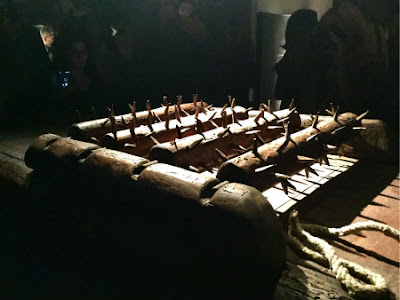
On the top floor, you will find some instruments of torture, which are also displayed throughout the entire exhibition. Some are originals from private collections, and others are replicas. There is information about the infamous Inquisition prison of Narni, discovered by accident in 1979. Documents and diagrams about the construction of the prisons at Palazzo Ducale are on display. A replica of Giacomo Casanova's cell is up there, too, along with documents about the accusations against him from the Archives, and a lot more.

Water torture - modern-day replica for "Venice Secrets" exhibition - Photo: Cat Bauer
TORTURE - Third Floor

Apparently water torture has been around for centuries. Branding irons, instruments for slicing off hands, and the stocks were also used to punish certain types of crimes. There is a heavy bell collar that had to be worn while walking through the city streets, so that everyone would know the perpetrator had done wrong.

In Venice, at least in theory, suspects were only subjected to torture when ample evidence had been gathered against them and only when a confession was lacking. The Torture of the Rope was a Venetian favorite, which dislocated the shoulders.

VENICE INSIDER - Plastinated human body in "Venice Secrets" - Photo: Cat Bauer
Plastinated human body in "Venice Secrets" - Photo: Cat Bauer
THE DEATH PENALTY - Second Floor

The second floor details some of the many creative ways human beings have invented to put someone to death, including being boiled or burned alive, which was frowned upon in La Serenissima. The preferred method of capital punishment for the ordinary citizen in Venice was hanging. Beheading was considered less dishonorable, and used for the nobility.

But in practice, Venice considered the death penalty barbaric. It was not the go-to method for punishment. The total number of recorded executions carried out by the Venetian Republic from 810 to September 1791, and then by subsequent governments until 1804 -- nearly a thousand years -- came to 691. In contrast, the United States has put over 1,500 people to death since 1976 when the Supreme Court affirmed the legality of capital punishment -- just over 40 years.

It is also on this floor that you will find the "real human bodies." Actually, there is only one body, with the top of its head sliced off, and its interiors, organs, muscles and veins exposed. There is also a human leg that looks like a very large turkey drumstick except for the very human foot. There is half a head, and an arm complete with shoulder, all plastinated.

It is not as gruesome as it sounds. Venice placed great importance on the study of human anatomy, and required practitioners to attend at least one year inside the anatomy theatre of corpses in order to learn the causes of the most widespread diseases. In fact, in 1588, the nobleman Antonio Milledone, left his body to science, after suffering from severe respiratory illnesses.

Head crusher, 16th-18th century - Photo: Cat Bauer
THE INQUISITION - First Floor

It turns out that contrary to what had been believed to date, Venice fully backed the Inquisition, but controlled it in those limited cases in which its political, economical, and social interests were affected. The Roman Inquisition was created by the pope in 1542 as part of its Counter-Reformation against the spread of Protestantism, and included prosecution of those suspected of heresy, witchcraft, sorcery, and immorality, as well as the censorship of printed literature. The Inquisition even got Galileo, who had the audacity to claim that the earth revolved around the sun, and remained under house arrest until his death.

Chastity belt - 19th century
That is a very brief summary. There is much, much more to "Venice Secrets" at Palazzo Zarugi. In addition to the records of daring individuals like Casanova, Da Ponte, Paolo Sarpi, Veronica Franco, and Giordano Bruno, there are many riveting stories of ordinary citizens who tangled with Venetian justice and the Inquisition. It takes a minimum of an hour and a half to get through the entire exhibition, especially if you take the time to read the descriptions of the installations in addition to listening to the audio guide.

 “Venice Secrets" was curated by Davide Busato, a Venetian historian and writer who, in additional to his own publications, has co-authored a couple of books with another Venetian writer, Alberto Toso Fei. If the aim of the exhibition is to be "a cultural stimulus and a starting point towards further research among the endless itineraries of study offered by the State Archive of Venice," as stated by Giovanna Giubbini, Director of the State Archive of Venice, then "Venice Secrets" has achieved its goal.

"Venice Secrets" opened on March 31, and runs through May 1, 2018, from 10am to 10pm. The price of admission is €16 for adults, but there are plenty of discounts and reductions. Go to "Venice Secrets" for more information.

UPDATE - I have been informed that Venice Secrets is now part of two other provocation-sounding exhibitions at Palazzo Zaguri, which I have not yet seen:

Real Bodies - "The most complete exhibition in the world with over 50 whole bodies and 450 human organs. A special edition with anatomical findings inspired by Venice"

Human Art Exhibition. Leonardo da Vinci - "For the first time in the world an exhibition with real anatomical findings inspired by Leonardo da Vinci’s drawings and anatomical studies. An extraordinary and unprecedented journey to discover the human body through the eyes of universal genius."

Go to Palazzo Zaguri for more information.

Ciao from Venezia,
Cat Bauer
Venetian Cat - The Venice Blog

Sunday, March 18, 2018

Fulvio Roiter, the Late, Great Venetian Photographer at Tre Oci in Venice

Fulvio Roiter, Venezia, Squero di San Trovaso, 1970 © Fondazione Fulvio Roiter
(Venice, Italy) Today, Venice is one of the most photographed cities on the planet. Every year about 30 million tourists clutching smart phones descend upon the fragile environment and tweet images of her astonishing beauty to their followers and friends around the globe. 

More serious hobbyists armed with Leicas or Canons shoot the Venetian sunset, her bridges and monuments, or the color-coordinated laundry flapping in the breeze.

But long before the phenomenon of instant pictures shot by foreigners, Fulvio Roiter, one of Venice's own photographers, introduced the world to her beauty through his soulful lens.

La Casa dei Tre Oci on the island of Giudecca presents the first retrospective show of Fulvio Roiter, who died in Venice on April 18, 2016. Presented by the Fondazione di Venezia in partnership with the City of Venice, Fulvio Roiter Photographs 1948-2007 is a tribute to the photographer who, more than any other, has linked the image of Venice to his name. Curated by artistic director Denis Curti, the exhibit is also an act of love by the photographer, Lou Embo, who was Roiter's wife.

Fulvio Roiter, Miniera di zolfo in Sicilia, 1953 © Fondazione Fulvio Roiter
Fulvio Roiter was born on November 1, 1926 in Meolo, a small town in the municipality of Venice on the mainland.  He became interested in photography while studying to become a chemist. In 1948, he met Paolo Monti, one of the founders of the photography group, "La Gondola," a circle of photographers that still maintains a strong presence here in Venice.  

Roiter's attraction to photography coincided with the Italian Neo-realism cultural movement, the period after World War II in which film and photography focused on the larger social concerns of humanity.

"And so 1953 arrived. My father was becoming increasingly less tolerant and he gave me an ultimatum: either I went back to chemistry or else my enthusiasm for photography had to be turned into a money-earner. I was at a crossroads. I asked for one last chance. This: give me the minimum means and let me go to Sicily."

Fulvio Roiter, Venezia, Gondola seen from the Rialto Bridge, 1953 © Fondazione Fulvio Roiter
The exhibition includes 200 photos on three floors of Tre Oci, most of them vintage, that wind through the scope of Roiter's life, from his first attempts at photography during the neo-realism period, to his fascination with the beauty of the female nude, through his innovative pictures of Venice and her lagoon, as well as his journeys abroad to places like New Orleans, Iran, the Amazon, Mexico and Andalusia.

Fulvio Roiter, Venezia, Fondamenta delle Zattere, 1965 © Fondazione Fulvio Roiter
Roiter spent the first 25 years of his career shooting in only black and white, "with an uncompromising formal and compositional rigor and a technique rooted in contrast." He later used the same discerning technique when working with color.
 
"I have always considered black and white as the only yardstick for judging a photo. Colour can be arrived at by chance or by calculation; black and white, no." 

Fulvio Roiter


Fulvio Roiter, Venezia, Ponte dei Tre Archi, 1979 © Fondazione Fulvio Roiter

From the exhibition:

VENICE IN BLACK AND WHITE:
A SELF-PORTRAIT

"The heart and soul of Fulvio Roiter's work was Venice, the city that first invited his eyes to look through a viewfinder in order to bring to light what nobody had seen before. A magical city overflowing with history, the set for a film that had never been released but that soon everyone would want to see by walking along the alleys by the lagoon.

His photos had the power of a megaphone and managed to connect the city to the world. Venice was the research field where Roiter discovered his artistic identity precisely at the time when the city was being reborn through unusual and attractive images, through photographs that allowed the whole world to get to know its poetry and enchantment." 


There is also a beautiful 272-page hardcover book about the exhibition published by Marsilio in both Italian and English, with essays by Denis Curti and Italo Zannier, which states that it is "The most complete monograph ever published and the first after the death of the great Venetian photographer.

The photographs are organized into thematic sections: “Venice in Black and White,” “The Tree,” “Venice in Color,” “Italy in Black and White,” “Around the World” and “A Man Without Desires.” The book is available now if you visit the exhibition at Tre Oci, or you can pre-order it at Libro Co. Italia, at Rizzoli, or on Amazon, when it will be available on September 4, 2018. 

Fulvio Roiter. Fotografie 1948 - 2007 runs from March 16, 2018 through August 26, 2018. Go to La Casa dei Tre Oci for more information.

Ciao from Venezia,
Cat Bauer
Venetian Cat - The Venice Blog