Friday, January 29, 2021

Rising from the Ashes - Teatro La Fenice in Venice

Teatro La Fenice New Year's Day 2021 - Photo: Ufficio Stampa

(Venice, Italy) On January 29, 1996, the world watched in horror and disbelief as Venice's beloved opera house, Teatro La Fenice, burned to the ground. But true to its name, La Fenice -- The Phoenix -- rose from its ashes, reopening in all its golden splendor on December 14, 2003.

Then during the pandemic, rising to the occasion, La Fenice delighted the planet once again with its innovative livestreams, enriching our spirits and uniting the global community as we applauded with silent emojis while confined inside our homes.
 
Venice has long had a strong theatrical presence on the world stage. The first public opera ever performed was in Venice in 1636, allowing spectators to witness the startling new phenomenon previously known only in royal courts. When ticket holders experienced the sheer power of the sung narrative — the intense heights and depths of human emotion that only music could convey — it created a social revolution. Claudio Monteverdi, the father of opera himself, adopted Venice as his home.
 
By 1773, Venice had seven theaters which produced plays and music. The grandest was San Benedetto, which was located where the Rossini Multiplex is today, and whose current facade was designed by the celebrated Venetian architect, Carlo Scarpa. Inaugurated on December 26, 1755, it was built by the Grimani family on land owned by the Veniers, and later assigned to a consortium of aristocrats, the Nobile Società dei Palchettisti -- Noble Association of Boxholders.

Teatro San Benedetto was destroyed by fire in 1773, and shortly rebuilt on the same site. The consortium and the Veniers haggled over who owned the new theater, and in 1787 a judicial ruling forced the Boxholders out. 
 
Undeterred, the Boxholders decided to immediately build a more sumptuous theater in a finer location, and call it ‘La Fenice’ after the legendary royal bird reborn from its own ashes. They bought land in a posh part of town, knocked down some private houses and held a competition for the design of the opera house, which was won by the architect Giannantonio Selva. Work began in 1791 and was completed just 18 months later, featuring a neo-classical facade and 174 boxes perfectly alike, gilded in gold. 

Teatro La Fenice was inaugurated on May 16, 1792 with I Giuochi di Agrigento by Giovanni Paisiello, and promptly became one of the leading opera houses in Europe. Then, just five years later, Napoleon came on the scene, and the entire Republic of Venice was no more.
 
Royal Box at La Fenice - Photo: Pietro Tessarin
But La Fenice was still standing, and Napoleon himself decided to pay it a visit. Since all Venetian nobility -- and their boxes -- were considered equal, Selvi had not designed an imperial loggia, which the emperor now required. Six central boxes were destroyed and a provisional loggia hastily constructed, with the definitive model unveiled the day after Christmas, December 26, 1808. 
 
Over the years, as Venice flipped between Napoleonic France and the Austrian Empire, then fought for its independence, then became part of the Kingdom of Italy, which itself morphed into a republic, the imperial loggia changed its form to accommodate the politics. Today it is called the “royal box” with the symbol of the Italian royal family on the side walls, and Venice’s lion of St. Mark front and center on the crown of the cornice. 

On December 13, 1836, while Venice was under the rule of the Austrian Empire, fire struck again. The theater was engulfed in flames caused by an Austrian heater, destroying everything but the facade, foyer and the Sale Appollinee. Again the Boxholders leapt into action, appointing the architect Giambattista Meduna and his engineer brother, Tomamaso, to resurrect The Phoenix. In less than a year, La Fenice was reborn.
 
During the next two centuries, composers such as Rossini, Stravinsky and Benjamin Britten dazzled spectators with world premieres. Verdi composed four of his operas for La Fenice, including La Traviata, which had its world premiere in Venice on March 6, 1853 and has since become a staple of every season. Divas like Joan Sutherland and Maria Callas -- who has an exhibition on the third floor -- thrilled audiences with their vocal gymnastics.
 
La Fenice fire, Jan. 29, 1996 - Photo: Ufficio Stampa

Then, on January 29, 1996, a stunned world watched as La Fenice burned again to the ground, this time a victim of arson. By then, the Boxholders had ceded their shares to the Comune di Venezia, making the opera house publicly-owned. The mayor declared it would be rebuilt “where it was, how it was.”

This time, it took nearly eight years for The Phoenix to rise from its ashes, reconstructed on a posthumous design by the celebrated architect, Aldo Rossi. La Fenice finally reopened on December 14, 2003 with music by Beethoven, Stravinsky, Caldara, and Wagner, conducted by Riccardo Mutti.
 
However, it would be nearly a year later until the theater was ready to stage an entire opera. La Fenice's inaugural opera after the 1996 fire was, fittingly, Verdi's La Traviata, which was performed on November 12, 2004 and directed by Robert Carsen with Lorin Maazel conducting the orchestra. 
 
Audience during intermission at Teatro La Fenice - Photo: Cat Bauer
Today, the theater looks much like it did in the 19th century, diligently restored, right down to the putti. Like the mythical bird it is named after, La Fenice has burned and risen from its ashes on more than one occasion, flying high above Earthly strife to delight humankind with music from the heavens. 
 
Go to Teatro La Fenice for more information. 
 
This article was originally published in a slightly different form in the Fall/Winter 2017-2018 print edition of Luxos Magazine. 
 
 
Ciao from Venezia,
Cat Bauer

Friday, January 15, 2021

Musica Venezia Presents Rossini’s “Moses in Egypt” for Holocaust Remembrance Day (Giorno della Memoria) 2021 at Ateneo Veneto in Venice

Moses and Aaron come before Pharaoh, from the Golden Haggadah, c. 1320, Northern Spain, probably Barcelona (British Library, MS. 27210, fol. 1o verso)

(Venice, Italy) Musica Venezia has been entertaining and educating Venice for decades with its distinct, top-quality events in some of the city's most impressive venues. Roberta Reeder, the Artistic Director of Associazione Culturale Musica Venezia and long-term resident of Venice, brings her rich background as a scholar and producer of culture events to focus attention on rarely performed works of great composers. From sacred music selections on Assumption Day in front of Titian's Assunta at the Frari, to outdoor sound and light projections on the facade of Palazzo Zenobio to celebrate Russian composer Alexander Scriabin, the events produced by Musica Venezia are exceptional, with spoken narration in both English and Italian. 

Venezia Musica always commemorates the Giorno della Memoria, the International Holocaust Remembrance Day, with a special event. This year the performance will be arias from Gioachino Rossini's Moses in Egypt at the Ateneo Veneto, a distinguished cultural institution in Venice that just celebrated its 209th birthday. Due to the ongoing pandemic, this year there will not be a public performance -- the concert will be available on Ateneo Veneto's YouTube channel starting on Sunday, January 24 at 5PM. It is available on demand, so you can watch it whenever you like from that time on.
 
Roberta Reeder, Artistic Director of Associazione Culturale Musica Venezia
 
Here is a description of the event written by Roberta Reeder, the Artistic Director:

Associazione Culturale Musica Venezia

presents


GIORNO DELLA MEMORIA DI VENEZIA 2021

DAY OF REMEMBRANCE

MOSES IN EGYPT: A SACRED TRAGIC ACTION

Arias from the opera by Gioachino Rossini 

Piano version – streaming

ATENEO VENETO – 24 January, 2021 at 5 p.m.

Contact:  Ateneo Veneto.  041 522 4459


Every year Musica Venezia presents a special event to commemorate the Holocaust.
 

This year they will perform “Moses in Egypt,” an opera by Rossini dedicated to a concrete event with a universal theme relevant at this time in history –  the liberation of the Jews from slavery in Egypt —  symbolizing the deliverance of oppressed peoples all over the world.  This performance is part of the events of the City of Venice to commemorate the Day of Remembrance of the Holocaust (Giorno della Memoria).


This performance is composed of beautiful arias from the original Italian version of the work with piano accompaniment.  It was written as a “sacred tragic action” (azione tragico-sacra) for Lent, the solemn period before Easter when it was not allowed to perform operas in Italy.  Later, when living in France, Rossini wrote Moise, Opera en quatre actes, a much longer grand opera version of this work in French.  The Italian libretto is by Andrea Leone Tottola and is based on an 18th century play by Francesco Ringhieri.  It premiered in March 1818 at the Teatro San Carlo in Naples, but it is usually performed in the 1820 third version.  It has recently been performed in Pesaro 2011 and Naples in 2018.  Balzac said this work reflects the genius of Italy and Stendahl praised it highly.


The opera is about Exodus, when Moses was chosen by God to lead the Jews, his people, out of slavery in Egypt. The work ends as they cross the Red Sea on the way to the Promised Land.  However, the librettist transformed the Biblical story to include a romantic theme — Osiride, the Pharaoh’s son, is in love with Elcìa, a young Jewish girl, which is why he convinces his father to rescind his promise of liberation of the Jews and keep them in Egypt. 


In the end, Osiride dies by the last plague, death of the first-born Egyptian sons.  The Pharaoh then again makes a false promise to free the Jews, but this time they escape when the Red Sea parts to let them through. As the waves close in behind them, the Pharaoh and his army drown in their chase after the Jews. At the end the Jewish chorus sing one of Italian opera’s most famous choral works, “The Prayer” (Dal tuo stellato soglio), praising God for their delivery. 


The opera will be performed by Nabila Dandara (Elcìa), soprano, Sara Cortolezzis (Almatea) soprano, Alessio Zenetti, (Osiride) tenor, and Stepan Polishchuk, (Pharaoh and Moses, bass), Alexandra Bochkareva, pianist.  Roberta Reeder (English) and Federica Zagatti (Italian) will be the narrators for a recitation based on the Biblical text.  


Due to the conditions of the Codiv virus in Italy, which precludes a live performance, the work will be available on the Ateneo Veneto YouTube channel starting on Sunday 24 January, 2021 at 5 p.m. 


Ciao from Venezia

Cat Bauer

Venetian Cat - The Venice Blog

Saturday, January 2, 2021

Happy New Year 2021 - The Ancient Majesty of Venice - The 14th Quaderno & Four Columns of the San Pietro Portal

The Four Black & White Aquitaine Marble Columns of the Portal of San Pietro - Photo: Cat Bauer

(Venice, Italy) As you step inside the main entrance, or narthex, of the majestic Basilica of San Marco in Piazza San Marco, you are confronted by a sacred and powerful presence. To the left of the main portal is the portal of San Pietro; the portal of San Clemente is on the right. There are eight free standing columns with shafts of black and white Aquitaine marble that adorn the sides of the portals, two by two. The columns were probably brought to San Marco way back in the first decades of the thirteenth century. 
 
The Proconnesian marble capitals atop the columns date back to the 9th or 10th century, and are embellished with animal and vegetable motifs. Four pairs of eagles, tails crossed, are perched on globes. Snarling from the corners of the capitals are lion heads with wide-open jaws. The remarkable quality and symbolic meaning -- power and domination -- lead to the conclusion that the eight artifacts once belonged to a building in the imperial palace of Constantinople, and were transported to Venice after 1204 when Doge Enrico Dandolo and the Fourth Crusade sacked the capital of the Eastern Roman Empire and divided up the empire. The Venetian Doges adopted the lofty title of Lord of a Quarter and a Half-quarter of All of Romania. When you enter the Basilica of San Marco, you come face to face with remnants of Byzantium.
 
Capitals of the Columns of the Portal of San Pietro - Photo: Cat Bauer
 
The lowest point in Venice is at the entrance to Saint Mark's Basilica. When the November 12, 2019 flood pummeled Piazza San Marco, the entire floor of the Basilica was submerged under more than 70cm of corrosive salt water. The construction site where work was being carried out on the four columns of the Portal of San Pietro was immersed by the sea. Then, no sooner had Venice wobbled to her feet after a series of exceptionally high tides, Italy was the first Western country hit by the global pandemic, and the entire country shut down.
 
Nonetheless, the Procuratoria di San Marco, which takes care of the Basilica, has managed to issue its fourteenth Quaderno, published in Italian by Marsilio, which contains essays by prominent scholars detailing the efforts and research conducted to safeguard and restore the ancient marble columns. It was presented at a conference on December 18, 2020 by Francesco Moraglia, the Patriarch of Venice, and Carlo Alberto Tesserin, the Primo Procuratore of San Marco, who have written introductions. Both men are passionate about safeguarding the Basilica, and Venice itself. For those readers who are fascinated by the restoration work, and read Italian, you can get a copy from Marsilio.

Quaderni della Procuratoria

Thankfully, MOSE, the barrier that holds back the Adriatic Sea during times of extreme acqua alta finally seems to be functioning, but there is much more work that needs to be done to protect the Basilica and Piazza San Marco from high tides. Since the area is so low, this most precious section of Venice still floods when the tide does not reach the level necessary to activate MOSE. Immediate solutions must be found.

On December 1, 2020, Italy assumed the G20 Presidency with international meetings and conferences scheduled in various cities throughout the year. Venice will host a meeting of the G20 finance ministers and central banks from July 7 to July 11, which will feature MOSE and "demonstrate its strategic role in the international context."
 
This year Venice has a special birthday -- she will be 1,600-years-old on March 25, 2021, the Feast of the Annunciation. Venice has lived through plagues and floods many times before. Century after century, Venice still stands because of the courage and resilience of those who love her, keeping the most beautiful city in the world alive despite all odds.  

As we begin another New Year, I wish good health, joy, prosperity, courage and resilience to all.

Happy New Year from Venezia,
Cat Bauer

Wednesday, December 16, 2020

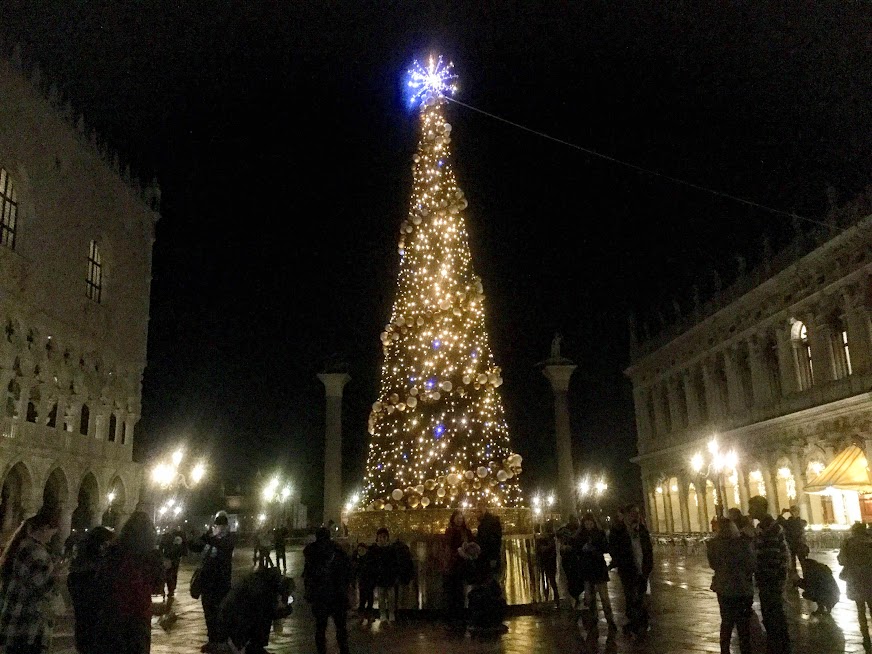
Controversial Christmas Tree in Venice, 2020 - Digital vs. Real - Why not both?

Venice Gold Plessi Digital Christmas Tree 2020 photo by Cat Bauer
Digital Christmas (2020) by Fabrizio Plessi - Photo: Cat Bauer

Updated after the death of Fabrizio Plessi on August 23, 2026, at the age of 86.

(Venice, Italy) There is a debate in Venice about whether or not you like the glowing gold Digital Christmas installation by the international artist Fabrizio Plessi that is currently shimmering in Piazzetta San Marco, made up of more than 80 panels of flowing light. Each river of gold flows in a different direction, symbolically uniting earth, water and sky. 
 
The 80-year-old Plessi was inspired by his deep love of Venice and the gold mosaics that enrich St. Mark's Basilica, which complement his Golden Age waterfalls currently cascading in the windows of the Correr Museum in the heart of Piazza San Marco. (For those not familiar with the geography, the Correr Museum and St. Mark's Basilica bookend Piazza San Marco, so the golden colors perform a celestial dance that arches across the square.)

An entire Golden Age installation was also supposed to open last May at Ca' Pesaro, Venice's International Gallery of Modern Art, to celebrate Fabrizio Plessi's 80th year, but the global pandemic put a halt to that.
 
Digital Christmas was intended to be a beacon of hope, light and unity but was met with controversy -- some members of the public understandably would have preferred a giant Rockefeller Center-style traditional tree, an old-fashioned Christmas after a year of being stuck at home, bleary from being confined to computer screens.

Fabrizio Plessi - The Golden Age at Correr Museum in September 
Photo: Cat Bauer

 
Long before every person on the planet was running around with a smartphone, Plessi worked with electronic media. As far back as 1968, his artistic focus was on water, which he expressed in film, video installations, and performances.

The very first time electronic media was shown at a film festival was Plessi's Underwater, presented at the Venice Film Festival in 1981. Throughout his long career, he has exhibited works throughout the world with titles such as Waterfire, Digital Fall, Digital Islands, Water Fall II, Water Windows, Liquid Labyrinth, Liquid Life, Liquid Light, Splash.

Creating liquid electronic images is what Plessi does, so it should be no surprise that he would create Digital Christmas. Like many artists, the 80-year-old Plessi is ahead of his time.

Venice Christmas Tree 2017 - Photo: Cat Bauer
 
Reality is that Venice has not had a real Christmas tree since 2016. I remember in 2017 when the first all-electric light tree arrived in the Piazzetta and immediately blew out all the lights in Piazza San Marco. Many people thought that it was instant karma for inflicting an unnatural tree upon the town.
 
Venice Christmas Tree 2018 - Photo: Cat Bauer
 
In 2018 it was worse: a bunch of blue and white electric light spheres in the shape of a tree that had zero Christmas spirit. The soulless blue tree was not embraced by the public.
 
Venice Christmas Tree 2019 - Photo: Cat Bauer
 
In 2019 it was another electric tree, but this time it was forgivable because Venice had just recovered from the November 12th flood, followed by day upon day of acqua alta. Yet Piazza San Marco had miraculously managed to pull itself together by November 29th with live Christmas carols by Vocal Skyline, a gospel choir that filled the square with hope, humanity and good cheer. Just getting a Christmas tree up last year under extreme circumstances was a sign that Venice could hitch up her skirts and clamber back to her feet.

Venice Gold Plessi Digital Christmas Tree 2020 photo by Cat Bauer
Digital Christmas by Fabrizio Plessi - Photo: Cat Bauer
 
Last week I took an informal survey of the few people who were gathered at the digital tree, taking photos. Everyone was a local because there is basically no one else in Venice right now, and the result was about 20% for and 80% against.

One woman told me that Venice is a grande dame, and deserves a grand tree befitting her dignity. A couple from Murano said they liked the installation, but not in Piazza San Marco, and not as the official Christmas tree. The husband said, "We have a great Christmas tree on Murano," and showed me the colorful glass Christmas tree created by the master glass maker Simone Cenedese. Three teenage girls were taking selfies and said they did not like it at all and wanted a real tree, basta.  
 
Then I spoke to two little children and asked them if they liked the tree. The boy, who was five years old, shouted, "Molllllttttooo!!!" which means "very much," but sounded like, "I love it!!!!" and the girl, who was four, sweetly concurred. They seemed fascinated by the cascading gold, each panel traveling in a different direction.

An older couple overheard the conversation and said it was because the children were used to digital things, and we are not, which made me wonder if the lockdown has altered their perspective, and now the digital world seems more real to children than the natural world...
 
Real Venice Christmas tree 2016, Piazzetta dei Leoncini - Photo: Cat Bauer

Personally, I think Digital Christmas is inspiring, and I thought it was beautiful and compelling to watch. To me, the solution would have been to call it an art installation, not a Christmas tree. Then, in addition, a real Christmas tree could have been brought into Piazzetta dei Leoncini, like the ones we used to have, and everyone in Venice could have been invited -- the artisans, the hotels, the shops, the citizens, the children, the churches, the museums, whoever felt like it -- to create a decoration and drop it off at a designated place so that someone official could hang the ornaments on the tree each day, all the way up to Christmas Eve. 
 
It would have been a lovely group project while everyone is stuck at home, and the children could experience the thrill of seeing their creations on display. Then everyone could gather in Piazza San Marco each evening to see which new ornaments had arrived on the real Christmas tree, with Plessi's Digital Christmas in the Piazzetta and his The Golden Age cascading in the windows of the Correr, the natural world and the digital world uniting to illuminate the entire square.

Maybe next year in 2021, for Venice’s 1600th birthday...

Ciao from Venezia,
Cat Bauer

Tuesday, December 8, 2020

Remembering John Lennon on the 40th Anniversary of his Death

The Imagine Circle in Strawberry Fields, Central Park, New York City

(Venice, Italy) On December 8, 1980, I was living in the West Village in New York, studying theater with Stella Adler, and working part-time as a waitress at a pub called Traders Inn on Hudson Street between West 11th and Bank. I lived right around the corner, and had gotten home about 11:00 PM. My phone rang a little while later. It was my sister calling from New Jersey.

"John Lennon has been shot."

I was stunned. I said, "But he's going to be OK..."

"No," she said. "I don't think so. I think he's dead."

The way the world found out so quickly about John Lennon's murder was by synchronicity -- even at the moment of his death, it seems that John Lennon was destined to be a topic of the entire planet's conversation. On the night of December 8, 1980, a news producer and journalist for ABC Eye Witness News named Alan Weiss had been hit by a taxi while riding his motorcycle, and had been taken to Roosevelt Hospital. Weiss just happened to be on a gurney in the emergency room when a man with bullet wounds was rushed into the room next to his. He thought he heard the name "John Lennon."

Weiss then saw a weeping woman who he thought was Yoko Ono. He got off his gurney and tried to make his way to the pay phone he had seen at the entrance, but was blocked by security. The same police officer who had brought Weiss to the hospital spotted him and told security to let Weiss go.

As the officer was helping Weiss back to his gurney, they passed the nurses' station. Weiss asked the officer if he could call his newsroom. The cop leaned over and picked up the phone that was on the nurses' desk and handed it to Weiss.

The assignment editor at the newsroom confirmed that an ambulance had been dispatched to The Dakota, John Lennon's home, shortly before. That was when Weiss knew for sure that it was John Lennon who had been shot -- sheer coincidence that even at the moment of John Lennon’s death there was a reporter there to record the moment for history.
 
It is difficult to describe the shock that shattered the planet that night. I remember the weather was unusually mild for the month of December. Numb, moving through a world that had suddenly turned surreal, I went back down to the Traders Inn pub and sat at the bar and watched the news. A swarm of New Yorkers rushed to John Lennon's home at The Dakota on 72nd Street and Central Park West, compelled by a common grief. I didn't go uptown that night; I went the next day. It was comforting to be in the company of fellow human beings at the moment the world flipped on its head.
 
Like many people of my generation, I was a huge John Lennon fan. In 1980, living in New York City was like living in paradise. Ed Koch was the mayor, and you could see him all around town, chatting with his constituents. The West Village was brimming with creative people -- everybody was an artist, or an actor, or a writer, or a dancer, or a musician, or a fashion designer.

It seemed like one great festival with comedians in Washington Square Park and Sunday brunch with the New York Times and free copies of the Village Voice. Newly-arrived immigrants would feed us exotic food at funky eateries -- back then, everyone could manage to find a way to live in the city if they were determined enough, with rent-controlled apartments protecting the old-timers.

And John Lennon himself was living on the Upper West Side, strolling around Central Park, finally making music again, posing for the camera wearing a New York City t-shirt. Back then, New York City was the place to be, churning with creative energy.
 
Then four shots rang out and the world would never be the same again. 
 
I've written about December 8th many times before, which is the birthday of my protagonist, Harley Columba, a young artist who was born at Roosevelt Hospital on the anniversary of John Lennon's death, and whose goal is to reach the Imagine Circle in Central Park. John Lennon was my hero, and I was deeply affected by his death, as were so many millions of others. It is also the Feast of the Immaculate Conception, a national holiday here in Italy. Here's a post from last year, with links to previous posts:
 
Ciao from Venezia,
Cat Bauer

Sunday, November 22, 2020

Visiting a Plague Church during a Pandemic - The Feast of the Madonna della Salute, Venice 2020 - Featuring Baldassare Longhena's High Altar

Madonna della Salute 2020 - Photo: Cat Bauer

(Venice, Italy) No blazing candles. No pontoon bridge. No balloons for the children, or sweets from the South of Italy. We can only imagine the discussions that went on as to how to celebrate the Feast of the Madonna della Salute this November 21st -- the day when Venice gives thanks for deliverance from the plague -- in a year restricted by a global pandemic. 
 
Normally, thousands of Venetians pour across a pontoon bridge that stretches across the Grand Canal from the Gritti Palace over to the Dorosoduro side. This year, pedestrian traffic was steered in a one-way direction through the Dorsoduro Museum Mile until you arrived in the Campo della Salute. Along the way, you could buy votive candles as usual -- but this year the eager masses waiting to have their wicks set ablaze inside the church was restricted. Instead, upon reaching the campo, you got in line and waited to enter through the front door of the church. The line moved quickly enough, and everyone was respectful. It goes without saying that everybody was required to wear masks indoors and out -- that is a rule throughout Italy.

Once inside, you placed your candles in wooden boxes scattered throughout the interior of the church "as a votive gift that will become a work of charity and support for families in economic difficulty." The magnificent rose mosaic was cordoned off, so I got my annual Beam-Me-Up-Scotty power charge not by standing in the center, but from a short distance away.

Church of Madonna della Salute on Nov. 21, 2020 - Photo: Cat Bauer

In 1630, Venice was raging with the plague, which, we now know, was caused by a bacteria, as opposed to COVID-19, which is caused by a virus. On October 22, 1630, the Venetian Senate decreed that in order to give thanks for the liberation of Venice from the plague that had wiped out a third of the population, they would build a church dedicated to the Virgin Mary, under whose protection Venice was founded on the Feast of the Annunciation, March 25, 421. 
 
Once inside, you could sit in the pews to pray, which I did. I contemplated the high altar, which was designed by Baldassare Longhena, as was the Church of Madonna della Salute itself. The impressive marble statues were carved by the Flemish sculptor, Josse de Corte.
 
High altar of the Church of Madonna della Salute - Photo: Cat Bauer
 
What fascinates me about the 17th-century high altar is that the females are the ones enacting the scene, and the males, Saint Mark, Venice's patron saint, and Saint Lorenzo Giustiniani, who was the first Patriarch of Venice, are only onlookers to the drama going on over their heads.

In the center of the altar stands the Virgin, holding the infant Christ, surrounded by cherubs. To her right, Venice, in the form of a beautiful young woman, is on her knees, pleading for help. To the left of the Virgin is a gruesome old woman, who represents the plague. A torch held by a cherub burns into the old woman's side; her arms flail as she teeters towards the edge. The Virgin does not even glance at the old woman. The expression on the Virgin's face is one of quiet confidence that the black death will be vanquished. The entire scene is supported by caryatid angels, which are sculptured female figures used as columns. 
 
Below the Virgin, in the center of the altar, is the star of the show, the Byzantine Black Madonna, whose powerful energy has attracted the faithful for centuries. The Panagia Mesopantitisa -- Madonna the Mediator -- was brought to Venice from Crete by Doge Francesco Morosini after the War of Candia with the Ottoman Turks.
 
Despite the restricted nature of the celebration this year, the spiritual elements were firmly in place. They say that Longhena's design of the church may have been inspired by a woodcutting in the mysterious Renaissance book Hypnerotomachia Poliphili. To me, simply entering the Church of the Madonna della Salute and communing with the Panagia Mesopantitisa is enough to boost one's immune system for another year. 

The only element I really missed was the lighting of the candles, so afterwards I went to the Church of Santo Stefano, where Francesco Morosini is buried, and lit a candle in front of the Madonna there.
 

I've written about the Feast of the Madonna della Salute many times before. My post from 2013 will give you an idea what the celebration is like in normal times:
 
Wishing everyone good health, vitality and compassion.
 
Ciao from Venezia,
Cat Bauer

Thursday, November 12, 2020

One Year After the Venice Flood - Yes, Walter Mutti's Newsstand is Back!

The Zattere during acqua alta - Photo: Cat Bauer
 
(Venice, Italy) One year ago, on the night of November 12, 2019, Venice was barraged by rising tides and whipped by winds of more than 75 miles per hour. Walter Mutti's newsstand struggled to remain upright in its perilous position on the Zattere, the main promenade that runs along the Giudecca Canal. Even though it was constructed from heavy steel, Walter's edicola was no match for the forces of nature. The violent winds knocked the newsstand over. The crashing waves swept it into the tumultuous waters. Walter's edicola, a local landmark for both Venetians and tourists, ended up on the bottom of the Giudecca Canal.
 
Walter's edicola in the flood

Walter had tried to salvage what he could from the newsstand that had been in his family for 25 years, but was forced to surrender to the powers of Mother Nature. In desperation, he had tweeted a photo of his edicola uprooted by the swirling waters with the caption "aiutoooooo" which means "Help!!!!!!"
 
Over on the mainland, Carlo Gardan, whose Twitter handle is @LordOfVenice, felt compelled to take action. He had never actually met Walter Mutti, but they followed each other on Twitter. Carlo immediately set up a "Go Fund Me" account which raised over €20,000 in 48 hours from small donations both locally and all over the globe. As images of a flooded, devastated Venice flashed across social media, Walter's simple newsstand personalized the tragedy and struck a chord in the heart of humanity. In contrast to the 1966 flood when Venice was completely isolated from the rest of the world for 22 hours, this time, thanks to the Internet, the city remained connected. The generous response was humanity at its best.

Walter Mutti & Prime Minister Giuseppe Conte
 
Giuseppe Conte, the Prime Minister of Italy, arrived in Venice on November 14th. Conte tweeted a photo of himself and Walter with the caption: "Walter Mutti has lost his newsstand, submerged by the rush of the waters. This morning I met him in the Prefecture in #Venezia: I listened to his words of pain, like many other Venetian citizens who have come to me. The Government is supportive and present, no one will be alone."
 
Last winter it seemed like the acqua alta would never end. Day after day the wail of the high water siren pierced the air as a weary city braced for another day of mopping out homes and drying out shops. There was a feeling of community as residents lent each other a helping hand, but also fury that MOSE, the flood barrier that was supposed to protect Venice from acqua alta, did not function after being mired in political corruption, with decades of work and billions of euro seemingly sucked into a vast black hole.

Walter's edicola emerges from the Giudecca Canal - Photo: Cat Bauer
 
At the beginning of December, divers from Venice's Fire Department found Walter's newsstand submerged in the Guidecca Canal. Luigi Brugnaro, the Mayor of Venice, declared that the edicola would be the "tangible symbol of a city that does not give up and is reborn." On an overcast December 6th, I joined a small crowd as we watched the newsstand emerge from the dark waters. It did feel like the edicola might represent a glimmer of hope. Slowly, slowly, life began to return to normal -- by the time Christmas season arrived, a great effort had been made to have carols and twinkling lights decorate Piazza San Marco, and importantly, locals had returned to the main square.

Then on February 23, 2020, Venice again was thrust into the international spotlight when Carnival was abruptly cancelled two days early due to a mysterious new virus that was sweeping the planet. The amount of visitors to Venice had already been greatly reduced after the winter floods. In the early morning hours of March 8, Prime Minister Giuseppe Conte announced that the entire nation of Italy would be quarantined -- the first country in the West to go into hibernation. Venice had not yet completely recovered from the flood, and was now hit by the lockdown. For a city whose main industry was tourism, it was another calamitous blow.
 
With everyone confined to their homes, and tourists forbidden to travel, the streets of Venice were eerily void of people while, at the same time, something magical happened -- nature flourished. The waters and canals became so still and clear that frolicking fish and other underwater creatures were visible. It was as if Mother Nature had shut down the entire frenetic enterprise that had been based on overtourism and consumption. Using weapons of the gods -- first with the flood and then with the plague -- Mother Nature claimed back the lagoon.

Newsstands were one of the few businesses that were allowed to remain open during the lockdown, but how would Walter sell his wares without his edicola? Thanks to the Don Orione Institute, a Christian charity, Walter was granted the use of a small space next to the location of his newsstand in order to stay in business. 

In May, Venice slowly emerged from hibernation, blinking her eyes, gauging the scene. First, visitors from the Veneto region arrived in town, followed by other Italian regions, then by most of Europe. Americans could not travel to Venice without a valid reason to come here -- a rule that remains in effect to this day. By summer, life had almost returned to normal.
 
On the sunny afternoon of August 10, 2020, Walter held a small, local gathering to finally celebrate the re-opening of his edicola, which had been completely restored with the donations from the Go Fund Me campaign and money allotted by the government. I was there, and met Carlo Gardan, the man behind the @LordOfVenice social media account who had initiated the fundraiser. Thanks to the combined efforts of ordinary people and powerful institutions, Walter Mutti's newsstand had been lifted out of the water and placed back on its feet.

Venice, Italy - Photo: Cat Bauer
 
On October 3, 2020, Venice experienced its first exceptional high tide of the season. To the astonishment and joy of Venetians, MOSE, the flood barrier, actually held back the tide! It is a temporary solution to a complex problem with much more work to be done, but it provides a breath of air to a city that was drowning.
 
If there is a message that can be delivered by the salvation of Walter's edicola, it might be that the human spirit can accomplish great things when we use our collective power for the forces of good. That the majestic city of Venice continues to exist inside her watery home after 1,600 years is a testament to impossible dreams coming true. At the time I write this, the planet is again being challenged by a surge of COVID-19. Let us hope that Venice and the world do not fall back into the destructive patterns of the past, but find new, creative ways to move forward to the future.

Ciao from Venezia,
Cat Bauer

Sunday, November 1, 2020

Mystical Hallowmass Season in Venice during the Blue Moon

San Michele, Venice's Island of the Dead - Photo: Cat Bauer

(Venice, Italy) A heavy mist engulfed Venice on All Hallows' Eve, adding a mystical element to the Hallowmass season. Enhanced by the light of the full Blue Moon, the air was so thick that it seemed to swirl with the phantoms of the ancestors. Now is the time of their annual journey through the veil that divides the realm of the dead from the world of the living.
 
San Michele, the cemetery island, is where Venice buries her dead. Each year thousands of Venetians make the pilgrimage to tend the tombs of their families, friends and loved ones. The ancient Christian festival to honor the dead includes All Hallows' Eve, or Halloween on October 31; All Hallows' Day, or All Saints' Day on November 1; and All Souls' Day, or the Day of the Dead on November 2. It is a time to reinforce the spiritual bond with those who have gone before.
 
Dante's Barque by Georgy Frangulyan - Photo: Cat Bauer
 
The vaporetto that carries the living to the island of the dead passes by "Dante's Barque," the haunting bronze sculpture that Russian artist Georgy Frangulyan created after he saw a vision of Virgil and Dante standing in a boat on the water of the lagoon. This year, Dante's outstretched arm pointed through the dense calìgo to an otherworldly island blanketed in a white cloud, an island where souls could easily slip from one dimension to another. I wrote about the sculpture last year when a floating bridge connected the Island of San Michele to Fondamenta Nuove, a bridge which has not been constructed in these coronavirus times. Follow the link to read the post: 

Honoring Death in Venice - A Bridge Across the Lagoon

 
Surrounded by cypress trees and birdsong, freshening up the graves of the ancestors with flowers and candles is like having a conversation with the wise minds of the past. Venice can seem supernatural even on sunny days, but when the town is immersed in fog the connection to another level of existence feels more powerful. It almost seemed as if the phantoms of the ancestors had managed to visit the Rialto Bridge...

A foggy Grand Canal from the Rialto Bridge - Photo: Cat Bauer
 
"What thou lovest well remains,
the rest is dross
What thou lov'est well will not be reft from thee
What thou lov'est well is your true heritage."
---Ezra Pound, The Pisan Cantos

Ezra Pound is buried in the Evangelical section of San Michele next to his long-time companion, Olga Rudge.
 
Ciao from Venezia,
Cat Bauer