Monday, May 23, 2022

Angels on Earth - Claudine Drai & Wim Wenders Create Présence in Venice

Claudine Drai - Photo: Cat Bauer

(Venice, Italy) Claudine Drai has been sculpting angelic beings out of tissue paper since she was a child, reaching through the ether to tug heavenly creatures onto the earth. It is as if she can open a portal into the seraphic world and grab hold of some other-worldly material to crinkle into her molds. It is art that must be witnessed to be appreciated -- her paper sculptures radiate something spiritual that a photograph cannot grasp.

The French artist believed the one person who could capture the essence of her art was the German filmmaker, Wim Wenders, so Drai sought him out. Wenders, we remember, directed the magical Wings of Desire.


The synopsis, according to the Wim Wenders Stiftung Foundation:

WINGS OF DESIRE marked Wenders’ “homecoming” and was his first German film after eight years in the USA.

The main characters are guardian angels—benevolent, invisible beings in trench coats—who listen to the thoughts of mortals and attempt to comfort them. One of them, Damiel (Bruno Ganz), wishes to become human after he falls in love with the beautiful trapeze artist Marion (Solveig Dommartin). Peter Falk, played by himself, helps him during his transformation, by introducing him to life’s little pleasures.

The film is narrated from the perspective of the angels, who see the world in black and white. Only when Damiel becomes human does the world of color reveal itself to him. He leaves behind his old friend Cassiel (Otto Sander), who continues to be accompanied by Homer (Curt Bois), the “storyteller of humanity.”

The film has achieved cult status all around the world; in 1998, it was remade under the title CITY OF ANGELS, which features Nicolas Cage and Meg Ryan in the lead roles.

After talking with Claudine Drai and seeing her ephemeral beings, Wenders agreed to work with her -- he did not know her before. Together, they created Présence, a 38 minute film in 3D, which is the core of the current angelic installation.

Claudine Drai works - Photo: Cat Bauer
Claudine Drai and Wim Wenders in Palazzo Polignac 

Now Claudine Drai has brought some of her celestial forms here to Venice, where they were on show at Palazzo Franchetti from April 21 to May 15, which I did not have a chance to see. Fortunately, now they on display inside the Magazzino Gallery at Palazzo Polignac until August 15.

When I first saw them, I felt like I was in the presence of something holy. Both Claudine Drai and Wim Wenders were at the opening on May 20, so we had the opportunity to hear first hand about how the project came to be.

Claudine Drai & Wim Wenders - Photo: Cat Bauer

This was not the first time I've had a chance to encounter Wim Wenders in the flesh, and think there is something honest and refreshing about him, in addition to a dash of heaven in his own work. I reminded him about how he said he'd never be on a jury again when he was the president of the Venice Film Festival jury back in 2008 and the Golden Lion -- the top prize of the festival for the best film -- had been awarded to The Wrestler starring Mickey Rourke. The frustration was that the jury had not been able to award Rourke the prize for Best Actor because of Venice's quirky rule that one film could not win two awards -- since the film had won the Golden Lion, Mickey Rourke could not win Best Actor. Wenders strongly felt that both the film and Rourke deserved to win (the rule has since been changed:-).

Wim Wenders Declares: "I Will Never Be on a Jury Again!" - 65th Venice Film Festival

I also told him how much I had loved his film in 3D "If Buildings Could Talk" about the Rolex Learning Center shown during the 2010 Biennale International Architecture Festival, and how I had wept over its gentle beauty as I watched it over and over again:

If Buildings Could Talk - The Architects are Here! - Venice Biennale 2010

Claudine Drai - Photo: Cat Bauer

Now with Présence, Wenders has again applied his singular brush stroke to a 3D film. The auteur director said that he was deeply touched by Drai's creations as soon as he saw her work.

Here is Wim Wenders, in his own words, from a Sky video, about how the project developed:
"We made this film together over the last two and a half years. It is like nothing I've done before. It's like nothing that exists... It's not a film about an artist by a filmmaker. It's a common creation. And it's not really a movie -- it's a strange thing between an installation and a 3D film.

"It's in three dimensions because these beings that Claudine makes need to be seen in three dimensions with the space... they are very, very... They need the space. ...They live in the space. And you have to be able to participate and immerse in the space of her creations -- her beings, as she calls them. Her êtres.

"My look is something alive. I've seen her work and been touched by her work. And my look is also a translation. The film presents her and her work, and how she works, but it also presents my reception. It presents my look and what I feel when I see these beings and these amazing spiritual creations."


Présence - the art of Claudine Drai - a 3D installation by Wim Wenders is at the Magazzino Gallery in Palazzo Polignac at Dorsoduro 878 until August 15th. If you would like some heaven in your home, her works range from €30,000 to €75,000. She is represented by Antoine Clavé of Clavé Fine Art in Paris.

Ciao from Venezia,
Cat Bauer

Sunday, May 1, 2022

Homo Faber Revamps the Renaissance - Contemporary Craftsmanship in Venice

The enchanted setting of Homo Faber Event in the Venice lagoon
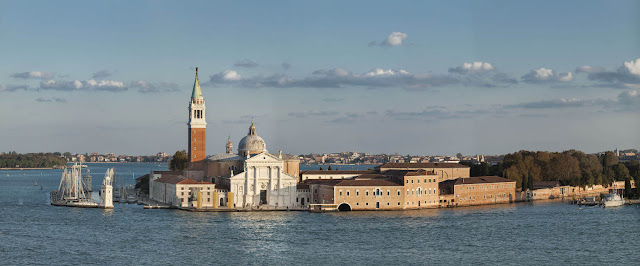
Fondazione Giorgio Cini on the Island of San Giorgio Maggiore
Photo: ©Michelangelo Foundation

“I will embroider the world,” declares Alicia Stanska as she pierces a panel of black silk fabric with her needle, a gold metallic thread swooping through the hook. Together with her partner, Tomasz Tarnowski, an architect, Alicia has invented a new form of haute couture for furniture, ceilings, walls and floors – even a hand-embroidered swimming pool – using the Luneville embroidery technique from 17th-century France. She embroiders golden stitches and timeless crystals onto black silk fabric encased in transparent panels made of a secret material described as “liquid glass,” creating the distinct Stanska brand of hand-embroidered architecture.

Embroidered Architecture 

Alicia’s father taught her to embroider by the age of six. Throughout her life, it was a way of relaxation. At the age of 28, after burning through a dozen different careers in the corporate world, she decided to bank on her talent and live off her embroidery skills. 

Seduced by haute couture, Alicia learned the Luneville embroidery technique, a high fashion essential. Instead of applying it to clothing, she was fascinated by its potential for interior design. After meeting Tomasz, they merged their different skills to create a daughter and a brand. Today the Polish couple live and work together in Warsaw, and I, an American expat based in Venice, am talking to them at the international exhibition entitled "Next of Europe" at the massive Homo Faber Event on the island of San Giorgio Maggiore, an event that was organized by the Michelangelo Foundation, headquartered in Geneva. 
 
Alicia Stanska from Warsaw, Poland embroidering her gold metallic thread at the 
Artisan at Work live demonstration in Next of Europe
Curated by Jean Blanchaert & Stefano Boeri
Photo: Nicolò Zanatta ©Michelangelo Foundation

Island of San Giorgio Maggiore 

Going behind the gates of the Giorgio Cini Foundation has always filled me with a sense of awe. Full of history and mystery, I can almost feel the wise phantoms of the past brush past me in the grand corridors of the former Benedictine monastery, an oasis of knowledge in the Venice lagoon. It is the ideal setting for a universal event that aims to craft a more human future.

Occupied since Roman times, the island was christened San Giorgio Maggiore between the eighth and the ninth centuries when the first church dedicated to St. George was built -- the monastery was founded in AD 982. Throughout the centuries, it has hosted kings, queens, and heads of state – twice the G7 Summit was held here. Cosimo de’ Medici, the powerful banker credited for kickstarting the Renaissance, stayed on San Giorgio when he was exiled from Florence in 1433.

Normally closed to the public, during Homo Faber visitors get a
rare opportunity to wander outdoors on the island - Totem  Garden 
Photo: Ginevra Formentini ©Michelangelo Foundation

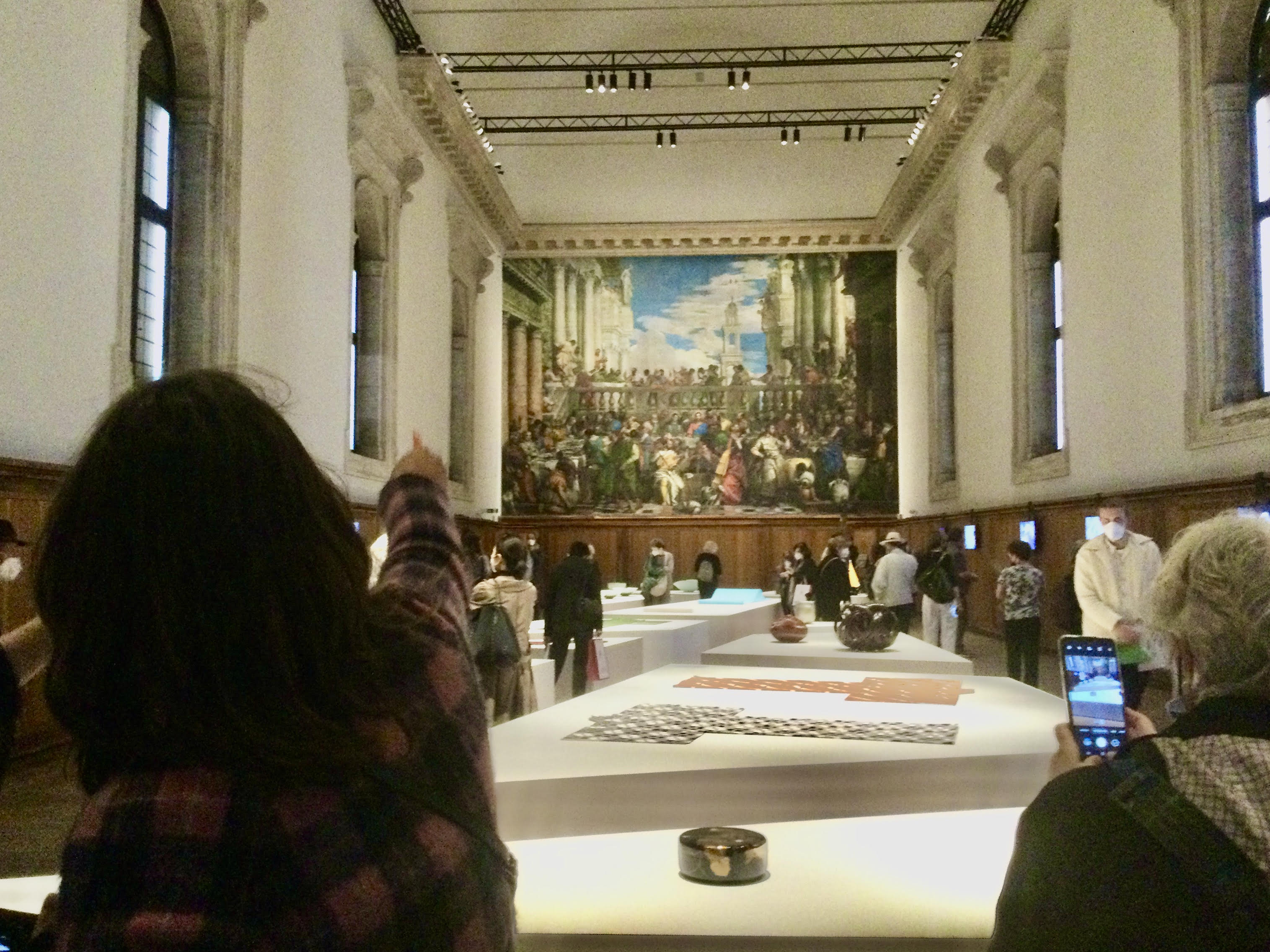
In 1560, Andrea Palladio, Renaissance architect extraordinaire, came on the scene and left his distinct imprint on the island. He got busy and built the new Refectory for which Veronese painted his masterpiece Wedding at Cana (1563), designed the second Cloister, renovated and enlarged the monastery, and replaced the existing Gothic church with the majestic landmark we know today.

After Napoleon suppressed the monastery and swiped most of its loot, the once-glorious compound became a military garrison and sunk into disrepair – that is, until Count Vittorio Cini, another powerful entrepreneur, blew the dust off Palladio’s original plans and transformed it into the Fondazione Giorgio Cini, an international cultural center, to honor his son, Giorgio, who was killed in a plane crash. Like Cosimo de’ Medici before him, Cini used his great wealth to bring humanism back to mankind.

Master works by "Japanese Living Treasures,"
artisans honored and subsidized by the Japanese government, on show in
12 Stone Garden in the Palladio Refectory, the facsimile of Veronese's Wedding at Cana as a backdrop
 (the original was nabbed by Napoleon and is now in the Louvre).
Curated by Naoto Fukasawa & Tokugo Uchida
Photo: Cat Bauer

The Michelangelo Foundation for Creativity and Craftsmanship
 
The Homo Faber Event first arrived in Venice in 2018 on the shoulders of the Michelangelo Foundation for Creativity and Craftsmanship, an international non-profit organization which was founded by two present-day enlightened entrepreneurs – Johann Rupert, CEO of Richemont, the third-largest luxury company in the world with maisons such as Cartier, Van Cleef & Arpels, Jaeger-LeCoultre and Montblanc -- and Franco Cologni, founder of Fondazione Cologni dei Mestieri d'Arte. Both patrons think it’s time for a new Renaissance. “It’s humanity’s creativity, individuality, strong character and perspectives that truly endure over centuries and grow into heritage,” said Rupert.

The fine details of luxury: From Cartier to Hermès to Jaeger-LeCoultre,
15 top maisons reveal the secrets of their crafts with live demonstrations
in Genealogies of Ornament, curated by Judith Clark
Photo: ©Michelangelo Foundation

The founding purpose of the Cologni Foundation is to “accomplish a new Renaissance of artistic crafts and rescue artisans from the threat of extinction.” Its initiatives focus on training the next generation of craftsmakers, which includes providing internships to talented beginners. Selecting San Giorgio Maggiore to host an event dedicated to a more human, inclusive and sustainable future was strategic. Cologni explains: “We chose Venice for this exhibition not only because it is a bastion of culture and a place of unequaled beauty, but also because Venice is today and has always been a European hub for exchange and international connection.”

Blossoming Beauty, a fairy tale garden where 10 floral artists display their arrangements in Murano glass vases
they designed themselves, brought to life by the master glassblowers of Venini
Magical soundtrack by French composer Christian Holl
4 Elements video by filmmaker Olivier Brunet
Curated by Michelangelo Foundation, Sylvain Roca & Venini
Photo: Simone Padovani ©Michelangelo Foundation

Homo Faber Event Celebrates the Cultural Dialogue Between Europe and Japan

The Homo Faber Event cranks up the magic and transforms the island of San Giorgio Maggiore into a wonderland where artisans live in a world pulsing with dedicated people who spin straw into gold with their bare hands. Cushioned by aristocratic cloisters, meandering gardens and cypress trees, this year’s edition sprawls over 4,000 square meters, galvanizing the ancient monastery with contemporary craftsmanship. Master artisans of Japan and Europe, considered “living treasures,” are celebrated in 15 different exhibitions organized by 22 curators and designers featuring 850 works by 400 artisans from 43 countries. You can feel the human energy crackling in the air.

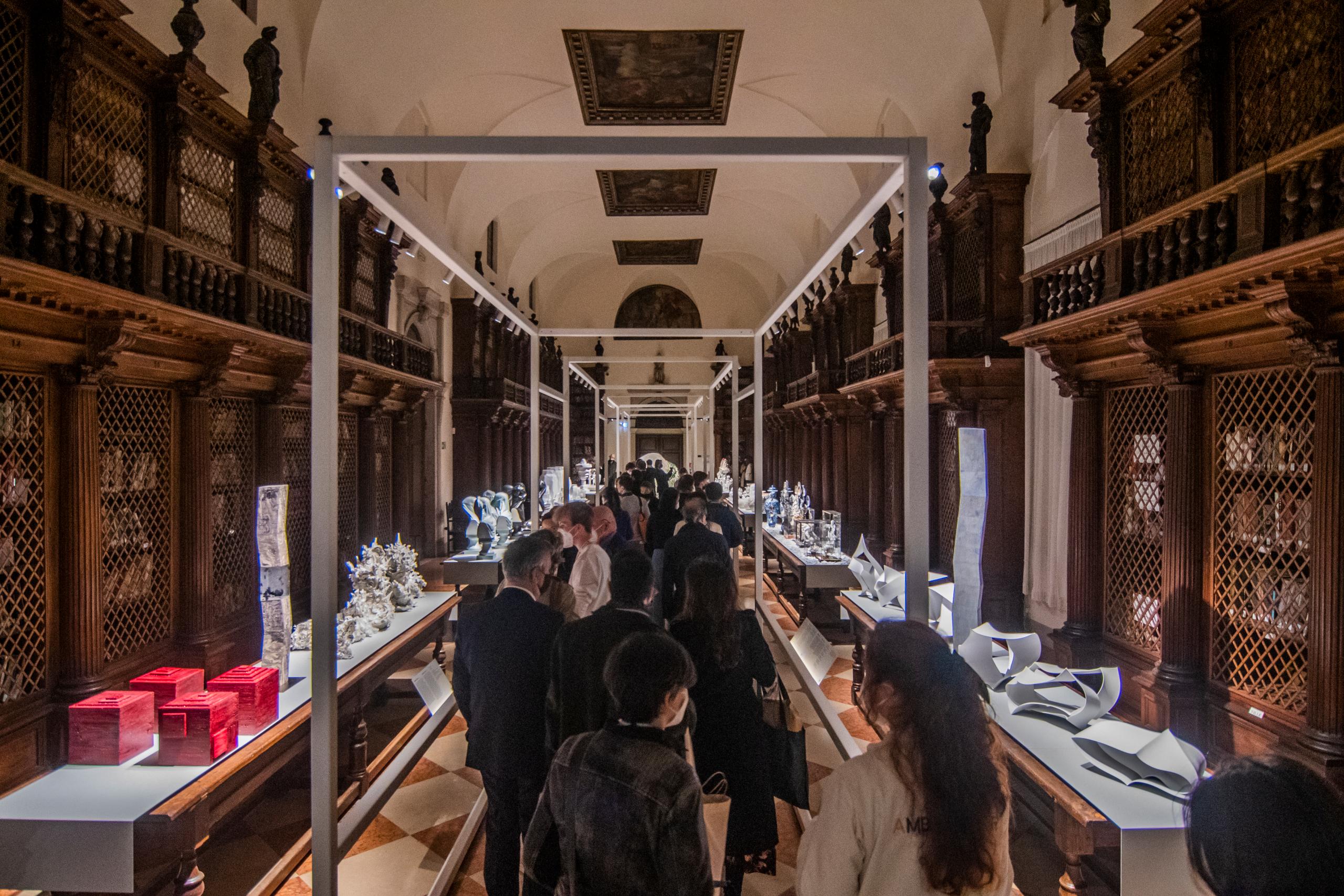
Baldassarre Longhena designed this library for the monastery between 1641 and 1680,
livened up by the white gold of Porcelain Virtuosity
Curated by David Caméo, Frédéric Bodet
Photo: Simone Padovani ©Michelangelo Foundation

The event is also a chance to glimpse venues rarely open to the public. There is porcelain in the 17th century Longhena Library, and Japanese Living Treasures in the Palladio Refectory. International artisans work in the Tapestry Room next door to custom-designed Venini vases spilling with floral arrangements. There are artisans from luxury houses at work in the former nautical school, and everyday objects and handcrafted games in the Artisan tea room. There is even a dramatic installation by American stage director Robert Wilson in the Gandini indoor swimming pool, inspired by his 1993 production of Madame Butterfly at the Paris Opera, complete with original props. From porcelain to paper, flowers to glass, ceramics to leather, gems to wood, it seems that whatever talented human beings can get their hands on they can turn into objects of beauty. 

Wearing two hats as both a Young Ambassador & designer,
Juraj Horňák plays the ancient Game of Ur with visitors in The Artisan:
a crafted tea room where every object tells a story
Curated by Tapiwa Matsinde
Photo: Simone Padovani ©Michelangelo Foundation

Young Ambassadors

We are not expected to navigate this monumental compound on our own.  Young Ambassadors are scattered throughout the grounds and inside every exhibition, eager to share their expertise — I love them. One hundred dynamic young people, screened and selected from the best European schools of arts, crafts, and design, were flown into Venice, fully trained, given food, shelter, a generous scholarship, sneakers from Venetian Heritage company Golden Goose, and some very cool uniforms from Makers Unite, an agency of refugee designers based in the Netherlands. The Young Ambassadors are grateful to be exactly where they are, mingling with the masters, and can answer any question about the crafts on display as if they made it themselves. 

From Young Ambassador to Designer

Juraj Horňák is a rising star. A Slovakian designer and craftsman working on his PhD in architecture, during his studies he started Lebo Mädveď (Beargames) with two classmates, a project that designs educational games.

Juraj was a Young Ambassador in 2018 and challenged himself: “I want to exhibit my work at the next Homo Faber.” He sent a one-minute motivational video along with his application describing his design for the Game of Ur, played in ancient Mesopotamia and believed to predict the player’s destiny. When informed he had been accepted as both a Young Ambassador and an artisan, Juraj scrambled to create two deluxe versions of the game. After playing a cutthroat round with him in The Artisan tea room, I predict his destiny: “You will become powerful like a lion.”

Young Ambassadors on the 17th-century Longhena Monumental staircase
inside the Giorgio Cini Foundation
Homo Faber Event 2022
Photo: Ginevra Formentini ©Michelangelo Foundation

Alberto Cavalli

“What is beautiful — and authentic — will always make you fall in love,“ says chief curator Alberto Cavalli, the powerhouse driving Homo Faber. Also the executive director of the Michelangelo Foundation and director general of the Cologni Foundation, Cavalli is heralded by stakeholders for his ability to keep the massive event running seamlessly, as well as his uncanny ability to materialize at critical junctures. Synchronicity is how we manage to meet for a coffee — I happened to arrive at a time when he had 17 minutes to spare.

Cavalli is a vibrant speaker whose passion for craftsmanship is contagious. “We need to form a common language. Take the word ‘sustainable.’ Is a world without dreams sustainable? Or a world without diversity? Can we sustain a world dominated by banality?”

One of Cavalli’s most important missions is to create a new generation of craftsmakers, which means empowering young people and providing opportunities for them to meet master artisans at the top of their game. “Why do we make things with our hands? Handwork can offer dreams to younger generations. When I was growing up, the future was full of promises. These days, the future can be full of threats. What kind of legacy are we leaving? Craftsmanship gives youth a clear, authentic way of expressing themselves.”

Alberto Cavalli at the Opening Ceremony 9th April Homo Faber Event 2022
speaking in "Lo Squero" auditorium, a one-time boat repair workshop
with a spectacular wall of glass that looks on the Venice lagoon
Photo: Marco Bucco ©Michelangelo Foundation

I ask Cavalli how he measures the success of Homo Faber. “Three ways. First, by ticket sales. We are asking people to visit an event in the Venice lagoon, reachable only by boat. For the inaugural edition in 2018, from September 14th to 30th, we had 62,500 visitors from all over the world. This year, opening weekend was sold out.

“Second, by comments from the participants – the curators, the master artisans, the rising stars – who genuinely appreciate interacting with like-minded people. What is so important for me about craft is the humanity – in the faces, the dreams, the expectations, the talent, the ability – also in the stubbornness of the master craftsman.

“And third, by the attendees themselves. Sometimes I take off my identification and mingle with the visitors, who are everyone from tourists to collectors to designers, and listen to the sparkle in their voices.

“We need to ask ourselves: do we want things that are just things? Or do we want objects that express who we are, what we are. When you surround yourself with goods made by hand, rather than being a passive consumer, you become an active participant. We were born to consciously change the world around us.”

WAITING with Peace and Darkness - American theater director Robert Wilson
transforms the Gandini indoor swimming pool into a stage set
inspired by his 1993 production of Madame Butterfly at the Paris Opera,
complete with original props
Photo: Alessandra Chemollo 
©Michelangelo Foundation


In Città and The Homo Faber Guide

In Città

During the Homo Faber Event, in addition to the main exhibition on San Giorgio Maggiore, visitors could create self-guided tours using In Città, a bounty of handcrafted experiences tucked throughout the labyrinth of Venice. All the artisans and craftsmakers in town threw open their doors and invited the public to witness Venetians in action -- the engine that keeps the city afloat. From shoemakers to costume designers, mask makers to glass blowers, eyeglass designers to local food and wine -- In Città gave visitors the golden opportunity to meet the actual people who live and work in Venice.

Homo Faber Guide

The Michelangelo Foundation has also created the Homo Faber Guide, an ever-evolving digital platform dedicated to craftsmanship that explores featured towns in Europe and beyond. From Greece to Norway, Portugal to Romania, the guide leads curious travelers through a world of artisans and their masterpieces in every corner of the continent, all year round. And with the recent addition of Japan, South Korea and Singapore, the Homo Faber network welcomes artisans from another continent – Asia.

The guide lets you view familiar cities through new eyes by following an itinerary that turns a spotlight on the world of high-quality crafts. Visit galleries and shops that sell singular objects. Explore workshops, ateliers and museums that embrace a human touch. Enjoy conversations and experiences of substance. The Homo Faber Guide aims to connect all the players in the world of fine craftsmanship on an international scale – from rising stars, to seasoned artisans, to astute consumers, and everyone along the way.

Practicing Ikebana, the ancient Japanese art of flower arranging
with Ikebana Ohara School Venice
Photo: Cat Bauer

Homo Faber is Latin for “man, the maker.” The ultimate aim of the Michelangelo Foundation is nothing less than to encourage the growth of a new cultural movement, one which would bring with it both social and economic rewards, most notably increased employment opportunities for artisans.

The Homo Faber Event hopes to return to the island of San Giorgio Maggiore in two years' time, weaving itself into the fabric of Venice as a regular biennale, and helping the dream of a more human future become reality.

Relive the Homo Faber Event 2022 edition.

The Art of Writing -
the joy of finding the handcrafted Montblanc nib
that fits my style
with the help of a pen artisan
Photo: Cat Bauer

Ciao from Venezia,
Cat Bauer
Venetian Cat - The Venice Blog


Monday, April 4, 2022

FontanaArte. House of Glass Glimmers at Le Stanze del Vetro in Venice

Illuminated Mirror by Max Ingrand (1955) - Photo: Cat Bauer

(Venice, Italy) Designs from legendary FontanaArte in Milan, the company that elevated industrial plate glass to coveted home decor in the 20th century, are the focus of the spring exhibition at Le Stanze del Vetro (Rooms of Glass) on the Island of San Giorgio Maggiore.

It is Italian design at its finest.
 
Christian Larsen, the curator who joins us here in Venice from the United States by way of such institutions as Museum of Arts & Design and the Metropolitan Museum in New York, said he was grateful for the "great opportunity" -- that it was difficult to have the final result match the curator's original vision, and that this exhibition was "the best experience in his entire career." 

Curator Christian Larsen - Photo: Cat Bauer
In 1881, Luigi Fontana founded Luigi Fontana & Co. in Milan to manufacture float glass -- a sheet of glass made by floating molten glass on a bed of molten metal -- for the construction industry. The company had a pavilion at the 1906 Milan International Fair where the public embraced its Art Nouveau style.  
 

Luigi Fontana first collaborated with celebrated starchitect Gio Ponti at the 1930 Monza Biennale of modern decorative and industrial arts (Ponti would go on to design masterpieces like the 32-storey Perilli Tower skyscraper in Milan built in 1958). Ponti's artistic vision merged with Fontana's industrial glass and FontanaArte was born.
 
The exhibition focuses on the poetic possibilities of plate glass from the time of the company's foundation by Ponti in 1932 through 1996 when Gae Aulenti, one of the few women designing in postwar Italy, was the artistic director. Each director attracted other singular designers to the company. On show are 85 of the most exceptional pieces produced by FontanaArte. 
 
'Teso' Bookcase by Renzo Piano (1987) - Photo: Cat Bauer

Christian Larsen takes us on a journey through the Rooms of Glass with an overview of the creative production periods of FontanaArte's four great artistic directors:
  • Gio Ponti: 1932-1933
  • Pietro Chiesa: 1933-1948
  • Max Ingrand: 1954-1967
  • Gae Aulenti: 1979-1996

FontanaArte set the standards of Italian design by elevating the everyday object to the art of living. The exhibition kicks off with black and white excerpts from newsreels of industrial glass production in the 1930s when FontanaArte was in its infancy. It's fascinating to watch the early mechanical process with a human touch that resulted in the creation of plate glass. Larsen believes that when consumers understand the way that things are made, we will be a smarter consumers.

From there, the installation is laid out with each gallery focusing on the designs created under each artistic director, climaxing with a grand suite furnished to evoke a dwelling made of glass interiors with staging by architect Massimiliano Locatelli. 

"A secret material, difficult to work with, but so noble and precious, glass seems to be the ideal complement to light, in which it plays by transmitting, by reflecting. It's a perfect combination."
                                                                ---Max Ingrand

 
My favorite artistic director was Max Ingrand, whose designs had a touch of the spiritual added to their functionality. I absolutely loved his 1955 mirror embellished with cut crystals that catch the light and sparkle like diamonds, making whoever gazes at their own reflection more beautiful.

Grand Chandelier by Max Ingrand (1958) Photo courtesy of Le Stanze del Vetro

Ingrand's Grand Chandelier was made for the 1958 Brussels World's Fair, and was one of the most complex and impressive of any work ever produced by FontanaArte. According to the exhibition, "With 32 bulbs housed in its brass and bronze structure, the cut crystal plates radiate light from the central core with the complexity of an intricately cut diamond."

The exhibition culminates in a 'house of glass,' a suite of galleries meant to evoke a domestic space furnished only with objects by FontanaArte. Massimiliano Locatelli's layout uses mirrors and glass to let us see through and across space, or get tangled up in reflections.

From the press release:

The house of glass has long been a dream of ideal architecture, since King Solomon's palace in the Bible, through to the technological solutions offered by modernist architects such as Taut, Careau, Mies van der Rohe, Johnson, Bo Bardi, and Frey. But it was the avant-garde vision of Luigi Fontana and Gio Ponti to reinvent industrial glass from an exterior construction material to a new luxurious standard for furnishing the interior of the home. To live not just encased in glass, but to live with glass.

FontanaArte. House of Glass curated by Christian Laresen is at Le Stanze del Vetro on the Island of San Giorgio Maggiore from April 4 to July 31, 2022. Go to Le Stanze del Vetro for more information.

Ciao from Venezia,
Cat Bauer
Venetian Cat - The Venice Blog

Thursday, March 17, 2022

Nearly a Century of Memories: Sabine Weiss, Pioneer Female Photographer Shines at the Loveliest Exhibition Space in Venice, Casa dei Tre Oci

Palazzo Ducale - 1950. Venezia, Italia © Sabine Weiss

(Venice, Italy) Sabine Weiss died last year on December 28th at the age of 97, as the tumultuous year of 2021 cranked to a close. Till the very end, she helped to bring her current exhibition at Casa dei Tre Oci here in Venice alive. Sabine Weiss. La poesia dell'istante celebrates her life-long devotion to photography. Through her images, we are privileged to witness nearly a century of human life caught on camera. What a great way to go!

"To be powerful, a photograph must speak to us about an aspect of the human condition, make us feel the emotion that the photographer felt in the presence of her subject."
                                                                        ---Sabine Weiss
1950. Porte de Saint-Cloud, Parigi, Francia © Sabine Weiss

Sabine Weiss was born Sabine Weber in Saint-Gingolph, Switzerland on July 23, 1924, and took her first photos at the age of 11. Her father was a chemist and inventor, and encouraged the young Sabine to pursue her passion to capture human emotion with her lens, even though she was a girl. After her studies in the prestigious Boissonnas studio in Geneva, in 1945 she produced her first news story featuring American soldiers on leave, which was immediately published in a Swiss newspaper.
 
Hugh & Sabine, Hotel de Nice, Paris, 1949

Emboldened by the fruits of her talent, Sabine journeyed off to Paris and presented herself to the German fashion and portrait photographer, Willy Maywald, who employed her as an assistant for four years and opened the doors to Parisian social circles. In 1949 she met her great love, the American artist Hugh Weiss, who became her husband and creative partner in life and work.
"Whether she is photographing a dress by Dior or a gang of kids, what is important for her is the struggle with and the control of all the elements in her picture."
                                                            ---Hugh Weiss
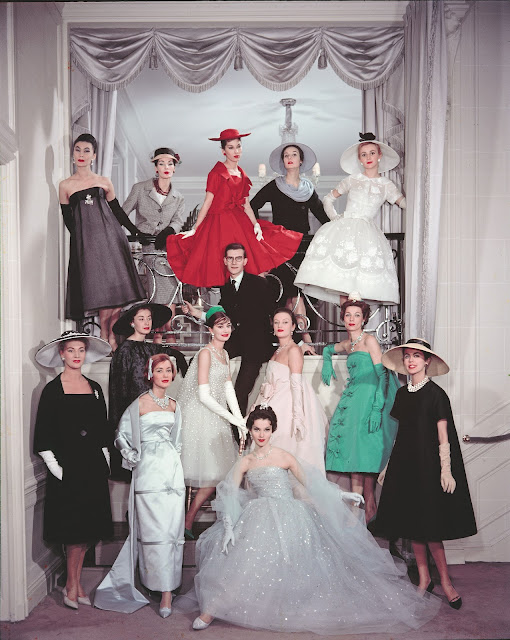
1958. Yves Saint-Laurent, prima collezione Dior, for Life © Sabine Weiss

Throughout the years, Sabine photographed everything from the extreme post-war living conditions in Paris, to cigarettes and babies and perfume. Her documentation of the human condition earned her a reputation as a humanist photojournalist, but she was just as comfortable snapping fashion, advertisements and portraits of celebrities -- she didn't like being put into a category. "I could photograph different worlds with very different people -- wealthy people in the morning, outcasts in the afternoon." 

As a pioneer female photographer in a field dominated by men, Sabine always kept her sense of humor even while documenting the darker side of humanity. She worked in every photographic genre, from reportage to artists' portraits to fashion to street photography. The images she captured of the faces of children are riveting. Of all the photographs that she took, the one that haunted me the most was one she took in Paris in 1953 of young children chained to a barge.
 
Children chained to a barge, Paris, France 1953 by Sabine Weiss - Photo: Cat Bauer
 
Last year, Nicolas Berggruen, the US-based, Paris-born billionaire investor and philanthropist made headlines when he signed an agreement to purchase the Casa dei Tre Oci on the island of Giudecca from the Fondazione di Venezia and turn it into the headquarters for his cultural thinktank, the Berggruen Institute. Berggruen has dual US and German citizenship, and is the son of Heinz Berggruen, the late German art dealer and collector whose funeral in 2007 was attended by both Chancellor Angela Merkel and President Horst Kohler.
 
A couple days ago, Nicolas Berggruen hit the news again when it was announced that he had bought another important property here in Venice, Palazzo Diedo, this time in the Cannaregio district. The property is set to be transformed into an exhibition venue and artist-in-residence space as part of the new Berggruen Arts & Culture, kicked-off with an installation by American artist Sterling Ruby. 
 
In the catalog of Sabine Weiss. La Poesia Dell'Istante, Nicolas Berggruen states: 

"As an institution whose goal is to develop ideas centered on the great transformations of the human condition brought about by changes in the economics of technology and politics, we are very pleased that Sabine Weiss's work is being celebrated at Casa dei Tre Oci.... It is our hope that the exhibition will draw wider attention to her way at looking for the spark in humanity."

Venice Through the Window of Casa dei Tre Oci - Photo: Cat Bauer

Sabine Weiss, The Poetry of the Instant, La Poesia Dell'Istante runs at the Casa dei Tre Oci through October 23, 2022. Curated by Virginie Chardin, the retrospective is sponsored by the Fondazione di Venezia, realized by Marsilio Arte in collaboration with the Berggruen Institute, and produced by the Sabine Weiss atelier Laure Delloye-Augustins, with the support of the Jeu de Paume and the International Festival Les Rencontres de la Photographie d'Arles under the high patronage of the Switzerland Consulate General in Milan. Go to Tre Oci for more information.

Ciao from Venezia,
Cat Bauer
Venetian Cat - The Venice Blog

Monday, February 28, 2022

The Venice Carnival and a Brief History of Masks

Il Ridotto (The Foyer) by Francesco Guardi (1755)

(Venice, Italy) A sleek, black gondola glides up the Grand Canal and docks in front of a 15th century Gothic palace blazing with candles. A masked nobleman wearing a tricorn hat steps out and offers his hand to his companion, also masked, draped in gold finery. The couple strides through space and time into a sumptuous world that once existed, and, if you step through the right portal, still exists in Venice today. 

In a city where there seems to be a mask shop on every corner, it may be surprising to learn that the ancient Venetian craft of mask making was only revived about forty years ago. During the political terrorism of the Years of Lead starting in the late 60s, the wearing of masks was discouraged, and Carnival limited to schoolchildren and private celebrations.

Mask making in Venice can be documented back to the 13th century, though it probably existed much earlier. On April 10, 1436, the ancient profession of mascareri was founded under the jurisdiction of the Painter's Guild. Over the years, masks were used for a variety of reasons -- in the government, the theater, and as a means of disguise. Masks provided the Venetians a degree of anonymity.

As far back as the 11th century, the mattaccino costume was worn by mischievous young men, who, dressed as clowns, would bombard noblewomen with eggs filled with rosewater, inspiring the first official documentation regarding masks: a 1268 law prohibiting the throwing of eggs while disguised. The Venetian government apparently gave up trying to enforce it, however, and resorted to putting up nets along the Procuratie in St. Mark's Square to protect the ladies and their rich clothing.

Venice Carnival 2022 - Photo: Cat Bauer
The wearing of a mask put everyone on the same level: rich and poor, nobleman and citizen, beautiful and ordinary, old and young. It permitted confidences to be exchanged anonymously -- everything from accusations before State Inquisitors, to a potpourri of sexual indiscretions. Prostitutes practiced their trade without fear of retribution; homosexuals hid their illicit lifestyle. In 1458, it was decreed that men were forbidden to dress up as women and enter convents to commit indecent acts.

Over the years, Carnival festivities grew more decadent until it evolved into a 250-day event of non-stop parties, gambling and dancing. Social and class distinctions were flipped on their heads, with servants dressing up as masters and vice versa. It was difficult to distinguish a housewife wearing a traditional mask, cape, hood and three corner hat from a nobleman dressed in the same outfit, allowing both to move freely though the city without fear of recognition.

Not all masks were used for indelicacies, however. The bauta was worn by both men and women, and was not considered a costume but a form of dress -- required wearing if a woman wanted to go to the theater. 

Teatro San Cassiano, the world's first public opera house, opened in Venice with Andromeda by Francesco Manelli during Carnival 1637. It was such a hit that more theaters were built. During the theater boom of the 17th century, Venetians spontaneously started wearing masks in public, until over the decades it became a natural way of life. 

Another ingredient in this colorful mix was the Italian theater, Commedia dell'arte. In the 18th century, the renowned Venetian playwright, Carlo Goldoni, enthralled Venice with his delightfully decadent masked characters. Pantalone, Harlequin, Colombina and Pulcinella were among the many masks that found their way into the Carnival.

Masks disappeared, along with Carnival, when Napoleon's troops brought an end to the Venetian Republic in 1797. Since then, they've resurfaced and submerged again throughout the decades until being vanquished to the pages of the history books by the 20th century.

And then masks staged a spectacular comeback in the late 1970s and early 1980s when a group of young people brought them once again into the forefront.
After that authentic relaunching of the Venice Carnival in 1980, as the decades passed, the celebrations grew more and more commercialized, televised and publicized as masses of tourists swarmed into the city.

Then, on February 23, 2020, the Venice Carnival suddenly shut down two days early when three cases of Covid-19 were discovered in the city and thrust the pandemic into the media spotlight of the Western world.


Il medico della peste or "The Black Death Doctor" - Photo: Cat Bauer, Carnival 2016

The word "quarantine" is a Venetian word, and means "forty days." In 1448, the Venice Senate passed a law that required ships and crews to remain isolated outside the city during the time of the plague, which had a 37-day cycle from infection to death.

A distinct mask evolved in response to the serious pandemic that wiped out much of Venice's population on more than one occasion. Il medico della peste or "The Black Death Doctor" had a long beak-like nose stuffed with disinfectants, and, as its name implies, was used to protect doctors from the plague.

In 2021, there was no official, physical Venice Carnival due to the Covid-19 pandemic -- only digital.

Now, two years after a contemporary plague shut down the Venice Carnival without warning, and with the current pandemic hopefully on the wane, Venice has once again hitched up her skirts and is pulsing with life. Even though there are still no official events in Piazza San Marco, this year people from all over the globe arrived in Venice to celebrate a new sense of freedom. Confetti was thick as snow on Piazza San Marco and laughter lightened the air. Wearing a mask became fun again.

Then, during these last days of Carnival 2022, Russia astonishingly attacked Ukraine, adding a thick layer of darkness beneath the festivities.

My heart is with everyone who is suffering. I am against war and violence in any form and fully support harmony and diplomatic solutions. Here's hoping the Venice Carnival is back in all its glory in 2023 and that Europe and the world are at peace.


Ciao from Venezia,
Cat Bauer
Venetian Cat - The Venice Blog


Note: I have published various versions of this article on Venetian Cat - The Venice Blog throughout the years. It was first published in print on February 27, 2001 in the International Herald Tribune - Italy Daily.

It seems that unethical marketer Filippo Merlo
of Venice City Tours continues to plagiarize my article in the year 2022 to the point of obsession. even though he was blocked by Google back in 2019 -- he just changes the link and date. From Google: In response to a complaint that we received under the US Digital Millennium Copyright Act, we have removed 7 result(s) from this page. If you wish, you may read the DMCA complaint that caused the removal(s) at LumenDatabase.org.

Message to Filippo Merlo: Knock it off. Ob-la-di ob-la-da Get a life, bra.

Sunday, February 13, 2022

April in Venice - Get Ready for Homo Faber & Biennale Art 2022

Venice through a window inside the Giorgio Cini Foundation - Photo: Cat Bauer

(Venice, Italy) The Queen of the Adriatic is ready to welcome visitors. In April, Venice will be the center of the cultural universe with the openings of both the Homo Faber Event and the 59th Biennale International Art Exhibition. Not only will visitors have the opportunity to witness some of the top contemporary artists and artisans on the planet, you will also wander through ancient venues so thick with history and mystery that you can almost reach through the ether and touch the phantoms of the past.

Island of San Giorgio Maggiore

The moment you step off the boat and onto the magical island of San Giorgio Maggiore, you sense adventure in the air. The island was inhabited in ancient Roman times and called Insula Memmia after the Memmo gens, a patrilineal clan who owned property on it. It was christened the Island of San Giorgio Maggio way back in the first half of the ninth century when the first church dedicated to Saint George was built.
 
In 982, Doge Tribuno Memmo granted the island to Abbot Giovanni Morosini to found a Benedictine monastery, which is still on San Giorgio to this very day. The island grew into a prosperous spiritual and economic base, and home to the ecclesiastical sons of Venetian nobility. 
 
Throughout the centuries, and with the addition of some impressive architecture by Andrea Palladio and other masters, it swelled into a thriving center for international get-togethers. In 1951, Count Vittorio Cini transformed the island into a tribute to his son, Giorgio, who was killed in a plane crash, using his great wealth to create the Giorgio Cini Foundation and bring humanism back to mankind. The island has hosted kings, queens and heads of state -- twice it was the setting for the weighty G7 summit.

Homo Faber Event

Crafting a more human future
Living Treasures of Europe and Japan
April 10 to May 1, 2022

 
Island of San Giorgio Maggiore - Photo: courtesy Giorgio Cini Foundation

Homo Faber 2022 celebrates Japan's National Living Treasures and its rich traditional heritage throughout the grounds of the Giorgio Cini Foundation. Fifteen exhibition spaces feature 12 top craftspeople from Japan who have earned the prestigious designation of "National Living Treasures."  
 
Organized by the Michelangelo Foundation for Craftsmanship and Creativity, the international Homo Faber Event is a major cultural exhibition dedicated to master craftspeople and their work. The second edition of the Homo Faber Event opens a portal into the vibrant cultural collaboration between Europe and Japan. It's an immersive experience dedicated to virtuoso master artisans and exceptional emerging craftspeople. 
 
You'll witness a spectrum of designers, curators and artisans imprint a human touch across a rainbow of sectors -- from jewelry to automotive, fashion to flowers, porcelain to glass, theater to interior design, and much, much more. Over 400 unique works drafted by over 350 designers and artisans from over 30 countries will be on display throughout the magnificent Giorgio Cini Foundation and its grounds. 
 
Blossoming Beauty - Venini glass at Homo Faber 2022

I wrote an inspired post after attending the first Homo Faber Event in 2018, along with 62,500 other people, which you can read here:


In addition to the event on the island of San Giorgio Maggiore, this year there will also be a self-guided tour called "In Città" throughout the labyrinthine calli and campi of the historic center of Venice itself. I love this idea! That means you can meet face to face the artisans who keep this city afloat by building their work on a solid foundation of ancient traditions. You can meet the soul of Venice itself.

You will be able to go digital and discover over 60 Venetian artisans, ateliers, museums and galleries by using the Homo Faber website or app. You can create your own tour or follow a suggested itinerary and be able to witness in person the craftspeople of Venice. 
 
Venezia su misura - Photo: Cat Bauer

At the press conference headed by the dynamic Alberto Cavalli, the Executive Director of the Michelangelo Foundation and general curator of Homo Faber, we were gifted with copies of a golden shopping guide called Venezia su misura, or Venice, Made to Measure. For those of us who still appreciate fine print, the beautiful guidebook is published by Gruppo Editoriale in both English and Italian, and contains descriptive passages of select Venetian artisans and their work as well as a fold-out map in the back. If you are are fortunate enough to attend Homo Faber in person, you will be able to purchase a copy in the bookshop. 

Visit the Homo Faber website for lots more information and to book your tickets.

La Biennale di Venezia

59th International Art Exhibition
The Milk of Dreams
April 23 to November 27, 2022

 
Jane Graverl, L'Ecole de la Vanité, 1967 - screenshot

On April 20, 21 and 22, smack in the middle of the Homo Faber Event, is the pre-opening of the 59th La Biennale International Art Exhibition, three days allotted to accredited visitors before the opening to the general public on April 23. Can you imagine such a thing? Venice will be galvanized by visiting adventurers following itineraries of creativity and excellence throughout April and beyond, a perfect way to welcome intrepid travelers back to the city.
 
Leonora Carrington (1917-2011) was a surrealist painter and storyteller who made up whimsical tales for her children complete with fantastical illustrations. She preserved some of her otherworldly stories in a notebook called The Milk of Dreams, which inspired Cecilia Alemani, the curator of the 2022 International Art Exhibition, to re-enchant the world with her own rendition of reality of during these surreal times.

Franz Zéphirin, The Slave Ship Brooks, 2007 - screenshot

Alemani said:
"The Milk of Dreams describes a magical world where life is constantly re-envisioned through the prism of the imagination. It is a world where everyone can change, be transformed, become something or someone else...
 
 ...During these endless months in front of the screen, I have pondered the question of what role the International Art Exhibition should play at this historical juncture, and the simplest, most sincere answer I could find is that the Biennale sums up all the things we have so sorely missed in the last two years: the freedom to meet people from all over the world, the possibility of travel, the joy of spending time together, the practice of difference, translation, incomprehension, and communion..." 
Tishan Hsu, Breath 3, 2021 - screenshot

In addition to the exhibition that takes place in the Central Pavilion at Giardini and in the Arsenale, Biennale Art 2022 also includes 80 National Participations by countries from all over the globe. Visit La Biennale website for lots more information and to watch the press conference with an English translation.
 
With the arrival of these two major global cultural events, as well as a firm foundation of more than a millennium of art and culture, Venice will once again hitch up her skirts and maintain her stalwart position as an international center where diverse civilizations converge. See you soon in Venice!

Ciao from Venezia,
Cat Bauer