Wednesday, October 31, 2012

All Hallows' Eve - All Saints' Day - All Souls' Day - Venice Blog

Flames from Burning Candles by: Photos8.org
(Venice, Italy) This evening is All Hallows' Eve, better known as Halloween, the evening before Hallowmass, better known All Saints' Day. This year, the full moon a few days ago caused All Sorts of Havoc, contributing to extreme storms All Over the Earth, including Hurricane Sandy, which devastated the East Coast of the United States of America.

CREDIT: NASA GOES Project
Here in Venice, we have been experiencing acqua alta on and off. Today happens to be an "on" day with rain and extreme high water expected this evening.

The ancient Celts believed that during this time of year the veil between this world and the Otherworld became thin, allowing spirits -- both dark and light -- to pass through more easily. So, tomorrow, Wednesday, November 1, we have All Saints' Day for the saintly spirits, and the day after, on Thursday, November 2, we have All Souls' Day for everybody else. Some say that the Venetian gondola resembles a boat on the River Styx...

Gondola Ride on the River Styx
I have written about this time of year before, an "evergreen" piece back on Sunday, October 31, 2010, which I will share with you again:

The Island of the Dead - Venice, Italy

Gods' aid, let not my bones lie in a public location
With crowds too assiduous in their crossing of it;
For thus are tombs of lovers most desecrated.
May a woody and sequestered place cover me with its foliage
Or may I inter beneath the hummock
of some as yet uncatalogued sand;
At any rate I shall not have my epitaph in a high road.
---from Homage to Sextus Propertius by Ezra Pound

(Venice, Italy) That image is of the Island of San Michele, where Venice buries her dead. November 1 is All Saints' Day and November 2 is All Souls' Day, or the Day of the Dead, here in Italy. There is a free shuttle vaporetto out to San Michele and back so everyone can tend to the tombs. The American poet Ezra Pound is buried here in Venice on the Island of the Dead, and also happened to die here in Venice, most remarkably, on the Day of the Dead, two days after his 87th birthday on October 30, 1972.

Ezra Pound grave - Venice, Italy - Photo by Cat Bauer - Venice Blog

Today is October 31, or Halloween, which has been one of my favorite holidays ever since I was a child. When I lived in Los Angeles, I would spend a good week decorating my house with dead bodies and skeletons, and setting up a proper graveyard under the white birch tree. I attracted kids from miles around, and some adults, too.

In fact, the first year I moved into the house in Los Feliz, back in 1988 before it was properly furnished, my sister and I decorated every room with a different spooky theme: the coffin room, the fortune teller room, etc. and threw a huge party complete with sound effects and lighting -- I even got the Frankenstein monster from Universal Studios to come, since he was a friend of mine. It was all in good fun, and there was certainly nothing religious about it, more like a Disneyland Haunted Mansion theme. To me, any holiday that can inspire Serious White Men to get creative, dress up in costumes and loosen up a bit is providing a service to mankind. One of my favorite costumes was worn by a fellow who was normally very... uptight. He dressed all in white and carried a big black felt marker, calling himself "Graffiti Man," and had people sign his clothes all night.

To me, Halloween in the States is more similar to Carnival in Venice than it is to the Day of the Dead.
When I first arrived in Venice in 1998, I had one of the few carved pumpkins around, and there were no celebrations except a small one in Campo Santa Margherita with the students. Halloween has been slowly growing more popular, with shop windows filled with cobwebs and witches.

This is what the Catholics think about that:

Please click HERE to continue reading Venetian Cat - The Venice Blog - The Island of the Dead.

Ciao from Venezia,
Cat
Venetian Cat - The Venice Blog

Friday, October 26, 2012

The Encyclopedic Palace Inspires the 2013 Venice International Exhibition of Contemporary Art

Marino Auriti
Encyclopedic Palace of the World
ca. 1950s
American Folk Art Museum
Photo by Gavin Ashworth
(Venice, Italy) Thanks to his loving grandchildren, self-taught Italian-American artist Marino Auriti's dream of a palace to house all worldly knowledge, bringing together the greatest discoveries of the human race -- from the wheel to the satellite -- lives on, inspiring the title for the 55th Venice Biennale Contemporary Art Exhibition.

Mario Auriti, a whimsical inventor and self-taught artist, was born in 1891 in Guardiagrele, a town in central Italy. He eventually settled in Kenneth Square, Pennsylvania with his family, where he built a huge garage and set up an auto-body shop and "artistic framing" business. In the garage, he painted with oils, copying old masters and photos clipped out of National Geographic. It was also where he created his ultimate dream, a large model for the Encyclopedic Palace, which, in his fantasy, would become a national monument for knowledge, a skyscraper in Washington, D.C. After his death 1980, his dream ended up in storage, where it slowly decomposed until resurrected by the American Folk Art Museum in 2004.

Auriti's granddaughter, B.G. Firmani, has written a poignant memorial about the efforts of the family to ensure that his dream did not die. From FORTE E GENTILE, a post entitled, Io Vivo! The Encyclopedic Palace Rises Again:

...But it was after my grandfather retired, in the 1950s, when he set to work on his pièce de résistance, the Encyclopedic Palace.  This one wasn’t just a model, though. 

It was a design for a museum, a national monument. He filled notebooks developing its concept; in his statement of purpose, in my stiff translation from his Italian, he called it “…an entirely new concept in museums, designed to hold all the works of man in whatever field, all discoveries made and those that may follow.”  He wanted it built on the mall in DC – and if built at the time, at 136 stories, it would have been the tallest skyscraper in the world.  With its surrounding piazza it would take up 16 city blocks.  He built the model, at a scale of 1:200 meters, out of wood, brass, plastic, and tiny celluloid windows on which he drew mullions; for the tiny balustrades, he cut down hair combs.  And this time, so no one could scoop him, he secured a patent for his creation.  

Continue reading at FORTE E GENTILE.

Massimiliano Gioni (Busto Arsizio, 1973), the curator for the 2013 Venice Biennale Contemporary Art Festival, chose the title Il Palazzo Enciclopedico/The Encyclopedic Palace, explaining, "...on November 16, 1955 Marino Auriti filed a design with the US Patent office depicting his Palazzo Enciclopedico... Auriti's plan was never carried out, of course, but the dream of universal, all-embracing knowledge crops up throughout history, as one the eccentrics like Auriti share with many other artists, writers, scientists and prophets who have tried -- often in vain -- to fashion an image of the world that will capture its infinite variety and richness."

I love this theme! Imagine that instead of the world's tallest skyscraper, Auriti's dream comes true in the sprawling Biennale International Contemporary Art Exhibition, each pavilion filled with art inspired by knowledge unique to that country. Paolo Baratta, the President of La Biennale, stated, "Each [pavilion] has its own history and style. It may certainly be said that in them the countries reveal the role attributed to contemporary art as messenger of their present and their cultural wealth. But the pavilions also provide revelations on more profound realities and riches than those of the usual official and stereotyped images or pretexts."

 
US Pavilion
Yesterday, October 25, 2012, Paolo Baratta and Massimiliano Gioni met the representatives of the participating countries at Ca' Giustinian, Biennale headquarters. There are eight countries participating in the art festival for the first time: the Bahamas, the Kingdom of Bahrain, the Republic of Kosovo, Kuwait, Maldives, the Republic of Côte d'Ivoire (Ivory Coast) & Nigeria, participating with the African countries, and Paraguay, participating with the IILa (the Italo-Latin America Institute). The vice-president of the promotional committee for the Holy See's participation at Biennale Arte 2013 was also present.


La Biennale
Imagine, the Biennale in Venice, a city that contains all sorts of libraries, churches and palaces stuffed with ancient knowledge, adding eight new countries to its ever-expanding contemporary universe, inspired by the dream of an Encyclopedic Palace created by an Italian immigrant out back in a Pennsylvania garage!

The 55th Venice Biennale International Contemporary Art Exhibition will run from June 1 to November 25, 2013, with previews on May 29, 30 and 31.

Ciao from Venezia,
Cat
Venetian Cat - The Venice Blog


Monday, October 22, 2012

Cleaning Day in Venice


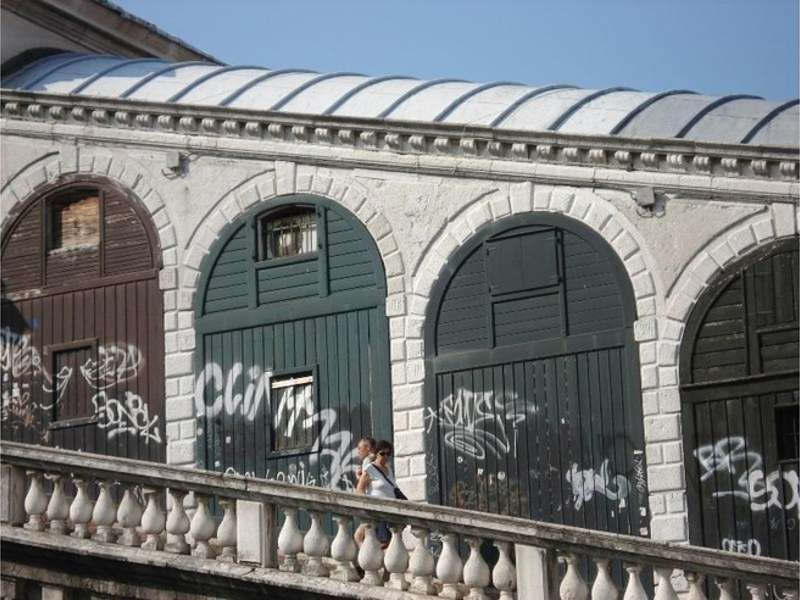
(Venice, Italy) Venice, the most romantic city in the world, has a dirty little not-so-secret: it is covered with graffiti, most of which is "tags." On Sunday, October 21, 2012, a group of concerned citizens in Venice participated in an anti-graffiti Cleaning Day, organized by Milan, joining cities throughout Italy in a national effort to clean up the country on the outside. At the same time, the Italian government fights to clean up the corruption on the inside with an anti-graft bill. 

From Reuters, Italy Moves Closer to Passing Anti-Corruption Law:

To accelerate passage of the draft law, which has languished in parliament for two years, Prime Minister Mario Monti called a confidence vote, which curtails debate and ends voting on individual amendments.

... "A serious law against corruption is a fundamental factor for Italian activities and international investment in order to unblock the country's growth," Monti told local government representatives at a conference in Bologna as voting took place.

Monti's unelected government is pushing hard to get the law passed quickly to shore up confidence in the political system and show that something is being done to stem graft.

In an economy of about 1.7 trillion euros, corruption siphons off 60 billion euros (48.7 billion pounds) a year out of the public coffers, according to the country's audit court, a body of magistrates which overlooks public finances.

Stories of extravagant corruption as Italians suffer in a deep recession have become a mainstay of the media.

For example, they have been reporting prosecutors' allegations that an official in the regional government of Lazio, which includes Rome, siphoned off millions of euros of public campaign financing to holiday in the French Riviera, dine on oysters and champagne at exclusive restaurants, and buy a BMW 4x4 when it snowed in the city.


Graffiti on Rialto Bridge
As the Italian government struggles to pass its anti-graft law, Italian citizens are fighting back, too, with an anti-graffiti effort. The Facebook group "I nostri masegni puliti e splendenti" or "Our Stones Clean and Bright" met in Campo San Leonardo to clean up a wall of graffiti. Masegni are stones that Venetians have been using for centuries for pavement and construction.

From Venipedia:

Masegni stones are the most prevalent paving stone in Venice, in fact they make up over 70% of all Venetian pavement. There are two types of masegni stones used in paving Streets. Traditional masegni have been used since 1676 and hold great historical value to the city. Newer masegni stones are used in some Street Pavement and are used to replace unusable traditional stones. Both stones are made from quarried Trachyte from the Euganean Hills.

The wall before the cleaning
When we arrived, we were handed an outfit that resembled a gauzy spacesuit to protect our clothing, a paint brush and a bucket of paint. Some of the group were professionals, but others, such as myself, were novices, including some children. The atmosphere was festive and light, and soon attracted a crowd that observed our efforts. Care was taken to prepare the area so that we didn't splatter the pavement with our good intentions. Reporters came by; we were on the local news, and even made the front page of the local paper, la Nuova Venezia, today.


After the wall (and the Telecom phone booth in front of it), was cleaned, the workers celebrated with prosecco and snacks sent over by local businesses. Everyone agreed the wall would look even better after the paint dried.

Photo: Venice Human Archipelago
While we were painting the wall in the historic center, over on the Lido another group polished up the Teatro Marinoni located inside the old hospital complex, getting ready for the new season. The Marinoni Theater was bequeathed to the residents of Venice by Mario Marinoni, and has been part of yet another ongoing struggle between the Venetians and private development, who want to turn the former hospital into a luxury complex. To me, there is no reason for one project to negate another. There is plenty of room for all.

Also, yesterday, was the FAI marathon, part of another national effort to rediscover treasures right in front of our eyes. If you missed it, you can find the Venetian Cat - Venice Blog post at The Wells of Venice - FAI Marathon.

As the world struggles to find its balance between creation and destruction, honesty and corruption, if we all just make some small efforts, the dark forces will be balanced by the light.

The Wall - Before and After
Ciao from Venezia,
Cat
Venetian Cat - The Venice Blog


Monday, October 15, 2012

Venice - Ancient City Young at Heart - Guggenheim, La Biennale & Premio Venezia at Teatro La Fenice Focus on Youth

Frank Stella - Gray Scramble -
Hannelore B. and Rudolph B. Schulhof Collection

(Venice, Italy) Hennelore B. and Rudolph B. Schulhof were passionate collectors of Italian, European and American art of the decades after 1945. They felt they were kindred spirits of Peggy Guggenheim.

Upon her death this past February, Hennelore bequested 83 works to the Peggy Guggenheim Collection, including those by Afro, Alberto Burri, Alexander Calder, Giuseppe Capogrossi, Eduardo Chillida, Tony Cragg, Ellsworth Kelly, Willem de Kooning, Lucio Fontana, Jean Dubuffet, Jasper Johns, Donald Judd, Anish Kapoor, Mark Rothko, Frank Stella, Cy Twombly and Andy Warhol, enriching the Peggy Guggenheim Collection with art dating up to the 1970s and 80s. 

When I saw pieces from new collection, which were deftly integrated into the existing art, I had the same feeling of wonder that I'd had on a class trip I took to the Museum of Modern Art in New York City when I was 13-years-old and witnessed modern art for the first time. The Schulhof Collection blends perfectly into the Peggy Guggenheim Collection.

Biennale International Festival of Contemporary Music

Sound Garden by Architettura Sonora
The Biennale's International Festival of Contemporary Music finished on an exciting note this year: attendance by students was way up -- over 20% of the audience was young people and students. Paolo Baratta, President of La Biennale, said that it was encouraging to look out over the audience and not only see a sea of white-haired heads. "We have reaped the rewards after spending a long time laying the ground work to attract young people.

Ivan Fedele, the new Director of the Music Sector, performed with presence and passion. The result is a turning point for the Music Sector of the Biennale, which will attach increasing importance to the dissemination of knowledge of music and supporting new talent, further strengthening the program and the Biennial Educational College." Ivan Fedele countered and said that even if someone has white hair, they can still be young at heart.

Premio Venezia National Piano Competition


Also doing their part to encourage the musical youth of Italy, the Fondazione Teatro La Fenice di Venezia and the Friends of La Fenice Foundation held their annual Premio Venezia National Piano Competition this past week. Saturday night, October 13, the two finalists competed against each other. This year, two young women ended up in the top slots: Martina Consonni, a 15-year-old from Como, and Giulia Rossini, a 19-year-old from Milan. 

The program:

Martina Consonni

Trenta due Variazioni in do minore sopra un tema orginale Wo0 80 by Ludwig van Beethoven
Scherzo n.2 in si bemolle minore op. 31 by Fryderyk Chopin 
Mephisto-Walzer n. 1, S. 514 by Franz Liszt

Martina Consonni - Second Place

 Giulia Rossini

Scherzo n. 3 in do diesis minore op. 39 by Fryderyk Chopin
Sonata n. 1 in fa minore op. 1 by Sergej Prokof'ev 
Sonata n. 2 in sol minore op. 22 by Robert Schumann 

Giulia Rossini - Winner Premio Venezia
Giulia made a striking figure at the piano, with long blond tresses held back with a crimson headband and matching crimson gown, looking a bit like Sleeping Beauty come to life. Martina chose an elegant, sophisticated black classic look. Both young women were excellent, poised and confident, playing with passion and grace.

During the intermission while the jury voted as the audience sipped prosecco, both girls ventured into the foyer, and it was evident that they had each other's support. Giulia won the top prize, which includes a plethora of cash and concerts, as does second place, so there really is no "winner" and "loser" if a young pianist reaches the finalist slot. I've written about the prize before: 

Friends of The Phoenix - Amici della Fenice - Premio Venezia


The other three 2012 finalists were:

Antonino Fiumara, born in Messina in 1993
William Greco, born in Nardò in 1987
Serena Valluzzi, born in Gioia del Colle in 1994

Congratulations to everyone! 


Photo: Comune di Venezia
On another note, Giorgio Orsoni, the Mayor of Venice himself attended the protest on Saturday, October 13, 2012 against the attempted grab of Arsenale by Consorzio Venezia Nuova, a group of private construction companies. From the Consorzio Venezia Nuova website:

The Consorzio Venezia Nuova consists of a group of Italy's leading construction companies of international importance and local cooperatives and firms with considerable experience of operating in the lagoon. 

To carry out its work as State concessionary responsible for studies, experimental activities, projects and works, the Consorzio Venezia Nuova has developed a structure able to plan, organise, manage and control the safeguarding measures during the various phases of implementation, while at the same time acting as the operational interface between the granting administration (the Venice Water Authority) on one hand and those carrying out the work on the other (designers, experts responsible for studies and experiments and companies carrying out the work). 

Giorgio Orsoni - Photo: Comune

This summer, after fighting the State for decades, the Comune of Venice had finally gotten control of Arsenale, an enormous section of Venice where the renowned Venetian ships were once built. Apparently Consorzio Venezia Nuova tacked a clause onto another piece of legislation and reversed the decision. Maybe they thought no one would notice...


Ciao from Venezia,
Cat Bauer
Venetian Cat - The Venice Blog 

Monday, October 8, 2012

The Wells of Venice - FAI MARATHON

FAI MARATHON
(Venice, Italy) If you are in Venice on Sunday, October 21, 2012, you are in for a treat. The Venetian chapter of FAI will take part in a national cultural marathon, "the only marathon that you run with your eyes." I have written about FAI before:

Italy, Defend Your Heart


The Fondo Ambiente Italiano (FAI), or the Italian Environmental Foundation was established in 1975 to "emulate the English National Trust." (For Americans, a similar organization would be the National Trust for Historic Preservation.) ...FAI declares that it bases its work on five principles: knowledge, pragmatism, consistency, independence and quality. Since FAI is a foundation, we can agree those are principles upon which any solid foundation should be built. FAI safeguards the heritage of art, nature and the Italian landscape. 

The FAIMARATHON is a non-competitive race involving more than 70 Italian cities, in which the goal is to call attention to cultural and artistic places that are part of hectic, everyday life, but often overlooked. Together with Il Gioco del Lotto, Italy's national lottery, FAI hopes to raise awareness of the art and culture that surrounds us here in Italy while raising funds to protect and restore that beauty. Using funds from the Lotto is a tradition that goes back 400 years when Pope Innocent XII finished construction of Palazzo Montecitorio, the current Chamber of Deputies, with lottery money.

Photo: ParadoxPlace
In Venice, the marathon will focus on the wellheads throughout the city that are a crucial part of its history. Providing fresh water to its citizens was always a serious concern during the Venetian Republic, and an estimated 2500 wells were constructed, mainly out of stone. The wells were located in the middle of squares and courtyards, and daily life revolved around them. Strict laws regulated the purity of the water, and the amount that could be drawn.

From The Venice Wikibook - Venetian Public Art:

Because Venice was cut off from reliable sources of fresh water, Venetians built underground basins to collect and filter rainwater. Their system of cisterns collected rainwater and retained it in a clay basin, which citizens could access. Wellheads capped these cisterns. Often, wellheads were festooned with carvings of saints, family crests, inscriptions, or other images important to Venetians; carvings of saints usually faced the nearest church. The decorative characteristics of wellheads ranged through the Carolingian, Byzantine, Gothic, Renaissance, and Baroque eras.

Photo: Nino Barbieri
Wellheads exemplified the city’s culture and its love for art, as well as functioning as a barrier between the important water reservoir and sources of possible contamination. Wellheads functioned as protection for the water source by preventing animals from falling in and keeping floodwaters from contaminating the drinking water. It was also common to have a small hollowed-out bowl near the base of the wellhead, which was kept full for animals to drink.

As the city grew, so did the number of wellheads. They were typically located in the center of campi, and were always a place for socializing and interacting with neighbors. Photographs dating to as late as the nineteenth century show women washing clothes on the steps of wellheads, children playing nearby, and men hauling up the water. With the completion of an aqueduct from the mainland in the late 1800s, wells lost their function and were quickly abandoned.

Photo: Renato Canciani
The FAIMARATHON will start at the Archivio di Stato at the Frari, wind its way through San Polo, Santa Croce, Cannaregio and finish at San Francesco della Vigna in Castello, visiting 35 wellheads along the way. All participants will be given a kit which includes a backpack, a bib, the itinerary, a postcard to mark the stages completed, a free ticket to one of the FAI landmarks and a sticker in support of the campaign Ricordati di salvare l'Italia or "Remember to Save Italy." All those who complete the course will receive an orange scarf, a symbol of commitment to the cultural heritage of Italy and support of the activities of the Foundation. In addition, the FAI delegation of Venice has also planned a surprise!

FAI MARATHON
Sunday, October 21, 2012
10:00 AM
Cloisters of the State Archives
Campo dei Frari
San Polo 3002

Registration:

Day of the event from 10:00AM to 11:00AM
Prior to the event at Olivetti Store, Piazza San Marco 101, Procuratie Vecchie
Online at: www.fondoambiente.it
English:  http://eng.fondoambiente.it/

Cost: 
Adults: minimum contribution of 6 euro, 5 euro for FAI members
Couples and families: minimum contribution of 10 euro; 8 euro for FAI members
Anyone who joins FAI or renews their membership may participate for free

Click to leave your comments at www.lottoperfai.it

*** 
In Memory of Sidney H. Stires


On another note, my fairy-godfather, Sid Stires, passed away beautifully in his sleep on October 4, 2012 here in Venice soon after he had arrived from the States. He was a musical man, and he died a musical death in the musical city where he wanted to die. Rest in Peace with the Angels, Sid. Click to read the New York Times obituary.

Ciao from Venezia,
Cat
Venetian Cat - The Venice Blog

Friday, September 28, 2012

Apocalypse Venice - Cruise Ship Parody


(Venice, Italy) I love this parody from Venessia.com so much that I just had to share it on Venetian Cat - The Venice Blog.

Ciao from Venice,
Cat
Venetian Cat - The Venice Blog

Wednesday, September 19, 2012

Anti-Cruise Ship Demonstration in Venice - September 16, 2012

Photo: Arved Gintenreiter
(Venice, Italy) There was a festive atmosphere when I arrived at the demonstration against the cruise ships here in Venice at the Punta della Dogana on Sunday, September 16, 2012 a bit before 3PM. During the Venetian Republic, the Punta della Dogana was the customs house, holding precious cargo from all over the world that arrived by sea. These days it is owned by billionaire Frenchman Francois Pinault, and contains contemporary art exhibits.

 Photo: Arved Gintenreiter
On Sunday, the tip of the triangle at the Dogana was crowded with locals and over 100 bicyclists (and their bikes) who joined the protest from the mainland, in addition to curiosity-seekers who bought up homemade sandwiches and red "No Grandi Navi" T-shirts. Aretha Franklin belted out "All I want is a little respect" over the loudspeakers. A flotilla of small boats -- many of which contained children -- decked out with "No Grandi Navi" flags and colorful balloons bobbed in the lagoon, surrounded by a strong police presence.

An article entitled Venice Rebels Against Cruise Ship Invasions written by Colleen Barry for the Associated Press on February 5, 2012, gives a good summary of the situation:

If the cruise ships were modern buildings, which they strongly resemble, they would certainly not be allowed in Venice, a UNESCO heritage site that mandates the view of protected places cannot be permanently altered. But because they move, there is no official sanction against them.

 ...Even before the Concordia disaster, Venice Mayor Giorgio Orsoni and the chief port official signed an agreement for new studies on alternative routes — but passenger terminal officials believe that passing by St. Mark's is a key attraction.

Francesco Bandarin, UNESCO's assistant director-general for culture — and a Venetian himself — said longer-term solutions are needed.

"The city is a very fragile city. This is a city that comes to us from the Middle Ages," Bandarin said. "It is not designed for having that kind of traffic. It is designed to have ships, and we will always have ships around Venice, but not these kind of ships."

Photo: Arved Gintenreiter
In March of this year, a ministerial decree was passed making it a crime for ships that weigh more than 40,000 tons to sail too close to the Palazzo Ducale, the ancient palace of the Doge, but that law has been suspended until an alternate solution can be found.

There were three cruise ships that were due to leave Venice on Sunday: the 3,000-passenger Costa Fascinosa, 1,712-passenger MSC Opera and 2,536-passenger MSC Musica, which were delayed by the flotilla of small boats.

From USA Today:
The protest is just the latest from groups arguing that the growth of large cruise ships visiting Venice in recent years has had a negative impact on the destination.

Cruise ships sailing into and out of Venice pass within yards of the city's famed Piazza San Marco, a route critics say is risky due to the possibility of environmental damage or an accident impacting historical treasures. The criticism has grown louder since the Costa Concordia accident off the coast of Italy earlier this year.
Berlusconi boards MCS Divine
The day before, former prime minister Silvio Berlusconi himself -- who, in his youth, had a job as a singer on a cruise ship -- and a group of supporters cruised out of Venice on the MCS Divina, the largest ship to ever enter the lagoon, on a trip sponsored by the conservative newspaper Il Giornale, which is owned by the Berluscoi family. Apparently, Berlusconi is contemplating whether to run for office again. 
 
From Reuters on September 15, 2012:
Speaking to reporters in Venice where he was preparing to board a cruise ship, the 75-year-old media magnate said his decision would depend on "the conditions that emerge, and what the electoral law will be."
One of the protestors' slogans was: STOP THE RAPE. Nearly every day up to nine monstrous cruise ships ram themselves through the fragile Giudecca Canal, forcing the narrow passage to accommodate their intimidating presence. The enormous ships gang-bang Venice, leaving behind a pornographic wake. Every ship that passes through the Giudecca Canal rips through the souls of the Venetians. Venetians are connected to the water, and to the lagoon, which is sacred and part of the culture. The locals witness the abuse of their city, and are trying to save her. They are behaving like any one of us would behave if we were forced to witness the repeated abuse of someone we love.

Photo: Arved Gintenreiter
I have been following the debate, and it seems that what the Venetians are asking is that a different berth for the ships be found immediately; that a ban on all ships of more than 40,000 tons be enacted immediately; that the impact of the cruise ships on the health of the local population be studied; that the air quality be monitored; that a daily quota of tourists be established; that the tourism be wise, controlled and regulated, and have a light foot inside the ancient city, benefiting everyone, not just a few. 
 
From a July 17, 2012 piece in The Guardian:
A ministerial decree was issued in March banning ships over 40,000 tonnes from sailing too close to the Doge's Palace, but it will only come into force once an alternative solution has been found. "All the authorities – the harbour master, the ministry of public works, the province, the municipality – are all putting the responsibility on someone else," says the senator for Venice, Felice Casson.

Increasing numbers of ships are mooring in the port, at the end of the Grand Canal. "The two or three big cruise operators which control international business have massive clout," says Francesco Bandarin, Unesco assistant director general for culture.

The head of the local council, Giorgio Orsoni, worries about "the damage to the city's foundations from ships passing through the Giudeccia canal, only 10 metres deep. The water they displace acts as a pump for the seabed, shaking even the San Marco basilica".

"We are victims of the state," Orsoni adds. "The San Marco basin is state property … The big cruise ships deal with the port authorities who report to central government. [The ships] pay €40,000 ($49,000) each time they moor, with 3,500 calls a year, but Venice gets nothing out of it. The 2 million passengers who disembark spend very little, maybe just buying a drink."
 Photo: Arved Gintenreiter
It is difficult to find accurate information and actual statistics of the impact the cruise ship industry is having on Venice. Are Venetian businesses benefiting at all? Or is the money all going to the State and special interest groups? 

I did find a December 17, 2010 report by the Worcester Polytechnic Institute entitled Cruise Control that said more research was needed, and stated:
To fully assess the impact cruise ships have on mobility, where (emphasis mine) the passengers are going after they disembarck (sic) needs to be determined. Many of the ships are turnaround so the passengers are often not going into the city of Venice but rather to the airport or the train station. 
If that is so, then why not put the dock for the cruise ships someplace where it doesn't create so much damage? Then provide quick, easy transportation for those individuals who are getting off the boat and going to other destinations.

La pescheria vecchia by Ettore Tito, 1893
Personally, I find it unimaginable to come all the way to Venice and not get a glimpse of some of the gems she has to offer. Create small boat tours that do not impact the environment for those who want to drive-by Palazzo Ducale without putting their feet on the stones. Create hotel/tour packages for those people who want to visit the magnificent city of Venice the way she should be seen. Introduce educated travelers to local cuisine, shops and products. But don't drive an enormous condominium through an ancient city leaving damage in your wake. And it's not only the Giudecca Canal. They were going to try to force the ancient fish market to move out of Venice to make way for more cruise ships until there was a major uproar to stop that.

It is a miracle that the city of Venice still exists in the year 2012. The architects who designed its glorious structures were geniuses, but even they could not imagine what impact a barrage of cruise ships 500, 1000 years in the future would have and plan accordingly. Venice's delicate infrastructure should be preserved, not destroyed.

From a January 20, 2012 Daily Beast article entitled Italy's Cruise Ship Disaster has Highlighted the Threat the Ships Pose to Venice by Manfred Manera:
It’s not just the risk of collisions that makes the passage of the mega-ships through Venice dangerous. These ships use a polluting sort of bunkerfuel, which is harmful to the lungs of the city’s inhabitants. The fuel’s sulphuric content also contributes to the corrosion of the stones of Venice’s monuments. The passage of each of these ships through Venice produces exhaust equivalent to the fumes of 14,000 cars or 2,000 trucks.

The San Marco basin is on UNESCO’s list of World Heritage Sites. Would UNESCO allow this kind of traffic through the Valley of the Kings in Egypt or through the middle of Pompeii? I asked this question of Engelbert Ruoss, head of the Venice UNESCO branch.

“Certainly not,” he said. “But as strange as it may sound the criteria are enforced in a much stricter way with the new sites on the World Heritage List, in developing nations, rather than with the old ones of the developed world, like in Italy or Spain.

Church of Redentore, 1592-Giudecca Canal
I took a peek on the Cruise Critic message boards, where cruisers themselves were discussing the topic. They seemed to be very reasonable, and had no problem with changing where the cruise ships dock or they way they approach Venice from the water. They said it was enough to be in Venice, and that there are other ports that are not inside the main attraction. They also said there were other ways to get to Venice than by ship. 

Roberto Perocchio, the managing director of Venice Terminal Passegeri, said, "We need the city to understand that we can’t take the risk of investing precious funds if the city is not committed to cruising."

I think the city would be more understanding if the cruise ships took their very valid concerns seriously. The Venetians have better things to do than fight with the cruise ships.Venice is so unique that people will always find a way to get here. Why not work with the Venetians instead of antagonizing them? Why not make the cruise ships a lucrative, thriving business that is welcomed instead of despised? Why not respect the lagoon and share the wealth? Why not practice sustainable tourism rather than squeezing the life out of the town?


Photo: Arved Gintenreiter
I left the peaceful, cheerful protest after about an hour, which seemed more like a Venetian party than a demonstration. I had spoken to the police when I arrived, and asked if the protest was legal, and they said yes, that the organizers had all the proper permits, and that as long as they stayed within the regulations, the demonstration was legal.

So I didn't witness what happened later on in the evening. Apparently there are disputes about the intentions of a low-flying police helicopter which scared the little boats and flew so low they were sprayed with water, and other confrontations.

On the other side, there is talk about charges being filed against the protesters by DIGOS, which is a special division of the Polizia di Stato, or the Federal Police, who investigate terrorism and organized crime. The protesters find the idea of a "suicide boater" laughable. But all in all, it was a successful, peaceful protest. No one got hurt; the police were reasonable, and the cruise ships were delayed for about three hours. The protesters are confident that enough people witnessed and documented the event so that the truth will come out. Here is a YouTube clip from the protestors' point of view:


Here is an amateur YouTube clip of what Venice looks like from the cruise ship point of view:


And here is how monstrous a passing cruise ship looks like from a pedestrian point of view:


Ciao from Venezia
Cat
Venetian Cat - The Venice Blog

Monday, September 10, 2012

AND THE WINNERS ARE! The 69th Venice Film Festival

Pieta by Kim Ki-duk
(Venice, Italy) The 69th International Venice Film Festival ended on Saturday, September 8, 2012. The winner was Pieta by Kim Ki-duk, which I saw after the Golden Lion award was announced at the press conference. It's an uber-violent film by Kim Ki-duk of the Republic of Korea, and tells the story of a gruesome loan shark who cripples people for the insurance money when they don't pay back their loans on time. The mother who abandoned him shows up after thirty years, awakening human feelings in the brute.

Paul Thomas Anderson of The Master won for Best Director, which also won in the best actor category. The award was shared by Joaquin Phoenix and Philip Seymour Hoffman, who flew in at the last minute and accepted both the awards on behalf of everybody. Hoffman apologized for his rumpled appearance, saying he had changed into a suit in the men's room.

Everybody's yacking about the rumors that The Master was supposed to win the Golden Lion, but couldn't because it had already won best director and best actor, and the rules in Venice are that the winner of the Golden Lion can't win any other awards.

The entire jury, headed by Michael Mann, was up on the podium during the press conference after the award ceremony, presenting a united front -- in the past, it's often been only the president of jury fending off the journalists. They said in no uncertain terms that the decisions had been arrived at after much serious consideration, and pointed out that they were truly an international jury, each member coming from a different country. The Venezia 69 Jury was comprised of Michael Mann, Marina Abramovic, Laetitia Casta, Peter Ho-Sun Chan, Ari Folman, Matteo Garrone, Ursula Meier, Samantha Morton, and Pablo Trapero.

The Jury
Shekhar Kapur, the Indian director whom Americans will know best from his film Elizabeth starring Cate Blanchett, was the head of the Luigi De Laurentiis award for the Lion of the Future. He spoke sincerely and said that after heading the jury, he was sure that the future of filmmaking was in very good hands. He was impressed by the quality of the contenders, the depth of the subject matter the young filmmakers were interested in, and pleased with their concerns about humanity.

As an aside, a couple of documentaries I really liked were Witness: Libya by Abdallah Omeish and Valentino's Ghost by Michael Singh.

From Ahramonline:

Director Michael Mann's production of "Witness Libya" is being shown out-of-competition at the Venice Film Festival, where he is chairing the jury that will decide the winner of the coveted Golden Lion.

"Witness Libya" is one of a four-part HBO documentary series following combat photographers into conflict zones. In the Libya entry, a small crew follows American photographer Michael Christopher Brown into Libya a few months after the death of leader Moammar Gadhafi.

From the Hartley Film Foundation:

Valentino's Ghost is a 110-min. film that takes viewers on a chronological journey through more than a century of images of Muslims, Arabs and Islam in the U.S. media, from the early-20th-century fantasies of romantic sheiks and golden palaces to today's portrayals of fanatics. Polls show that 46 percent of Americans hold negative views of Islam, such as "Islam is a religion of hatred and violence." Valentino's Ghost will explore the media's role in perpetuating stereotypes about Arabs, Muslims and Islam as well as the media's role in setting the record straight.


Kim Ki-duk and his Golden Lion
The full list of winners is below.

GOLDEN LION for Best Film to PIETA by Kim Ki-duk (Republic of Korea)
SILVER LION for Best Director to THE MASTER by Paul Thomas Anderson (USA)
SPECIAL JURY PRIZE to Paradies: Glaube by Ulrich Seidl (Austria, Germany, France)
COPPA VOLPI for Best Actor to Philip Seymour Hoffman and Joaquin Phoenix
in the film THE MASTER by Paul Thomas Anderson (USA)
Joaquin Phoenix in The Master
COPPA VOLPI for Best Actress Hadas Yaron
in the film LEMALE ET HA’CHALAL by Rama Bursthein (Israel)
MARCELLO MASTROIANNI AWARD for Best New Young Actor or Actress to Fabrizio Falco
in the films BELLA ADDORMENTATA by Marco Bellocchio (Italy) and È STATO IL FIGLIO by Daniele Ciprí (Italy)
AWARD FOR BEST SCREENPLAY to Olivier Assayas
for the film APRES MAI by Olivier Assayas (France)

Apres Mai by Olivier Assayas
AWARD FOR THE BEST TECHNICAL CONTRIBUTION (CINEMATOGRAPHY) to Daniele Ciprì
for the film È STATO IL FIGLIO by Daniele Ciprì (Italy)
LION OF THE FUTURE – “LUIGI DE LAURENTIIS” VENICE AWARD FOR A DEBUT FILM to KÜF (MOLD) by Ali Aydin (Turkey, Germany) VENICE INTERNATIONAL FILM CRITICS’ WEEK
as well as a prize of 100,000 USD, donated by Filmauro di Aurelio e Luigi De Laurentiis to be divided equally between director and producer
ORIZZONTI

ORIZZONTI AWARD FOR BEST FILM (full-length films) to
SAN ZIMEI by Wang Bing (France, Hong Kong)
SPECIAL ORIZZONTI JURY PRIZE (full-length films) to
TANGO LIBRE by Frédéric Fonteyne (France, Belgium, Luxembourg)
ORIZZONTI YOUTUBE AWARD FOR BEST SHORT FILM to
CHO-DE by Yoo Min-young (South Korea)

CHO-DE by Yoo Min-young - YouTube Award
EUROPEAN FILM AWARDS 2012-EFA to
TITLOI TELOUS by Yorgos Zois (Greece)

GOLDEN LION FOR LIFETIME ACHIEVEMENT 2012
to Francesco Rosi
JAEGER-LECOULTRE GLORY TO THE FILMMAKER AWARD
to Spike Lee
PERSOL AWARD
to Michael Cimino

Heaven's Gate by Michael Cimino
L’ORÉAL PARIS PER IL CINEMA AWARD
to Giulia Bevilacqua

Ciao from Venezia,
Cat
Venetian Cat - The Venice Blog