Monday, April 30, 2018

Those Big Hands Need a Home - #ClimateChange in Venice - "Support" by Lorenzo Quinn

Support by Lorenzo Quinn - Photo courtesy of Halcyon Gallery
(Venice, Italy) Lorenzo Quinn's technique is to first conceptualize his sculptures with written words. The text is then displayed along with the artwork as an integral part of the piece.

Two years ago, on his birthday, May 7, Lorenzo was with his friend, Lorenza Lain, the general manager of Ca' Sagredo Hotel, when he got the idea for Support -- two giant white hands of a child emerging from the water of the Grand Canal, supporting and protecting the historic palace.
SUPPORT
Venice, the floating city of art and culture that has inspired
humanity for centuries, is threatened by climate change and
time decay and is in need of the support of our generation
and future ones.

As the young grow in hunger for knowledge and action, so
does their ability to spread ideas and inspire us all. The hands 
of a child, representing our present and future, supporting 
life and culture, hold the historic palazzo of Ca' Sagredo in
Venice -- the birthplace of my mother and my wife, a city to
which I feel deep connection, love and gratitude.

Sitting one day on Ca' Sagredo's terrace, viewing the scene
of the Grand Canal and reflecting on art, history and our
responsibilities, I was inspired by the vision of Support rising
from the waters, greeting and protecting us all.

The realisation of this artwork is a fulfillment of a dream and
a hope that we all share in our hearts.

---Lorenzo Quinn

Lorenza Lain & Lorenzo Quinn on Ca' Sagredo terrace - Photo: Cat Bauer
Lorenzo is one of Anthony Quinn's thirteen children (by three wives and two mistresses), and was at his father's side when he died on June 3, 2001. Lorenzo's mother was Quinn's second wife, Iolanda Addolori, a Venetian wardrobe mistress whom Anthony Quinn met on the Rome set of Barabbas in 1961. Lorenzo split his childhood between the United States and Italy, and feels deeply connected to Venice.

Support by Lorenzo Quinn - Photo: Cat Bauer
Support had been given permission to be exhibited as a temporary art installation during La Biennale di Venezia's 57th International Art Exhibition in 2017 until it closed on November 26, 2017. It was not an official collateral event selected by Christine Macel, the curator of Viva Arte Viva, and approved by La Biennale di Venezia.

Today, at a conference on the terrace of Ca' Sagredo, Lorenzo Quinn said that he was sad. He feels the artwork belongs to everyone, and has donated Support to Venice, but a public space to display the monumental work has yet to be found. Since it had been given permission to be exhibited as a temporary exhibition only during the La Biennale Art Exhibition, Support must leave Ca' Sagredo by next week, May 7th, Lorenzo's 52nd birthday -- it's already about six months overdue.

Right now, the plan is to move Support to Spain, where Lorenzo has his studio. Unfortunately, the hands must be cut in order to transport them. Someone asked that instead of the hands moving from Ca' Sagredo up the Grand Canal to Piazzale Roma, if they could instead go in the opposite direction so that the whole city of Venice could see them.

Lorenzo Quinn & Cat Bauer - Photo: Silvana Di Puorto "Support" at Ca' Sagredo in Venice
Lorenzo Quinn & Cat Bauer - Photo: Silvana Di Puorto
In my view, it seemed nonsensical to move the hands all the way to Spain, just to move them back to Venice when a permanent space was found. I thought that Support might also fit the theme of La Biennale's International Architecture Exhibition, FREESPACE, which previews on May 24, and focuses on "a generosity of spirit and a sense of humanity." (While researching this post, after discovering Support on such sites like The Atlantic, I even found it featured on an architecture site, Archipanic, published during the 2017 Art Biennale as an architecture and design-related event; Archipanic's motto is: “Be respectful and keep a down to earth attitude, because humans must always be at the center“.)

I suggested that they reapply for permission as a temporary exhibition during the Architecture Exhibition, which would allow the hands to remain in place until November 25, and give them more time to find a permanent location in Venice. I have no idea if that's even possible, but the worst that can happen is that the answer is no.

Who knows what the future will bring. For sure, those big, powerful hands draw attention as you pass by on the Grand Canal. I wonder how many people know what they actually represent...

Ciao from Venezia,
Cat Bauer
Venetian Cat - The Venice Blog

Thursday, April 12, 2018

Be the Flame, not the Moth: World's first Casanova Museum in Venice

Shadow installation at Casanova Museum & Experience
(Venice, Italy) The world's first Casanova Museum & Experience challenges what, exactly, constitutes a museum. The six-room museum housed in Palazzo Pesaro Papafava, a Gothic-style palace overlooking the Misericordia Canal, is crammed with the high-impact story of a complex man whose very name still seduces us nearly 300 years after his birth. It combines virtual reality, a shadow installation and an audio guide narrated in a potpourri of languages, together with 18th century fashion, gambling and much more.

"Be the flame, not the moth."
---Giacomo Casanova 

Giacomo Casanova was born on April 2, 1725 in Venice into a family of actors, the oldest of six brothers and sisters. He was sickly, and thought to be mentally deficit. His grandmother watched him while his parents were on tour; his mother gave birth to a second, more favored, son while in London. His father died when he was eight-years-old, but there is a question about his paternity -- rumor was that he was the illegitimate son of Michele Grimani, the aristocratic owner of the San Samuele Theatre where his parents worked.

Casanova was sent to a boardinghouse in Padua at age nine, where he finally kicked into gear and started to find his voice, and refused to accept his circumstances. He felt abandoned in the lice-ridden house, insisted on eating with his own silverware, and moved in with his primary instructor, a priest named Gozzi, who tutored him and taught him the violin.

It turned out that he was, in reality, supremely intelligent. Casanova obtained a law degree from the University of Padua at age seventeen, but would have preferred a career in medicine -- he also studied philosophy, mathematics and chemistry, and prescribed his own treatments for himself and his friends. Under the insistence of his guardian, he became an abbot, and began a career as an ecclesiastical attorney, which was was short-lived.

He bought a commission and became a military officer because he liked dressing up as a soldier, but found his duty boring, and lost most of his pay playing faro. He sold his commission and decided to become a professional gambler, but again lost all his money. To make ends meet, he next became a violinist who delighted in playing scandalous practical jokes with his fellow musicians. And he discovered women.

Casanova Museum & Experience
During Carnival, I highlighted one of Casanova's escapades in which he and his gang kidnapped a pretty young wife away from her husband, which gives you a taste of his personality in his own words. Click the link to read the post:

Casanova & Friends - A Venice Carnival Seduction


In April 1746, at the age of 21, fate stepped in and flipped Casanova's life around. He was hired to play the violin during a three-day wedding celebration of two aristocratic families. On the third day, near the end of the festivities, just before dawn, he left to go home. He noticed a senator in a red robe reach into his pocket for a handkerchief and drop a letter. Casanova picked up the letter, caught up to the nobleman, and handed it to him just as he was about to get in his gondola. The senator thanked him, and offered him a ride home.

During the gondola ride, the senator suffered an apoplectic fit and seemed to be dying. Casanova stayed by his side when the senator was brought home to Palazzo Bragadin -- it turned out that the senator was the celebrated Matteo Bragadin, one of Venice's most eloquent statesmen. Two other patricians arrived; a doctor arrived and applied mercury to Bragadin's chest, and a priest was called to administer last rites.

The young Casanova, an obscure fiddler, refused to leave the senator because he felt that if he left Bragadin would die, but as long as he stayed, he would live. Around midnight, Bragadin could barely breathe. Casanova thought the doctor was a quack and took things into his own hands. He woke up the two other patricians, and washed the poisonous mercury ointment off Bragadin's chest. Immediately the senator improved.

Bragadin became convinced that Casanova had esoteric knowledge, and Casanova played the role to the hilt. The illustrious senator declared that he owed his life to Casanova, and offered to treat him as a son, giving him an apartment inside the palazzo, a servant and a stipend. And thus a legend was born.

Casanova Museum - Photo: Cat Bauer
Bragadin became his lifelong patron and introduced him to the aristocracy, a lifestyle that Casanova much preferred. He set off on his own Grand Tour, and joined the Freemasonry in Lyon, France, which provided him a network of connections. However, when he returned to Venice, his antics and escapades brought him to the attention of the Venetian inquisitors. He was arrested and thrown into the Piombi, or The Leads, the prison in Palazzo Ducale from which he made a daring escape.

He was not to return to Venice for eighteen years. During that time, he met everyone in Europe who was anyone, including Benjamin Franklin and Catherine the Great. He made and lost millions, and had numerous licentious and ardent love affairs. The affairs that fascinated him the most were the ones with intelligent women.

"Let anyone ask a beautiful woman without wit whether she would be willing to exchange a small portion of her beauty for a sufficient dose of wit. If she speaks the truth, she will say, 'No, I am satisfied to be as I am.' But why is she satisfied? Because she is not aware of her own deficiency. 

Let an ugly but witty woman be asked if she would change her wit against beauty, and she will not hesitate in saying no. Why? Because, knowing the value of her wit, she is well aware that it is sufficient by itself to make her a queen in any society."
---Giacomo Casanova 

Mayor Luigi Brugnaro & President Carlo Parodi
Carlo Parodi, President of the Casanova Foundation is passionate about his subject, and plans to invest a lot of time and money into further research of the seductive Venetian's life. Parodi said, "The museum is just the beginning. What we know about Casanova is only the tip of the iceberg. Most of the information is still hidden beneath the surface."

The Casanova Museum & Experience opened on April 2, 2018, the 293rd anniversary of Casanova's birthday. The sun was shining for the inauguration on April 6th, which had the blessing of Luigi Brugnaro, the Mayor of Venice. 

Garden at Palazzo Pesaro Papafava - Photo: Cat Bauer
The museum pulses with sound and dramatic lighting. It is divided into six different rooms, with seven different categories -- "Gambling in Society" segues through a hall:

  1. Birth, Family, Youth
  2. Travels, Society, Europe
  3. His Return to Venice, Prison, Escape
  4. Gambling in Society
  5. Poet and Writer
  6. Cinema
  7. Eighteenth Century Fashion: The Bedroom

Casanova Museum & Experience
Casanova started his famous 3,700-page memoir and autobiography, Histoire de ma vie or Story of My Life by 1789, written in French, at age 64 while he was working as a librarian to Count Joseph Karl von Waldstein in the Castle of Dux, Bohemia, now the Czech Republic. The first complete and authentic edition was published between 1960 and 1962. Prior to that, censored and pirated editions existed; wars got in the way, and the manuscript was hidden.

The memoir was originally titled The Story of My Life until the year 1797, but stopped abruptly in the middle of the year 1794. Today, the last four chapters are still missing, and it is not known if Casanova didn't finish it, or whether he destroyed the chapters himself, or whether the pages were destroyed by others, or whether they still exist and are still hidden. In 2010, The Story of My Life was bought for the French government for a record-breaking $9.6 million by an anonymous donor and is now at the National Library of France in Paris. It has been digitized, and you can read it for free.

Giacomo Casanova died on June 4, 1798 at the Castle of Dux. The whereabouts of his grave are unknown. Even though centuries have passed, the freedom and passion with which he lived his life still fascinates us today. Thanks to his memoir, Casanova has left plenty of breadcrumbs that we can follow.

"I will begin with this confession: whatever I have done in the course of my life, whether it be good or evil, has been done freely; I am a free agent."
---Giacomo Casanova  

Go to the Casanova Museum & Experience for more information.

Ciao from Venezia,
Cat Bauer
Venetian Cat - The Venice Blog
I will begin with this confession: whatever I have done in the course of my life, whether it be good or evil, has been done freely; I am a free agent.
Read more at: https://www.brainyquote.com/quotes/giacomo_casanova_316376
I will begin with this confession: whatever I have done in the course of my life, whether it be good or evil, has been done freely; I am a free agent.
Read more at: https://www.brainyquote.com/quotes/giacomo_casanova_316376
I will begin with this confession: whatever I have done in the course of my life, whether it be good or evil, has been done freely; I am a free agent.
Read more at: https://www.brainyquote.com/quotes/giacomo_casanova_316376

Saturday, March 31, 2018

Venice Secrets - Crime & Justice - Instruments of Death and Torture at Palazzo Zaguri

VENICE INSIDER "Venice Secrets" at Palazzo Zaguri - Photo: Cat Bauer
"Venice Secrets" at Palazzo Zaguri - Photo: Cat Bauer
(Venice, Italy) There are some nasty instruments of torture on view at Palazzo Zaguri, Venice's newest museum smack in the center of town in Campo San Maurizio. Don't be mislead. "Venice Secrets" is not a bloodthirsty exhibition, nor are all the torture devices from Venice. Rather, it is a device to draw you inside, and treat you to an fascinating lesson in history backed up by documents newly released by the State Archive of Venice about how criminal law was administered during the Venetian Republic.

Venetians were so notorious for their secrecy that in the 16th century, the papal nuncio wrote: "you are more likely to obtain a secret from God." In order to keep the peace in La Serenissima, an intricate system of police, spies and denunciations by ordinary citizens dropped into the Bocche di Leone (Mouths of the Lions) scattered throughout the city kept crime in check.

The Venetian Republic wrote things down, and stored them in the State Archive. Today, the Archivio di Stato still exists. It is one of the largest in Italy, and preserves more than 1000 years of Venetian history covering about 80km (50 miles) of shelves. It is enormous, and located inside the former convent of Santa Maria dei Frari. The Archivio di Stato has worked with "Venice Secrets" to present a cultural stimulus and a starting point toward further research.


Palazzo Zaguri in Campo San Maurizio - Photo: Cat Bauer

A BRIEF HISTORY OF PALAZZO ZAGURI

Palazzo Zaguri itself has been cloaked in secrecy and closed for decades, one of those mysterious palaces that you pass by every day and wonder about its past. The first information about the Venetian Gothic palace dates to 1353, after it had already been built. Throughout the centuries it was owned by powerful and influential families, and was an important center of social life for some of the most colorful Venetian aristocrats. Illustrious guests often attended sumptuous parties.

One of the last of the Zaguris residing at the palace was Pietro I Antonio (1733-1806), a great friend of the famous seducer, Giacomo Casanova. It is claimed that Pietro Antonio introduced Casanova to Lorenzo Da Ponte, who was credited for writing the libretto to Mozart's infamous opera, Don Giovanni. Da Ponte was born a Jew, became a Roman Catholic priest, and was later thought to be an Anglican. He ended up in the United States as the first professor of Italian literature at Columbia College, which became Columbia University. You will learn a lot more about Casanova and Da Ponte after visiting "Venice Secrets," and why both of them left Venice on the run.

The first and second floors of Palazzo Zaguri were later acquired by the Venice Comune between 1905 and 1909 to build an all-girls school. Scuola Media Sanudo was transferred from San Aponal to Palazzo Zaguri in 1962 through 1983, and renamed Dante Alighieri. After morphing into offices for the municipality, it was then abandoned and put up for sale in 2007.

Palazzo Zaguri is now owned by Serenissima SGR SpA, a real estate fund, who plopped down €15 million to buy it. It is managed by Venice Exhibition, who sunk another €5 million into its two-year restoration, and have an 18-year lease. So instead of another hotel, we now have a privately-owned museum.

Venice Exhibition, based in Jesolo, is known for its zesty exhibitions so there is dramatic music and lots of ominous sound effects to entertain you as the narrator enlightens you about crime and justice in centuries past. Their flyer blares: "The Secrets and Most Cruel Side of Venice Revealed to the Public," and "Justice in the Service of Science. An Anatomical Theater with Real Human Bodies." That is true, but it is not as sensational as it sounds. 


Last Judgment by Giotto (detail) - Photo: Cat Bauer
BOOKSHOP - Ground Floor

You enter on the ground floor through a new bookshop, Libreria Zaguri, run by Alessandro Tridello, who has chosen an eclectic selection of books for your reading pleasure, some in key with the crime and justice theme, and others just because they interest him (Fire and Fury by Michael Wolff is there in English). After buying your ticket, and receiving your audio guide (in Italian, English or French), you climb a very steep staircase that had been boarded up when the palace was a school, all the way up to the mansardo, or attic. There you are confronted by a screen filled with images of Giotto's Last Judgment -- the beginning of a journey that aims to put some cracks in the myth of La Serenissma.
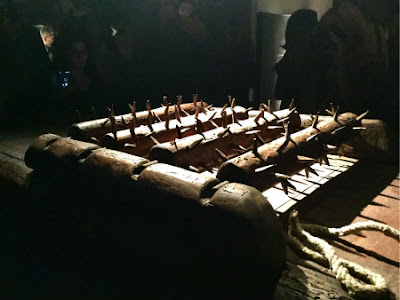
VENICE BLOG - Torture in Venice - Photo: Cat Bauer
Inside "Venice Secrets" - Photo: Cat Bauer
PRISON - Top Floor

On the top floor, you will find some instruments of torture, which are also displayed throughout the entire exhibition. Some are originals from private collections, and others are replicas. There is information about the infamous Inquisition prison of Narni, discovered by accident in 1979. Documents and diagrams about the construction of the prisons at Palazzo Ducale are on display. A replica of Giacomo Casanova's cell is up there, too, along with documents about the accusations against him from the Archives, and a lot more.

Water torture - modern-day replica for "Venice Secrets" exhibition - Photo: Cat Bauer
TORTURE - Third Floor

Apparently water torture has been around for centuries. Branding irons, instruments for slicing off hands, and the stocks were also used to punish certain types of crimes. There is a heavy bell collar that had to be worn while walking through the city streets, so that everyone would know the perpetrator had done wrong.

In Venice, at least in theory, suspects were only subjected to torture when ample evidence had been gathered against them and only when a confession was lacking. The Torture of the Rope was a Venetian favorite, which dislocated the shoulders.

VENICE INSIDER - Plastinated human body in "Venice Secrets" - Photo: Cat Bauer
Plastinated human body in "Venice Secrets" - Photo: Cat Bauer
THE DEATH PENALTY - Second Floor

The second floor details some of the many creative ways human beings have invented to put someone to death, including being boiled or burned alive, which was frowned upon in La Serenissima. The preferred method of capital punishment for the ordinary citizen in Venice was hanging. Beheading was considered less dishonorable, and used for the nobility.

But in practice, Venice considered the death penalty barbaric. It was not the go-to method for punishment. The total number of recorded executions carried out by the Venetian Republic from 810 to September 1791, and then by subsequent governments until 1804 -- nearly a thousand years -- came to 691. In contrast, the United States has put over 1,500 people to death since 1976 when the Supreme Court affirmed the legality of capital punishment -- just over 40 years.

It is also on this floor that you will find the "real human bodies." Actually, there is only one body, with the top of its head sliced off, and its interiors, organs, muscles and veins exposed. There is also a human leg that looks like a very large turkey drumstick except for the very human foot. There is half a head, and an arm complete with shoulder, all plastinated.

It is not as gruesome as it sounds. Venice placed great importance on the study of human anatomy, and required practitioners to attend at least one year inside the anatomy theatre of corpses in order to learn the causes of the most widespread diseases. In fact, in 1588, the nobleman Antonio Milledone, left his body to science, after suffering from severe respiratory illnesses.

Head crusher, 16th-18th century - Photo: Cat Bauer
THE INQUISITION - First Floor

It turns out that contrary to what had been believed to date, Venice fully backed the Inquisition, but controlled it in those limited cases in which its political, economical, and social interests were affected. The Roman Inquisition was created by the pope in 1542 as part of its Counter-Reformation against the spread of Protestantism, and included prosecution of those suspected of heresy, witchcraft, sorcery, and immorality, as well as the censorship of printed literature. The Inquisition even got Galileo, who had the audacity to claim that the earth revolved around the sun, and remained under house arrest until his death.

Chastity belt - 19th century
That is a very brief summary. There is much, much more to "Venice Secrets" at Palazzo Zarugi. In addition to the records of daring individuals like Casanova, Da Ponte, Paolo Sarpi, Veronica Franco, and Giordano Bruno, there are many riveting stories of ordinary citizens who tangled with Venetian justice and the Inquisition. It takes a minimum of an hour and a half to get through the entire exhibition, especially if you take the time to read the descriptions of the installations in addition to listening to the audio guide.

 “Venice Secrets" was curated by Davide Busato, a Venetian historian and writer who, in additional to his own publications, has co-authored a couple of books with another Venetian writer, Alberto Toso Fei. If the aim of the exhibition is to be "a cultural stimulus and a starting point towards further research among the endless itineraries of study offered by the State Archive of Venice," as stated by Giovanna Giubbini, Director of the State Archive of Venice, then "Venice Secrets" has achieved its goal.

"Venice Secrets" opened on March 31, and runs through May 1, 2018, from 10am to 10pm. The price of admission is €16 for adults, but there are plenty of discounts and reductions. Go to "Venice Secrets" for more information.

UPDATE - I have been informed that Venice Secrets is now part of two other provocation-sounding exhibitions at Palazzo Zaguri, which I have not yet seen:

Real Bodies - "The most complete exhibition in the world with over 50 whole bodies and 450 human organs. A special edition with anatomical findings inspired by Venice"

Human Art Exhibition. Leonardo da Vinci - "For the first time in the world an exhibition with real anatomical findings inspired by Leonardo da Vinci’s drawings and anatomical studies. An extraordinary and unprecedented journey to discover the human body through the eyes of universal genius."

Go to Palazzo Zaguri for more information.

Ciao from Venezia,
Cat Bauer
Venetian Cat - The Venice Blog

Sunday, March 18, 2018

Fulvio Roiter, the Late, Great Venetian Photographer at Tre Oci in Venice

Fulvio Roiter, Venezia, Squero di San Trovaso, 1970 © Fondazione Fulvio Roiter
(Venice, Italy) Today, Venice is one of the most photographed cities on the planet. Every year about 30 million tourists clutching smart phones descend upon the fragile environment and tweet images of her astonishing beauty to their followers and friends around the globe. 

More serious hobbyists armed with Leicas or Canons shoot the Venetian sunset, her bridges and monuments, or the color-coordinated laundry flapping in the breeze.

But long before the phenomenon of instant pictures shot by foreigners, Fulvio Roiter, one of Venice's own photographers, introduced the world to her beauty through his soulful lens.

La Casa dei Tre Oci on the island of Giudecca presents the first retrospective show of Fulvio Roiter, who died in Venice on April 18, 2016. Presented by the Fondazione di Venezia in partnership with the City of Venice, Fulvio Roiter Photographs 1948-2007 is a tribute to the photographer who, more than any other, has linked the image of Venice to his name. Curated by artistic director Denis Curti, the exhibit is also an act of love by the photographer, Lou Embo, who was Roiter's wife.

Fulvio Roiter, Miniera di zolfo in Sicilia, 1953 © Fondazione Fulvio Roiter
Fulvio Roiter was born on November 1, 1926 in Meolo, a small town in the municipality of Venice on the mainland.  He became interested in photography while studying to become a chemist. In 1948, he met Paolo Monti, one of the founders of the photography group, "La Gondola," a circle of photographers that still maintains a strong presence here in Venice.  

Roiter's attraction to photography coincided with the Italian Neo-realism cultural movement, the period after World War II in which film and photography focused on the larger social concerns of humanity.

"And so 1953 arrived. My father was becoming increasingly less tolerant and he gave me an ultimatum: either I went back to chemistry or else my enthusiasm for photography had to be turned into a money-earner. I was at a crossroads. I asked for one last chance. This: give me the minimum means and let me go to Sicily."

Fulvio Roiter, Venezia, Gondola seen from the Rialto Bridge, 1953 © Fondazione Fulvio Roiter
The exhibition includes 200 photos on three floors of Tre Oci, most of them vintage, that wind through the scope of Roiter's life, from his first attempts at photography during the neo-realism period, to his fascination with the beauty of the female nude, through his innovative pictures of Venice and her lagoon, as well as his journeys abroad to places like New Orleans, Iran, the Amazon, Mexico and Andalusia.

Fulvio Roiter, Venezia, Fondamenta delle Zattere, 1965 © Fondazione Fulvio Roiter
Roiter spent the first 25 years of his career shooting in only black and white, "with an uncompromising formal and compositional rigor and a technique rooted in contrast." He later used the same discerning technique when working with color.
 
"I have always considered black and white as the only yardstick for judging a photo. Colour can be arrived at by chance or by calculation; black and white, no." 

Fulvio Roiter


Fulvio Roiter, Venezia, Ponte dei Tre Archi, 1979 © Fondazione Fulvio Roiter

From the exhibition:

VENICE IN BLACK AND WHITE:
A SELF-PORTRAIT

"The heart and soul of Fulvio Roiter's work was Venice, the city that first invited his eyes to look through a viewfinder in order to bring to light what nobody had seen before. A magical city overflowing with history, the set for a film that had never been released but that soon everyone would want to see by walking along the alleys by the lagoon.

His photos had the power of a megaphone and managed to connect the city to the world. Venice was the research field where Roiter discovered his artistic identity precisely at the time when the city was being reborn through unusual and attractive images, through photographs that allowed the whole world to get to know its poetry and enchantment." 


There is also a beautiful 272-page hardcover book about the exhibition published by Marsilio in both Italian and English, with essays by Denis Curti and Italo Zannier, which states that it is "The most complete monograph ever published and the first after the death of the great Venetian photographer.

The photographs are organized into thematic sections: “Venice in Black and White,” “The Tree,” “Venice in Color,” “Italy in Black and White,” “Around the World” and “A Man Without Desires.” The book is available now if you visit the exhibition at Tre Oci, or you can pre-order it at Libro Co. Italia, at Rizzoli, or on Amazon, when it will be available on September 4, 2018. 

Fulvio Roiter. Fotografie 1948 - 2007 runs from March 16, 2018 through August 26, 2018. Go to La Casa dei Tre Oci for more information.

Ciao from Venezia,
Cat Bauer
Venetian Cat - The Venice Blog

Sunday, March 11, 2018

John Ruskin Returns to Venice

Self portrait with blue necktie by John Ruskin (1873) Morgan Library & Museum, NY
(Venice, Italy) John Ruskin (1819-1900) was one of the first foreigners who tried to "save Venice," a phenomenon that continues to this very day. An English art critic, writer, historian, artist and social reformer with a tormented personal life, Ruskin arrived in Venice with his wife, Effie, in the winter of November 1849 and stayed through March 1850, to research what would become his most famous work: The Stones of Venice.

Ruskin had been visiting Venice with his parents ever since he was a young man, which he described as "the paradise of cities," and would continue to do so throughout his life. At the time he arrived as a married man in 1849, the Venetians had just lost the Republic of San Marco, a revolutionary state that had lasted for 17 months (1848-1849) after Venice had declared her independence from the Habsburg Austrian Empire. On August 28, 1849, Austrian forces reconquered the city following a long siege. Ruskin was alarmed that Venice's fragile beauty would be lost forever, and worked diligently to document her monuments and stones.

"Venice is still left for our beholding in the final period of her decline: a ghost upon the sands of the sea, so weak, so quiet, so bereft of all but her loveliness, that we might well doubt, as we watched her faint reflection in the mirage of the lagoon, which was the City, and which the Shadow. I would endeavour to trace the lines of this image before it be for ever lost, and to record, as far as I may, the warning which seems to me to be uttered by every one of the fast-gaining waves that beat like passing bells against the Stones of Venice."

Ponte dei Pugni, Santa Fosca by John Ruskin (1849) - Ruskin Foundation
There are no works by John Ruskin in any Italian public collection, so everything in the excellent John Ruskin - The Stones of Venice exhibition at the Palazzo Ducale comes from major museums all over the world. The exhibition was conceived by Gabriella Bella, the Director of Venice's Civic Museums, and was curated by Anna Ottani Cavina with scenography by Pier Luigi Pizzi.

Divided into ten sections inside the Doge's apartment, the exhibition presents drawings, watercolors, writings and other marvels, including Ruskin's original manuscripts for The Stones of Venice never before exhibited and conserved at the Morgan Library & Museum in New York. The exhibition is the first major presentation in Italy of an artist who "crossed every border in the name of an interdisciplinary vision, which he practised even before the term itself was coined."

Venice, Punta della Dogana and Santa Maria della Salute by JMW Turner (1843) - National Gallery of Art, Washington
John Ruskin was the only child of two first cousins, born in London on February 8, 1819. His mother, Margaret, was four years older than his father, and gave birth to John Ruskin at age 38. She was English, a fervent Evangelical Christian, and insisted that Ruskin read the King James Bible over and again. His father, James, was a wealthy Scottish wine importer with a passion for art and literature. 

The Ruskins traveled frequently, taking their young son with them, exposing him to privileged international travel, foreign landscapes and the beauty of nature. He was precocious, which his parents encouraged. Ruskin graduated with a double degree in Classical Literature and Mathematics from Christ Church College, Oxford. He then went to live with his parents in Denmark Hill, south of the Thames, where he remained until his mother's death in 1871 at age 90.

On his 13th birthday, he received a copy of Samuel Roger's poem, Italy. The illustrations by J.M.W. Turner deeply affected him, beginning a life-long obsession with the artist's work. In fact, three magical paintings by Turner add zest to the exhibit: Venice and Venice: The Dogana and Santa Maria della Salute, both from the National Gallery of Art in Washington, D.C., and Venice, the Ceremony of the Doge Marrying the Sea from Tate Britain, London.

"He is the greatest artist who has embodied, in the sum of his work, the greatest number of the greatest ideas."

Portrait of Rose La Touche by John Ruskin (1860) - Ruskin Foundation
I didn't know much about Ruskin before I saw the exhibition, except for the scandal that continues to fascinate us 150 years later -- that he had never consummated his marriage with Effie Gray, which was annulled after six years. We will never know exactly what went wrong, but the most persistent rumor is that he was so used to seeing the nude female figure depicted by smooth classical statues, that he was shocked to discover that Effie had pubic hair.

The exhibition kicks off with a room full of portraits, some of Ruskin himself, and others of important women in his life. In addition to his strange marriage, Ruskin had another bizarre relationship with the opposite sex: a student, Rose La Touche, whom he met when she was nine-years-old and he was was about to turn 39. He eventually fell in love with her, and asked her parents if he could marry her. Warned off by Effie, who, by that time, had married the artist John Everett Mallais, Rose's parents refused.

Ruskin proposed again when Rose turned 18 and could decide for herself, but she again refused. Rose died at the age of 27 in a Dublin nursing home, probably of anorexia, which caused Ruskin to go a bit mad. He convinced himself that Vittore Carpaccio had included portraits of Rose in his paintings of Saint Ursula, delved into spiritualism, and tried to contact her spirit beyond the grave.

Rocks in unrest by John Ruskin (1886) - Morgan Library & Museum, NY - Photo: Cat Bauer
"These great cathedrals of the earth, with their gates of rock, pavements of cloud, choirs of stream and stone, altars of snow, and vaults of purple traversed by the continual stars."

In contrast to his tumultuous relationships with human beings, when it came to nature, Ruskin was in perfect sync. He believed that nature was the handiwork of God, and that you could see the fingerprint of God in the rocks, in the trees and in the mountains themselves. In the summer of 1845 and then again in 1858 and 1869, Ruskin retraced the route through the Alps that Turner had taken before him.

When Ruskin returned to Venice in 1876, he was disturbed by the enormous amount of restoration the city was undergoing. He was particularly concerned about the fate of the mosaics in the Basilica of San Marco. Of the entire facade, only the mosaics on the Northwest entrance that dated from the 13th century had survived, and risked being destroyed. He thought St. Mark's was "a jewelled casket, every jewel of which was itself sacred." 

In a letter to Count Zorzi in 1877, he wrote, "I... being in truth a foster-child of Venice; she has taught me all that I have rightly learned of the arts which are my joy; and of all the happy and ardent days, which, in my earlier life, it was granted to me to spend in this holy land of Italy, none were so precious as those which I used to pass in the bright recess of your Piazzetta, by the pillars of Acre; looking sometimes to the glimmering mosaics in the vaults of the church; sometimes to the Square, thinking of its immortal memories; sometimes to the Palace and the Sea."

Basilica of San Marco by John Ruskin (1879) - The British Museum, London - Photo: Cat Bauer
The exhibition focuses on "the nature of Gothic," and its rediscovery and celebration. From Wikipedia:

For Ruskin, the Gothic style in architecture embodied the same moral truths he sought to promote in the visual arts. It expressed the 'meaning' of architecture—as a combination of the values of strength, solidity and aspiration—all written, as it were, in stone. For Ruskin, creating true Gothic architecture involved the whole community, and expressed the full range of human emotions, from the sublime effects of soaring spires to the comically ridiculous carved grotesques and gargoyles. Even its crude and "savage" aspects were proof of "the liberty of every workman who struck the stone; a freedom of thought, and rank in scale of being, such as no laws, no charters, no charities can secure."
Classical architecture, in contrast, expressed a morally vacuous and repressive standardisation. Ruskin associated Classical values with modern developments, in particular with the demoralising consequences of the industrial revolution, resulting in buildings such as the Crystal Palace, which he criticised.[196] Although Ruskin wrote about architecture in many works over the course of his career, his much-anthologised essay "The Nature of Gothic" from the second volume of The Stones of Venice (1853) is widely considered to be one of his most important and evocative discussions of his central argument.

In all, Ruskin visited Venice eleven times between 1835 and 1888, documenting her palaces, monuments and stones, and the exhibition does a terrific job in taking us on a journey through his life and works by use of drawings, paintings, photos and excerpts from personal correspondence with friends and relatives. Venice has bewitched many suitors throughout the centuries, and Ruskin was one of her most passionate. In June, 1852, he wrote to his father from Verona: "I should like to draw all St. Mark's, and all this Verona, stone by stone, to eat it all up into my mind, touch by touch."

In addition to art and architecture, Ruskin had very strong views about social reform and politics, attacking industrial capitalism and formulating what would constitute the ideal community. When his father died in 1864, he inherited a fortune, which allowed him to put his strong political and social theories into practice.

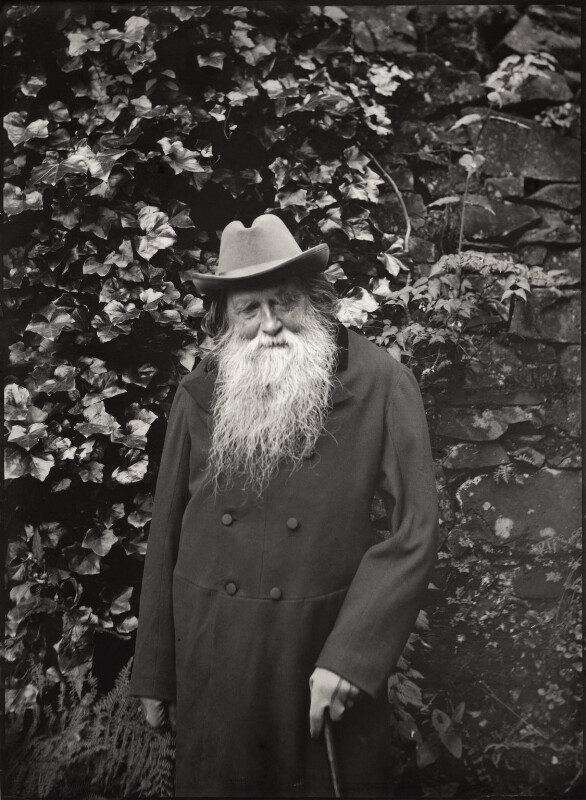
I spent a good two hours absorbing the exhibition, and could easily have spent more. Ruskin seemed to be a prolific, complicated genius, with a dark Victorian side. At the end of his life, he grew a long beard, and had frequent bouts of mental illness, haunted by the memory of Rose La Touche.

John Ruskin in 1892 - Photo by John McClelland - National Portrait Gallery, London
That is just the tip of what the exhibition has in store; there is much, much more. The thought-provoking John Ruskin - The Stones of Venice opened on March 10 and runs through June 10, 2018, and is a MUST SEE. Go to Palazzo Ducale for more information.

Ciao from Venezia,
Cat Bauer
Venetian Cat - The Venice Blog

Wednesday, March 7, 2018

Can #Generosity go Viral? FREESPACE - Venice's 16th International Architecture Exhibition

Light on the Doge's Palace - Photo: Shelley McNamara
(Venice, Italy) "The Beast from the East meets Storm Emma" stranded co-curators Yvonne Farrell and Shelley McNamara in Dublin on Friday, March 2, so they Skyped into the presentation of La Biennale's 16th International Architecture Exhibition. McNamara said they were sad not to be able to come to Venice, but observed how Nature -- the winds from Siberia hitting a storm in the Bay of Biscay -- was still running the show here on planet Earth.

Yvonne Farrell and Shelley McNamara are famous for working as a team. They live and work in Dublin, and co-founded the firm Grafton Architects in 1977. Grafton won the World Building of the Year Award in 2008 for the design of the new building for the Università Bocconi in Milan, as well as many other prestigious awards.

The Arts of La Biennale in 2018
The Arts of La Biennale 2018 - Click to englarge

Paolo Baratta, President of La Biennale di Venezia, said that it is we, the citizens, who create the historic center of a city, and that the Architecture Exhibition has two goals:
1. To complete the system of the arts that La Biennale is devoted to -- Art, Cinema, Theatre, Dance, Music -- by engaging in the most political of all the arts
2. To address the public with an informative as well as pedagogical-political function
Showing how something "can be done differently" is in itself a gesture against dependence and conformism.

Therefore, the goal is to promote the desire for architecture.

Giardini - Photo: Francesco Galli
Attendance by both professionals and the public at La Biennale's International Architecture Exhibition has exploded over the years, evolving into one of the most important events on the cultural calendar. There are 65 countries from around the globe that will participate, in addition to the 71 participants who have been invited by the curators. Farrell and McNamara's theme is FREESPACE, and they have written a Manifesto, which you can read in its entirety on La Biennale di Venezia website.

In addition to the 65 national pavilions and the 71 participants, there will be two Special Sections. The first is titled Close Encounter where 16 participants will present works inspired by well-known buildings of the past. The second is titled The Practice of Teaching in which 13 participants, many of whom are actively involved in teaching, will collect projects developed as teaching experiences. There will be Biennale Sessions for universities and institutes of higher learning. There will be educational experiences for students, children, families, adults, professionals and companies. For six months, FREESPACE will be a topic of discussion here in Venice that will resonate throughout the Earth. As architects, Farrel and McNamara see Earth as a client.

FREESPACE describes a generosity of spirit and a sense of humanity at the core of architecture's agenda, focusing on the quality of space itself. It provides the opportunity to emphasize nature's free gifts of light -- sunlight and moonlight, air gravity, materials -- natural and man-made resources.

Danish architect Jorn Utzon's concrete and tiled seat at the entrance of the house at Can Lis, Majorca is an example of an element molded perfectly to accommodate the human body. The sunlight on Palazzo Ducale in Venice is an example of a free gift of beauty from Nature.

Jorn Utzon's entrance seat at Can Lis - Photo by Beatrice Pedrotti
Farrell and McNamara relied on the FREESPACE Manifesto to put the Exhibition together, calling it a "robust tool." They revealed the list of participants on Friday, saying that it was wonderful to think that for months architects around the globe have been pondering and responding to the FREESPACE Manifesto, trying to dig deep and reveal the FREESPACE ingredient in their work.

"We believe that everyone has the right to benefit from architecture. The role of architecture is to give shelter to our bodies and to lift our spirits A beautiful wall forming a street edge gives pleasure to the passer-by, even if they never go inside. So, too, does a glimpse into a courtyard through an archway, or a place to lean against in the shade, or a recess which offers protection from the wind and rain."

There are seven countries that are participating in the Architecture Exhibition for the first time: Antigua & Barbuda, Saudi Arabia, Guatemala, Lebanon, Mongolia, Pakistan, and, most intriguingly -- the Holy See.

Aerial View of the Island of San Giorgio Maggiore 
photo by Alessandra Chemollo 
Curated by Francesco Dal Co, who was the Director of La Biennale's Architecture Exhibition in 1988 through 1991, the Holy See's pavilion will be set inside the mystical forest on the Island of San Giorgio Maggiore -- which is truly one of the most enchanting venues on the planet. Peaceful and serene, the island has been a haven for enlightened thinkers since the ninth century.

Inspired by Skogskapellet, or, "Woodland Chapel," a simple wooden structure built in 1920 by Gunnar Asplund in the Stockholm cemetery, Francesco Dal Co has selected ten architects to create their own personal chapels set in the woods. The chapels must be constructed so that they can be transported to places that lack their own houses of worship when La Biennale is over in November. (If you would like to learn more about the Island of San Giorgio Maggiore, I wrote an article for LUXOS.com entitled "A Heavenly Island in Venice - Where Humanism Meets Heaven.")

Personally, I can't wait until the Architectural Exhibition previews, which are on May 24 -25, so I can experience how the architects have incorporated FREESPACE into their work. Yvonne Farrell and Shelley McNamara ended their statement with an ancient Greek Proverb:

"A society grows great when old men plant trees whose shade they know they shall never sit in."

La Biennale di Venezia 16th International Architecture Exhibition will run from May 26 through November 25, 2018. Go to La Biennale di Venezia for more information.

Ciao from Venezia,
Cat Bauer
Venetian Cat - The Venice Blog

Wednesday, February 21, 2018

The Artist Behind that Famous Phallus - Marino Marini at the Peggy Guggenheim Collection in Venice

The Angel of the City by Marino Marini (1948) - Photo: Cat Bauer
(Venice, Italy) You know the statue. A rider with outstretched arms and an erect phallus astride a horse challenging the Grand Canal at the water entrance of Palazzo Venier dei Leone, also known as the Peggy Guggenheim Collection.

And now, thanks to an excellent exhibition at the Guggenheim entitled Visual Passions, you can learn more about the artist, Marino Marini (1901-1980), in the first retrospective dedicated to him.

Left - Etruscan art (early 1st century BCE)
Right - Portrait of Lucosius by Marino Marini (1935)
Photos: Cat Bauer
Marini was the most famous and admired Italian sculptor of the 20th century. Considered an "artist outside history," he was inspired by works from the ancient Etruscans and Greeks, to Eastern art, to Renaissance sculpture, to Auguste Rodin, to Henry Moore, to Pablo Picasso.

By mounting selections of his works next to those of his inspirations, the exhibition illustrates how he went through different stylistic phases and accepted challenges from many diverse subjects.

Horse by Marino Marini (1942) - Photo: Cat Bauer
His development of the theme of a rider and a horse brought Marini international acclaim. There are two galleries full of the dramatic equestrian wonders. When James Thrall Soby bought one Rider for the Museum of Modern Art in New York in 1948, Marini was on his way.

Portrait of Igor Stravinsky, second version (1951) Photo: Cat Bauer
And Marini was not just about horses. He sculpted both male and female nudes, and loved creating portraiture of his friends and acquaintances like Igor Stravinsky.

Peggy Guggenheim next to Angel of the City, 1960s
©Fondazione Solomon R. Guggenheim
fotoArchivio CameraphotoEpoche
donazione Cassa di Risparmio di Venezia 2005

There are more than 50 sculptures by Marino Marini on show, together with 20 additional inspirational works ranging from antiquity to the 20th century. 

Marino Marini. Visual Pleasures
is co-curated by Barbara Cinelli and Flavio Fergonzi, and runs through May 1, 2018. Go to the Peggy Guggenheim Collection for more information.

Ciao from Venezia,
Cat Bauer
Venetian Cat - The Venice Blog

Friday, February 9, 2018

Casanova & Friends - A Venice Carnival Seduction

Outside the Caffè Florian - Venice Carnival 2018 - Photo: Cat Bauer
Updated February 2026

(Venice, Italy) Together with Marco Polo, Giacomo Casanova is Venice's most famous hometown boy. In addition to his notorious reputation as a lover, Casanova was also a prolific and gifted author, as well as a spy, cleric, violinist, alchemist, Freemason, financier, gambler, traveler, adventurer, and prison escapee.

Casanova met everybody who was anybody in nearly all of Europe, including Catherine the Great and Benjamin Franklin. Even today, during Carnival, the wild, wonderful, seductive spirit of Casanova permeates the air. You can still sip a hot chocolate in Caffè Florian with your lover, just as Casanova did about 275 years ago.

Creatum: Civitas Ludes is the theme of the 2018 Carnival. Chosen by Marco Maccapani, the artistic director, it sort of translates to "Creativity: City of Games." 

Now, what Venice considers games might not be everyone's definition. It can include games of seduction, gambling, pranks, and mischief -- even exotic animals. And there are masks involved.

Playing cards printed by Antonio Moro (1841) Photo: Cat Bauer
Playing cards printed by Antonio Moro (1841)
Photo: Cat Bauer

Venice State Archive

The other day I went over to the Archivio di Stato to see what their offerings were for Civitas Ludes. The Venice State Archive is one of the largest in Italy, and preserves more than 1000 years of Venetian history covering about 80km (50 miles) of shelves. It is enormous, and located inside the former convent of Santa Maria dei Frari.

The Archive has dug up some intriguing official documents regarding the behavior of its citizens -- it is as if the FBI, the CIA and the US State Department released their files for public consumption under the Freedom of Information Act. 

In 1310, Venice created the Council of Ten to overcome the revolt against the Doge and the Republic by Bajamonte Tiepolo. The Council, composed of ten patrician magistrates, were elected to one-year terms by the Great Council. They had the power to impose punishments upon nobles, including banishment and the death penalty. It was supposed to be a temporary body, but became a permanent fixture by 1334. 

Over the centuries, its powers grew greater until it had almost unlimited authority over all governmental affairs, including Venice's diplomatic and intelligence services. The ten individuals became Venice's spy chiefs -- and Venice had a vast network of spies. (Centuries later, Casanova would become one of them.)

In 1539, an additional, even smaller unit was created: the State Inquisitors -- three super-secret judges who wore masks and had as much authority as the entire Council of Ten. They could independently try and convict those accused of treason -- and sentence people to exile, or even death. Needless to say, being called in front of the Council of Ten or the State Inquisitors was a terrifying prospect.

July 13, 1734-Council of Ten prohibits all lotteries whatsoever under penalty of 500 ducats Photo: Cat Bauer
July 13, 1734-Council of Ten prohibits all lotteries whatsoever under penalty of 500 ducats
Photo: Cat Bauer
On display at the State Archive is a document dated 1776 from the State Inquisitors by a confidant named Camillo Pasini, who reported on the gambling habits of the nobility. Another is dated 1580 from the Heresy Magistrates regarding the card-playing manner of the renowned courtesan, Victoria Franco.

But the most interesting document is one dated 1754 from the State Inquisitors about Casanova, who is called a card player and a "hyperbolate." Casanova had returned to Venice the year before from his own Grand Tour, and was under surveillance due to his wild escapades, and association with Freemasonry and secret rites.

The next year, on July 26, 1755, at age 30, Casanova would be arrested for affront to religion and common decency, and thrown into the Piombi prison in Palazzo Ducale, from which he would make a daring escape. He romped throughout Europe, from one escapade to another. After 18 years of exile, the State Inquisitors of La Serenissima allowed Casanova to return to Venice in September 1774 — when he became a spy for Venice.

We know a lot about Casanova because he wrote a terrific erotic memoir called, The Story of my Life, which you can read for free in English as an ebook thanks to Project Gutenberg. Because Casanova is such a clever writer, I thought my readers might enjoy an excerpt from the man himself.

Casanova describes an adventure that he and his gang-of-eight had during Carnival 1745 -- ten years before his imprisonment -- when they snatched a pretty young woman away from her husband and his two friends and seduced her at Do Spade (near Rialto, where you can still have a drink to this very day) -- much to her enjoyment. She did file a complaint with the Council of Ten -- not because of the orgy, to which, according to the complaint, she had willingly succumbed -- but because she was frightened about the welfare of her husband.

Here's Casanova, in his own words, translated into English by Arthur Machen:


Excerpt from A Story of My Life

We were seven, and sometimes eight, because, being much attached to my brother Francois, I gave him a share now and then in our nocturnal orgies. But at last fear put a stop to our criminal jokes, which in those days I used to call only the frolics of young men. This is the amusing adventure which closed our exploits. 


In every one of the seventy-two parishes of the city of Venice, there is a large public-house called ‘magazzino’. It remains open all night, and wine is retailed there at a cheaper price than in all the other drinking houses.

People can likewise eat in the ‘magazzino’, but they must obtain what they want from the pork butcher near by, who has the exclusive sale of eatables, and likewise keeps his shop open throughout the night. The pork butcher is usually a very poor cook, but as he is cheap, poor people are willingly satisfied with him, and these resorts are considered very useful to the lower class.

The nobility, the merchants, even workmen in good circumstances, are never seen in the ‘magazzino’, for cleanliness is not exactly worshipped in such places. Yet there are a few private rooms which contain a table surrounded with benches, in which a respectable family or a few friends can enjoy themselves in a decent way. 


It was during the Carnival of 1745, after midnight; we were, all the eight of us, rambling about together with our masks on, in quest of some new sort of mischief to amuse us, and we went into the magazzino of the parish of Santa Croce to get something to drink. We found the public room empty, but in one of the private chambers we discovered three men quietly conversing with a young and pretty woman, and enjoying their wine. 

Our leader, a noble Venetian belonging to the Balbi family, said to us, “It would be a good joke to carry off those three blockheads, and to keep the pretty woman in our possession.”

He immediately explained his plan, and under cover of our masks we entered their room, Balbi at the head of us. Our sudden appearance rather surprised the good people, but you may fancy their astonishment when they heard Balbi say to them: “Under penalty of death, and by order of the Council of Ten, I command you to follow us immediately, without making the slightest noise; as to you, my good woman, you need not be frightened, you will be escorted to your house.”

When he had finished his speech, two of us got hold of the woman to take her where our leader had arranged beforehand, and the others seized the three poor fellows, who were trembling all over, and had not the slightest idea of opposing any resistance. 


The waiter of the magazzino came to be paid, and our leader gave him what was due, enjoining silence under penalty of death. We took our three prisoners to a large boat. Balbi went to the stern, ordered the boatman to stand at the bow, and told him that he need not enquire where we were going, that he would steer himself whichever way he thought fit. Not one of us knew where Balbi wanted to take the three poor devils. 

He sails all along the canal, gets out of it, takes several turnings, and in a quarter of an hour, we reach San Giorgio where Balbi lands our prisoners, who are delighted to find themselves at liberty. After this, the boatman is ordered to take us to Saint Genevieve, where we land, after paying for the boat. 
 
We proceed at once to Palombo Square, where my brother and another of our band were waiting for us with our lovely prisoner, who was crying. 

“Do not weep, my beauty,” says Balbi to her, “we will not hurt you. We intend only to take some refreshment at the Rialto, and then we will take you home in safety.” 

“Where is my husband?” 

“Never fear; you shall see him again to-morrow.” 

Comforted by that promise, and as gentle as a lamb, she follows us to Do Spade. We ordered a good fire in a private room, and, everything we wanted to eat and to drink having been brought in, we send the waiter away, and remain alone.

We take off our masks, and the sight of eight young, healthy faces seems to please the beauty we had so unceremoniously carried off. We soon manage to reconcile her to her fate by the gallantry of our proceedings; encouraged by a good supper and by the stimulus of wine, prepared by our compliments and by a few kisses, she realizes what is in store for her, and does not seem to have any unconquerable objection.

Our leader, as a matter of right, claims the privilege of opening the ball; and by dint of sweet words he overcomes the very natural repugnance she feels at consummating the sacrifice in so numerous company. She, doubtless, thinks the offering agreeable, for, when I present myself as the priest appointed to sacrifice a second time to the god of love, she receives me almost with gratitude, and she cannot conceal her joy when she finds out that she is destined to make us all happy.

My brother Francois alone exempted himself from paying the tribute, saying that he was ill, the only excuse which could render his refusal valid, for we had established as a law that every member of our society was bound to do whatever was done by the others. 


After that fine exploit, we put on our masks, and, the bill being paid, escorted the happy victim to San Giobbe, where she lived, and did not leave her till we had seen her safe in her house, and the street door closed.

My readers may imagine whether we felt inclined to laugh when the charming creature bade us good night, thanking us all with perfect good faith! 


From the Archives 1754: State Inquisitors re: Giacomo Casanova Photo: Cat Bauer
From the Archives 1754: State Inquisitors re: Giacomo Casanova
Photo: Cat Bauer
Two days afterwards, our nocturnal orgy began to be talked of. The young woman’s husband was a weaver by trade, and so were his two friends. They joined together to address a complaint to the Council of Ten.

The complaint was candidly written and contained nothing but the truth, but the criminal portion of the truth was veiled by a circumstance which must have brought a smile on the grave countenances of the judges, and highly amused the public at large: the complaint setting forth that the eight masked men had not rendered themselves guilty of any act disagreeable to the wife.

It went on to say that the two men who had carried her off had taken her to such a place, where they had, an hour later, been met by the other six, and that they had all repaired to Do Spade, where they had spent an hour in drinking. The said lady having been handsomely entertained by the eight masked men, had been escorted to her house, where she had been politely requested to excuse the joke perpetrated upon her husband. 


The three plaintiffs had not been able to leave the island of San Giorgio until day-break, and the husband, on reaching his house, had found his wife quietly asleep in her bed. She had informed him of all that had happened; she complained of nothing but of the great fright she had experienced on account of her husband, and on that count she entreated justice and the punishment of the guilty parties. 

That complaint was comic throughout, for the three rogues shewed themselves very brave in writing, stating that they would certainly not have given way so easily if the dread authority of the council had not been put forth by the leader of the band.

The document produced three different results; in the first place, it amused the town; in the second, all the idlers of Venice went to San Giobbe to hear the account of the adventure from the lips of the heroine herself, and she got many presents from her numerous visitors; in the third place, the Council of Ten offered a reward of five hundred ducats to any person giving such information as would lead to the arrest of the perpetrators of the practical joke, even if the informer belonged to the band, provided he was not the leader. 


The offer of that reward would have made us tremble if our leader, precisely the one who alone had no interest in turning informer, had not been a patrician. The rank of Balbi quieted my anxiety at once, because I knew that, even supposing one of us were vile enough to betray our secret for the sake of the reward, the tribunal would have done nothing in order not to implicate a patrician. There was no cowardly traitor amongst us, although we were all poor; but fear had its effect, and our nocturnal pranks were not renewed. 

Three or four months afterwards the chevalier Nicolas Ferro, then one of the inquisitors, astonished me greatly by telling me the whole story, giving the names of all the actors. He did not tell me whether any one of the band had betrayed the secret, and I did not care to know; but I could clearly see the characteristic spirit of the aristocracy, for which the ‘solo mihi’ is the supreme law. 
 
From The Story of My Life by Giacomo Casanova.

Venice Carnival 2018, Piazza San Marco - Photo: Cat Bauer
Now it's Cat again. So the crime was not the orgy, which the woman had apparently enjoyed, but that she was caused unnecessary fright because she thought her husband had been arrested by the Council of Ten. 
Luckily for Casanova and the gang the accusation took place during Carnevale, when conventions are flipped on their heads. Otherwise, I think the Council of Ten would not have been amused that they had been impersonated by Balbi, a young member of the aristocracy, or that Casanova went along for the ride. 

Go to the official site for the program of Carnevale di Venezia.

Ciao from Venezia,
Cat Bauer
Venetian Cat - The Venice Blog