Sunday, October 27, 2019

Adam & Eve + Mars Get Complete Makeovers and New Lodgings Thanks to Peter Marino & Toto Bergamo Rossi of Venetian Heritage

Adam & Eve + Mars by Antonio Rizzo, restored by Venetian Heritage - Photo: Cat Bauer
Adam, Mars & Eve by Antonio Rizzo - Photo: Cat Bauer
(Venice, Italy) Adam & Eve and their friend Mars were in very bad shape. The three icons, crucial to the story of humanity, were showing their age. The marble masterpieces had been created by the Veronese sculptor, Antonio Rizzo, more than 500 years ago, and needed some nips and tucks. 

For centuries, they had adorned the Foscari Arch outside in the courtyard of the Doge's Palace opposite the Giants' Staircase, the official entrance to the palace, also designed by Rizzo. The weather in Venice was corroding their bones.

As the years ticked by, the white marble turned to black due to atmospheric pollution. Fingers and toes cracked. Adam broke an arm. At the beginning of the 20th century, Eve was brought inside and replaced by a bronze copy. After World War II, between 1953 and 1955, Adam and Mars were also replaced. The originals were better off inside but they still were black and broken.

Peter Marino & Toto Bergamo Rossi
Photo: Cat Bauer
Enter art restorer Toto Bergamo Rossi, the Director of  Venetian Heritage, a non-profit organization dedicated to safeguarding the cultural legacy of the Venetian Republic. Bringing the marble trio back to their former glory became one of his missions. 

Toto spoke to the American architect, Peter Marino, the new Chairman of Venetian Heritage and said they would need about €225,000. Peter was convinced that the restorations were vital after Toto told him that Adam & Eve were the first nude free-standing public statues in the Republic of Venice.

Venice, Italy - Jonathan Hoyte & Peter Marino - Photo: Cat Bauer
Jonathan Hoyte & Peter Marino - Photo: Cat Bauer
The restoration team was headed by Jonathan Hoyte, an American restorer. When I first saw Jonathan at the presentation on Friday, October 25, I recognized him immediately -- he had been part of the first Cleaning Day in Venice in 2012 when a group of volunteers organized by Masegni & Nizioleti removed graffiti from a building off Strada Nuova. I told him I didn't realize back then that he was a professional!

Jonathan said that the statues were black because of pollutants and previous restoration treatments -- there were even remnants of wax from when the plaster molds to create the replicas were made -- and that they had tried several methods to remove the grime. 

They finally settled on a laser treatment, the type they use to remove tattoos. It is astonishing how the laser removed the black layers, restoring the precious Carrara marble to a beautiful sheen.

Cleaning Eve - Photo courtesy Venetian Heritage
The statues looked so impressive standing there in the Sala dello Scrutinio, the great hall where elections were held during the Venetian Republic, that Gabriella Belli, the Director of Venice's Civic Museums, said that there is where they will stay.

Venice, Italy - Sala dello Scrutinio, Palazzo Ducale Photo: Cat Bauer
Sala dello Scrutinio, Palazzo Ducale, Venice - Photo: Cat Bauer
So not only did Adam, Eve, and Mars get complete makeovers, but they also got grand new lodgings -- another reason to visit the Doge's Palace. 

Thank you Venetian Heritage for bringing the statues back to life. Go to Palazzo Ducale for more information.

Ciao from Venezia,
Cat Bauer
Venetian Cat - The Venice Blog

Friday, October 18, 2019

Venice Fashion Week Kicks off with "The Very Last Layer" by Romi Loch Davis

Giulia Mazzon in "The Very Last Layer" by Romi Loch Davis - Photo: Cat Bauer
(Venice, Italy) Venice Fashion Week kicked off with L'Ultimo Spessore (The Very Last Layer), a poignant tableau vivant by South African fashion designer, Romi Loch Davis. The standing-room-only audience at the intimate Magazzino Gallery of Palazzo Contarini Polignac was entranced as layer upon layer of Romi's unique designs were revealed until only an elegant chemise remained.

It was a poem created from fabric.

CONSTRUCTIONS ...    INTERIORITY

you tailored a robe
of many colours for me
a biblical gesture
layer by layer
piece by piece
texture by texture
the seams were painfully frayed
weak defenses
tacked together
like crests
almost scars

you were engraved in me 

---Romi Loch Davis

L'Ultimo Spessore by Romi Loch Davis - Photo: Cat Bauer
Romi's wistful text was read by actress Rosanna Mantese, while the haunting notes of  violinist Luisa Bassetto accented the story of lost love and the discovery of hidden fire: "The ultimate depth. The regenerating footprint of love." 

Giulia Mazzon moved from fragile-and-desperate to brave-and-hopeful as Luna Pesce removed each layer of clothing, attaching and detaching angel wings... a gauntlet... a crown.

Skeleton of my Soul from L'Ultimo Spessore by Romi Loch Davis - Photo: Cat Bauer
Perhaps the most moving passage was a section entitled SKELETON OF MY SOUL, in which the model was stripped down until she wore only a seamstress's pattern, "the essential layer, the underlying layer of myself..."

Romi Loch Davis (right) with Gigi Bon - Photo: Cat Bauer
It was a beautiful start to Venice Fashion Week, now in its ninth year, which has been growing ever more impressive. A project by Venezia da Vivere, "Venice Fashion Week presents sustainable, tailored, Made in Italy and international fashion through fashion shows, conferences and exhibitions taking place in hotels, art galleries, boutiques and artisan ateliers."

Venice Fashion Week runs through October 26 and is part of Le Città in Festa cultural program of the City of Venice, and actively shares the #enjoyrespectvenezia commitment. Go to Venice Fashion Week for the calendar, map and further information.

Ciao from Venezia,
Cat Bauer
Venetian Cat - The Venice Blog

Monday, October 14, 2019

#VeniceBooks: "L'Antipapa Veneziano" by Gianmaria Donà Dalle Rose - Venice vs. Rome -The Battle Between Church and State

Galileo displays his telescope to Doge Leonardo Dona and the Venetian Senate (painting by HJ Detouche, c. 1754)
(Venice, Italy) When Galileo Galilee first invented his telescope back in 1609, within 24 hours, on August 21, he was with Doge Leonardo Donà and his advisors demonstrating his new invention at the top of the Campanile in Piazza San Marco in Venice. Galileo had been brought there by Fra Paolo Sarpi, the cutting edge Venetian theologian and humanist. 

As Doge Donà gazed at the ships far away on the Adriatic sea, Galileo emphasized the tactical advantages of being able to see enemy ships hours sooner than with the naked eye.

Galileo would go on to discover the moons of Jupiter and observe the rings of Saturn. His discoveries confirmed the Copernican theory that the Earth and other planets revolved around the Sun. 

This put him in direct conflict with the Roman Catholic Church, who taught that the Earth was the center of the universe. He was condemned for heresy, and lived out his days under house arrest. Unbelievably, it wasn't until 1992 that the Church admitted its treatment of Galileo had been wrong. 

This is an example of the dark power the papal authority had over Catholic Europe during the time of Doge Leonardo Donà.

Gianmaria Donà Dalle Rose at Ateneo Veneto - Photo: Cat Bauer
Gianmaria Donà Dalle Rose presented his book L'Antipapa Veneziano (The Venetian Anti-Pope) about his ancestor, Leonardo Donà (1536-1612), the 90th Doge of Venice, to a packed house at Ateneo Veneto on Thursday, October 10th, supported by authors Ario Gervasutti and Walter Mariotti. 

Doge Donà was the leader of the Republic of Venice from January 10, 1606 until his death on July 16, 1612. During his rule, the battle between Church and State came roaring to a head.

THE CONFLICTS & THREAT OF EXCOMMUNICATION 

Under Donà's predecessor, Doge Marino Grimani, two clerics had been tried, convicted and imprisoned in Venice for crimes such as rape, fraud and murder. This was a shock to the system, as previously members of the clergy had always had Vatican immunity. 

Pope Paul V declared that the clergy were outside the jurisdiction of the Venetian Republic, and demanded that the prisoners be handed over to the ecclesiastical authorities, who would take whatever action they deemed appropriate. Venice knew that if they released the prisoners to the jurisdiction of the Vatican, their crimes would go unpunished.

Venice had also challenged the Holy See by passing a law restricting Church building -- in a small island city like Venice there were already numerous ecclesiastical buildings, which paid no tax -- there was room for no more -- but Pope Paul V wanted the law repealed. 

During the fall of 1605, these arguments raged on, growing exceedingly more heated as the year drew to an end.

LEONARDO DONÁ BECOMES DOGE OF VENICE

Doge Grimani died in 1605 on Christmas day, the same day that a missive from Pope Paul V arrived. Leonardo Donà was elected Doge on January 10th. 

In addition to being a seasoned diplomat, Donà was part of a group of scientific thinkers who met regularly in Venice, whose members also included Galileo and Fra Paolo Sarpi. 

Even though he was a Catholic prelate, Sarpi was a firm believer in the separation between Church and State. Sarpi was appointed official counselor to the Venetian Senate, and drafted the replies to the papal briefs.

Both sides refused to budge. Pope Paul V was outraged, and called Venice's actions heresy. 

The Holy See ordered Venice to hand over the clerics or face banishment. 

On April 17, 1606, Pope Paul launched a Bull of interdict and excommunication, warning that if Venice did not submit all Venetian churches would be locked up and no Masses could be celebrated; no baptisms, marriages or funerals would be sanctified; children would be considered illegitimate, marriages declared invalid; and citizens would not be obligated to pay taxes. 

Venice was given 24 plus 3 days to submit or the Pope would excommunicate La Serenissima.

In response, Venice doubled down. 

They threw out the Papal Nuncio, the Vatican's Ambassador to Venice. Doge Donà retorted that as Doge of Venice, in temporal affairs he recognized no superior power except the Divine Majesty itself and told all the patriarchs, archbishops, bishops, vicars, abbots and priors throughout the territory of the Republic to continue to celebrate the Mass. 

On Sarpi's advice, Donà banished all the Jesuits, Theatines and Capuchins from the Republic of Venice, declaring: "We ignore your excommunication: it is nothing to us."

Venice had been excommunicated in the past. This time she was challenging the Holy See's authority in secular matters. In spiritual matters, Venice wanted to remain part of the Church. 

Paolo Sarpi wrote countless letters and held endless debates, defining the boundaries between what fell under celestial matters of the Church, and what were secular matters of the State. He was called before the Inquisition, but refused to appear.

The clergy in Venetian territory continued to celebrate Mass; the churches were teeming with more worshipers than ever. There was fear that Venice would break with Rome, risking civil war in Italy. Other nations began taking sides. 

It was decided that France would mediate. In April 1607, a compromise was reached, and Pope Paul V lifted the Interdict. Venice agreed to release the two clerics to the French Ambassador, but reserved the right to judge and punish them. They refused to let the Jesuits return. 

Venice, under Doge Donà, had won the battle between Church and State. It was the last Interdict in the history of the Church.

L'Antipapa Veneziano by Gianmaria Donà Dalle Rose published by Giunti Editore
On October 5, 1607, Paolo Sarpi was stabbed fifteen times, with three serious wounds to his neck and temple, but miraculously survived the attack. The would-be assassins fled to Rome, where they moved openly and freely, and were never charged. 

Unsurprisingly, it was learned that Pope Paul V was behind the assassination attempt. Two more attempts were made on Sarpi's life, which he also survived. 

Sarpi died in his own bed on January 15, 1623. His last words were "Esto Perpetua" -- "may she endure forever," referring to the Republic of Venice. 

These words were recalled in an 1820 letter by John Adams to Thomas Jefferson when Adams wrote "I wish as devoutly as Father Paul for the preservation of our vast American empire and our free institutions."

On July 16, 1612, Doge Leonardo Donà collapsed during a heated debate in the Collegio, the main executive body of the Republic of Venice, and died an hour later at the age of 76.

Gianmaria Donà Dalle Rose signing L'Antipapa Veneziano - Photo: Cat Bauer
That's a brief part of the story. For the rest, we'll have to read the book. 

The Donà family can trace its origins back to the beginnings of Venice. It is astounding that members of the noble family still exist today, and that one of them has written a book about his distinct ancestor. 

Right now, L'Antipapa Veneziano, published by Giunti Editore, is only available in Italian. I am looking forward to reading the English edition when it comes out and learning more about the life of Doge Leonardo Donà and the critical times in which he lived. 

Bravo Gianmaria!

Ciao from Venezia,
#VeniceBooks
Cat Bauer
Venetian Cat - The Venice Blog

Monday, September 23, 2019

The Legacy of Peggy Guggenheim - The Last Dogaressa of Venice


Peggy Guggenheim at Home in Palazzo Venier dei Leoni 
Photo courtesy Peggy Guggeheim Collection 
Peggy Guggenheim in the dining room of Palazzo Venier dei Leoni, Venice, mid 1960s. 
On the left wall, Vasily Kandinsky, Landscape with Red Spots, No. 2 (Landschaft mit roten Flecken, Nr. 2), 1913. 
On the back wall, at center, Umberto Boccioni, Dynamism of a Speeding Horse + Houses  
(Dinamismo di un cavallo in corsa + case), 1915.  
The Solomon R. Guggenheim Foundation. Photo Archivio Cameraphoto Epoche. Gift, Cassa di Risparmio di Venezia, 2005.
.
(Venice, Italy) Karole Vail, the curator of The Last Dogaressa, continues the legacy of her renowned grandmother, Peggy Guggenheim, by celebrating her Venetian life. Karole stepped into the ruby slippers in 2017 when she became the director of the Peggy Guggenheim Collection, one of the most visited museums of modern art in all of Italy. The daughter of Sindbad Vail, Peggy's son with her first husband, Laurence Vail, Karole reigns judiciously over Palazzo Venier dei Leoni, once Peggy's own home on the Grand Canal, which houses her collection.

Alchemy by Jackson Pollock at Peggy Guggenheim: The Last Dogaressa - photo by Cat Bauer
The hypnotic Alchemy by Jackson Pollock - Photo: Cat Bauer
The exhibition focuses on Peggy's collecting after 1948 when she closed Art of This Century, her museum-gallery in New York City, packed up her mind-blowing collection, and moved to Venice. That year, Peggy was invited to exhibit her artists at the 24th Venice Art Biennale. The exhibit kicks off with a tribute to the works of art that Peggy put on show in the Greek Pavilion, which created a sensation -- after the end of WWII, it rocked the world with its young American Abstract Expressionists, including Jackson Pollock's European debut -- Arshile Gorky, Robert Motherwell, Mark Rothko, Irene Rice Pereira and Clyfford Still are all there. We get a peek into Peggy's scrapbooks, including the June 11, 1948 note from the former Consul General of Greece in Venice, typos and all.


In July 1949, Peggy acquired Palazzo Venier dei Leoni, an 18th-century unfinished palace on the Grand Canal. Wasting no time, she opened her garden to the public in September with Exhibition of Contemporary Sculpture. The exhibition marks its 70th anniversary with works by artists such as Jean Arp, Constantin Brancusi and Alberto Giacometti.

Soon Peggy began a new phase in her collecting -- Italian artists. She scooped up Edmondo Bacci, Piero Dorazio, Emilio Vedova and Tancredi Parmeggiani, putting Tancredi under contract, the only artist besides Jackson Pollock to gain that distinction.

There is a section devoted to the CoBrA group -- artists from Copenhagen, Brussels and Amsterdam -- contemporary British art, and highlights of Op and Kinetic Art, which used geometric forms and industrial materials to create optical effects and illusions. More than 60 works by famous and lesser-known artists are on display, including paintings, sculptures and works on paper -- everyone from Francis Bacon to René Magritte to to Heinz Mack to Henry Moore.

Sphere by Franco Costalonga - Photo: Cat Bauer
Concurrently with The Last Dogaressa, Palazzo Venier dei Leoni is displaying works that Peggy bought between 1938 -- when she opened Guggenheim Jeune, her very first gallery in London -- and 1947, when she moved to Venice, so you have the chance to see her collection almost in its entirety. Marcel Duchamp's masterpiece, the first Box in a Valise, is so fragile that it is rarely on view to the public, but after a fresh conservation campaign, it is there waiting for you to admire.

Francesca Lavazza and Karole Vail at Peggy Guggenheim: The Last Dogaressa - photo by Cat Bauer
Francesca Lavazza & Karole Vail - Photo: Cat Bauer
The exhibition is made possible thanks to the support of Lavazza, that famous Italian coffee. Another hard-working heiress born into a legendary family, Francesca Lavazza, great-grandaughter of founder Luigi Lavazza, was on hand for the opening. Lavazza was established in Turin in 1895, three years before Peggy Guggenheim was born.

Francesca said, "Peggy Guggenheim not only left an indelible mark on Twentieth Century culture, but also changed the role of women in the art world: a woman who said of herself, 'I am not an art collector. I am a museum,' testifying to how individual passion can be a revolutionary factor for society as a whole."

Peggy Guggenheim: The Last Dogaressa runs from September 21, 2019 until January 27, 2020. Go to the Peggy Guggenheim Collection for more information.

Ciao from Venezia,
Cat Bauer
Venetian Cat - The Venice Blog

Wednesday, September 11, 2019

Quickie Recap of the Venice Film Festival 2019 - New Movies on the Horizon

Waiting for the stars at the Venice Film Festival - Photo: Cat Bauer
(Venice, Italy) Attending the Venice Film Festival is like traveling to another world, a place where cultures from all over the globe present their unique views of life. It is a place to be entertained, a place to learn, and a chance to meet people from many different countries -- people who can travel and speak freely, as well as people who have trouble getting a visa just to attend. It is about freedom of expression, and how important that freedom is for humanity to thrive.

La Biennale di Venezia has made it easier for those not connected to the film industry to attend screenings, with accreditation for students 26 and under, and those over 60, in addition to the single tickets that can be purchased for a specific film. At the major screenings in the Sala Grande, the public watches the movie with the stars themselves.

I didn't get to see as many movies as I would have liked this year, but here is a short recap of the ones I did see, with letter grades.

1. Joker

I thought Joker was a exceptional, and wrote about it here: Joker is a Masterpiece - Winner of Venice's Golden Lion, Coming Soon to a Theater Near You. Joquin Phoenix is brilliant. Winner of the Venice Film Festival's top prize. Grade: A

2. J'Accuse - An Officer and a Spy

The Venice Film Festival was criticized by several members of the international press for including Roman Polanski's film in its lineup. But the film is excellent and well-researched. It is the story of the famous Dreyfus Affair in France, when an innocent Jewish artillery officer was convicted of treason. The story is told from the point of view of Georges Picquart, the head of counter-intelligence, who refused to buckle under political pressure to keep the status quo. J'Accuse won the Silver Lion Grand Jury Prize. The film is in French. Read the review at The Guardian. Grade: A-

3. Roger Waters Us + Them

Roger Waters celebrated his 76th birthday at the Venice Film Festival with his film Us + Them, which was recorded during his concert tour in Amsterdam last year. The film is so powerful that I have to remind myself that I was not actually at the live concert because it feels like I was there. The film is only screening at select theaters around the world on a couple of dates in October, and promises “state-of-the-art visual production and breath-taking sound" -- a promise I can assure you it fulfills. Here's the link to the Us + Them booking site to see if you can score tickets. Grade: A

Roger Waters - Us + Them - Photo: Maxim Italia
4. The Burnt Orange Heresy

Slick, intriguing and elegant. The dark side of the art world. Starring Claes Bang, Elizabeth Debicki, Donald Sutherland and Mick Jagger. See the review at The Hollywood Reporter. Grade B+

5. Marriage Story 

The story of a Hollywood divorce, starring Adam Driver and Scarlett Johannson. I thought it was terrific, and wrote about it here: I Loved Marriage Story! A Film about Divorce at the Venice Film Festival. Grade: A

6. Ad Astra

Brad Pitt as an astronaut with father issues. I thought it was way too slow, but a lot of critics liked it. A man's movie. Read the review at Variety. Grade: B-

7. La Vérité - The Truth

This French film starring two of my favorite actresses, Catherine Deneuve and Juliette Binoche, by the Japanese director, Hirokazu Kore-eda, is basically about the relationship between a movie star and her screenwriter daughter. It was a bit too cutesy, and I couldn't really connect. Read the review at The Hollywood Reporter. Grade: C

8. Seberg

Kristin Stewart is terrific as actress Jean Seberg who was outrageously and illegally targeted by the FBI in the late 60s for her involvement with the Black Panthers. The film has flaws, but it is interesting to confirm that there are people in the United States government who abuse their power and actually enjoy destroying the lives of civilians. Read the review at Variety. Grade: B+

9. The Laundromat

Stephen Soderbergh attempts to explain the Panama Papers and why there is such a gap between the super-rich and the rest of us. Answer: they are a bunch of crooks. Starring Meryl Streep, Gary Oldman and Antonio Banderas. Soderbergh spoke about how quickly he shot the film, and it shows. Don't see it in the theater; wait for it on Netflix and don't miss the Meryl Streep surprise at the end. Read the review at ScreenDaily. Grade: B-

10. Citizen K

I always enjoy Alex Gibney's documentaries. This one is about Russian oligarch, Mikhail Khodorkovsky, who was actually at the Venice Film Festival. I was surprised to learn that there were only seven oligarchs that controlled half of Russia's economy. Read the review at Variety. Grade: B

Lily Rose Depp & Timothée Chalamet - Photo by
Vittorio Zunino Celotto Getty Images
at Harper's Bazaar
11. The King

What makes The King fascinating to watch is Timothée Chalamet as Henry V. A lot of critics didn't like it, but I agree with Owen Gleiberman at Variety. And by the reaction of the fans on the Red Carpet, I think Gleiberman is right. Grade: B+

Handsome is the wrong word for this actor. He’s beautiful, and the camera drinks him in. “The King” gives Chalamet one of the choicest roles he’s had, but when you take an actor who looks like this and cast him as a young king, it’s not just about how fascinating the role is — the film is capturing the elevation of his stardom. And Timothée Chalemet, I predict, could be the biggest movie star of his generation. As he demonstrates in “The King,” he’s got it — not just the talent (though he’s a superb actor), but the ability to fix an audience with his stare, so that even when he’s doing nothing much at all, what he’s looking at or thinking about becomes the story the movie is telling.

12.  Saturday Fiction

I was completely confused while watching this black and white spy thriller set in Shanghai on the days leading up to Pearl Harbor on December 7, 1941 until I realized it was a story within a story, or rather, within a play. Gong Li is another one of my favorite actresses, and she is riveting to watch. Read the review at Indiewire. Grade: B-

13. Waiting for the Barbarians

At the press conference, Johnny Depp said, "there is no sadist without the masochist." There is some pretty gruesome torture going on in this film about colonists keeping their control over "barbarians" set in an unnamed country. Read the review at The Guardian. Grade: B+

Sunset in Venice - Photo: Cat Bauer
The process of how a movie evolves from creation to execution to critical response to the eyes of the audience is fascinating. By the time we get to watch a film, it has been through its own drama. That human beings have even figured out how to make movies, and that we love to watch them, is one of life's most mysterious and exciting wonders.

Ciao from Venezia,
Cat Bauer
Venetian Cat - The Venice Blog

Monday, September 9, 2019

Joker is a Masterpiece - Winner of Venice's Golden Lion, Coming Soon to a Theater Near You

Joaquin Phoenix as JOKER - Photo: Nico Tavernise
(Venice, Italy) Joker is a masterpiece. In a few weeks, on October 4, those in the States will find themselves waiting on a long line to see the film, and the line will be made up of people of all ages, all sexes, all races, rich and poor. If Joker doesn't change the gun laws in the United States, nothing will.

On the surface, Joker is not my kind of movie, and you wouldn't imagine it would be the type of movie that would impress the jury of the Venice Film Festival, chaired by Argentine film director Lucrecia Martel, and comprised of French actress Stacy Martin, Canadian film maker Mary Harron, former director of the Toronto International Film Festival Piers Handling, Mexican cinematographer Rodrigo Prieto, Japanese film maker Shinya Tsukamoto, and Italian film maker Paolo Virzì. But impress them it did. There was a gasp in the press room when it was announced that Joker had won the Golden Lion, Venice Film Festival's highest award. 

The only background I have when it comes to Batman and Joker is from my childhood and the campy Batman TV show. I am not that interested in comic book movies, so I didn't make much effort to see Joker the first morning it screened at the Venice Film Festival, which was a mistake. So I saw it yesterday with the general public -- one of the perks of being in Venice is that the winner of the Golden Lion screens at the local Rossini Multiplex in San Marco the day after the award ceremony. 

Todd Phillips and Joaquin Phoenix on the Red Carpet - Photo courtesy of La Biennale di Venezia ASAC
Joker is a brilliant character study of what happens when you give a mentally ill individual a weapon, and should be required watching for everyone in the United States Congress. Joaquin Phoenix's performance is sheer genius, a close collaboration with Todd Phillips, who directed the film and co-wrote the screenplay with Scott Silver. In addition to spending about six months exploring the character prior to shooting, as filming progressed, the script changed daily, incorporating new discoveries, resulting in a riveting character arc. Joaquin Phoenix transforms from Arthur Fleck, a mentally ill part-time clown with Pseudobulbar affect, into Joker, the unwitting leader of a violent proletarian revolution, in front of our eyes. 

Hildur Guðnadóttir, the Icelandic composer, wrote the music by reading the screenplay, not after a scene was shot, so the music influenced Phoenix's performance and Phillips' direction. An example: there is a haunting scene in the bathroom where Phoenix slowly starts doing a tai chi-like dance, inspired by a piece of music that had arrived from Guðnadóttir the day before. Phoenix makes Joker's dancing a critical element of his character, and it is compelling to watch.

By giving such talented people so much freedom to create, and incorporating the results into the film, Todd Phillips has made a movie that will definitely be a global topic of discussion. Phillips said that "lack of empathy" is one of the main themes of the film.

I have read many reviews and analyses of the film. In Indiwire, David Ehrlich, who was critical of the movie, writes: "It’s good enough to be dangerous, and bad enough to demand better. It’s going to turn the world upside down and make us all hysterical in the process."

To me, we all are already hysterical. I hope it will make us all more thoughtful.

By awarding Joker the top prize, the jury has kicked it up into the stratosphere. Hopefully, it will motivate many people like myself who would not ordinarily watch a film inspired by a comic book character to go see it.

Let the conversation begin.

Ciao from Venezia,
Cat Bauer
Venetian Cat - The Venice Blog

Tuesday, September 3, 2019

You Want Data? Female Directors in Film - Statistics from the Venice Film Festival

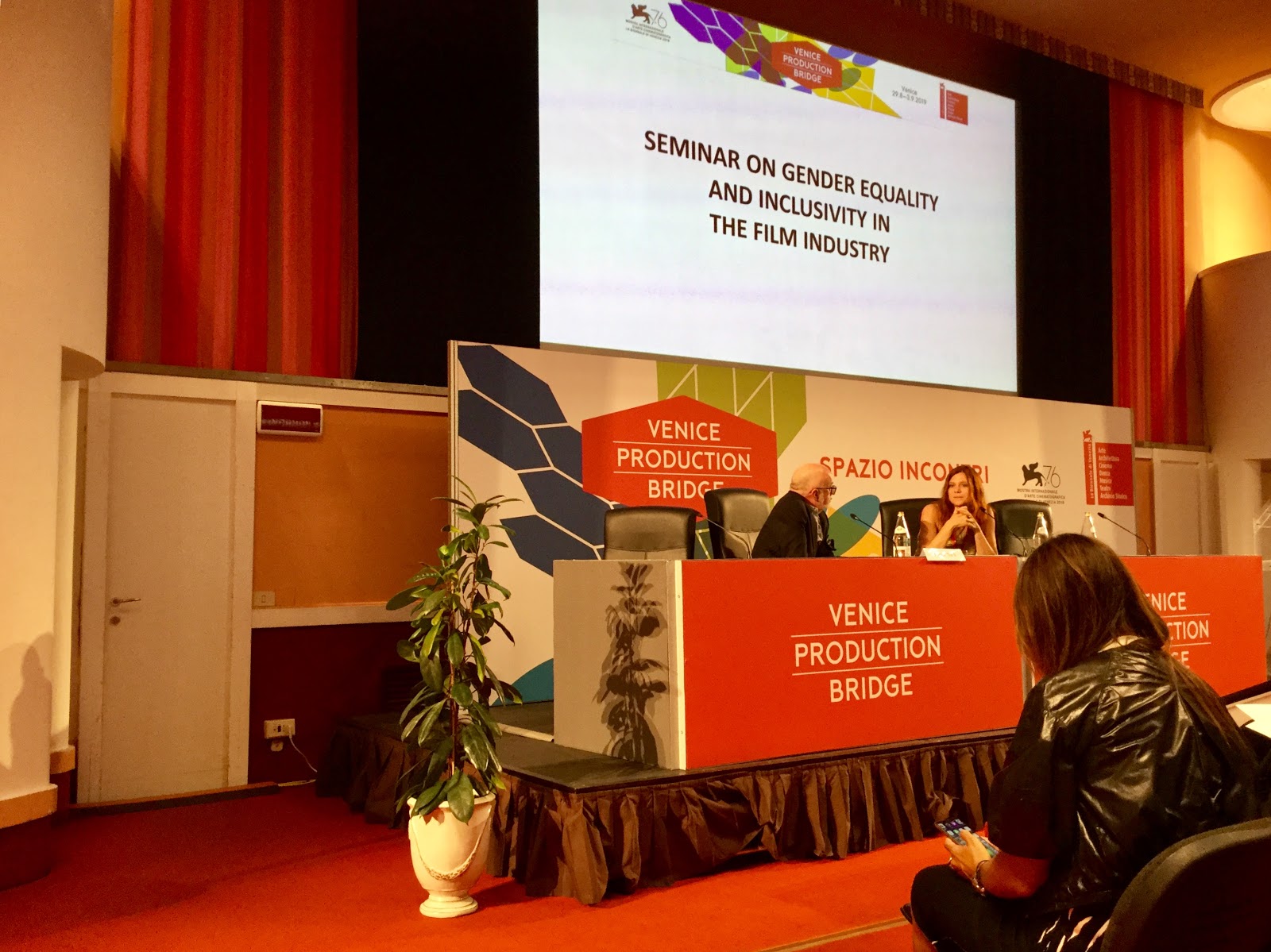
Seminar on Gender Equality & Inclusivity in the Film Industry - Photo: Cat Bauer
(Venice, Italy) Ask and ye shall receive. Lucrecia Martel, the president of the jury of this year's Venice International Film Festival (VIFF), had expressed an interest in seeing the gender breakdown of film submissions to the festival after Venice had been criticized by some members of the international press for having only two films by female directors in competition.

On Monday, September 2, La Biennale, together with Eurimages, Women in Film,Television & Media Italia, and Dissenso Comune, hosted the Seminar on Gender Equality and Inclusivity in the Film Industry that presented an enormous amount of data on the situation in Europe to a packed house.

Paolo Baratta, the President of La Biennale di Venezia said he "totally rejects the idea that we can be accused of anything. We can be witness. La Biennale is a witness, not the accused." Alberto Barbera, the Artistic Director of VIFF, said he and the President agreed on a lot, and that they recognize there is inequality in the film world.

La Biennale presented several different graphs that included the management of the organization -- out of 8 members of the executive committee, 5 are female and 3 are male -- as well as the makeup of the VIFF selection committee -- 14 male and 12 female, or nearly 50/50. There were so many graphs that I will concentrate on the submissions.

Overall Submissions to the 76th VIFF
That is the graph of the overall submissions to the 76th Venice Film Festival. As you can see, the submissions by males were a whopping 72.1% while females accounted for only 22.6%.

Films Selected for the 76th VIFF per number of Directors
That is a graph of the films that were selected. Of the 21 films selected for the main competition, 90.5% were directed by men. Of the overall selected films in all categories, 162 were directed by men, while 40 were directed by women. Some hope for the future lies with Biennale College Cinema, where of the 3 films selected, 67% had a female director.


Eurimages - Female Directors - Eligible Projects
There were similar findings presented by the other organizations. Eurimages is a cultural support fund of the Council of Europe, the leading human rights organization on the continent. The Council of Europe predates the European Union. All 28 members of the EU belong to the Council, which has a total of 47 member states -- no country has ever joined the EU without first being a member of the Council. It is located in Strasbourg, France, not in Brussels, Belgium, headquarters of the EU.

It is interesting to note that if the UK leaves the EU, they do not have to leave the Council. Russia is a member. Canada is an associate member, and on October 1, Argentina will be an associate member, too.

Eurimages funds art house films, and have a different way of breaking down their data, with all sorts of categories and subcategories. They've been collecting data since 2012, and have seen the percentage of female directors rise from 11% in 2008, to 28% in 2018 -- an improvement, at least, but still completely unbalanced. Out of the eligible projects, 23% were directed by women and 77% by men. Their mission is 50/50 by 2020, which they hope to achieve by providing extra points to projects with female elements.

Italian Ministry of Cultural Heritage - Cinema & Audiovisual
Through the Ministry of Culture, Italy provides funding to film projects, and has similar statistics, which they break down into even more categories. The good news is that funding for films directed by women is up from 11% to 20%. The bad news is that funding for films directed by women is 20%... And there are no Italian female directors in animation.

Source: WIFTMI findings based on data from Istituto Luce Cinecittà - FilmItalia
Dissenso Comune or Common Dissent, the Italian #MeToo movement, also presented similar numbers. Graph after graph showed the same dismal statistics.

David Rooney & Susanna Nicchiarelli
David Rooney, a journalist with The Hollywood Reporter had a conversation with Susanna Nicchiarelli, whose film Nico, 1988 about the singer in The Velvet Underground, won Best Film in the Orrizonti section of the Venice Film Festival in 2017. Nicchiarelli is emphatically against quotas. "I would not have been happy if my film was accepted because I was a woman." She believes that women need more access to money, and that more young women need to be encouraged to go to film school.

President Paolo Baratta said that next year VIFF seminar would focus on those statistics -- what is the percentage of young women entering film school? In that area, La Biennale shines -- out of the 12 selected projects for Biennale College Cinema 2019-2020, the gender was split 6 male and 5 female, with one "other" individual in transition.

When you see the same numbers over and over again in front of your eyes, there is no denying the reality: there is an enormous gender gap in the film industry. Paolo Baratta said, "Numbers are a very powerful shooting weapon."

The Venice Film Festival has taken a positive step forward in addressing the situation. I have worked with La Biennale for decades, and I deeply respect President Paolo Baratta. The man will be 80-years-old in November, and I can't image life in Venice without his presence -- his intelligence, sophistication, wisdom, warmth and empathy. Let's hope this seminar kicks off rapid change.

Ciao from the Venice Film Festival,
Cat Bauer
Venetian Cat - The Venice Blog

Saturday, August 31, 2019

I loved Marriage Story! A Film about Divorce at the Venice Film Festival

MARRIAGE STORY photo call - Laura Dern, Noah Baumbach, Scarlett Johansson, Adam Driver
Photo courtesy of La Biennale di Venezia - ASAC
(Venice, Italy) I loved "Marriage Story." As someone who lived in New York and Los Angeles for more than two decades, and was married to a television director, I completely related to it. I want my ex-husband to see it so he will appreciate how much money I saved him in lawyer's fees!

Those of us who have gone through a divorce know how shattering the process is, a real human drama. It is tragic and comedic, devastating and cathartic. Noah Baumbach wrote "Marriage Story" after his divorce from Jennifer Jason Leigh. He didn't know when he first spoke to to Scarlett Johansson about the project that she was going through a divorce, too.


Charlie (Adam Driver) is a theater director, and Nicole (Scarlett Johansson) is an actor from a family of mid-level actors in Los Angeles. They have an eight-year-old son, Henry (Azhy Robertson). Charlie has an experimental theater company in New York, and after Nicole fell in love with him, she left LA to become the star of his company. So Henry has grown up in New York, though the way bi-coastal relationships work, they are often in LA to visit Nicole's wacky family.

Baumbach wrote the film specifically for Johansson and Driver, and also for Laura Dern, who nails it as Nicole's fierce and funny Los Angeles divorce attorney. Alan Alda and Ray Liotta co-star as Charlie's divorce attorneys (one gets fired for being too nice).

Noah Baumbach
There is a powerful scene in the film -- actually, there are many powerful scenes, but one intense scene really stands out. Driver and Johansson are having a vicious argument, which was so real, their emotions jumped off the screen and into the theater. It was like watching a live performance.

Later, at the press conference, they were asked about that particular scene -- when you see the movie, you will know exactly which scene it is. Driver said, "Obviously, there is a theme of theater and performance. I am a theater director and Scarlett is an actor. There is something about the theatrics of getting a divorce... you're kind of performing for a judge and the mediators... It felt like theater -- we blocked it out, we talked about where we going to go; it wasn't something we winged. Noah's scripts are very well written and concise... there wasn't a lot of changing things on the day. The words are the words, which also feels like theater to me; working on it felt very much like theater."

Anyone who has a background in theater and film knows how difficult it is to crank up the emotional level in a scene, while, at the same time, remembering to hit the mark. The performance is staged. It is a dance between losing control while knowing exactly what you are doing. 

Baumbach elaborated, and said that it was a very technical scene. They blocked it out. He knew when he was going to cut to close ups, and when he needed the actors to stop and hit their marks, or lunge, or turn their heads to the camera. "To have these two actors completely lose themselves and at the same time they are in absolute control... it was such a privilege. It was the most rewarding experience I've had as a director."

Laura Dern at Marriage Story press conference
Photo courtesy of La Biennale di Venezia - ASAC
Laura Dern has never been better as she goes for the jugular in a very Los Angeles way (I wish I had had Nora Fanshaw as my divorce lawyer!). She has a hysterical scene about the difference between mothers and fathers (the Virgin Mary is involved) that had the audience of journalists roaring with laughter.

The performances are so outstanding, I think everyone will get nominated for Oscars -- Adam Driver and Scarlett Johansson for Best Actor, Laura Dern for Best Supporting and Noah Baumbach for Best Director and Original Screenplay.

Here is an excerpt from a review by Owen Gleiberman of Variety that I like a lot. You should click over and read the whole thing:
...one of the powerful subtleties of “Marriage Story” is that the divorce process, flawed as it is, becomes the vehicle through which Charlie and Nicole confront the underlying reality of their marriage. They go to court, and tear up their lives, all to solve a problem that Charlie, if he was a different sort of man, could have solved in two minutes.
Baumbach’s brilliant screenplay never falters or hits a wrong note. He has come up with smart, witty, saddened, and searching characters whose ability to articulate their feelings is never less than lifelike, and he writes scenes that are like verbal arias.
"Marriage Story" is also about the eternal battle between New York and Los Angeles, theater and film, subways and cars. It is a battle of lifestyles. Being based in Los Angeles and commuting to New York for work is utterly different than being based in New York and commuting to LA.

I asked some Italian journalists who have never lived in Hollywood and New York and were never married to a director if they liked it as much as I did, and they said yes. Go see it! There are no superheroes. It's a real movie with a real story and real characters, just like the good old days.

Ciao from the Venice Film Festival,
Cat Bauer
Venetian Cat - The Venice Blog

Thursday, August 29, 2019

All About Mujeres (Women) - Variety Bash at Hotel Daniel - 76th Venice Film Festival

Lucrecia Martel, President of Jury with partner Julieta Laso - Photo: Cat Bauer
(Venice, Italy) The exclusive Variety bash at the Hotel Danieli that kicks off the Venice Film Festival is a warm-hearted tradition, now in its11th edition. Usually it celebrates the President of the Jury with whimsical food and creative drinks inspired by his or her body of work. This year the party took slightly a different twist, honoring both Argentinian Lucrecia Martel, the President of the Jury, and Spaniard Pedro Almodóvar, one of the winners of the Golden Lion for Lifetime Achievement, with the theme: All About Mujeres (Women).

In these "Me Too" times, Venice has been criticized for its lack of films directed by females, while including the controversial directors Roman Polanski and Nate Parker in its line-up. The Hollywood Reporter led the charge with an article entitled "Completely Tone Deaf": How Venice Became the F-You Film Festival -- illustrated with a cartoon of a male winged lion sprawled in a gondola, a cigar in one hand, his other hand raised in a middle finger salute.

Let us not forget that the Argentinian director Lucrecia Martel is at the helm of the jury of the 76th Venice International Film Festival, and she is no wimp (and she smokes cigars:-). Recovering from a broken arm after she fell off a hoverboard a couple weeks ago, Martel is here in Venice with her partner, Julieta Laso, and sees her position as President of the Jury as a responsibility and an opportunity.

I had the chance to speak to Martel, and she is cool. She told Paolo Baratta, La Biennale President, that she would like to see a list of all the films submitted to the festival. "Is the problem with the choices the film festival itself is making? Or is the root of the problem at the national level and the amount of submissions by female directors?" 

Let's take Hollywood itself. Despite all the chatter about equality and the "Me Too"movement, according to a January 3, 2019 article in IndieWire the percentage of female directors actually decreased in 2018:
The new study, released today by executive director Dr. Martha Lauzen, reveals that the percentage of women working as directors on the top 250 grossing films declined from 11% in 2017 to 8% in 2018. The percentages of women directing films in the top 100 and 500 films declined as well, with women only directing 4% of the top 100 films (a decline of 4 percentage points) and 15% of the top 500 (a decline of 3 percentage points).

 All About Women? - Photo: Mirco Toffolo
These are some touchy times, and I do think that Venice is making an effort despite the optics. Alberto Barbera, Director of the Venice Film Festival, praised Martel in his written statement:  
“Four feature films and a handful of shorts, in just under two decades, have been enough to make Lucrecia Martel Latin America’s most important female director, and one of the top worldwide. In her films, the originality of her stylistic research and her meticulous mise-en-scène are at the service of a worldview free of compromises, dedicated to exploring the mysteries of female sexuality and the dynamics of groups and classes. We are grateful to her for having enthusiastically agreed to put her exacting, yet anything but uncharitable, gaze at the service of this commitment we have requested of her.”
During the opening press conference Martel challenged Barbera. According to Variety:
Martel then said to Barbera: “For this 76th edition of the festival, you could have tried as an experiment, Mr. Barbera, to have 50-50, just to see what happens – if it’s so certain that the quality of movies would suffer or if this could foster a distinct industry-wide movement. The industry transformation underway is so deep that, after 76 years, Venice could experiment for a couple of years.” 
Barbera declined to take up the idea. “If I had found 50% of movies directed by women [that were worthy of the selection], I would have done that, without any need for a quota,” he said.
By putting films by Polanski and Parker on the line-up, two male directors accused of rape, and then appointing a strong, independent, intelligent woman like Lucrecia Martel as President of the Jury, Venice has actually provided a platform for what could be a vital conversation. Whether anything productive will come of it has yet to be seen.

Cat Bauer and Alejandro Aravena
Meanwhile, I was happy to run into Pritzer-Architecture-Prize winner Alejandro Aravena, who was the Director of the 2016 Biennale Architecture Festival. Alejandro is here in Venice with his brother and childhood friend. I asked him if he knew Lucrecia Martel, and he said no, but he would be happy to meet her. I spent much of the evening wading through the sea of party-goers, trying to locate Martel and Aravena in the same space and time. Since they were both cool and from South America -- Martel is from Argentina; Aravena is from Chile -- wouldn't a Meeting of their Minds be something fantastic?

Santa Maria Bloody Mary prepared with flair by the St. Regis Venice
The evening's food was inspired by Almodóvar's body of work, and the cocktails by Martel's.

THE FOOD - INSPIRED BY PEDRO ALMODOVAR

Spanish director and writer Pedro Almodóvar, a two-time Academy Award winner, made his name as a "women's director," and the tasty nibbles were inspired by the complex characters in his films. Volver was the inspiration for Executive Chef Alberto Fol of the Hotel Danieli. He whipped up meatballs of Raimunda: beef meatballs and chorizo with a soup of roasted peppers, and a datterino tomato Gazpacho with Manchego cheese and caramelized onion crumbs, a dish from the regional cuisine of La Mancha, where the film's main characters are from.

Inspired by Women on the Verge of a Nervous Breakdown, chef Nadia Frisina of the new St. Regis Venice, was live with a cooking station that served pescado Mojo Rojo and Pulpo tinto.

From the JW Marriott Venice Resort & Spa, Chef Dario Parascandolo and Chef Fabio Trabocchi of Fiola at Dopolavoro Venezia teamed up for a menu inspired by Everything About my Mother, with Travestiti Cod and Paella Impostor.

THE COCKTAILS - INSPIRED BY LUCRECIA MARTEL

The cocktails were just as fanciful and creative as the food.

Martel's La Ciénaga inspired barman Facundo Gallegos of The St. Regis Venice to create the "Laguna Roja, an Argentine reinterpretation of the classic Negroni made with Mate and Beefeater Gin infusion, as well as the "Santa Maria Bloody Mary," a signature cocktail of the St. Regis brand, zapped with a modern twist and dedicated to the Venetian grape.

The Hotel Danieli and its bartender Roberto Naccari celebrated the movie Zama with "Don Diego Chimarrao," a cold infusion of berries and ginger, inspired by Don Diego, the protagonist of the film, and from the Chimarrao, a typical South American drink.

The JW Marriott Venice Resort & Spa paid homage to La Mujer sin Cabeza with cocktails created by the barman of the hotel, Lorenzo Romano: "Septimo Capitulo" with Gin, Campari, Martini Bianco and Ginger Syrup; and the "Cabeza," dedicated to the main character Maria Onetto – a darkly colored cocktail that symbolized her obscure mind and psychic disorder, with Fernet Branca, Earl Grey Syrup, Lemon zest, topped with Chinotto.

Lucrecia Martel and Cat Bauer
As the evening went on, I finally spotted Martel's partner, Julieta Laso. "Where is Lucrecia?" Julieta took my hand and pulled me straight toward Martel, who was swamped with people wanting a photo with her. I wanted one, too. As we smiled for the camera, I told her that I would like to introduce her to Alejandro Aravena. But it was too late. She said the boat taxi had just arrived to whisk them away. Another time...

Then I ran into Alejandro's brother. "Where is Alejandro?" "He's got to be around somewhere." "Would he leave without you?" "No." I searched again through the mass of bodies and eventually spotted Alejandro out on the terrace. "When I finally found Lucrecia Martel, the boat taxi had just come to take her away. Another time, perhaps."

Alejandro smiled. "But I did meet her. We were in the line for risotto, and we heard Spanish being spoken, so we started to chat."

The Spirit of Venice (who is female, of course:-) must have thought it was a good idea for them to meet, too... and what better place than the Variety party at Hotel Danieli, with the spectacular view of the lagoon as the backdrop, and the magic of the film festival wafting through the air?

One thing is certain -- the topic of conversation at the Venice Film Festival is All About Women!

Ciao from Venezia,
Cat Bauer
Venetian Cat - The Venice Blog