Monday, March 30, 2020

Imagining the World - How can Venice transform after coronavirus?

Grand Canal, Venice, Italy during quarantine - Photo: Cat Bauer
(Venice, Italy) Dear Friends & Readers -- please forgive me for not updating. I've started writing about 10 different posts, but the situation changes so rapidly that it seems that before I finish one sentence, it is already out of date.

I am well. Everyone I know is well. Personally, I don't know a single person who has the COVID-19 coronavirus, nor do any of my friends, but that is a limited circle. Everyone wants numbers, and so do I.

I am focused only on the numbers inside the historic center of Venice. Most of the time the official numbers about Venice get lumped together with Mestre, or with the province, or with the region, or with all of Italy -- it is difficult to get accurate numbers.

As far as I can understand, there are about 7 people in intensive care at Ospedale San Giovanni e Paolo. There are around 10 or less inside the hospital that are non-critical. There are less than 50 cases inside the historic center who are confined inside their homes. Those numbers are not official or accurate. It is just to let you know that all of Venice has not fallen victim to the pandemic.

I am a great believer in Mother Nature, the gods, Jesus Christ and the stars. I am also pragmatic and logical. Most of all, I believe in the power of Imagination. Venice only exists because of the powerful imagination of committed, enlightened, honorable souls.

This tragedy can transform into an opportunity. Mother Nature is creating a new world in front of our eyes. After the coronavirus, what kind of world do we want? Together, we can imagine anything. Together, we can re-imagine the world.

Stay strong from Venice,
Cat Bauer
Venetian Cat - The Venice Blog

Friday, March 13, 2020

Charity in the Time of Coronavirus -The Virtue of Caritas in Venice

Public Hospital of Venice -The Scuola Grande di San Marco - Photo: Cat Bauer
 
(Venice, Italy) The entire country of Italy has been quarantined in a herculean effort to stop the spread of the COVID-19 coronavirus. Much of the media has described the lockdown as "draconian," which gives it an authoritarian connotation. On the contrary, I think it is more of an act of Caritas -- an act of charity in the true sense of the word.

The Scuola Grande di San Marco is home to Venice's main public hospital, the Santi Giovanni e Paolo Civil Hospital. It has been my hospital for the 22 years that Venice has been my residence, and I have made good use of its excellent services. 

It was originally the home of the Confraternity of San Marco, one of the six major confraternities in Venice. The core value of the confraternities was Caritas.

In Christian thought, charity is the highest form of love. It is the love of God expressed by human beings for fellow human beings. Saint Paul called charity the greatest virtue of all. 

Even though ancient Venetians could be distinctly decadent, the confraternities of Venice considered it their responsibility to provide acts of charity to those in need -- caring for the sick and destitute, distributing food, providing shelter, offering funeral services and prayers -- practicing the concept of "love thy neighbor as thyself." 

The Scuole Grandi were an integral part of Venetian society that provided for those less fortunate.

Carved & gilded ceiling in Scuola Grande di San Marco - Photo: Cat Bauer
 
Putting an entire Democratic Republic like Italy under quarantine is not easy to do. The Italian word "furbo" is difficult to explain to English-speakers, and is often translated as "sly" or "cunning." But in Italy, it can have a positive attribute -- more a sense of using ingenuity or being clever to get around the rules.

On Saturday night, March 7, as new regulations were being formulated in Rome, someone leaked an unsigned draft to the press, and all hell broke loose. Some politicians who were omitted from the decision-making process first saw the news on television. It spread like wildfire through social media

Italy was in quarantine. Everyone had to stay at their legal residence. 

Both Luigi Brugnaro, the Mayor of Venice, and Luca Zaia, the President of the Veneto, said the draft had been written without their knowledge, and was being rushed through. 

People who were outside their regions of residence dashed to the train stations before the new rules kicked into effect, wrongly thinking they would be forced to remain where they were. If they were going to be quarantined, they wanted to be at home, in their own region. This mad dash from one region to another could possibly spread the virus from the north of Italy to the south. 

This compelled Giuseppe Conte, the prime minister of Italy, to address the nation on Sunday morning, March 8, 2020 at 2AM. He told Italians not to be furbo

Instead, he appealed to their sense of Caritas, their civic duty to protect "our health, that of our parents, and above all, the health of our grandparents." He later said, "It's not easy to change the habits of an entire life from one day to the next, and accept personal sacrifices for the greater good.... But if we all respect the rules, the country will soon be able to raise its head." 

Even though Italy is a secular Republic, it is more than 80% Christian -- Catholic in particular -- and backed up by a popular Pope in Rome, that message can be very effective.

I experienced first-hand the damage the English-language press and foreign-based social media accounts wreaked on Venice when the city closed its Carnival two days early after three elderly people tested positive for the virus. 

Misinformation flashed rapidly across Twitter, as if controlling the English-language narrative about Italy were a competition. Reality on the ground was utterly different from what was being reported, creating unnecessary panic as tourists fled the city.

As I wrote in a previous post, the word "quarantine" is a Venetian word, and means "forty days." In 1448, the Venice Senate passed a law that required ships and crews to remain isolated outside the city during the time of the plague, which had a 37-day cycle from infection to death.

Entrance to San Giovanni e Paolo Civil Hospital, Venice - Photo: Cat Bauer
 
I spent hours searching for a trustworthy voice that clearly explained the current situation. I finally stumbled on an article in SIR, the news source of the Episcopal Conference of Italy, featuring Dr. Giovanni Leoni, a surgeon at the Civil Hospital in Venice, who was also the President of the Order of Doctors of Venice (OMCeO). 

Dr. Leoni explained the situation succinctly with a touch of wit, and concluded with the message that the Serenissima Republic was the master of quarantine:

"If we survived several plagues without antibiotics and respirators, despite serious loss of life, we owe it to the use of isolation implemented by our ancestors."

That made sense. In today's society, when the pharmaceutical industry has promoted a vaccine or a pill for all that ails you, if there is no cure to an infectious disease then the only thing to do is resort to tried and true techniques, stretching back to medieval times. Hence, the quarantine.

I am glad the quarantine has expanded to include all of Italy. Before it felt unfair, with much of the mainstream media using images of the historic center of Venice to illustrate the coronavirus outbreak in the entire country, as if Venice were the center of the outbreak. 

Reality was very different. Now that everyone's movement has been limited, it feels more like a united front.

More confusion lies in the way the numbers are reported. In 2015, the province of Venice transformed into the Metropolitan City of Venice that includes 41 comuni or municipalities with a population of around 850,000 and Venice as its capital. 

But in the historic center of Venice itself  there are just over 50,000 residents. So far in Venice there has been a handful of cases and one death linked to the virus, that of Danilo Carraro, a well-liked optician and eyeglass designer, who was 80-years-old and already seriously ill. 

As of today, March 13, there are 9 non-critical cases and 5 cases in intensive care in Venice's Civil Hospital, according to Il Gazzettino, although the numbers in all of Italy change rapidly.

Cats inside Venice's Civil Hospital - Photo: Cat Bauer
 
It has been my experience (which has been limited to South Tyrol and the Veneto Region, the historic center of Venice in particular) that the healthcare in Italy is excellent. It is a human right. Again I think it's because it's based on a sense of Caritas, something that has been inherent in the Italian nature for centuries -- especially in Venice, where going to the hospital is an awesome experience.

Cats wander in the gardens and in the majestic halls of the former Scuola Grande di San Marco. There is a fountain full of turtles and bathing songbirds.

The World Health Organization European Office for Investment for Health and Development is located inside, down an immense corridor. 

The original building was completed in 1260, but almost destroyed by fire in 1485. It was immediately rebuilt and completed by 1495, which is the structure still standing today. 

Just stepping through the portal is like entering a magical, ancient world. But woven inside the historic structure is a slick, modern hospital, with a Venetian attitude.

WHO office in Venice - Photo: Cat Bauer
 
Last Monday, I went to the hospital for a routine exam. The mood was jovial and friendly, full of  humor and community spirit, though we all knew reality was harsh and scary beneath the surface. 

The doctor who examined me was calm, and explained things clearly with diagrams, stressing that when people understand a situation there is no need for panic and fear. His manner was reassuring, and I glanced at his name tag. 

"You're Giovanni Leoni! You're the president of all the doctors. I read your article. I quoted you. It is an honor!"

That is the real beauty of Venice -- not just the magnificent structures, not just the priceless art, not just the calli and campi. It is the people who live and work here today, combined with the wisdom of the ancestors. It is the sense of community that stretches back through the centuries. 

It is the fact that I can go for a routine exam and be consulted by the same Venetian doctor whose calm, clear voice sang out among all the discord on the Internet

Even though Venice has been thrust into the international spotlight by the media, at its heart it is a close-knit town based on human relationships.

Italy is making great sacrifices, not just for the people inside the country, but on behalf of the entire world. Healthcare in Italy operates on something for which there is no prescription, but still within the grasp of humanity -- the greatest virtue of all, the virtue of Caritas.

Ciao from Venezia,
Cat Bauer
Venetian Cat - The Venice Blog

Saturday, February 29, 2020

Should You Come to Venice? Report from the Ground: Venice & the COVIT-19 Coronavirus

Venice Carnival 2020 - Costumed revelers from France - Photo: Cat Bauer
(Venice, Italy) The word "quarantine" is a Venetian word, and means "forty days." In medieval times, Venice was on the cutting edge of healthcare for its citizens by confronting how to prevent the plague from entering the city. Venice was a major commercial center for international trade, and much of the world's goods passed through its waters.

In 1423, Venice established the first plague hospital on Lazzaretto Vecchio, an island in the lagoon just off Lido, a lazaret for maritime travelers with infectious diseases. Nowadays, if you have ever been to the Virtual Reality competition during the Venice Film Festival, you have visited that very island, which transforms into a very cool screening area, mixing the ancient with the contemporary and pulsing with the newest VR offerings.

In 1448, after determining that the plague had a 37-day cycle from infection to death, the Venice Senate passed a law requiring ships and crews to wait outside the city for 40 days. This system was remarkably effective -- you either got better or you died, or you were not contagious.

Quarantine has since become an English-language word, and means any period of isolation from infectious diseases. Since there is no cure at the present time for COVIT-19, the world has resorted to medieval techniques to try to contain the spread of the infection. So in the year 2020, we are back to using quarantine to limit the spread of the disease from human contact until an antidote can be developed.

 Venice Carnival 2020 - Revelers from England - Photo: Cat Bauer
Venice caught the eye of the world when it cancelled the last two days of Carnival -- Monday and Fat Tuesday, Martedì Grasso -- news that blared across the headlines of the international press and thrust COVIT-19 into the spotlight. Some people thought it was too harsh a decision. 

Others thought Carnival should have been cancelled on Sunday morning when health officials first learned there were two cases of the coronavirus inside the historic center -- two elderly Venetians in their 80s who didn't know each other and had no contact with the Chinese community ended up in the Civic Hospital. Later, a third female case was included. So inside the historic center of Venice itself there are three cases.

I thought the decision was just right. Sunday at noon was the Flight of the Eagle in Piazza San Marco, an event that I did not attend, but attracted about 20,000 people -- far lower than previous years, but still substantial. There was not enough time to turn that many people away without causing chaos and panic. I was notified by the press office about the cancellation of Carnival on Sunday, February 23 at 5:24pm, something I would have found out sooner if I watched TV.

But what I found outrageous was the immediate level of panic and misinformation about Venice being generated on social media by accounts that were not even based in Italy, and had no first-hand knowledge of what they were talking about. I have wondered repeatedly about the abnormal interest in Venice by professional marketers posing as simple bloggers and self-published booksellers who try to control the English-language narrative by giving "expert" advice as if they were actually on the ground. What's up with that?

Venice Carnival 2020 - Performers from Korea - Photo: Cat Bauer
Before the cancellation of Carnival, I was having a very good time, zipping all over the city. This year's Carnival had a different vibe under the new direction of Massimo Checchetto, the scenographer of Teatro La Fenice, with many projects nurtured by Venice residents. I came into contact with people from all over the world, including China and South Korea.

Right now, I feel healthy and fine. In Venice, children play in the courtyards and people go about their everyday business. The only difference is the lack of tourists, which to me is a good thing.

Marietta Barovier - Woman of Fire
Pioneer of Venetian Glass Beads
Project by Chiarastella Seravalle
As I've said repeatedly, Venice is a microcosm of the macrocosm. There were way too many tourists tripping through Venice, clogging up the calli and campi, feasting on junk food and buying fake souvenirs made in China. 

It would be nice if educated, civilized tourists who appreciate real Venetian artisans and fresh, local food came and supported the city. It would be wonderful if AirBnB tourist rentals were diminished, and landlords rented their properties to people who actually live in Venice, bringing life to the city. It would be great if the cruise ship industry was hit with a wake-up call, causing them to rethink and evaluate how they operate, not just in Venice but all over the world.

The entire mass-market tourism industry must take responsibility for the state of travel today, from airlines, to hotels, to cruise ships, to AirBnBs. The travel business is out of control, profiting with quantity not quality, and destroying the beauty and ecosystem of the whole planet.

In the past, Venice built churches, thanking Christ the Redeemer (Chiesa del Santissimo Redentore) and the Madonna of the Salute (Basilica di Santa Maria della Salute) for delivering them from the plague, which was believed to be a punishment from God. These days, instead of trying to squeeze another buck out of Venice, the focus should be on what can be done to create an environment where the citizens of Venice can thrive.

Isadora Duncan Dance Co. from USA at Palazzo Contarini Polignac - Photo: Cat Bauer
Should you come to Venice? That is an individual decision. As panic spreads across the world, there is no place that is "safe." Italy has been very aggressive about testing for the coronavirus, as well as closing schools, postponing soccer matches -- even religious ceremonies for the beginning of Lent were cancelled.

Emma Thompson and Greg Wise have just moved to Venice, and I hope they inspire a new colony of like-minded people to make Venice their home. Artists like Titian, Tintoretto and Veronese, who were valued by the Venetian Republic, allowed Venice to thrive in the past. With a solid base of creative people, Venice can flourish once again today. The November 12, 2019 flood and the current coronavirus epidemic can be a blessing, not a curse.

To me, Venice is especially beautiful when it is mostly full of residents, living everyday lives. Personally, I don't know a single person who is afflicted with the coronavirus, and neither do any of my friends. 

Just walking around Venice is magical, sitting in a campo and enjoying a leisurely lunch, or seeking out genuine Venetian artisans. When it comes to Carnival, everyone agrees that next year's Carnevale will be better than ever.

Italy is ranked number 2 in the world after Spain in the 2019 Bloomberg Healthiest Country Index. The U.S. is in 35th place. Italy's healthcare system is ranked number 2 in the world by population after France, according to the World Population Review.

So, if you're feeling healthy, flexible and ready for reflection, now is a great time to take a deep breath and come to Venice, and confront the present by embracing the knowledge of the past.

Ciao from Venezia,
Cat Bauer
Venetian Cat - The Venice Blog

Tuesday, February 18, 2020

Caffè Florian Celebrates Venice Carnival 2020

Carnival Revelers at Caffè Florian - Photo: Cat Bauer Venice Blog
Carnival Revelers at Caffè Florian - Photo: Cat Bauer
(Venice, Italy) Caffè Florian has always been the place to be and be seen during the Venice Carnival. Thousands of people all over the world expressed their love and concern about the plight of Caffè Florian when images of the flooded cafè spread across social media after the November 12 aqua granda in Venice. The situation seemed bleak.

Happily, life goes on: I am glad to report that Carnival revelers have once again flocked to the beloved coffeehouse decked out in all their Carnevale regalia, as they have done for centuries.

Carnival Revelers at Caffè Florian - Photo: Cat Bauer Venice Blog
Carnival Revelers at Caffè Florian - Photo: Cat Bauer
The word "coffee" comes from the Venetian word "caveé." Venetians were introduced to coffee through their trade with the Islamic world, importing the exotic brew from the East. The first coffeehouses appeared in Venice between 1629 and 1645, and became gathering places for writers, intellectuals and artists.

Carnival Revelers at Caffè Florian - Photo: Cat Bauer Venice Blog
Carnival Revelers at Caffè Florian - Photo: Cat Bauer
Caffè Florian was established in Piazza San Marco in 1720 and celebrates its 300th anniversary this year. It is the world's oldest coffeehouse in continuous operation.

It was the only coffeehouse that served women, making it one of Casanova's favorite hunting grounds. The Venetian playwright Carlo Goldoni was a regular.

Since its early years, it has attracted everybody who is anybody -- Lord Byron, Goethe, Marcel Proust, Charles Dickens, Richard Wagner and D'Annunzio were some of the notable clientele.

Carnival Revelers at Caffè Florian - Photo: Cat Bauer Venice Blog
Carnival Revelers at Caffè Florian - Photo: Cat Bauer
Caffè Florian's original name was "Venezia Trionfante," or "Triumphant Venice," but it soon became known as Caffè Florian, after its owner Floriano Francesconi. It was a place where history was written. Inside its rooms, plots were devised to overthrow French and Austrian rule after the Napoleonic conquest of the Republic of Venice in 1797.

Carnival Revelers at Caffè Florian - Photo: Cat Bauer Venice Blog
Carnival Revelers at Caffè Florian - Photo: Cat Bauer
The idea for the very first Venice Art Biennale was hatched at the Florian. In 1893, Riccardo Selvatico, the mayor of Venice, together with a group of artists and intellectuals, decided to hold an illustrious art exhibition in honor of the silver anniversary of King Umberto and Margherita of Savoy. Beneath the paintings of The Age of Enlightenment and Civilization Educating the Nations in the Senate Room, the first international art festival in the world was born.

Through the window of Caffè Florian, Venice Carnival - Photo: Cat Bauer
Through the window of Caffè Florian - Venice Carnival - Photo: Cat Bauer
Throughout the years, celebrating the Carnival of Venice inside the rooms of Caffè Florian became a staunch tradition. To this day, revelers wearing elaborate costumes walk through the door and into another dimension, sipping hot chocolate and dreaming up adventures along with the spirits of Carnevale past.

Those who do not love life do not deserve it.
---Giacomo Casanova 

Ciao from Venezia,
Cat Bauer
Venetian Cat - The Venice Blog

Sunday, January 19, 2020

Burning the Good Witch & Climate Change in Venice

Epiphany Eve in the Veneto - Photo: Cat Buaer
(Venice, Italy) First, I want to thank those of you who have been long-time readers of Venetian Cat - The Venice Blog. Many of you have been loyal subscribers for more than a decade, through triumphs and tribulations, and I greatly appreciate it -- especially those of you who took the time to write with New Year's greetings. (For those who prefer not to leave a public comment, I can always be reached at venetiancat@gmail.com, and you can follow me on Twitter and Facebook.)

I started this particular blog in January 2008, twelve years ago, and have written 665 posts about the life, art, history and culture of Venice. My blog evolved from one I had on the now-defunct MySpace, and before that, on my now-defunct Author's Guild site before much of the world even knew what a blog was. Some of you have even followed me from the old America Online travel boards, back when I first arrived in Venice in 1998, nearly 22 years ago.

Venice has been through many changes since that time, many of them not positive. One of the most serious is how climate change is progressively affecting the city -- the November 12th flood was a shock to the system -- in addition to rampant over-tourism, monster cruise ships, short-term apartment rentals, new hotels, lack of affordable housing and outside interference on social media.  

MOSE, the underwater barrier that was supposed to protect the city from acqua alta, was wracked by corruption, money laundering and kickbacks, and is now set to function by the end of 2021 after years of delays. The first real test of MOSE was this past Monday night. The results were "OK," and it seems that the barrier can be raised in emergency situations. Let's hope it's not soon put to the test.

Sunset in Venice - Photo: Cat Bauer
When I first moved to Venice from Hollywood in 1998, an American living in the city was still something of a novelty. Before moving to the highly-visible apartment on the Grand Canal at Rialto (which is now a short-term tourist rental), I first lived down in Castello, a zone thick with Venetians and mom & pop shops -- cheese, bread, wine, vegetables, meat, fish -- everything was nearby and came with a conversation -- not easy, because I didn't speak a word of Italian, let alone Venetian. But somehow we communicated. 

Back then, there were about 80,000 Venetians who lived in the historic center, as opposed to less than 55,000 today. There were tourists, but not 30 million of them, and they stayed in hotels, not short-term tourist rentals, a 21st Century plague that is killing Venetian life. It was an utterly different, magical world.

There were exotic new traditions to discover, and one of the most marvelous was the Venetian celebration of Christmas, which began on December 24th, Christmas Eve, and continued through January 6th, the Epiphany, the day the three Magi visited the Christ child.

Unlike Christmas in the States, the festival season actually felt tied to the birth of the Christ child, and connected to Mother Nature. It was a combination of the Christian world and the pagan world rolled into one great festival, culminating in the burning of a good witch called La Befana -- an element of the tradition that occurs on the mainland of the Veneto, not in Venice. (Venice has evolved its own quirky Befana tradition, which includes a short regata of Venetian male rowers dressed in drag as female witches, which I have written about many times before.)

La Befana in the Veneto - Photo: Cat Bauer
Even though the holidays have passed, I have still been thinking about La Befana, and how she came to be. La Befana behaves a lot like Santa Claus, filling children's stockings with sweets if they are good, and coal if they are naughty -- except she looks like a Halloween witch, and flies on a broom.

One legend says the three Magi stopped by her house asking for directions to bring gifts to the infant Christ, and asked her to join them, but La Befana was so busy cleaning, that she refused. After she realized what an opportunity she had missed, she jumped on her broom and went house to house leaving gifts for children, searching for the Christ child.

Back on the Eve of Epiphany on January 5, 1999, 21 years ago, my Venetian friends brought me to the Veneto countryside, where they burnt La Befana in a bonfire -- something that is missing in Venice. The whole community joined together, sang songs, drank hot mulled wine and ate pinsa, which is sort of like a fruitcake, but moist and delicious, and is reportedly La Befana's favorite food.

The visitation of the three Magi was reenacted with live human beings, and there was a real-live witch that handed out stockings. It was an anticipated event for all the families, and kept the focus of the holiday season on the birth of Jesus Christ all the way through to the day of Epiphany on January 6th.

This year, I again had the opportunity to join the Epiphany celebrations on the mainland, where the bonfire is still in full swing. I think this element of the festival is critical because it symbolizes the ending of the old year, and the ringing in of the new. It is tied to nature because the new year will be good or bad depending on which direction the ashes of the fire blow. I am happy to report that this year is predicted to be a good one.

But it still doesn't answer the question: why a craggy, hooked-nose old witch? Even though she is physically "bruta" or "ugly," the children see her as "bella" or "beautiful." There are many theories, none of them definitive. I think La Befana is a unique amalgamation of all of them. But what fascinates me the most is that in the United States, we don't have her at all:

From Wikipedia:

A theory connects the tradition of exchanging gifts to an ancient Roman festivity in honour of Ianus and Strenia (in Italian a Christmas gift used to be called strenna), celebrated at the beginning of the year, when Romans used to give each other presents. ...

...The tradition of Befana appears to incorporate other pre-Christian popular elements as well, adapted to Christian culture and related to the celebration of the New Year. Historian Carlo Ginzburg relates her to Nicnevin. The old lady character should then represent the "old year" just passed, ready to be burned in order to give place to the new one.
In many European countries the tradition still exists of burning a puppet of an old lady at the beginning of the New Year, called Giubiana in Northern Italy, with clear Celtic origins....

...Befana also maintains many similarities with Perchta and her Pre-Christian Alpine traditions.

Christ Pantocrator in the Basilica of San Marco, Venice - Photo: Cat Bauer
Something important to remember is that Venice did not evolve like the rest of Italy, which was inhabited by many different peoples over the centuries, who were eventually conquered by pagan Rome. Back then, Venice was just a bunch of mud flats and salt marshes inhabited by fisherman until refugees fleeing Germanic and Hun invasions settled in the lagoon.

According to tradition, Venice was born in 421 A.D., four hundred years after the birth of Jesus Christ, but shortly after Christianity became the State Church of the Roman Empire in 380 A.D. -- Emperor Constantine in Constantinople himself converted in 312 A.D.

Venetians were Christians linked to the Eastern Roman Empire from the start, not the Western Roman Empire, which finally collapsed in 476 A.D. The image of Christ that is in the Basilica of San Marco is that of the Christ Pantocrator, an image that is an Eastern Catholic conception.

Over the centuries, on those mud flats and salt marshes, Venetians created the most beautiful, impossible city made by man, a city that today is tragically at the center of the international news after the November 12th flood -- an event that was the scream of Mother Nature herself.

With the invasion of mindless tourists and foreign investment into Venice, this mystical, magical element of Christianity is being suffocated, which is as critical to the foundation of Venice as the stones, marble and piles used to physically build the city.

Venice's unique expression of Catholicism is an invisible, crucial fabric that was woven into the construction of her churches and palaces, in the bells that chime throughout the city, the images, the festivals, in the calli and campi.
It is embedded into the very soul of Venice itself.


Last Sunday, on January 12th, exactly two months after the November 12th flood, Venice was featured on 60 Minutes, the esteemed, long-running television program that airs in the United States. For those of you who have never seen it, the show is a news magazine and Sunday-evening fixture that debuted way back in 1968. Here is an excerpt. To watch the entire clip, go to 60 Minutes.

In the episode, Luigi Brugnaro, the mayor of Venice, said the November flood was due to climate change, and that he would like to make Venice a "world laboratory." As always, there are people on social media who complain about this, saying it is not only climate change to blame for acqua alta.

Of course it's not, but if the mayor announces publicly that he wants to combat climate change on one of the most important television programs in the United States of America, then let's hold him to it! I think it is an excellent idea, and have said the same thing for years, as have many others.

In fact, there are several organizations already in existence in the city; you can get a PhD in the Science & Management of Climate Change at Ca' Foscari, Venice's university. Venice desperately needs another industry besides tourism.

LET'S SAVE VENICE TO SAVE THE WORLD

From 60 Minutes:

To give Venice a future, its mayor wants to turn the city into a world laboratory to combat climate change.
Mayor Luigi Brugnaro (Translation): Why don't we do it here? Let's do it here, let's study it here. Let's study the water, let's study the pollution, the rising waters, the temperature. It could be an example of great mobilization at a world level.
John Dickerson: Is the message to the rest of the world, if you don't save Venice, it will happen to you next?
Mayor Luigi Brugnaro (Translation): I don't want to worry anybody, but I think that I'd like a different message. Let's save Venice to save the world.

Are those just empty words, or is Luigi Brugnaro serious about rallying behind such a plan? Making Venice a world laboratory is not an impossible dream. Venice is the perfect city to become a showcase for the best of mankind, self-sufficient and thriving on its own natural resources, with alternative energy, electric/solar transportation, healthy salt marshes, housing for residents, fresh, local food, world-class craftsmanship & artisans, and sustainable tourism.

What exists instead is a system based on greed, corruption, overtourism, depopulation, more hotels, AirBnBs, cruise ships, etc. -- in short, the worst of mankind, a disease that is afflicting the entire planet.

Naughty or Nice? Photo: iItaly.org
Yes, Venice can be a World Laboratory, but we need the help of the entire world to accomplish such a feat. If we don't act immediately, there will be no Venice to save. It is a New Year and a New Decade, and time to make radical changes.

Right now, if La Befana left Venice a Christmas stocking, it would be filled with coal, not sweets. You don't have to burn the good witch to see which way the wind blows.

Ciao from Venezia,
Cat Bauer
Venetian Cat - The Venice Blog

Wednesday, January 1, 2020

Happy New Year 2020 from Venice!

Piazza San Marco, Venice, Italy - Happy New Year 2020 - Photo: Cat Bauer

Wishing everyone, everywhere
the courage to create
the strength to be gentle
and the wisdom to see with fresh eyes. 

Here's to a joyous, prosperous New Year & New Decade

Buon Anno!

 
Cat Bauer New Year 2020 Venice, Italy Venice Blog
Cat Bauer, Venice, Italy 2020
Happy New Year,
Cat Bauer

Friday, December 20, 2019

Good News from Venice: The Royal Gardens have Re-Opened!

The Royal Gardens in Venice Pergola Photo by Cat Bauer Venice Blog
Strolling under the pergola - Opening of the Giardini Royali in Venice - Photo: Cat Bauer
(Venice, Italy) After surviving wars, occupations, revolutions and neglect, the Royal Gardens in Venice, the Giardini Reali, re-opened on Tuesday, December 17, 2019. Thanks to five years of effort under the wise, loving and passionate guidance of Adele Re Rebaudengo, president of the Venice Gardens Foundation, the public once again has a place in Venice to pause and reflect, surrounded by greenery, flowers, birds and bees. 

A BRIEF HISTORY OF THE ROYAL GARDENS IN VENICE

After Napoleon had conquered Venice, he thought that the perfect complement to his new Royal Palace in the Procuratie Nuove in Piazza San Marco would be a Royal Garden. So he had the 14th century public granaries knocked down, where the Venetian Republic had stocked their wheat.

That was the beginning of the Royal Gardens, which are on an island surrounded by canals and the Basin of St. Mark. Created on the initiative of Napoleon and Viceroy Eugene de Beauhamais, son of Napoleon's wife Joséphine, the gardens and royal residence were initially designed by the architect Giovanni Antonio Antolini. Viceroy Beauhamais changed Antolini's approach, and subsequently Antolini's son-in-law, the engineer Giuseppe Mezzani, reworked the plans, overseen by Royal Architect Luigi Canonica. After a series of delays and disagreements, next up was the architect Giuseppe Maria Soli. 

From 1797, Venice had been tossed back and forth under French domination, then Austrian, then French, then Austrian again as the garden was being developed. When the dust settled, a drawbridge had been built in 1815 over a small internal canal to provide access to the gardens from the Royal Palace, which also allowed gondolas to glide by.

Royal Gardens in Venice in the 19th Century
By then, the architect Lorenzo Santi had been put in charge of the Royal Palace construction, recommended by the great artist Antonio Canova himself. It was Santi who put the final touches on the gardens, complete with a wooded grove, flowering plants, greenhouse, potted citrus trees and a tree-lined avenue along the Basin of St. Mark. At the end of the avenue, Santi placed the Cafehaus, a neoclassical pavilion. All this was off limits to the public and reserved for the court.

The Generali Group is the main partner in today's restoration project thanks to incentives from Art Bonus, which gives tax credits to those who support culture with charitable donations. The Generali Group was founded in Trieste in 1831. The next year, they opened an office in Venice in Piazza San Marco in the Procuratie Vecchie building, which is where they are still located today. Generali is a major player in the global insurance market. .

Venice was not thrilled to be under the rule of Austria, and revolted in 1848 under the revolutionary leader Daniele Manin, a jurist and passionate statesman. Generali was sympathetic to the cause, and took the winged Lion of San Marco as their symbol rather than the Hapsburg eagle. They did this right under the nose of the Austrians who were located next door in the Royal Palace aka the Procuratie Nuove in Piazza San Marco.

In 2017 I wrote a post which gives the layout of the land, and which I strongly suggest you read, that gives more details.

Did you know there are Royal Gardens in Venice? You will soon!


The Venetians briefly drove out the Austrians and elected Daniele Manin as president of the re-created Republic of Venice. But the Austrians came roaring back and re-took Venice in 1849.

Needless to say, the Venetians were enraged. To calm everybody down, in 1857 Emperor Franz Joseph allowed the public to walk along the avenue flanking the Basin of St. Mark, but they could not go inside the gardens, which were used exclusively by the court. So iron bars were built to separate the path from the gardens. (Can you imagine such a thing? The Venetian public were given permission to walk along their own lagoon while the Austrians partied inside the barred-off garden.)

View from Sissi's window in Museo Correr on Dec 4, 2019 - Photo: Cat Bauer
But now that the public could walk along the avenue, where was the court supposed to stroll? To solve that problem, an iron and cast iron pergola that ran the length of the gardens was constructed to provide a shaded private walk, adapted from a temporary one that had been built to welcome Emperor Franz Joseph and Empress Sissi when they had first arrived on the scene in November 1856. But when Sissi lived by herself in the Royal Palace in Venice from October 1861 to May 1862, she revoked the permission. (If you visit the Correr Museum, which is what the wing of the Royal Palace morphed into, you can look out Sissi's windows and pretend you are an empress trapped in her rooms.)

In 1866, Venice became part of the Kingdom of Italy, and the Savoy monarchs let the public walk along the edge of the water again. In fact, an iron bridge was built so it could be accessed from Piazzetta di San Marco. The drawbridge connecting the gardens to the palace was rebuilt in 1893.

After World War I, on December 23, 1920, the Crown ceded the Royal Gardens to the State Property Office, which entrusted them to the City of Venice, who threw the gates wide open. They also opened the drawbridge in the former Royal Palace, so you could stroll right from Piazza San Marco into the gardens.

Then Mussolini came along and suspended the drawbridge. And then the Nazis came to town.

During World War II, a concrete bunker was constructed right in the central area of the gardens. 

After the war, as the decades progressed, the gardens were neglected until the pergola was in ruins, the drawbridge unusable -- frozen in a raised position -- the gate rusted and crumbling, the trees diseased, and the greenery and flowers wild and chaotic. Hordes of tourists invaded the gardens, munching on sandwiches and drinking Coke. The Cafehaus had transformed from coffeehouse to headquarters of the Bucintoro Rowing Club, to air terminal(!), to an info point for the tourist office until it was closed and abandoned. The whole place was a wreck.

On December 23, 2014, the State Property Office entrusted the management of the Royal Gardens to the Venice Garden Foundation, who began its recovery, and is now responsible for its care and conservation.

Inauguration of Venice Royal Gardens - Photo: Cat Bauer
On December 19, 2019, the Royal Gardens re-opened to the public. Paolo Pejrone, the renowned landscape architect in charge of the garden project said, "It takes a lot of courage to create a garden like this, and even more courage to open it in the middle of December. Creating a garden in a lagoon is not easy."

Why didn't the gardens flood during the Acqua Granda of November 12? Especially because they are located between Piazza San Marco, Venice's lowest point, and the mouth of the Grand Canal? Pejrone said it was because Napoleon, foresighted emperor that he was, ordered them built high to protect them from flooding. Pejrone is also looking to the future, and populated the gardens with sustainable plants, shrubs and trees that require little water and provide plenty of shade.

Luigi Brugnaro, the Mayor of Venice, was at the inauguration and said that the project had the full support of the current administration. Dario Franceschini, the Italian Minister of Culture, was also on hand and said, "It is a beautiful story of love and generosity."

The Coffee House at Royal Gardens - Photo: Cat Bauer
The Cafehaus is once again a coffeehouse and eatery, thanks to the support of the Italian family-owned company, illycaffè. Andrea Illy, the chairman of the premium coffee company and grandson of the founder, was at the inauguration. (If you haven't heard of illycaffè before, you could soon, as they are considering expanding into the United States.) The elegant pavilion of Istrian stone was restored to its former glory under the direction of the Venetian architect, Alberto Torsello.
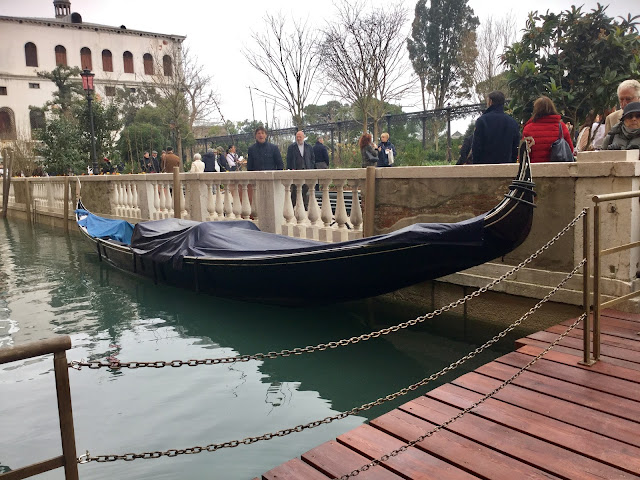
Royal Gardens in Venice, drawbridge, photo by Cat Bauer Venice Insider Blog
Standing on the drawbridge - Photo: Cat Bauer
The first thing I did after the press conference was head over to the newly restored drawbridge and take a photo. It was a thrill to walk from the gardens right into Piazza San Marco. 

The Royal Gardens are located in one of Mediterranean Europe's most important bird areas, which will be a small oasis where resident birds can build their nests and where birds migrating to East-Central Europe can rest before continuing on their journeys. There are two beehives that will make it possible to witness the behavior of those fascinating creatures up close and personal.

The concrete bunker was demolished. The pergola was rebuilt. The greenery and flowers restored with:

New plantings:
22 trees;
804 shrubs;
6,560 flowering plants;
3,150 bulbs;
68 climbing plants.
Trees being treated: 7
Diseased or dead trees replaced: 19
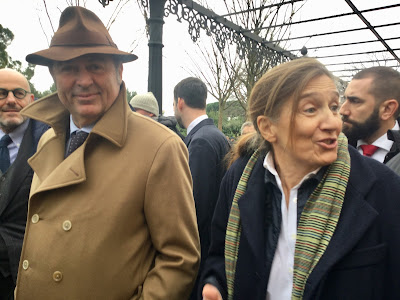
Philippe Bonnet & Adele Re Rebaudengo - Photo: Cat Bauer
Philippe Bonnet, the CEO of Generali Group, was also at the inauguration, and said their work was only partially complete. Generali wants to cure the planet, and is restoring the Procutarie Vecchie, with a design by David Chipperfield, which will house its ambitious "Human Safety Net" project. The Human Safety Net supports families, children and vulnerable communities, and is a movement of people helping people, "inspired by the idea of ‘chain aid’, where those who benefit may one day give back to someone else, creating a ‘ripple’ of positive change that extends worldwide with limitless potential."

The Procutarie will be open to the public for the first time in 500 years, and will include exhibition spaces, offices, workshops and an auditorium. The restoration will use original Venetian materials and craftsmanship from local tradespeople. 

When the entire project is complete, Piazza San Marco will be utterly transformed, all the way to the edge of the lagoon, welcoming the public with open arms. Let's hope the public responds with respect and appreciation, and treats Venice with the dignity she deserves.

ROYAL GARDENS OPENING HOURS

Open from Tuesday to Sunday:
from April 15 to October 15, 8.30 a.m. - 7.30 p.m. (last entry at 7.15 p.m.)
from October 16 to April 14, 9.00 a.m. - 5.00 p.m. (last entry at 4.45 p.m.)
The Gardens are closed: Mondays, December 25 and 31, January 1, the last Saturday and last Sunday of Carnival, Easter Sunday, Saturday during the Feast of the Redeemer (3rd Saturday in July).

Ciao from Venezia,
Cat Bauer
Venetian Cat - The Venice Blog

Sunday, December 15, 2019

The Day Before the Venice Flood: Joe Tacopina & The Venice Football Club at Palazzo Ducale

High water boots under the table - Joe Tacopina, Paolo Romor, Mariacristina Gribaudi, Matthew Senno - Photo: Cat Bauer
(Venice, Italy) On the afternoon of November 12, 2019, an intimate press conference was held in Palazzo Ducale to announce the Agreement between the Venice Civic Museums Foundation (MUVE) and Venezia FC, the Venice Football Club. The conference had been postponed an hour due to seasonal flooding in Piazza San Marco, and we all arrived wearing our acqua alta boots. 

Little did we know that later that same evening Venice would be hit by the worse flood in over 50 years, from which the city is slowly recovering.

But that afternoon, the mood was festive. The Agreement was to promote the historical and artistic heritage of Venice internationally, and to increase awareness among the children of the youth sector of Venezia Football Club, who come to Venice from all over the world.

To those who live and work in Venice, it was business as usual for a November afternoon. To Joe Tacopina, the dynamic attorney from New York and owner of Venezia FC, it was a novelty. He jumped up on his chair and exclaimed, "What other city in the world can you wear high water boots to sign an Agreement?"

High water boots in Venice are a great equalizer. If you want to move around the city during acqua alta, everybody must wear them -- doctors, lawyers, shop owners, fishmongers, counts and countesses. There is a certain charm about businessmen in suits and ties wearing knee-high boots to a meeting. Although it may seem peculiar to the rest of the world, in Venice, it is part of life.


Pierluigi Penzo Stadium in Venice - Photo:Pierluigi Penzo Stadium La Nuovo di Venezia e Mestre
 
What is Venezia FC?

Venezia FC is Venice's soccer team, founded on December 14, 1907. For much of their existence, they have played in Serie A and Serie B, the two top divisions in Italy; they currently play in Serie B. Their home stadium, the Pierluigi Penzo, which was built in 1913, is the second oldest in Italy. The stadium takes its name from a World War I Venetian aviator, and is down on Sant' Elena, the island at the eastern tip of Venice. Part of the vision for the team is to build a new world-class stadium on the mainland.

Who is Joe Tacopina?

Joe Tacopina is a high-powered, high-profile celebrity defense attorney, representing clients like  Meek Mill, Jay-Z, Maroon 5 and former New York Yankees star Alex Rodriguez. Tacopina is based in Manhattan and grew up in Brooklyn, the son of Italian immigrants. He is the father of five, has a passion for soccer, and bought Venezia Football Club in October, 2015. He is a present, hands-on owner. I found his New York style and American energy refreshing. Have a look at this very effective YouTube clip to learn more about the man and the Venice Football Club:


I know next to nothing about soccer, except to appreciate how gorgeous the players are, and was puzzled as to what it had to do with art, culture and Venice's civic museums. So I asked Tacopina:
"I want to strengthen the rapport with the city. I fell in love with Venice five years ago. Wherever you look you find beauty. Just look where we're sitting right now! I have to pinch myself. I want the players to understand the importance of the jersey they are wearing, and gain an understanding of the rich history and culture of Venice over the centuries. I want them to have a sense of pride."


As well as the professional soccer team, Venezia FC is developing its Venezia Football Academy, which has programs for young people on a local and international level. In addition to kids from the surrounding area, students participate from all over the world -- China, the U.S., Canada, Australia, South Korea, Vietnam, Mongolia, Finland and Oman. The international clubs come to Venice for a couple of weeks, and in addition to polishing their soccer skills, have the opportunity to visit Venice's museums.

Think about it -- if you were a 14-year-old aspiring athlete from the U.S. who traveled all the way to Venice to improve his or her soccer skills, and were brought to the awesome Palazzo Ducale so you could understand centuries of Venetian history -- how mind-blowing would that be?


Mariacristina Gribaudi gets a Venezia FC jersey - Photo: Cat Bauer
At the end of the conference, Mariacristina Gribaudi, the President of MUVE and a powerhouse herself, was presented with a jersey with her name on it. She whipped off her jacket and slipped it over her head (she's got a tattoo!).

Gribaudi is the mother of six -- she and her second husband are a modern-day Brady Bunch, combining their kids from previous marriages into a solid family unit. She is also the Administrator of the family business, Keyline, founded in 1770 and based in the Veneto, which produces door and car keys, as well as key cutting machines on a global scale. 

In addition to running MUVE and Keyline, Gribaudi's passions are young people and women -- one of the first things she did as MUVE President was install Baby Pit Stops at the museums where you can pop in and tune-up your baby: breastfeed and change a diaper. If you can understand Italian, here's a YouTube video, (which apparently is not longer available as of August 22, 2021).
 
Mixing sports and culture? I think it is a terrific idea, especially with these two passionate individuals at the helm. The Venice Civic Museums has a rich educational section, offering programs and adventures for adults, kids, schools and families on a local and international level -- not just for soccer players -- so if you're in Venice with the family, discover what programs MUVE has to offer. Developing the educational program and encouraging kids to enrich their knowledge of Venetian heritage is a powerful tool to creating a strong foundation for future generations.  


Go to Educational Services of the Venice Civic Museums for more information.

Ciao from Venezia,
Cat Bauer
Venetian Cat - The Venice Blog