Monday, August 31, 2020

The Disquieted Muses Grapple with the World - When La Biennale di Venezia Meets History


Freedom for Chile (1973) at Le Muse Disquiete - Photo: Cat Bauer
(Venice, Italy) When La Biennale was forced to postpone the International Architecture Exhibition due to the current health crisis, it got creative and dug into its Historical Archives for Contemporary Arts (ASAC) to mark the 125 years that it has been in existence. 

For the first time, all the artistic directors of La Biennale's six different departments -- Art, Architecture, Cinema, Music, Dance and Theater -- have come together to curate Le Muse Inquiete, an enlightening exhibition illustrating how history has crossed paths with the dynamic cultural institution.

Back in the 1890s, the original idea to hold an international art festival in Venice was the brainchild of Riccardo Selvatico, a playwright, poet, and mayor of Venice, who, together with his circle of intellectuals, would meet in CaffĂ© Florian in Piazza San Marco to organize their plans. 

La Biennale's first International Art Exhibition of the City of Venice opened on April 22, 1895 in a purposely-built pavilion in the sprawling gardens of Venice's Giardini sector. Belgium built the first national pavilion in 1907, soon joined by Hungary, Germany, Great Britain, France and Russia, creating individual art embassies where each country could spotlight their talent. 

Aside from interruptions by two world wars (and now the COVID-19 pandemic), La Biennale has taken place ever since, growing into one of the most important global cultural events.

The Disquieted Muses - Photo: Cat Bauer
The Disquieted Muses grabs us from the moment we enter the Central Pavilion. We come face to face with clips from June 14, 1934 of Adolf Hitler landing at the airport on the Lido in Venice and disembarking from a Lufthansa plane where he was greeted by Benito Mussolini. The two dictators hop into a boat taxi along with Giuseppe Volpi, the powerful businessman and president of La Biennale -- who created the Venice Film Festival -- and Antonio Maraini, the secretary general of La Biennale and Florentine sculptor who had a "dazzling career of absolute dominance over artistic life during Fascism."

We weave our way through rooms documenting La Biennale's transformation from a local public institution that organized international art exhibitions into an organization controlled by the Fascists, who viewed the arts as a political propaganda tool. From 1934 to 1938, La Biennale was visited by  Mussolini, Hitler, Joseph Goebbels and the king of Italy, "demonstrating its importance as a stage for new Italian alliances with the world."

In May 1940, war raged in Europe but La Biennale still opened its doors, now totally under Fascist control, with artists chosen by direct invitation or through competitions based on Fascist themes. The Palazzo del Cinema on the Lido had been requisitioned by the armed forces, so the 8th Venice International Film Festival was held in the historic center of Venice at the San Marco and Rossini cinemas, and only Axis allies or neutral countries were allowed to take part.

Military Requisition for Property - Photo: Cat Bauer
Italy was at war in 1942 and La Biennale did not have the staff or resources to open, but geared back up in 1946 after the war. One of the most interesting documents on display is the MILITARY REQUISITION FOR PROPERTY dated May 1, 1947 notifying the Comune di Venezia that elements of the United States of America were temporarily occupying the Palazzo del Cinema.

Model of the Peggy Guggenheim Collection - Photo: Cat Bauer
Peggy Guggenheim brought her collection -- which included Jackson Pollack -- to Venice in 1948, the same year of the first solo exhibition by 67-year-old Pablo Picasso, who had never exhibited at La Biennale before. A small model of the Greek pavilion where Peggy exhibited her collection is an amazing reproduction of the show with the tiny works of art all in their places.

We journey through the Cold War and the 1950s when Bertolt Brecht was invited to stage Mother Courage and Her Children, but was refused a visa by the Italian government. In 1954, mayhem broke out at the award ceremony in the Sala Grande when Federico Fellini's La Strada won the Silver Lion and Luchino Visconti's Senso was totally ignored. "Visconti's assistant Franco Zeffirelli got in a physical fight with Fellini's assistant Moraldo Rossi, and the police had to intervene to separate them, while La Strada's producer Dino De Laurentiis engaged in a shouting match with Visconti supporters."

In the 1960s Abstract Expressionism arrived on the scene from the United States, bringing an American contingent of Pop artists like Andy Warhol and Jasper Johns to La Biennale. Robert Rauschenberg's controversial 1964 win of the coveted Golden Lion, La Biennale's top prize, created an uproar in the art world.

That is just a small taste of the overwhelming history lesson that awaits you at the Central Pavilion down at Giardini. The titles of the rooms illustrate more of what's in store:

ROOM 1
The Film Festival, 1932-1939

Room 2A
The Biennale during Fascism 1928-1945

Room 2B
The Cold War and the New World Order 1947-1964

Room 3
1968: a year of protests and new ideals

ROOM 4
The 1970s: interdisciplinary and political work

ROOM 5
Freedom for Chile, 1974

ROOM 6
Sofija Guvajdulina, applied music and absolute music

ROOM 7
The Biennale of Dissent, 1977

ROOM 8
The First International Architecture Exhibition and Postmodernism, 1980

ROOM 9
La Biennale and the Society of the spectacle

GIARDINO SCARPA
Tan Dun, traditional music and technology

ROOM 12
The 1990s: from Nation-States to a Global Biennale

ROOM 13
Central Pavilion since 1895

It was fascinating to discover the extent that international events and politics actually play out in the world of art, and the tense equilibrium artists create when they react to the world around them with powerful creative expression. We can only imagine what the current state of affairs will inspire in future Disquieted Muses.

Le Muse Inquiete - When La Biennale Meets History is at the Central Pavilion in Giardini until December 8, 2020. Go to La Biennale di Venezia for more information.

Ciao from Venezia,
Cat Bauer
Venetian Cat - The Venice Blog

Thursday, August 20, 2020

Mysteries of the Month of August & the Divine Feminine - The Sacred Meets the Profane During the "Easter of Summer" - Thoughts on Ferragosto from a Scalding Venice

The Sun - Photo: NASA
UPDATED August 2026

(Venice, Italy) In 18 BC, Augustus, the first emperor of the Roman Empire, created the Feriae Augusti, the Festivals of Augustus. Many sources say he consolidated several pre-existing Roman festivals in August to give his people a longer period of time off after their hard work during the harvests. 

Others say the future emperor created the festivals when he was called Octavian to celebrate his conquest of Egypt and victory over Mark Antony, who committed suicide on August 1, 30 BC.

But long before that, stretching back to 600 BC, the peak of summertime we now call the Ides of August -- Ferragosto -- celebrated divine female energy. In Italy, honoring August isn't just a tradition; it is woven into the very soul of the country. Let’s go back in time…

JULIUS CAESAR, THE FATHER OF AUGUSTUS, WAS THE FIRST ROMAN TO BECOME A GOD

How does a man become a god?

Julius Caesar, along with Pompey the Great and Marcus Crassus, was one-third of the First Triumvirate, a secret, unofficial Roman political alliance formed in 60 BC that would deteriorate over time under the weight of each man's cunning ambition.

By January 49 BC, General Julius Caesar was the governor of Cisalpine Gaul, a province in the north of the Roman Republic. (If Venice had existed at that time, it would have been part of Gaul.) Caesar had many reasons for wanting to leave Rome. He had taken this northern governorship to win military glory, pay off massive debts, and maintain legal immunity from his political rivals. 

While Caesar was becoming rich and famous by conquering territory up north, his secret alliance collapsed. Marcus Crassus died in battle, and an envious Pompey the Great turned against Caesar, teaming up with the Roman Senate. Fearing Caesar's growing power, the Senate ordered him to disband his army and return to Rome as a private citizen. 

First you cross the Rubicon

Knowing he would face immediate arrest if he complied, Caesar chose defiance. The Rubicon was a shallow river that was the border between Gaul and the Roman homeland. Caesar knew that by crossing the Rubicon into the core of the sacred homeland with an army, he would start a civil war, famously uttering, "The die is cast."

I was surprised to learn that the Rubicon is not far from Venice, just 28 minutes outside Rimini.

The Rubicon - 28 minutes from Rimini - Google Maps

At one point, Gaul stretched from France, Germany, Switzerland, and beyond, across Northern Italy to the Adriatic Sea.

A "history buff" named Dixit on Quora does an excellent job answering the question:

Why did Julius Caesar cross the Rubicon as it is on the eastern edge of Italy when he came from Gaul towards Rome? 


The Rubicon - Dixit on Quora

"You can see that the Northern part of Italy, now called the ‘Po Valley', is North of the Rubicon and is labelled ‘Gaul', more correctly the ‘Province of Cisalpine Gaul'.

The Rubicon is outlined in blue on the above map, and you can see that it ends (or rather begins), in the Apennine mountains (which is that rougher terrain on the left side of the Rubicon).

In Roman times, the Rubicon marked the border between Italy, and Cisalpine Gaul, which was administered separately." Keep reading

To make a long, complex story very short, Caesar crossed the Rubicon on the night of January 10 or 11, 49 BC. He defeated Pompey in 48 BC at the Battle of Pharsalus, and vowed to build the Temple of Venus Genetrix, Venice the Mother, honoring the goddess as his family's divine ancestress.

Pompey fled to Egypt, where he was assassinated. Caesar was back in Rome as dictator by July 25, 46 BC. He would go on to reorganize time itself and create the Julian Calendar, but first had some unfinished business to attend to. 

Julius Caesar finally defeated the last of the rebel forces at the Battle of Munda in Spain during the Great Roman Civil War on March 17, 45 BC.

The official news of his victory reached the Senate in Rome on the evening of April 20, 45 BC, the day before Rome's birthday. The ancient games commemorating the founding of Rome in 753 BC, seven centuries earlier, were already scheduled to be held the next day -- chariot races, gladiator fights, and other spectaculars. After Caesar's victory, his propaganda team quickly re-dedicated the celebrations to Caesar, as if he were the founder of Rome itself.

After years of turmoil and civil unrest, the people of Rome were ready to move on. Caesar was given a house built like a temple on the sacred Palatine Hill. He was the first living man to have his portrait put on coins.

The Aphrodite of Fréjus (Musée du Louvre)
Roman marble copy representing Venus Genetrix statue
commissioned by Julius Caesar in 46 BCE

By early 44 BC, the groundwork for Caesar's celestial ascent had been laid.
His family had long claimed to be descended from the goddess Venus. Fulfilling his earlier battlefield vow from the fight against Pompey, he had built a magnificent temple dedicated to Venus Genetrix. He was the Pontifex Maximus, the chief high priest in the ancient Roman religion. If he became a living god, his name would be Divus Julius -- if and when ratified by the Senate.

Caesar’s enemies -- along with some of his most trusted friends -- put a stop to his divine ambitions when they assassinated him on the Ides of March 44 BC.

Or so they thought. 

Future emperor Augustus comes on the scene

Augustus was born Gaius Octavius on September 23, 63 BC. He was the grandnephew of Julius Caesar. In his will, Julius Caesar had named Octavius as his adopted son and sole heir. When Julius Caesar was murdered, the 18-year-old Gaius Octavius claimed his legal inheritance and became Gaius Julius Caesar Octavian, instantly becoming one of the wealthiest and most powerful citizens in the Republic of Rome.

I was curious as to why Julius Caesar chose the young teenager, Octavian, over Mark Antony, who had been expected to be the heir, and did some research.

When Octavian was four years old, his father died. His mother, Atia, remarried, and the boy was sent to live with his grandmother, Julia Minor, Julius Caesar's beloved sister, who raised him. Through his grandmother and mother, Octavian shared Caesar's sacred bloodline, the direct descent from the goddess Venus Genetrix

When Julia died, the 12-year-old Octavian stood before Rome and delivered an eloquent, moving eulogy for his grandmother. Word reached Caesar in Gaul, who was impressed by the young boy's poise and oratorical skill. While Mark Antony was a formidable general, he did not share this divine bloodline. Through the women who raised him, Octavian carried the living lineage of Venus Genetrix, the Divine Mother -- a connection that set him apart in Caesar's eyes as his rightful heir. 

Julius Caesar becomes a god

In July 44 BC, four months after Julius Caesar's assassination, Octavian held funeral games in honor of his adopted father, incorporating the games into the celebration of the goddess Venus -- games that Caesar had established two years earlier that ran from July 20th to July 28th (a lovely time for summer festivities since my own birthday is July 27th:-). 

Astonishingly, a bright comet appeared in the skies during the games -- a comet that has since been verified by historical records. 

Comets are hard to ignore

All of Rome witnessed the comet, which was visible for seven straight days. Julius Caesar had just been assassinated. The games celebrated the goddess Venus. Octavian proclaimed the obvious -- that Julius Caesar had become a god and had joined his ancestor, Venus, in heaven. 

Julius Caesar was deified as Divus Julius in 42 BC and was worshipped as a god by the masses. Octavian took the comet as a sign of his own rebirth and the dawning of a New Age. Octavian had become Divi Filius, the son of the divine. (Remember, all this was going on before Jesus Christ came on the scene.)

Head of Church + State = Emperor 

After nearly two decades of conquering and destroying his strongest enemies -- including Mark Antony and Cleopatra -- and expanding Rome's reach, Octavian received the title "Augustus" from the Roman Senate on January 16, 27 BC, transforming the Roman Republic into the Roman Empire with Augustus as its first emperor.
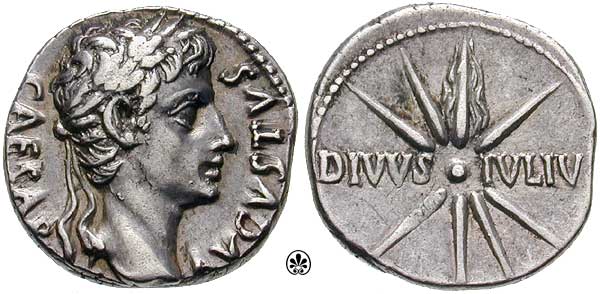
A denarius minted c. 18 BC. Obverse: CAESAR AVGVSTVS; reverse: comet of eight rays with tail upward; DIVVS IVLIV[S] (DIVINE JULIUS) - Image: Classical Numismatic Group, Inc

THE MONTH OF AUGUST

Prior to Emperor Augustus, the month of August was called Sextilis because it was the sixth month in the ten-month Roman calendar. It became the eighth month around 700 BC when January and February were added to the calendar, but was still called Sextilis. 
 
To this day, we still use the wrong numbers for the last four months of the year -- September is not the seventh month, but the ninth, yet we do not call it "November" after the Latin word novem for "nine."
  • September = septem = seven - but is the ninth month
  • October = octo = eight - but is the 10th month
  • November = novem = nine - but is the 11th month
  • December = decem = ten - but is the 12th month
Before Julius Caesar came along, the Roman calendar was often manipulated for political purposes. Julius Caesar reformed the calendar on January 1, 45 BC, aligning it with the Sun. But Caesar didn't name July after himself; he was assassinated before he could. It was Mark Antony who pushed a law through the Senate later in 44 BC to rename Caesar's birth month of Quintilis to "Iulius," or July, in his honor, making his birthday July 12, 100 BC. 

After Augustus came to power, in 8 BC he renamed Sextilis "Augustus," a month dear to his heart, but not because it was the month he was born -- remember, he was born on September 23, 63 BC. Ironically, Caesar Augustus would die on August 19, AD 14, in the month he created, at the age of 75.

From Wikipedia:
Whereas the emperor Augustus Caesar, in the month of Sextilis, was first admitted to the consulate, and thrice entered the city in triumph, and in the same month the legions, from the Janiculum, placed themselves under his auspices, and in the same month Egypt was brought under the authority of the Roman people, and in the same month an end was put to the civil wars; and whereas for these reasons the said month is, and has been, most fortunate to this empire, it is hereby decreed by the senate that the said month shall be called Augustus.

Roman fresco of goddess Diana hunting, 4th century AD,
from the Via Livenza hypogeum in Rome

THE VIRGIN MOON GODDESS DIANA

Centuries before Augustus swept onto the stage, Romans had already been celebrating the Nemoralia on the Ides of what would become August. The Nemoralia was a three-day festival in honor of the virgin goddess, Diana. 

Diana was a complicated deity -- a triple goddess of the Moon, the hunt, and the underworld -- as well as wild animals, virginity, fertility, and childbirth. She was often depicted with a bow and arrow.

Worshippers carried blazing torches and candles in a night procession to the shores of Lake Nemi, a volcanic lake just south of Rome in the city of Aricia. They adorned hunting dogs with garlands of flowers. It was a day of rest for women and slaves, to whom Diana offered protection. 

The Romans co-opted the twelve Olympian Greek gods and changed their names, but the gods retained much of their essential nature. The Romans conflated the virgin goddess Diana with the virgin Greek goddess Artemis, whose worship stretched back to pre-Hellenic times. Both Diana and Artemis were the daughters of the primary Olympian god, Zeus in Greek mythology, and Jupiter in Roman mythology.

By the time the Romans had conquered the Latin people of Aricia in 338 BC, Diana Nemorensis (Diana of the Wood) had been worshipped in the sacred grove of the Arician forest since very ancient times. The Grove of Diana was a healing sanctuary that would grow into a small city with Hellenized architecture and an international clientele. 

The moon goddess Diana was revered by Augustus, who had ties to Aricia on the maternal side of his family.

Virgin and Child on the Crescent Moon with a Diadem by
Albrecht DĂĽrer (1514) Rijksmusem

THE VIRGIN MARY

Meanwhile, around 4 BC, Jesus Christ was born to a Jewish virgin named Mary in Bethlehem, a city located on the West Bank in Palestine in the Roman province of Judea, six miles south of Jerusalem. With her husband, Joseph, she had traveled from Nazareth -- 90 miles away -- supposedly in order to register in the census ordered by Emperor Augustus (which, in reality, did not take place until AD 6).

The Archangel Gabriel had appeared to Mary and told her she would be the mother of the Son of God, conceived by the Holy Spirit, chosen above all women on earth for her goodness and purity, fulfilling the prophecy in the Old Testament of the promised Messiah.

At the time of the birth of Jesus, Herod the Great was the King of Judea, a title bestowed upon him by the Roman Senate, with whom he had close relations. Herod died in 4 BC, and his kingdom was divided among three of his sons and his sister. Under Augustus in AD 6, Judea was turned into a Roman province, and the general population was taxed. The Roman prefect was granted the power of a supreme judge and had the authority to order a criminal's execution.

After Augustus died in AD 14, his stepson, Tiberius, was named emperor. Pontius Pilate was the Roman prefect of Judea when Jesus Christ flipped Judaism on its head and challenged the pagan gods. With words as his only weapon, Jesus was a charismatic leader who could draw a crowd. 

He claimed God was his father. He rode a donkey into Jerusalem on Passover, surrounded by adoring masses. He went into the Temple, tossed over tables and drove out the merchants, accusing them of turning his Father's house into a den of thieves. He was a threat to the Jewish leadership, and an annoyance to Rome.

Around AD 30 or 33, Pontius Pilate condemned Jesus Christ to death, reportedly for claiming to be the Son of God and the King of the Jews. Jesus was crucified on a cross on a Friday and placed in a tomb, his mother Mary and others at the scene.

On Sunday morning, Mary Magdalene went to the tomb and found it empty. Jesus then appeared to Mary Magdalene and his disciples before he ascended body and soul into heaven forty days later. Rome and the Jewish leadership had severely underestimated the power of Jesus Christ.

Christ Pantocrator in the Basilica of San Marco, Venice
Photo: Cat Bauer

CHRISTIANITY  vs. THE ROMANS

As the centuries passed, it became clear that Jesus Christ had founded an entirely new religion: Christianity, with devout worshippers willing to die for their faith. The highest of Christianity's holy days is Easter or Pascha, a movable feast tied to the Moon that celebrates Jesus Christ's resurrection from the dead.

There is a difference between the way the date is calculated between the Western Roman Catholic Church, which uses the Gregorian calendar, and the Eastern Orthodox Church, which still uses the Julian calendar.

For its first 300 years, Christianity was viewed by Rome as an illegal religion, and most Roman citizens, who were pagans, sought to repress it. Initially, persecution of Christians was carried out on a local level, instigated by pagan mobs. Christians were forced to renounce their religion and sacrifice to the Roman gods upon fear of death. One particularly gruesome form of capital punishment was damnatio ad bestias, condemnation to beasts, a blood sport reserved for the worst criminals and Christians.

In AD 68, Mark the Evangelist, Venice's own patron saint and the founder of the Church of Alexandria, was killed by a pagan mob when they put a rope around his neck and dragged him through the streets until he died.

The local persecutions escalated until in 303 AD, during the Great Persecution, the Roman state ordered the destruction of churches, the seizure of Christian property and the burning of Christian texts. Christians were tortured and burned alive or mutilated and forced to work in the copper mines in Egypt.

EMPEROR CONSTANTINE CONVERTS TO CHRISTIANITY

Constantine the Great put an end to the persecution of Christians in AD 313, together with his eastern counterpart, Licinius, with the Edict of Milan, granting the freedom for each individual to worship as he pleased. 

Constantine was a pagan who converted to Christianity in AD 312. He decreed that Sunday, sacred to the official Roman Sun god, Sol Invictus, would be a day of rest. He reunited the Roman Empire under one emperor and moved the capital to the Greek city of Byzantium, which he renamed Constantinople, founded in AD 324. He built churches, ordered up Bibles, and promoted Christians to high-ranking offices. Constantine was baptized on his deathbed on May 22, AD 337.

Christianity became the official state religion of the Roman Empire with the Edict of Thessalonica on February 27, AD 380. Similar to how Rome absorbed the Greek gods, it changed the images and feast days of the pagan gods to represent the Christian religion.

Church of Santa Maria Assunta, Torcello, Venice - Photo: Cat Bauer

THE ASSUMPTION OF MARY & THE EASTER OF SUMMER

There is no mention of how the Virgin Mary, the mother of Jesus Christ, died, and it has been a topic of discussion throughout the ages, including whether to call her the Theotokos, the Mother of God, the Christotokos, the Mother of Christ, or even the contentious role of Co-Redemptrix, a concept suggesting that Mary actively co-operated in the saving of humanity by offering her own maternal suffering at the foot of the cross.

For centuries, it was debated whether:
  • she died a natural death
  • Christ transported her soul to heaven, and on the third day her body was resurrected
  • she was still alive at the time of the Assumption
The Virgin Mary's ascent into heaven is called the Dormition in the Eastern Orthodox Church, and the Assumption in the Roman Catholic Church. It is the same celebration with different interpretations. 

The earliest records about the celebration of the Virgin Mary are lost to history, but reference was made to a feast day as far back as the 3rd century. Then, in AD 431, during the time of the Council of Ephesus, it was decided that the Virgin Mary was to be called the Theotokos, "the one who gave birth to God." 

The Byzantine emperor Maurice (539-602) selected August 15th as the feast of the Dormition, the passing of the Virgin Mary from earthly life.

The Easter of Summer

The Greek Orthodox Church celebrates the Dormition of the Theotokos on August 15, and calls it the "Easter of Summer." It is preceded by a two-week fast, broken by a traditional feast with family and friends. 

The Orthodox Church teaches that Mary died a natural death at the house of John the Evangelist in Jerusalem, surrounded by the Apostles except for Thomas. The Apostles buried her in the garden of Gethsemane. When Thomas arrived three days later, he visited her tomb and found it empty. So, the Orthodox Church believes that Mary died on earth, Christ took her soul to heaven, and then her body was assumed.

After the fall of the Western Roman Empire, the Papal State institutionalized the Feast of the Assumption as a Catholic holiday on August 15th and moved the pagan Ferragosto festival so it would coincide with the religious festival of the Virgin Mary.

FASCISTS HOP ON THE FESTIVAL

During Fascism in the late 1920s and 30s, the regime organized discounted train trips so that working classes in Italy could have an opportunity to relax and visit the sea or the mountains on August 13, 14, and 15, establishing a tradition of traveling to different regions that continues to this day.

In the Roman Catholic Church, it was not until 1950 that Pope Pius XII made the Assumption of the Virgin Mary part of Church dogma, declaring "that the immaculate Mother of God, Mary ever virgin, when the course of her earthly life was finished, was taken up body and soul into the glory of heaven." He did not say whether or not she was already dead.

So in Italy, the pagan festival of the ancient moon goddess, Diana, was absorbed into the Roman Imperial festivities of Ferragosto, which was absorbed into the Catholic feast of the Assumption of Mary, the Mother of God, which was absorbed into the Fascist festivities of Ferragosto...

Happy August from Venezia,
Cat Bauer
Venetian Cat - The Venice Blog

Wednesday, July 15, 2020

The Invention of Happiness - Jacques Henri Lartigue at Casa dei Tre Oci in Venice

by Jacques Henri Lartigue
© Ministère de la Culture (France),
MAP-AAJHL


(Venice, Italy) Jacques Henri Lartigue was seven-years-old when his father, an amateur photographer, gave him his first camera. But it wouldn't be until he was nearly seventy-years-old that an exhibition at MoMA in New York City and a portfolio in Life magazine marked the real beginning of his international fame for works he had produced more than fifty years before.

Born into a wealthy family on June 13, 1894 in Courbevoie in the region of ĂŽle de France, Lartigue grew up in Paris. He took photos of the world around him -- friends and relatives jumping and playing -- everyday life of the affluent middle class. He developed the photos himself, and experimented with double exposure. In 1911 he started keeping a diary, which he would continue to do his entire life.

Dani Lartigue, Aix les Bain, August, 1925
Photograph by Jacques Henri Lartigue
© Ministère de la Culture (France),
MAP-AAJHL
 
By the age of sixteen he started taking photographs of fashionable women strolling along the Bois de Boulogne and other images of La Belle Époque, the period before World War I when Paris was a thriving hub of art and culture and Europe's future was optimistic. He was interested in automobile and horse races, and the wealthy people who attended them. Even though Lartigue would live through the atrocities of two world wars, he continued to photograph the fanciful side of life, preserving moments that delighted him -- the invention of happiness.

In 1919 he married his first wife, Madeleine Messager, known as "Bibi." Two years later she gave birth to their son, Dani.

Madeleine Messager known as Bibi on her honeymoon,
Hotel des Alpes, Chamonix, 1920
Photograph by Jacques Henri Lartigue
© Ministère de la Culture (France),
MAP-AAJHL
 
In the middle of the First World War Lartigue decided to devote himself to painting. He also worked as a set designer, illustrator and still photographer, and started spending time with key personalities from the world of art and cinema.

In 1934, he married his second wife, Marcelle Paolucci, known as "Coco." His illustrations were published in fashion magazines, and he became creative director for important festivals in Cannes, La Baule and Lausanne.

Coco, Deauville, 1938
Photograph by Jacques Henri Lartigue
© Ministère de la Culture (France),
MAP-AAJHL
 
In 1945, he married Flore Orméa, known as "Florette," whom he had met in Monte Carlo in 1942. Florette was twenty-seven years younger than Lartigue, but this wife was a keeper -- they would remain married for nearly fifty years.

Thanks to Albert Plecy, an influential personality of the world of photography in France, in 1954 the Gens d’Images association was founded and Lartigue became its Vice-President. The following year Lartigue exhibited his photographs for the first time at the Galerie d’Orsay, alongside works by BrassaĂŻ, Doisneau and Man Ray.

Hands of Florette, 1961
Photograph by Jacques Henri Lartigue
© Ministère de la Culture (France),
MAP-AAJHL
 
But it wasn't until 1962 when Lartigue and Florette spent four months in the United States that his career as a photographer really began to take off. Latigue showed his photographs to Charles Rado of the Rapho agency in New York, who in turn showed them to John Szarkowski, the newly-appointed director of the photography department at the Museum of Modern Art. Szarkowski jumped at the chance to exhibit the works.

Lartigue was almost seventy, and Szarkowski presented him as the "father" of the renowned photographer Henri Cartier-Bresson and the "decisive moment," focusing on Lartigue's pre-WWI photos of La Belle Époque. In 1963, MoMA devoted a one-man show to him entitled The Photographs of Jacques Henri Lartigue. The portfolio of the exhibition was published in Life, the preeminent photo magazine in the U.S., in the same issue devoted to the assassination of President Kennedy -- a huge seller -- establishing Lartigue's reputation in front of a wide audience.

Towards the end of the 1960s, Lartigue met Richard Avedon and Hiro, two of the most influential fashion photographers of the time, who were enthralled by his art. Combining Lartigue's journal entries and his photos, Avedon conceived of the photography book, Diary of a Century, which cemented Lartigue's place in history.

Lartigue died on September 12, 1986 in Nice at the age of ninety-two, leaving us selective memories of a golden age, a rosy reality created by the cherished moments he chose to preserve. The Inventor of Happiness punctuated his signature with a sun.

J.H. Lartigue - Photo: Cat Bauer
 
The exhibition at Tre Oci was originally scheduled to run from March 4 until June 12, but was postponed due to the COVID-19 pandemic. This turned out to be a blessing in disguise because it now coincides with the Henri Cartier-Bresson exhibition at Palazzo Grassi -- the very same photographer that MoMA linked Lartigue's name to back in 1963 as the "father" of HCB's "decisive moment." This means that you can devote an entire weekend relishing the work of two powerhouse French photographers of the 20th century if you make a trip to La Serenissima.

Henri Cartier-Bresson. Le Grand Jeu runs from July 11 through March 20, 2021 at Palazzo Grassi, which I wrote about in my previous post The Great Game - Henri Cartier-Bresson Master Collection at Palazzo Grassi in Venice

The Invention of Happiness - Jacques Henri Lartigue runs from July 11 to January 10, 2021. It is curated by Marion Perceval, Director and Charles-Antoine Revol, Project Manager of the Donation Jacques Henri Lartigue, and Denis Curti, artistic director of La Casa dei Tre Oci, and is organized by Civita Tre Venezie and promoted by Fondazione di Venezia in close collaboration with the Donation Jacques Henri Lartigue in Paris with the patronage of the French Ministry of Culture. Go to Casa dei Tre Oci for more information -- whose site is now thankfully also in English.

Ciao from Venezia,
Cat Bauer
Venetian Cat - The Venice Blog

Friday, July 10, 2020

The Great Game - Henri Cartier-Bresson Master Collection at Palazzo Grassi in Venice

Henri Cartier-Bresson, prisoner of war
(Venice, Italy) Henri Cartier-Bresson (1908-2004) used a small Leica camera to capture his singular vision of humanity, disguising the shiny chrome parts with a black ribbon or tape to make it less conspicuous. He was adverse to fame, yet seemed to be at every important event or in the company of every prominent figure of the 20th century. Most importantly, he pioneered the art of street photography.

Born into a wealthy bourgeois family, he painted with the Surrealists and fought with the French Resistance. He was a hungry traveler who roamed the world and caught unparalleled moments of every level of life with his lens. The result was a treasure trove of riveting, candid images that earned him the title "The Eye of the Century."

"Seeing Cartier-Bresson's work made me want to become a photographer."
---Annie Liebovitz 

Lake Sevan, Armenia, USSR, 1972

THE MASTER COLLECTION

At the height of his fame in 1973, HCB decided to take a break from photography and return to his first passion of drawing. His art-collector friends Donimique and John de Menil asked him to create a collection of his best photographs from his contact sheets. At that point, HCB had spent 20 years of intense work at the renowned Magnum Photos, a photographic cooperative which he had co-founded in 1947 after finally escaping a German prisoner of war camp in 1943 on his third attempt. HCB selected 385 images from among tens of thousands of photographs to make up his Master Collection, or Grand Jeu, of which six sets were printed. One of those sets was acquired by the Pinault Collection.

"...how his eyes looked at the world. Can that actually be learned?"
---Wim Wenders

Samuel Beckett, Paris, France, 1964

THE PLAYERS - The five curators

1. François Pinault, Collector, from France
"The ordinary and extraordinary passage of time"

2. Annie Liebovitz, Photographer, from the United States
"Seeing Cartier-Bresson's work"

3. Javier Cercas, Writer, from Spain
"An imminent revelation"

4. Wim Wenders, Director, from Germany
"An eye for an eye (but in a new sense, not with that old meaning of 'revenge')"

5. Sylvie Aubenas, Curator, from France
"Life lines, convergence lines"

 "...this elusive character...constructed a photographic ensemble dazzling with lightness, empathy, humanism and humor..."
---Sylvie Aubenas

Washington, D.C., 1957

THE RULES OF THE GAME

The five co-curators were asked to choose 50 images by HCB from the Master Collection. None of the curators knew what the others had selected. Each curator was given carte blanche to create their own individual backdrop -- the scenography, framing, and color of the walls. The result is five unique perspectives on what influenced Henri Cartier-Bresson, allowing us to see his work from different angles.

"...like catching a fly in midflight."
---Javier Cercas

A Young Belgian Woman is Denounced as a Gestapo Informer, Dessau, April 1945
To come out of quarantine and walk into the halls of Palazzo Grassi and witness the images of Henri Cartier-Bresson is like stumbling upon an oasis of culture after months in a virtual desert. And to see the selections of the five different curators is especially fascinating -- some of the same images crop up in each independent exhibit, seen through different eyes. Each vision has its own impact as it tries to define the mysterious talent that left behind a remarkable trail of captured moments in history.

"Truth, simplicity, humility: that is what characterizes the work of Cariter-Bresson in my eyes."
---François Pinault

Hyères, France, 1932
Based on a project conceived and coordinated by Matthie Humery, Palazzo Grassi presents Henri Cartier-Bresson. Le Grand Jeu, co-organized with the Bibliothèque nationale di France in partnership with the Fondation Henri Cartier-Bresson, which runs from July 11, 2020 through March 20, 2021. A ticket includes the Egyptian photographer Youssef Nabil. Once Upon a Dream also at Palazzo Grassi, and the collective Untitled, 2020. Three Perspectives on the Art of the Present at Punta della Dogana. Go to Palazzo Grassi for more information.

Ciao from Venezia,
Cat Bauer
Venetian Cat - The Venice Blog

Thursday, June 25, 2020

Bottega Cini - New Concept Store in Venice Celebrates Excellence

Bottega Cini - Photo: Cat Bauer
(Venice, Italy) Bottega Cini, a new type of museum shop in Venice, is a cause for celebration. It is refreshing to witness the opening of a store that fits so perfectly into the local community, mixing commerce and traditional Venetian culture, positioned in just the right zone. Located directly in front of Palazzo Cini at San Vio in the Dorsoduro district of Venice, Bottega Cini is sure to attract both locals and travelers who visit the Accademia Galleries, the Palazzo Cini Gallery, the Peggy Guggenheim Collection and the Punta della Dogana art collections -- known as the "Dorsoduro Museum Mile."

The store was created from an encounter between three entrepreneurial entities -- The Merchant of Venice, The Vittorio Cini Archive Foundation and Museyoum, each known for excellence in their respective sectors. The aim is to keep centuries-old Venetian artisan production alive -- a Renaissance workshop with a contemporary flair.

Jelena Vesic at the counter of Bottega Cini - Photo: Cat Bauer

THE MERCHANT OF VENICE

Inside the store you will find the perfume art of the Merchant of Venice, created by the Vidal Family, known internationally for their high-quality products for more than a century.

In 1900, Angelo Vidal established a small laboratory for perfumes and soaps in Venice, a city known since ancient times as a center of the perfume industry. In 1986, Massimo Vidal, Angelo's grandson, established Mavive -- an acronym formed by "Massimo Vidal Venezia" -- and launched the company with its beloved Italian brand, Pino Silvestre. Over the years, the company would go on to acquire new brands like Police and Replay.

In December of 2012, there was an intimate press conference held in in the Sala della Bolla at Palazzo Ducale to launch The Merchant of Venice, Mavive's new luxury line of exotic fragrances, which is where I met Massimo Vidal and his son, Marco, 21st century alchemists.

The Merchant of Venice

I was immediately impressed, and wrote a post:

The Merchant of Venice - Noble Secrets of the Art of Perfumery

...With the strong support of the Vidal family, the Venetian owners of the international fragrance company, Mavive, Venice has decided to reveal some of its ancient secrets and perfume recipes, and has reprinted Secreti Nobilissimi dell'Arte Profumatoria by Giovanbattista Rosetti.

Noble Secrets of the Art of Perfumery was first published in Venice in 1555, then reprinted in Bologna in 1672. I am holding the little book in my hand right now... 
The creation of perfumes and cosmetics was considered an art performed by Venetian spezieri, or spice-makers, who, according to Giancarlo Ottolini, were "part alchemists and part physicians who had a sound knowledge of chemistry, herbal medicine and the numerous ingredients (and their properties) that were available at the time"... read more
 
Palazzo Cini
THE PALAZZO CINI GALLERY, THE VITTORIO CINI ARCHIVE FOUNDATION AND YANA CINI ALLIATA DI MONTEREALE

Count Vittorio Cini (1885-1977) was a 20th century entrepreneur, collector, politician, philanthropist and creator of the renowned Giorgio Cini Foundation on the Island of San Giorgio Maggiore in Venice, dedicated to the memory of his son, Giorgio, who died in 1949 in a plane crash in Cannes at age 30.

In 1919, Vittorio acquired Palazzo Foscari-Loredan at San Vio and united it with Palazzo Grimani, the adjoining palace, creating the magnificent Palazzo Cini where Vittorio lived with his wife, the actress Lyda Borelli, and their children, Giorgio, Mynna, and the twins Yana and Ylda, who were born in the house. Vittorio Cini was an avid collector, acquiring fine artworks and objects with which he adorned the palazzo. The Vittorio Cini Archive Foundation keeps his impressive life and works alive.

As a child, Yana Cini was stricken with polio. The forced immobilization allowed her to concentrate on reading and developing cultural interests, and gave her a deep sense of empathy to those who suffer.

In 1953, Yana married Prince Fabrizio Alliata di Montereale in a ceremony at Venice's Church of Salute, with a "legendary" reception held at Palazzo Cini. The couple moved to Rome, where they would go on to have five children, the first, Giovanni, born in 1954. But Yana remained committed to her native city, often staying in her father's house and engaging with the Giorgio Cini Foundation's events.

In 1961, Yana founded the "Nido Verde" in Rome for the care and re-education of children afflicted by polio. Through this organization, Yana met Albert Sabin, the medical researcher who developed the oral polio vaccine, credited with nearly eradicating the disease. Sabin encouraged Yana and Fabrizio to form AIL, the Italian Association against Leukemia, Lymphomas and Myeloma. Today, their eldest son, Giovanni Alliata di Montereale, heads the Venice branch of AIL.

Yana left a significant part of her inheritance to the Foundation, including some rooms in Palazzo Cini, the family home, along with a collection of Tuscan paintings and other art objects.

Palazzo Cini Gallery is now a museum house, open to the public. The Gallery is laid out on two floors. The first recreates the refined residence of Vittorio Cini, while the second hosts exhibitions and cultural events.

Veduta del Pantheon d'Agrippa by Piranese - Photo: Cat Bauer
The Basilico Piranesi Rome exhibition kicked off at Palazza Cini Gallery on June 20 as Venice emerged from quarantine, coinciding with the opening of Bottega Cini, just steps away. The exhibition combines the contemporary photography of Gabriele Basilico with the veduta art of Piranesi in honor of the 300th anniversary of the artist's birth. Juxtaposed with the poetic etchings of city views in Rome by Piranesi are contemporary photos of the same scenes by Basilico. The exhibition was curated by the always excellent Luca Massimo Barbero, and runs through November 23, 2020.

Giovanni Alliata di Montereale & Marco Vidal safe distancing at Bottega Cini - Photo: Cat Bauer

OSELLA D'ORO AWARD

On the day of the Festa della Sensa, the day that Venice marries the sea, the Osella d'Oro Award is presented by the Festa della Sensa Committee on behalf of the Venice Comune to three institutions, agencies and private citizens who, with their activity in the sectors of culture, commerce and crafts, bring value and prestige to the city of Venice. The "Osella d'Oro" is the reproduction of an ancient Venetian gold coin minted at the time of Doge Mocenigo under the Serenissima Republic.

Last year, Marco Vidal, the CEO of The Merchant of Venice and Giovanni Alliata di Montereale, President of AIL Venezia and Vittorio Cini's grandson, were awarded the prize along with the Master Printer, Gianni Basso. Their commitment and dedication to the city in their respective sectors are part of the ethereal engine that keeps Venice running. Soon after, the idea for Bottega Cini was born.

Museyoum

MUSEYOUM

A new way to experience art and culture using Virtual Reality and Artificial Intelligence, Museyoum was co-founded by Stefano Bergonzoni and Riccardo Ricci. "Museyoum offers user-friendly visiting experiences thanks to an intelligent technology that captures the visitor's interests and offers diversified content by adapting themes and narrative keys linked to the uniqueness of each person. The system is a careful, discreet and interactive virtual assistant that tells, understands and answers direct questions."

Museyoum is a cutting-edge collaborator with the Vittorio Cini Archive Foundation, creating virtual tours and an interactive biography to perpetuate and honor the entrepreneur's memory.

Giovanni Alliata di Montereale at Bottega Cini - Photo: Cat Bauer
The system was not up and running yet on opening day, but it sounds exciting, especially "Raphael - From the Origins to the Myth" that comes to Venice after Urbino in honor of the 500 year anniversary of Raphael's death in 1520.
 
Rosa Moceniga Luxury Hand Cleansing Gel - Photo: Cat Bauer

BOTTEGA CINI

Inside the cultural concept store you will find some of the finest quality products created by artisans who are dedicated to their craft. Bottega Cini is determined to keep alive, develop and expand centuries-old Venetian traditions, as well as providing high quality service and innovative technology. 

VENETIAN GLASS 

NasonMoretti, founded in 1923 by the Nason brothers, set the benchmark for the "art of the table" with their innovative, elegant Venetian glassware. Now the third generation focuses on contemporary designs, and has collaborated with top fashion brands and fine restaurants.

At the core of Ercole Moretti is the murrina, that distinctive mosaic glass that is enchanting to behold. Founded in 1911 by three brothers, today the company is run by the founders' grandchildren using techniques that stretch back to ancient Rome.
 
Marisa Convento at Bottega Cini - Photo: Cat Bauer

The art of the Impiraressa was once prevalent in Venice. It was a profession only performed by women, who would string glass beads produced by the furnaces on Murano. Now it is a rare craft, and the treasured Marisa Convento is the Queen, not only creating distinctive jewelry and original designs, but also passing her knowledge on to future generations. Those of you who know Marisa from her days on Calle della Mandola will be delighted to know that she and her laboratory are ready to welcome you again inside Bottega Cini.

BOOKS 

Two of Venice's most respected publishing houses, Marsilio Editore and Linea d'Acqua, are well-represented at Bottega Cini. They are known for their fine quality books and the excellence of their presentation -- everything from the paper, the bindings, the ink, to the high-quality images. Many of the most important exhibitions in Venice are preserved within the pages their books, as well as contemporary authors of distinction.

Also represented is Toscolano 1381, carrying on the tradition of Toscolano, a paper-making center that dates back to the 14th century.  

ROSA MOCENIGA LUXURY HAND CLEANSING GEL

While you are at Bottega Cini, you can purchase a small hand cleansing gel, created especially for the surreal times we live in. The Rosa Moceniga perfume was born from a collaboration between The Merchant of Venice and the author Andrea di Robilant, whose aristocratic Venetian ancestors and their antics have provided a wealth of material. In Chasing the Rose, Andrea goes on a quest to find the origins of a pink rose growing wild on his family's former country estate, which leads him all the way back to Napoleon's court. I've been fortunate enough to inhale the fragrance of the actual rose -- the Rosa Moceniga itself -- and can confirm that The Merchant of Venice has miraculously captured its scent -- even in a hand cleansing gel!

Bottega Cini's website is still under construction, but you can find more information here.

Ciao from Venezia,
Cat Bauer
Venetian Cat - The Venice Blog