Friday, July 14, 2023

Venice Glass Maestro Lino Tagliapietra Speaks the Language of the Angels - "The Origin of the Journey" at Ca' Rezzonico

At Lino Tagliapietra's InGalleria on Murano 
Photo: Cat Bauer

(Venice, Italy) Lino Tagliapietra will be on 89-years-old on August 10, 2023. He is a Leo, a fire sign, ruled by the Sun, and represented by the Lion. (So am I, which is one reason why I love him:-) Working with fire on an island in the lagoon seems like a good job for a Venetian Leo.

At InGalleria, Tagliapietra's exhibition space on the island on Murano, I asked him the meaning of the cursive white glass symbols that seemed to spill out from the heavens and onto earth through an image of his open hands. To me, the white glass sculptures looked like letters that formed a word. Were they symbols written in a secret language? He said, no, he had created them just for fun. But I kept thinking there was something more...

Other reasons why I love Lino Taglipieatra:
  • He is the most brilliant glass artist on the planet today. 
  • He can translate the language of the angels into physical images that human beings can understand.
  • He's zooming around Venice at 90ish as if he were only 70ish.

    Lino Tagliapietra at Ca' Rezzonico
    Photo: Cat Bauer

I first encountered Lino Tagliapietra more than 12 years ago, back in 2011 when his retrospective Lino Tagliapietra, De Murano allo Studio Glass. Opere 1954-2011 starred at the Istituto Veneto di Scienza Lettere ed Arti. I reviewed it in a post entitled Lino Tagliapietra, Master of the Glass in Venice.

The post started off:

Lino Tagliapietra thinks in glass. His thoughts are beautiful and complex, and we have the great privilege of seeing those thoughts solidified in glass, a material created by the gods themselves when lightning strikes the earth.

Please click over and finishing reading what I wrote (it's short:-) so you can get the backstory (it is just a simple click!):

Angel Tear by Lino Taglipietra

Lino Tagliapietra, Master of the Glass in Venice

OK. Are you back now? Did you read it?

Right now Lino Tagliapietra has another gem of a show tucked inside the enormous Ca' Rezzonico palace on the Grand Canal, which itself just recently re-opened to the public. Entitled "L'origine del viaggio" or "The Origin of the Journey," it represents the core of his life's work.

Back in the 1970s, Tagliapietra revolutionized American glass design when he introduced students at Dale Chihuly's Pilchuck School in Seattle to Venetian glassblowing techniques. Since then, Tagliapietra divides his time between Murano and Seattle, so he slides easily between speaking in both Italian and English.

L'origine del viaggio at Ca' Rezzonico by Lino Taglipietra 
Photo: Cat Bauer
 
After the press preview, we were fortunate enough to be whisked across the lagoon to the glass-blowing island of Murano where Lino Tagliapietra was born almost 90 years ago. We entered his showroom, and ... he was already there! Minutes ago he was at Ca' Rezzonico! And now he was greeting us on Murano!


There are some moments in life when you know that you are actually living something rare and precious in real time, and yesterday was one of those days. To be chatting with Lino Tagliapietra, in the showroom of Lino Tagliapietra, on the island of Murano...


While I was nosing around on the upper level of InGalleria, I stumbled upon a letter in a blue frame on a bookshelf signed by Jeff Babcock. To me, it sums the man up:

Lino

You are a lion
my Maestro
the studio
your domain
you move with the power and grace
of the great cat

At the bench
you work magic
with this unruly glass

Touching
softly as you would a baby
when the piece is young
but as it grows
it needs a firmer hand

At times you pounce
attacking with power
and gentleness
controlling but never breaking the spirit
of the object you form

In your hands
you make of it
all it could ever wish to be

You are the best
I have ever known
You have my eternal respect

Jeff Babcock
6-7-97


Lino Tagliapietra explaining avventurina
(If you've read my previous blog post, you will know what that is:-)

When it was time to leave, I wanted to ask the Maestro something that had been on my mind the entire visit. I showed Lino Tagliapietra the photo of his hands and the squiggly glass objects below that he said he had created just for fun.

I said, in Italian, "To me, those are letters from another language -- the language of the angels. You have translated the words of the angels into something humans can understand. And the word you have written is 'love.' Do you agree?"

Lino Tagliapietra smiled and said, in English, "I agree one hundred percent."

Lino Tagliapietra. L'origine del viaggio at Ca' Rezzonico runs through September 25, 2023. Go to Ca' Rezzonico for more information. Go to Lino Tagliapietra for more information about the Maestro.

Ciao from Venezia,
Cat Bauer
Venetian Cat - The Venice Blog


Friday, June 30, 2023

The Fierce Art of Artemisia Gentileschi Broke the 17th-Century Glass Ceiling - "Cleopatra" Is a Guest at Palazzo Cini in Venice

Cleopatra by Artemisia Gentileschi (c.1620-26)
Private Collection Fondazione Cavallini Sgarbi

 
(Venice, Italy) More than four hundred years ago, Artemisia Gentileschi rocked the world with her intense depictions of the female spirit. After four centuries, the #MeToo movement is finally catching up to the crusade she pioneered.

Artemisia Gentileschi (1593-1653) was a female painter during the Baroque period when the art world was controlled by men. Her gripping talent and fiery resilience featured female protagonists of myth and biblical lore as heroines in control of their own destinies, not submissive damsels as portrayed by men.

Caravaggio, the influence

Artemisia was born in Rome on July 8, 1593, the eldest of four children; her siblings were boys. Her father was the well-known artist Orazio Gentileschi (1563-1639), who supported his family with commissions for altarpieces and chapels. When the brilliant wild child Caravaggio (1571-1610) exploded on the scene in Rome in July 1600 with his two Saint Matthew works, Orazio was enthralled.

Artemisia was just seven-years-old when Caravaggio inspired the art movement that would become Baroque. Caravaggio painted directly from life on to the canvas without drawing first, using real people to model the saints and sinners he whisked alive with his brush. His dramatic use of chiaroscuro -- dark and light -- exhilarated and shocked Rome. Artemisa's father, Orazio, fell under Caravaggio's spell. The younger man's influence seeped into his work. 

At one point, Orazio was such good friends with Caravaggio that he was famously sued for libel in August 1603 by painter and biographer Giovanni Baglione (1566-1643) author of the artists' bible The Lives of Painters, Sculptors, Architects and Engravers, active from 1572-1642 (if you weren't in that book, you were nobody). Orazio was part of Caravaggio's circle who had distributed crude poems about Baglione's art around Rome.

The tumultuous Caravaggio was not just a provocative painter, he went to trial at least 11 times for charges that included brawling and assault, and had to flee Rome in 1606 after being accused of murder. He died at the age of 38. People are still arguing if his death was the result of a vendetta.

Artemisia, the artist

Artemisia's mother died in childbirth in 1605 when Artemisia was 12-years-old. After that, she was raised by her father. Orazio had planned on his daughter becoming a nun, but through her impressive talent and ambition, she convinced him to teach her what he knew.

Caravaggio had greatly influenced Orazio with his revolutionary technique. Orazio, in turn, influenced Artemisia, who developed her own distinct style. Her earliest surviving work is Susanna and the Elders painted in 1610 at age 17. A popular subject for many male painters from the Old Testament Book of Daniel, two old lechers -- respectable members of the community -- spy on the beautiful and youthful Susanna while she is bathing. They try to blackmail her for sex, saying they will accuse her of cheating on her husband if she doesn't acquiesce. She refuses and then is put on trial for their false claims. She wins; they lose, and are stoned to death. Many male artists have depicted the scene -- researching it can take you down a predictable rabbit hole.

Susanna and the Elders by Artemisia Gentileschi (1610)

Artemisia's version was the first to capture the female point of view. The two elders are a couple of perverts right in her face, teamed up to intimidate Susanna into having sex. Susanna is naked and horrified, hands up in protest as one elder whispers threats into her ear, urged on by the other elder who whispers into his ear.

Astonishingly, the next year, Artemisia Gentielschi would be raped in real life by her father's colleague, Agostino Tassi. We know this because the records of the seven-month trial are in the State Archive in Rome. During Artemisia's testimony, they used thumbscrew torture to be sure she was telling the truth, which could have broken her fingers and destroyed her career as an artist. We can only imagine her trauma.

Agostino Tassi turned out to be the Harvey Weinstein of his day. "Never have I had carnal relations..." The trial revealed other rapes in his wake. Artemisia won. Tassi was convicted and imprisoned, but his verdict was later annulled...

Cleopatra by Artemisia Gentileschi (detail)
Photo: Cat Bauer

Instead of living her life hounded by the rape, Artemisia funneled her emotions down through her fingertips and out through her paintbrush. We know she was beautiful because she often used her own image in her paintings. Her intense storytelling made her a star -- she was commissioned by royalty and nobility. Grand Duke Cosimo II de’ Medici and the Grand Duchess, Cristina di Lorena, wife of Ferdinando I de’ Medici were her patrons. She was friends with Galileo Galilei.

We also know Artemisia was in Venice in the 1620s, but only recently do we know it was probably from the end of 1626 until 1630. She painted her striking Cleopatra shortly before her arrival in the lagoon.

At that time there was a mysterious society in Venice called the Accademia degli Incogniti -- the Academy of the Incognitos, or Unknowns. Composed of free-thinking intellectuals, mostly noblemen, with Giovan Francesco Loredan as one of the founders, they impacted Venetian political and cultural life. They wrote in their own language and pioneered opera as a public event.

The Ospite a Palazzo press notes describe The Incogniti as "one of the most original and lively realities in Venice at the time, and among the freest and most innovative in the whole of seventeenth-century Italy." Wikipedia notes that The Incogniti
were often depicted as a group of "sceptical libertines extolling a peculiarly Venetian brand of (im)morality." In addition to literature and musical theater, The Incogniti were interested in the role of women in society and dedicated about 20 missives and poetic compositions in honor of Artemisia. Did her work influence other artists in Venice?

Renata Codello, Vittore Sgarbi, Luca Massimo Barbero, Giovanni Alliata di Monterale
Opening of Cleopatra L'Ospite a Palazzo Cini
Photo: Cat Bauer

Artemisia Gentileschi's dramatic Cleopatra is a Guest of Palazzo Cini until July 16 thanks to the Collezione Cavallini Sgarbi. In fact, the always entertaining Vittorio Sgarbi, who is currently the Italian Undersecretary of State to the Minister of Culture, was here at the opening because it is basically his painting.

Go to Palazzo Cini for more information.

Ciao from Venezia,
Cat Bauer

Friday, May 26, 2023

AFRICA - Journey into "The Laboratory of the Future" at the 18th International Architecture Exhibition in Venice

Lesley Lokko, Curator &
Demas Nwoko,
Golden Lion for Lifetime Achievement Award
Photo: Cat Bauer

(Venice, Italy) Blue. The color blue is the first thing you see when you enter "The Laboratory of the Future," La Biennale's 18th International Architecture Exhibition set at Arsenale, where Venice once built her ships. 

Blue — and these words:

The Blue Hour. A period of time just before sunrise or sunset when the sun casts a diffuse light from below the horizon and the sky takes on a vivid blue tone. The landscape is wrapped in a muffled and suspended atmosphere. It only lasts a few minutes, half an hour at most, but it represents a rare chromatic beauty. In photography, it represents the ideal condition to highlight colour contrasts that would otherwise be invisible. The Blue Hour is sometimes marked by a subtle melancholy or a moment between dream and awakening. It is also considered a moment of hope.
Lesley Lokko
Curator of the
18th International
Architecture
Exhibition


Lesley Lokko, the Curator of Venice's International Architecture Exhibition, was born in Dundee, Scotland about 60 years ago. Her father was from Ghana and her mother was from Scotland. Lokko grew up in both countries. In addition to being an architect, she is a university professor and best-selling novelist -- she took 14 years off from architecture to write. There are touches of her wise words sprinkled throughout the exhibition. 

Those With Walls for Windows - Rhael "Lionheart" Cape
A meditation & exploration into the 'laws of freedom'
Photo: Cat Bauer

Lesley Lokko: "In South Africa -- where fierce battles
over language, custom, ritual, and memory are still being
fought -- a unique opportunity exists for architects, and
architecture, to play a different role, using different tactics
and tools to stitch together conflicting accounts,
possibly even to resolve them."


Lokko has put Africa firmly in the center of the show. Africa is the youngest continent in the world in terms of age; the average citizen is 20-years-old. "The Laboratory of the Future" includes 89 participants, over half of whom are from Africa or the African Diaspora. The exhibition focuses on the mighty themes of "decarbonisation" and "decolonisation." Instead of featuring the usual wooden models, it aims for a light touch, incorporating other mediums like digital, performance, and drawings, and re-using the infrastructure of last year’s Art Biennale. 

Architects are pragmatic artists, capturing an idea and interpreting it with physical nuts and bolts — different, than, say, a musician. Here, instead of their practical side, we see their artistic inspiration -- the essence of the structure made visible….the invisible spirit of architecture expressed by the installations. We get a glimpse of the core of Africa.


Lokko said something that made me think: "The Black body, the African body was Europe's first unit of energy. The first unit of labor." It is as if that ethereal energy has finally been revealed.


From Lesley Lokko's statement:

    "For the first time ever, the spotlight has fallen on Africa and the African Diaspora, that fluid and enmeshed culture of people of African descent that now straddles the globe. What do we wish to say? How will what we say change anything? And, perhaps most importantly of all, how will what we say interact with and infuse what ‘others’ say, so that the exhibition is not a single story, but multiple stories that reflect the vexing, gorgeous kaleidoscope of ideas, contexts, aspirations, and meanings that is every voice responding to the issues of its time?

        It is often said that culture is the sum total of the stories we tell ourselves, about ourselves. Whilst it is true, what is missing in the statement is any acknowledgement of who the ‘we’ in question is.

        In architecture particularly, the dominant voice has historically been a singular, exclusive voice, whose reach and power ignores huge swathes of humanity — financially, creatively, conceptually — as though we have been listening and speaking in one tongue only.

        The ‘story’ of architecture is therefore incomplete. Not wrong, but incomplete. It is in this context particularly that exhibitions matter."


Lesley Lokko's mission is to be an agent of change. She feels architectural schools have been too rigid to allow for really new knowledge to emerge and hopes that more renegade schools spring up.

During the press conference, Lokko attributed a quote to Oprah Winfrey. I checked, and it was actually Oprah Winfrey quoting Maya Angelou, although it seems no one is really sure who said it first. In any event, it's a good quote: "Nobody remembers what you said or what you did. People only remember how you made them feel."

How did Lesley Lokko's architecture exhibition make me feel? As I moved through the installations, I heard new voices I'd never heard before and saw things I'd never seen. I felt deeply moved and intrigued, as if I had been given the opportunity to pull back the curtain and see ancient knowledge that was new to me, but part of the very fabric of the earth.  

Not only does Lokko offer us a new way of looking at the world with her singular African-Scottish perspective, she is a woman in a profession overwhelmingly dominated by men -- she is only the fourth female curator of the architecture exhibition. It felt like Lokko took a huge chunk of material that has been missing from architecture -- missing from the world -- and added it to the foundation.

Like any good novelist, she has rewritten the story and improved the ending.

Biennale Architettura 2023 - The 18th International Architecture Exhibition opened to the public on May 20 and runs to November 26, 2023. Click for more information and tickets.

Ciao from Venezia,
Cat Bauer
Venetian Cat - The Venice Blog

Wednesday, April 26, 2023

A Red Rose for Venice Redux - April 25, 2023, the Celebration of the Feast of Saint Mark

A Rose for Venice - April 25, Feast of Saint Mark - View from the ground - Piazza San Marco
Photo: Cat Bauer

(Venice, Italy) There was a deluge on the morning of April 25, 2023, the Feast of Saint Mark, the day we celebrate Venice's patron saint. Italy is in the midst of a severe drought, so it would have been like a gift from the heavens -- just not on that day.

That day, at 12:30 PM, the Venetian artist Elena Tagliapietra and the Venetian author, Alberto Toso Fei were planning to recreate a Bocolo Umano or "Human Rose Blossom" in Piazza San Marco -- the same extravaganza a thousand citizens of Venice had magically manifested nine years ago, back on April 25, 2014.

April 25 is a national holiday for all of Italy -- Liberation Day, to commemorate the end of the Fascist regime and Nazi occupation. But in Venice, long, long before there was a united Italy, it was always a day of celebration.

During the Festa del Bocolo, men have been giving a single rose to the women they love for more than a thousand years.

Behind that tradition is a wonderful -- and poignant -- Venetian legend...

Human Rose Blossom April 25, 2014

On my way over to Piazza San Marco, I stopped by Rialto to see my friend, the mask-maker Sergio Boldrin, in his tiny shop at the foot of the Rialto Bridge. I was wearing a short red dress because it was the only red outfit I had.

I was soaked. I stood dripping in the doorway.

Sergio laughed: "What are you doing, Red One?" Sergio calls me "Red One" even when I'm not dressed in red because of the color of my hair. But today it seemed especially appropriate.

Me: "Remember when we made the human rose in Piazza San Marco back in 2014? This year we're doing it again."

Sergio peered out at the downpour. There were just a few hardy souls on the street. "How many people do you need for the rose?"

Me: "I think about a thousand."

Sergio: "You can always have a spritz." (If you've never been to Venice, a spritz is a traditional Venetian cocktail. It, too, is red.)

Cat Bauer in red for Festa del Bocolo 2023, Venice
Off I splashed. I was running late and the rain seemed determined to impede my progress.

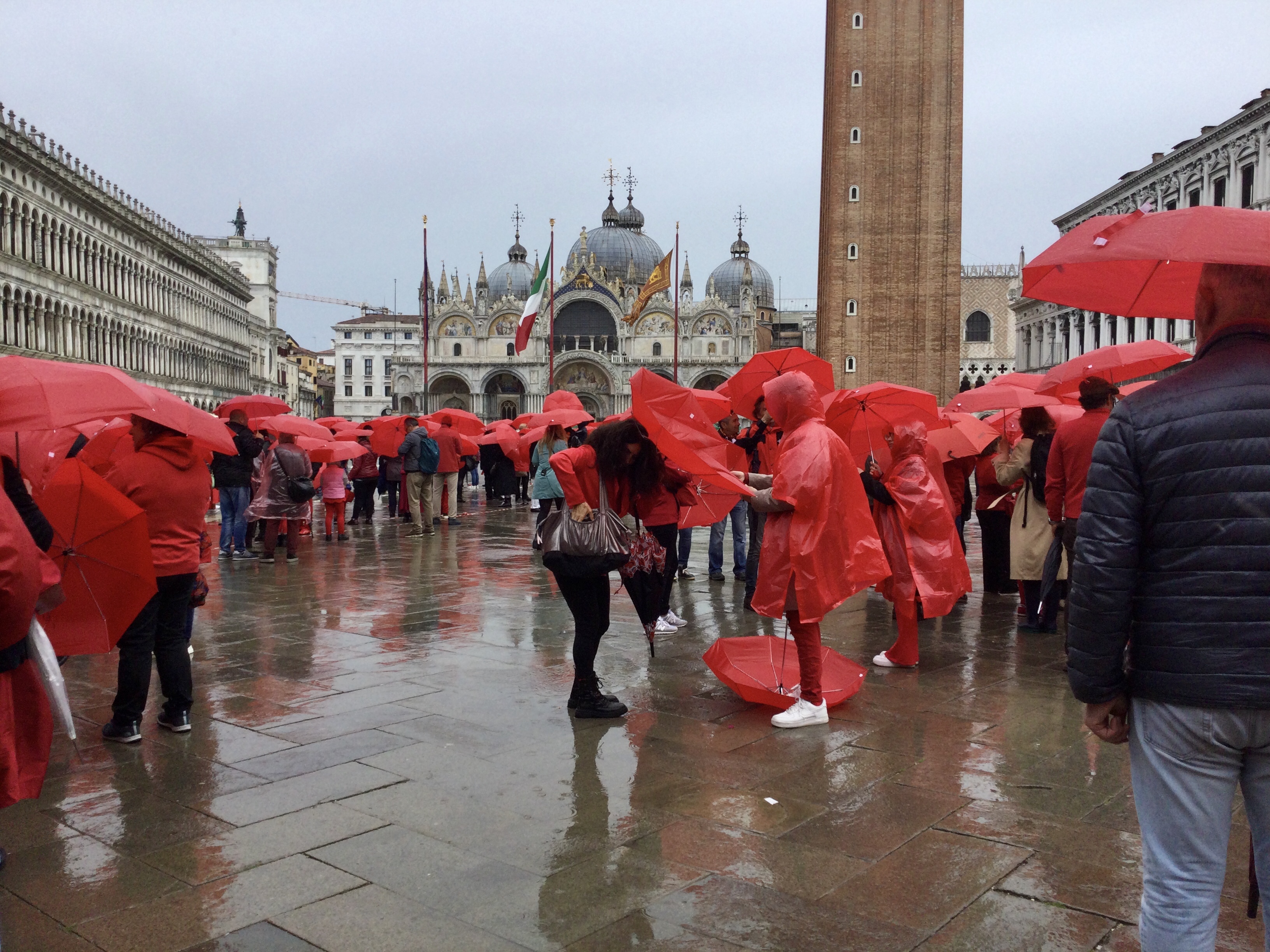
When I finally made it to Piazza San Marco, there was nobody in the square. I ducked into an empty ATM inside the Procuratie Vecchie and checked the group's Facebook page to make sure it was still happening. "WE WILL ALSO DO IT IN THE RAIN!! THE COLORS WILL BE CREATED BY THE FREE UMBRELLAS."

I did not see a mass of red or green umbrellas anywhere in the piazza. I asked a police officer where everyone was. He wanted to practice his English and I wanted to practice my Italian. Together we figured out in each other's languages out that neither one of us had a clue.

Bewildered, I wandered through the crowd packed inside the Procuratie Vecchie, sheltering from the storm. I got about halfway through when I realized that most of the crowd was at a standstill, divided into about 20 groups clustered around a person holding a number.

Ah, ha! The human rose was crammed inside the Procuratie Vecchie! I forged towards Group 2, which was the last one to the end.

I greeted my comrades. They were young and old, male and female; people who lived in town and people who had sloshed in from the mainland, despite the weather. My name was checked off the list. I was handed a red umbrella. Yay!

Alberto Toso Fei tells the story of the Bocolo

Then I saw a familiar face, Alberto Toso Fei, walking along the crowd with a megaphone, telling the legend of the Festa del Bocolo. The story dates back to the 9th century, and goes something like this:
A noblewoman, Maria Partecipazio, called "Vulcana" because of her flaming red hair, and a troubadour, Tancredi, fell in love. But Maria was the daughter of the Doge, and marriage to a troubadour would never have her father's approval.

In order to overcome the social class differences, Tancredi went off to war to find glory and raise himself to the higher social level of his beloved. 

Tancredi served as a valiant soldier under Charles the Great (Charlemagne) in the war against the Moors, but was mortally wounded. As he lay dying in a pool of blood by a bed of red roses, he plucked a rose for Maria Partecipazio and asked his comrade, Orlando, to take the blossom to his beloved Lady in Venice, stained with his blood. 

Orlando kept his vow, and arrived in Venice the day before the Feast of Saint Mark. He gave the rose to Maria Partecipazio as the last message of love from the dying Tancredi.

The next morning, Maria Partecipazio herself was found dead, the red rose lying on her heart, finally joined with her beloved in the celestial world.
 
Since that time, Venetian lovers use the symbol of the red rose blossom to pledge their love.

Alberto Toso Fei & Ermelinda Damiano, City Council President
Photo: Cat Bauer 

I don't remember where I found that version of the legend. I tried to fact-check it along with other versions of the story. As the writer and historian John Julian Norwich said, "One of the most infuriating aspects of early Venetian history is the regularity with which truth and legend pursue separate courses."

Agnello Participazio became Doge in 811 and died in 827. Charlemagne died in 814. So for this story to work, it would have had to taken place between 811 and January 28, 814. But the war against the Muslims, the Battle of Tours, took place about 80 years earlier in 732, and was won by Charles Martel, who was Charlemagne's grandfather.

I was curious to know which version of the story Alberto Toso Fei uses, but the scene was too hectic during the Festa del Bocolo to ask him.

Just before 12:30, the rain had lightened to a drizzle. We scrambled into Piazza San Marco to create the human rose as cameras from the Campanile and drones photographed us from above.

Right on time, Saint Mark worked his wonders. The rain stopped completely after about five minutes and the sun poked its head out.

I was surprised (but not really) at how many people had turned out in the tempest to celebrate the day! We shared a sense of joy and community as we chatted and bounced our red and green umbrellas to create a human rose. It was a beautiful moment and a moving realization of how deeply locals love Venice, no matter what challenges the gods -- and the tourists -- throw at us.

Do you really think that Saint Mark would let some rain spoil his special day? Whether the story of the rose blossom is actually true, it is a bittersweet love story dating back over 1,200 years and a remarkable element of Venetian culture. The belief in the story is felt so deeply by the locals that a thousand people will splash into Piazza San Marco to manifest the Festa del Bocolo in human form. 

That is reality.

Venice sends a message of love to the world, embedded in tradition.

Una Rosa per Venezia - A Rose for Venice 2023 - Photo: Venezia Serenissima

Thank you to Elena Tagliapietra and Alberto Toso Fei for bringing everyone together with all your powerful projects throughout the years. You keep Venice alive! Un grande abbraccio.

Elena Tagliapietra & Alberto Toso Fei

Ciao from Venezia,
Cat Bauer
Venetian Cat - The Venice Blog 

Friday, March 31, 2023

Nikos Aliagas - "Regards Vénitiens" - Venice Through the Lens of a Newcomer

Traghetto Canal Grande - Venezia, 2022 by Nikos Aliagas - Photo: Cat Bauer

(Venice, Italy) I am happy that the insightful and delightful Nikos Aliagas photography exhibition at Fondazione dell'Albero d'Oro in Palazzo Vendramin Grimani that was set to close on April 2 has been extended to November 26, 2023. The ancient palace was recently restored and is full of promise.

Palazzo Vendramin Grimani is located on the Grand Canal right off Campo San Polo, which is my old 'hood, and many of the local images captured by Nikos's lens are faces and places familiar to me. I found his attitude refreshing:
"...Being here is an honor and a responsibility, too...
...You feel small when you first arrive in Venice...
...Everyone wants their share of Venice..."

Nikos Aliagas in Venice - Photo: Cat Bauer

Nikos Aliagas is a well-known Greek-French journalist and entertainer who hosted "Star Academy," the French version of "America's Got Talent," featuring guest stars like Beyoncé, Rihanna, Madonna, etc. So I was surprised to discover that he was one of the few people on this planet who had never been to Venice before, even though he's in his 50s and based in Paris -- you'd think he would have stopped by a bit sooner. 
"I had never been to Venice before the summer of 2022, and I had a strange apprehension, a fear of arriving after the party, of wearing the mask of the intruder who sneaks into a setting where tourists and onlookers are swarming, eager for souvenirs and selfies." 
Fondazione dell'Albero d'Oro itself is new, born in 2019 with the aim of bringing the ancient Palazzo Vendramin Grimani back to life as a "cultural salon with an international outlook, a crossroads of exchange and creativity."

Dans le vent - Venezia, 2022 by Nikos Aliagas - Photo: Cat Bauer

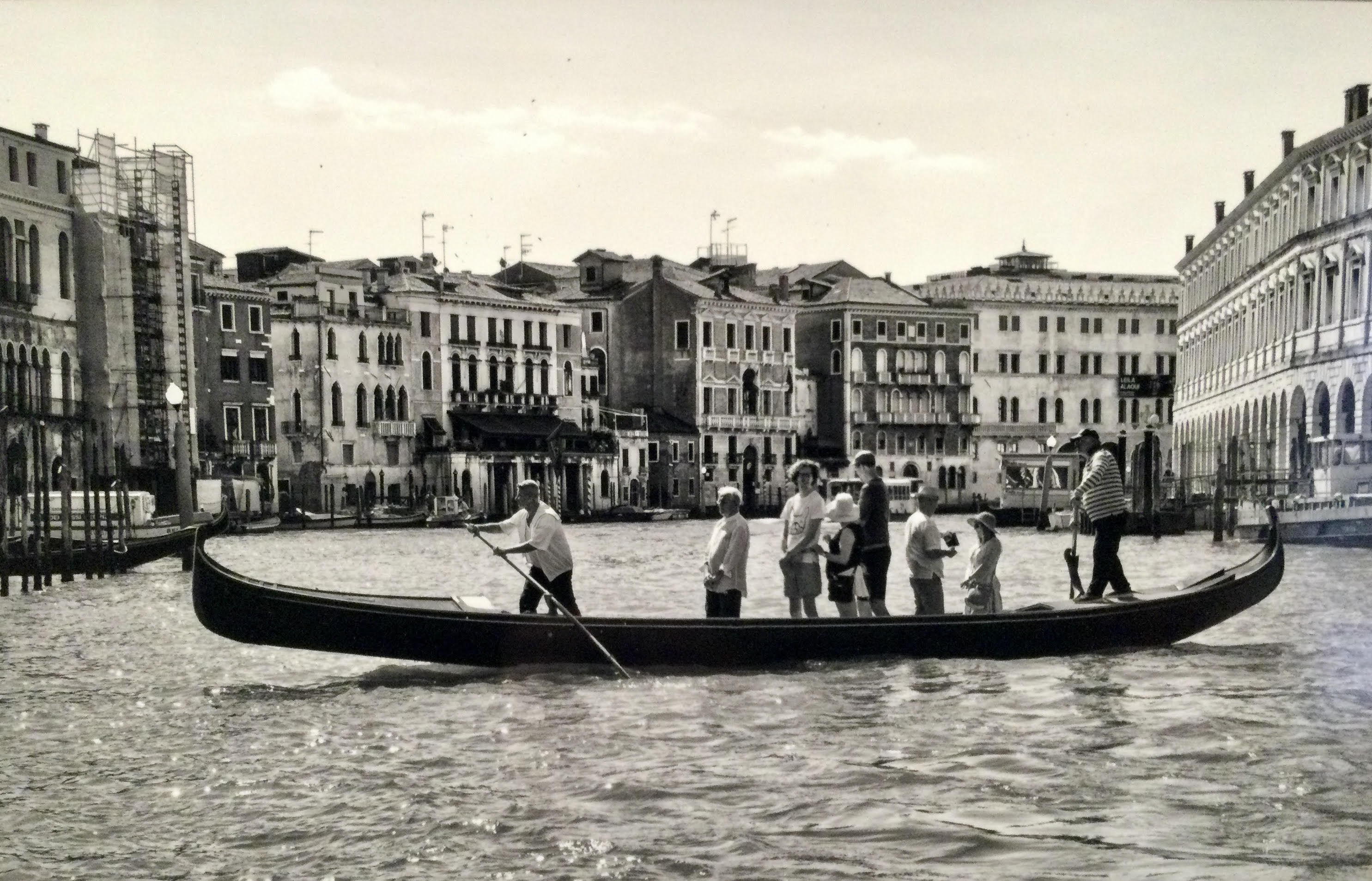
I was puzzled when I first saw the photos -- before speaking to Nikos. To my jaded eyes, they were the same old images that could have been taken 30 years ago -- laundry in the calli, people crossing the Grand Canal in a traghetto -- yet there was something both innocent and wise about them.
"Images and mirages, and always this impression of being observed from behind the shutters; the show seems to come from within, intimate and mysterious, from the apartments of the high-ceilinged palazzi, with their sculpted beams and crack-varnish paintings. I can sense silhouettes from another time that peer out over the Grand Canal. I lose myself like a pilgrim in the alleyways that all resemble each other, only to find myself in their field of vision behind the lens."

Les mains de l'artisane Gabriele Gmeiner,
Campiello del Sol, San Polo Venezia, 2022 by Nikos Aliagas
Photo: Cat Bauer

I slowly realized that these vibrant images that Nikos had captured were of the singular life that still exists in Venice. That the Venice mystique that had captivated me a quarter of a century ago still thrives in the lagoon for those who have eyes to see it. 
"What do you think, that we are waiting for you? Nobody is waiting for you here. The place is so much more powerful than you. You can only try to melt into its universe."
Nikos Aliagas "Regards Vénitiens"is at Palazzo Vendramin Grimani until November 26, 2023. Go to Fondazione dell'Albero d'Oro for more information.

Ciao from Venezia,
Cat Bauer

Sunday, February 26, 2023

Simon Berger Pushes Glass to its Breaking Point: "Shattering Beauty" on the Island of Murano, Venice

Shattered Glass Lion by Simon Berger - Photo: Cat Bauer

(Venice, Italy) Swiss artist Simon Berger uses a hammer as a paintbrush. His canvas is glass. He paints with the blows of a hammer. The closer and briefer the blows of the hammer, the stronger the contrasts and shades. 

Simon Berger has somehow figured out how to hammer glass with a mystical force that shatters the transparent panes into powerful portraits of human and animal faces.

At the time I actually took that photo, above, I saw no majestic lion in the splintered glass cubes arranged in the exhibition space of  the Murano Glass Museum. I saw only shattered glass, the way a windshield would look after a car accident. 

It was only when I was reviewing which images I wanted to use to illustrate this blog post that the tower of broken glass on my iPad magically transformed into the dramatic face of a lion. By chance, I had photographed the shattered glass cubes at an angle that had captured the lion's portrait.

The shattering stroke liberates beauty.
-- Simon Berger

The Museo del Vetro of Murano in Venice is hosting a solo show by Simon Berger from January 28th to May 7th, 2023. The exhibition, entitled "Shattering Beauty," features around twenty original artworks that explore the fragility of the human condition through the splinters of the fragile glass canvases.

Curated by Sandrine Welte and Chiara Squarcina in collaboration with the Fondazione Musei Civici di Venezia and Berengo Studio, the exhibition is conceived as an immersive installation where visitors are invited to lose themselves among glass cubes and sculptures of varying dimensions.

The show features numerous glass portraits created using Berger's singular technique of "morphogenesis" that has put him in the international spotlight: smashing glass with a hammer with such utter precision that the splinters form haunting portraits… almost as if the blows of his hammer releases an image trapped inside the glass.

 "The difficulty of working with glass is also what gives rise to my artworks: its fragility. The material does not allow for corrections. If one hammer blow is not right, I have to discard the whole work. Of course, there is a nervousness when I start a new work. My expectations of myself and the fear of not meeting my requirements sometimes even stops me from starting. In these moments, I try to block out these thoughts and concentrate on the essentials -- my passion for making art and the and soul I put into it."

Shattering Beauty by Simon Berger - Photo: Cat Bauer

Trained as a carpenter, Berger's artistic journey began with a fascination for different materials like wood and metal. He became a street artist, using cans of spray paint as his medium, then started using the carcasses of junked cars as his canvas. As he pondered what to do with the laminated glass windshields, he had an ah-ha moment, took up his hammer, and started carefully cracking the glass into portraits. From the hammer of a carpenter, his remarkable technique was born. 

Simon Berger & Sandrine Welte - Photo: Cat Bauer

I wanted to know how Berger arrived on the Island of Murano in Venice, so I tracked down Sandrine Welte, the co-curator. She told me that Adriano Berengo, President of Berengo Studio, had stumbled upon a YouTube video of Berger cracking his glass and told her to find him -- Beregno Studio is a glass studio on the Island of Murano; Berengo Foundation is an art foundation; and Glasstress is an internationally acclaimed exhibition, all headed by Adriano Berengo, a Venetian entrepreneur who is determined to revive the ancient tradition of Murano glass by infusing it with contemporary energy.

From the Berengo website:
After the success of the exhibition Tony Cragg: Silicon Dioxide at the Museo del Vetro in 2022, Berengo Studio is delighted to be partnering once again with the Fondazione Musei Civici di Venezia to bring a new exhibition to the island of Murano: Shattering Beauty.

I mentioned to Sandine that Tony Cragg and Simon Berger had the same birthday, April 9th -- I knew this because it is also the birthday of my ex-husband, and I had written about it years ago. They are all Aires, and they are all artists of a kind. To me, using a hammer to crack glass into works of art is the perfect creative use of the headstrong ram-energy that Aires is known for. (I don't know what astrological sign Adriano Berengo is, but I would be curious to find out!) 

Simon Berger in action

Berger's artwork is visually stunning and provocative, and the exhibition is a unique and immersive experience once you figure out that the portraits look different with the naked eye than they do through the lens of a camera. If you don't witness the glass portraits from the correct perspective, it just looks like a bunch of broken glass. I think Simon Berger is some kind of genius. 
"What I like about the face as a motif is that faces are universally recognizable. Everyone knows what a face looks like. It takes very little visual information to make a face recognizable; it is a universal language."
Berger created a shattered glass portrait in front of us by looking at the image of a female in his smartphone held by his left hand while, at the same time, shattering glass with a hammer held in his right hand. 

Afterwards, I asked Berger which way he saw the image while he was creating it -- the way it looked through the camera lens or with the naked eye. "Both. I see portraits everywhere." I asked him who the female was. He said he didn't know. To him, it was simply an interesting face.

Shattering Glass by Simon Berger - Photo: Cat Bauer

Simon Berger's work serves as a testament to the power of creativity and imagination. Through his innovative use of shattered glass, he transforms a symbol of destruction into something beautiful and thought-provoking. "

Shattering Beauty" is at the Venice Glass Museum until May 7, 2023. Take a trip across the Venice lagoon and explore all the voices of glass on the island of Murano, from ancient traditions to contemporary artistic expressions.

Ciao from Venezia,
Cat Bauer

Thursday, January 19, 2023

Never Before Seen In Italy! Venice Photos Shot in 1955 by Inge Morath, Pioneer Photographer, at Palazzo Grimani in Venice

Inge Morath, Venezia, 1955 ©Fotohof archiv/Inge Morath/Magnum Photos

(Venice, Italy) The pioneer female Austrian photographer, Inge Morath, was one of the first girls to play with the boys. She was one of the first women to gain entrance into the esteemed Magnum Photo agency, an international photographic cooperative owned by its members who are, to this day, mostly men. 

Morath visited Venice in 1951 during her honeymoon with her then-husband, the British journalist, Lionel Birch. She was the daughter of two scientists whose careers transported the family to different laboratories and universities throughout Europe. Her mother had given Morath the camera that had once been screwed to the top of her microscope after she got a new one. Morath dragged her mother's camera around on her travels, but never used it. 

It was raining in Venice during Morath's honeymoon -- the same weather we had at the press conference on January 17 for Inge Morath - Fotografare da Venezia in poi (Photographing From Venice Onward) at Palazzo Grimani, an exhibition that commemorates 100 years since the birth of the artist on May 27, 1923.
"The light was beautiful; the rain had covered everything with a gliss."
Morath was already in the publishing game before she went on her honeymoon, working as a journalist and translator. She spoke German, English, French, and Romanian fluently, and would later add Spanish, Russian and Mandarin to her repertoire. In 1949, she had been invited to join the newly-formed Magnum Photos agency in Paris as an editor by co-founder Robert Capa, "the greatest combat photographer in history." Her work included writing captions to accompany contact sheets of the elite male photographers in the agency.

But it was on that rainy November day in Venice in 1951 that Inge Morath decided to plunge into the boys' club and become a photographer before she even knew how to use a camera:

"I didn't really know how to use it; it got lost, and yet somehow I always managed to get it back... It was raining in Venice. The light was incredibly beautiful, and suddenly I was convinced of the need to photograph it: someone had to photograph it. I called up a few photographers. No one was interested. Bob Capa in Paris simply said, "Why the hell don't you take a picture yourself, you idiot?"

...It was like a revelation. To realize in an instant what had been simmering away inside you for so long, capturing it the moment it took on the shape I felt was right.

After that, there was no stopping me. I went everywhere, standing on bridges, in church entrances, on corners that looked promising. And then there was no film left. I bought another and decided there and then to become a photographer."


Inge Morath in Connecticut, 1986 - portrait by daughter Rebecca Miller
Photo of image: Cat Bauer

Inge Morath divorced her husband and returned to Paris to pursue her passion. After becoming an associate member of the Magnum Photos agency in 1953, she completed a reportage dedicated to Venice on one of her first assignments as a photographer -- she contributed photos to the illustrated volume Venice Observed, that provocative examination of La Serenissima by American author, Mary McCarthy.
"I am especially interested in photographing in countries where a new tradition emerges from an ancient one. I am more attracted to the human element than the abstract."
In the autumn of 1955, by then a full member of Magnum Photos, Morath returned to Venice on assignment for the art magazine L'Oeil, to take photographs focused on the daily life of the city. She was so enchanted by Venice that she managed to stretch her stay into three months with the help of a painter who found her a cheap place to stay. She roamed the calli and campi, capturing hundreds of images of ordinary Venetians going about their everyday lives -- about 80 photos of the 1955 Venetian series are here in Venice on display. The images were eventually printed as thumbnails onto contact sheets, but were never developed into actual photographs until about 10 years ago. Where were they hiding all that time?
Contact sheet of Inge Morath's first photos taken in 1951 - Photo: Cat Bauer

Enter Kurt Kaindl of the Fotohof gallery and publishing company in Salzburg, Austria, and one of the curators of the exhibition. Kaindl had plenty of personal anecdotes about Inge Morath to tell. He had met Morath when he interviewed her as a journalist for an article, and they became friends and colleagues.

Fotohof, which was supported by the Austrian government to encourage photography on a national level, acquired part of her archive. Kaindl happened upon the contact sheets taken in Venice in 1955, and thought they would make an interesting compilation. Before Morath died of cancer on January 30, 2002 at the age of 78, they began the project based on those early Venetian photos that we can witness in Palazzo Grimani today.

Inge Morath, Marilyn Monroe on the set of The Misfits, Nevada, 1960,
©Fotohof archiv/Inge Morath Foundation/ Magnum Photos
Those first photos in Venice were the foundation of a career that spanned the globe. There are about 200 photos taken over the course of Morath's extraordinary life on the first and second floors of Palazzo Grimani. One of the images of the exhibition that intrigued me the most was the photo that Morath took in 1960 of Marilyn Monroe silently rehearsing her moves on the set of The Misfits, a film written by Monroe's then-husband, the celebrated playwright, Arthur Miller. It took a real woman to capture the real essence of another real woman, concentrating on her work.

Fate?

After meeting Arthur Miller on The Misfit set, Inge Morath would go on to become his third wife -- she married him on February 17, 1962, about a year after his divorce from Marilyn Monroe was finalized on January 20, 1961. Months later, the glamorous movie star would shock the world when she overdosed on August 4, 1962.

Inge Morath and Arthur Miller had two children, Rebecca and Daniel, and lived a life in the "rurals" of Connecticut, with neighbors like the sculptor, Alexander Calder. Their daughter, Rebecca Miller, would grow up to become a filmmaker and novelist and Lady Day-Lewis after marrying the acclaimed and elusive actor, Daniel Day-Lewis.

Forgotten Shoes by Inge Morath
Photo of image: Cat Bauer

Inge Morath captured everyday life in Venice in 1955, glimpses of which I was fortunate to witness myself when I moved here in 1998. Back then, there were still elderly women weaving lace in the courtyards and gossiping in the calli, and plenty of butchers, cheese vendors, and fishmongers selling essentials, and school children walking around free guarded by the watchful eyes of neighbors, while the aristocracy got up to their own shenanigans on the Grand Canal. A Venetian colleague said that Morath's photos of what life was once like in Venice made her sad.

Morath never lived to see an exhibition of the 1955 work she did in Venice -- but she can see it now from the heavens. Kurt Kaindl said she would be very happy to have her early work shown in Venice, where the whole thing began.

Inge Morath - Fotografare da Venezia in poi runs from January 18 to June 4 2023 at Palazzo Grimani, a museum house that I have written about before. Go to Palazzo Grimani for more information -- if you can read Italian!

Ciao from Venezia,
Cat Bauer

Saturday, December 31, 2022

The Spirit of Venice, a Beacon for Civilization in the New Year 2023

Palazzo Polignac far right; Salute Church far left - Photo: Cat Bauer from the Accademia Bridge

(Venice, Italy) It has become a happy tradition to kick off the New Year in Venice with a late morning concert at Palazzo Contarini Polignac on the day of New Year’s Eve when an international crowd is here. Music keeps the palace alive and humming — as it did during the days of the salon of the American heiress Winnaretta Singer aka Princess Edmond de Polignac, one of the heirs of the Singer sewing machine fortune (Isaac Singer had 24 kids!). Winnaretta's protégés included Debussy and Ravel. Both composers were on the program today. It was the best of all cultures.

Full house at Palazzo Polignac for New Year’s Eve Day concert

Call me old-fashioned, but I’m grateful that Venice remains a civilized city despite all the nastiness and deceit confronting the world these days. (Especially those who still try to cyber-influence Venice’s narrative from afar by way of social media, trying to create the illusion that they actually live here. Suggestion: Run the gauntlet and try to get a resident visa — it’s not easy. Really come and live here — see if you can make it. Or else get a real life.)

Today's New Year’s Eve Matinée invitation was worded like the good old days when people were cordial even if they disagreed:


This year there were two pianos, eight hands and a string quartet. The audience in the palace responded with applause and goodwill. Here is the program:


As long as there is music in the palaces of Venice, there is hope for the world. #LoveWins. #TruthWins.

Love is so powerful that it always wins.
Truth is so powerful that it always wins.
All it takes is Time.
——Cat Bauer

Happy New Year 2023!

Ciao from Venezia,
Cat Bauer