Friday, June 28, 2019

Is it by Leonardo? The Bare Breasted Magdalene at the Ugo & Olga Levi Foundation in Venice

Maddalena Discinta by Leonardo & Assistant
(Venice, Italy) There is an astonishing painting at Palazzo Giustinian Lolin on the Grand Canal in Venice, home to Fondazione Ugo e Olga Levi. Part of the exhibition Leonardo and his Outstanding Circle, the Maddalena Discinta -- the Bare-Breasted Magdalene -- is claimed to be by the hand of Leonardo da Vinci himself and one of his assistants.

We are all fascinated by the mysterious Leonardo and his life. Is he sending us secret messages embedded in his paintings from 500 years ago? Why did he use "mirror writing" from left to right in his notebooks? As part of the world-wide celebrations marking the 500th anniversary of his death, curator Nicola Barbatelli and other national scholars have gathered together 24 works from some of the painters in Leonardo's workshop, all of which come from private collections.

If you are in the Leonardo loop, you will know that the record-breaking $450 million Leonardo da Vinci painting Salvator Mundi, which sold at a Christie's auction in November 2017, has disappeared. It was supposed to be part of the 500th anniversary celebrations at the Paris Louvre, but there are whispers that it is not an authentic Leonardo at all, but by the hand of one of his assistants in his workshop.

Which makes the claim that the Bare-Breasted Magdalene here in Venice is a collaboration by the master himself and one of his pupils all the more incredible.

There are a couple of things that give weight to the claim. First, there is a quote from Leonardo in Chapter 25 of his book, A Treatise on Painting, which were writings gathered together from his notebooks:

"And I once happened to make a painting representing a divine thing, which was bought by its lover who then wanted to have the representation of the divine attributes removed in order to be able to kiss it without misgivings, but finally his conscience won over his libidinous sighs, and he was forced to have it removed from his house."

Now, of course, a passage like that would make everyone want to see that luscious painting, but there were no known Leonardo works that fit such a description, so it was assumed that it referred to a lost work.

Enter Carlo Pedretti, an expert on the life and works of Leonardo da Vinci who  died last year on January 5, one day shy of his 90th birthday. Born in Bologna in 1928, Pedretti was so obsessed with Leonardo that he taught himself to write left-handed and read backwards like the great maestro when he was just thirteen-years-old. He published his first articles about Leonardo at age sixteen, and went on to become a professor of art history and the Armand Hammer Chair in Leonardo Studies at the University of California, Los Angeles.

In 2004, apparently Pedretti had the opportunity to examine the painting he had been hunting. How this happened is not clear. But here was his reaction:

"I am not the one to say that it is Leonardo's painting, it is the painting itself that compels me to do so! It is stunning! It feels as if it is the painter's intention to imitate the ancient. And Magdalene seems to come from another temporal dimension, indefinite. It is obvious that there is something more here than just the usual pupil."

Pedretti thought that the enormous red mantle that cloaks Magdalene's shoulders did not make sense, and could have been added at a later time to conceal something, perhaps the jar with the ointment that she used to anoint the feet of Christ.

"Then, there is that landscape in the background made with tricks of light and shadows, more evocative than literal, as if lying halfway between incantation and dream. So close to that of the Mona Lisa."

Pedretti proposed that the pupil who collaborated with Leonardo was Giampietrino. Now, years after Pedretti's initial attribution, the painting has been more thoroughly and professionally analyzed, and it is thought that the assistant is more likely Marco d'Oggiono.

After seeing the painting up close myself, I, too, think that Leonardo had a major hand in painting it. I am certainly no expert, but am going on the same feelings that the Bare-Breasted Magdalene evoked in me as soon as I saw her: I wanted to kiss her, too! Really! Get that painting out of here before I am compelled to do something unholy!

What I am still waiting to learn is: where has the painting been for the past 500 years? And if it really is by the hand of Leonardo himself, with the collaboration of one of his "outstanding circle," why do we not hear more about this earth-shattering news from the international art world, especially after all the fuss about Salvator Mundi?

Marta & Maria Maddalena by Bernardino Luini - Photo: Cat Bauer
Go over to Palazzzo Giustinian Lolin and have a look for yourself, and decide what you think. Leonardo surrounded himself with a workshop of talented young assistants known as "Leonardeschi" some of whose works are also on show. How much of a hand, if any, did the master have in the paintings of his helpers?

Leonardo and His Outstanding Circle will be at the Ugo and Olga Levi Foundation until August 25, 2019, after which it is going on an international tour. First stop will be China, opening at the Art Museum of the Central Academy of Fine Arts (CAFAM) in Bejing on September 15, and then on to Shanghai and Shezhen.

Just remember to look and not touch!

Ciao from Venezia,
Cat Bauer
Venetian Cat - The Venice Blog

Tuesday, June 18, 2019

Contemporary Art Galvanizes the Historic Villa Barbaro in the Veneto

Red Line by Doron Gazit - Photo: Cat Bauer 
(with thanks to photographer Manfredi Bellati for designing the composition)
(Venice, Italy) Until September, the first thing you will see when you approach Villa Barbaro is a shocking red tube splashed across the front of the meadow, woven through the branches of dead trees. It is the work of environmental artist Doron Gazit, who draws red lines, not with a pencil, but with long red tubes.

In November 2018, Northern Italy was ravaged by storms and winds that razed 14 million trees -- trees that once provided the lumber to build the ships of the Republic of Venice. It was a devastating blow to the ecosystem. As a long-term Californian and Israeli, Gazit is on the leading edge of the struggle against environmental degradation, and uses his works as bright exclamation points. "It is the blood of the trees that died."

The installation is the eye-catching intro to Casa di Vita - Armonia del tempo, the first contemporary art show at Villa Barbaro, the historic Palladian masterpiece in Maser designed by Andrea Palladio with frescoes by Paolo Vernonese and sculptures by Alessandro Vittoria, each man working at the top of his game. Part of the ArtLife for the World project, and curated by Simonetta Gorreri Casini in collaboration with Giovanna Poggi Marchesi and Villa di Maser, the contemporary exhibition is a dynamic interaction between past and present

Ancient & Contemporary art meet at Villa Barbaro - Photo: Cat Bauer
The ongoing project of ArtLife for the World is to install great works of environmental art in historical venues throughout the Veneto. The works of 20 different contemporary Italian and international artists are sprinkled throughout the spacious grounds and the interior of the first floor of the 16th-century Villa, truly transforming it into a "Home of Life."

The Nature of the Present by Chicco Margaroli - Photo: Cat Bauer
Leaves that fell last year from the walnut trees behind Villa Barbaro
in transparent treasure chests of protein jelly
The inauguration was uplifting and filled with warmhearted energy -- especially moving as the vibrant heiress of Villa di Maser, Diamante Luling Boschetti, had passed away in April of last year -- you could feel her smiling from the heavens. Diamante was the granddaughter of the wealthy industrialist Count Giuseppe Volpi, who had bought the neglected Villa in 1934 for his daughter, Marina, and restored it to its Renaissance splendor.

Vittorio Dalle Ore & real-life "Little Dog" - Photo: Cat Bauer
Diamante and her husband, Vittorio Dalle Ore, continued the tradition, lovingly caring for the UNESCO World Heritage Site, which is also an agricultural estate with its own vineyards and award-winning wines. Vittorio hosted the inauguration followed faithfully by his small pack of Kooikerhondje Spaniels, the famous Veronese "Little Dog" brought to life.

Palladio's Tempietto at Villa Barbaro - Photo: Cat Bauer
In April 2016, I wrote a post entitled Villa Barbaro - Paradise on Earth - Palladio & Veronese in the Veneto after my first visit to Villa Barbaro. Here is an excerpt:

Tradition says that Palladio died in Maser in 1580 while working on the building of the Tempietto, the last structure he designed (along with the Teatro Olimpico, a Renaissance theatre in Vicenza), and the first religious structure to be attached to a Palladian villa. Designing the Tempietto was a dream come true for Palladio, allowing him to combine a circle and a Greek cross, inspired by the Pantheon in Rome. The Temple served the Villa Barbaro, and was also the church of Maser, located at the foot of the hill where the villa stands.
Interior of Palladio's Tempietto at Villa Barbaro - Photo: Cat Bauer
On Saturday, I had the rare privilege to enter Palladio's vision, together with a small private group. It was a great honor to witness the sacred structure from the inside and gaze upon the sculptures by Alessandro Vittoria. Palladio and Marcantonio Barbaro both believed that the design was the epitome of the perfect religious building, even though it reflected the Pantheon, a pagan Roman structure. Constructing the Tempietto was the fulfillment of their long-held dream, and seeing it with my own eyes was a deeply emotional experience; I felt as if I were in the presence of divine energy harnessed by humankind.

Contemporary art in ancient Nymphaeum at Villa Barbero - Photo: Cat Bauer
A visit to Villa di Maser should also include a stop at the farmhouse next to the Villa where you can sample the wine and try the tasting menus that feature the best local food from the region. Casa di Vita - Armonia del tempo runs through September 15, 2019. Go to Villa di Maser for more information.

UPDATE: Casa di Vita exhibition has been extended through October 13, 2019.

Ciao from Venezia,
Cat Bauer
Venetian Cat - The Venice Blog

Saturday, May 25, 2019

Banksy Crashes Venice and Improves the Neighborhood

VENICE BLOG - Ca' Banksy in Venice - Photo: Cat Bauer
Ca' Banksy - Photo: Cat Bauer
(Venice, Italy) The Art World is buzzing because Banksy, that elusive artist, painted a mural on the wall of a building in Venice that has been closed for years. So, yesterday, I went over to Campo San Pantalon to have a look for myself. The mural on the Rio Novo canal is easy to spot. It depicts a migrant child wearing a life jacket, dreadlocks flowing in the breeze, with a hand raised high, holding a pink flare.

I stopped in the shop next door to ask who owned the building. First the kindly shopkeeper gave me a lengthy presentation about the hand-painted Russian lacquered papier-mâché boxes on display after I told her someone had given me two of the beautiful boxes as gifts. It was educational, because I had no idea about the history of Russian lacquer art, which was developed from icon painting after the collapse of Imperial Russia.

Then I asked her who owned the building.

"Why? Do you want to buy it? It costs 4.5 million euro, and you can talk to the real estate agent in Campo Santa Margherita about it."

VENICE BLOG - Banksy mural in Venice, Italy - Photo: Cat Bauer
Banksy mural in Venice - Photo: Cat Bauer
So, over to Santa Margherita I went and found the office of Engel & Volkers. I asked the woman at the reception desk if what the shopkeeper had told me was true.

"It was 4.5 million euro, but now it is 'price upon request.'"

"You must be happy."

"We are very happy. Banksy just claimed ownership of the mural two hours ago on his Instagram, and we are still trying to understand all the implications..."

Street Artist in Venice on YouTube


On Wednesday, Banksy had uploaded a video on his YouTube channel with the caption:
Setting out my stall at the Venice Biennale.

Despite being the largest and most prestigious art event in the world, for some reason I’ve never been invited.
The video sends an effective message about the cruise ships in Venice.

I just love Banksy...

Ciao from Venezia,
Cat Bauer
Venetian Cat - The Venice Blog

Sunday, May 19, 2019

Let's Talk About that Controversial Boat - “Barca Nostra” at the Venice Art Biennale

Barca Nostra - Christoph Büchel - Photo: Cat Bauer
(Venice, Italy) Let's talk about that boat.

Barca Nostra (Our Boat), an installation by Swiss artist Christoph Büchel at the Venice Art Biennale, is causing all sorts of controversy.

On the night of the 18th of April, 2015, just off the coast of the Italian island of Lampedusa, a fishing boat designed for a maximum crew of 15 set off from Libya with between 700 and 1,100 migrants crammed into its hull when it collided with an enormous Portuguese merchant ship trying to come to its rescue. After it sank, only 28 people survived. It was the largest single loss of life in decades.

Before the shipwreck, the Italian Navy and Air Force had run a search and rescue operation called "Mare Nostrum," which was credited with saving thousands of lives. But it was extremely expensive for one member state of the European Union to handle the overwhelming flow of migrants -- Italy is just a treacherous hop across the Mediterranean from North Africa. Simply put, to reach the EU, and the hope of finding a better way of life, one of the shortest routes is to get on a boat from Africa to Italy. Similar to migrants crossing from Mexico to the United States, they cross from Africa to Italy -- except there is no need for a wall; there is, instead, the harrowing Mediterranean Sea.

Despite Italy's request for additional funds to run the operation, the EU did not offer more support. Instead, it was replaced by Operation Triton, managed by the EU's border agency, Frontex. Triton's area of operation was much more limited in scope than Mare Nostrum, and they called more often on merchant ships to assist with migrant rescues -- huge cargo carriers to save small fishing boats -- according to the normal rules of navigation, which impose the obligation of providing assistance to boats in distress upon which ship is closest.

After the tragedy, the Italian government decided to retrieve the shipwreck at a cost of 9.5 million euros, and began the laborious and distressing work of identifying the bodies to give them some dignity. The fishing boat was transported to the Pontile Marina Militare di Melilli (NATO) in the Port of Augusta, Sicily where an average of 150 people a day -- professionals and volunteers -- worked to extract hundreds of bodies, perform autopsies and attempt to identify the victims so they could inform the families and have a proper burial. Nuns came from all over Sicily to volunteer their services. That operation concluded in 2017 at a cost of 23 million euros.

All sorts of proposals of what to do with the wreck were then put on the table, including sending it to Brussels so the EU could take responsibility for the migrant crisis; putting it in a Human Rights Museum in Milan; or floating it throughout Europe as a human rights symbol. 

This year, on April 18, 2019, the fourth anniversary of the shipwreck, the Italian government handed the boat over to the Commune of Augusta in Sicily, which worked with the Swiss artist Christoph Büchel on the Barca Nostra project. (We can only imagine what negotiations went on behind the scenes to make that happen.) According to a press release:

"The project facilitates a symbolic transfer of the status of the shipwreck that changes its legal status from a former object of court evidence to an artifact, considered “a special vessel to be disposed of” by ministerial decree, to a “bene culturale”, a significant symbol of our “interesting times” and collective complicity and memory, resulting in its first public exhibition at the Arsenale in Venice."

Barca Nostra - Christoph Büchel - Photo: Cat Bauer
And now the wreck is here in Venice as part of the Biennale. Some critics find it outrageous, especially since it is located right next to an outdoor refreshment cafe. But that is not how most people will first encounter it. Most people will come out of the dimly-lit Indonesian pavilion, as I did, and get smacked in the face with the haunting shipwreck looming over them. The shock of the encounter took my breath away. 

One criticism is that because there are no labels informing the visitor what it is, most people will not know what terror took place aboard that boat. I, for one, knew the boat was at Biennale, but did not know exactly where it was, and was certainly not thinking about it when it rattled my bones.

I think Barca Nostra is exactly where it is should be, and where it will stay until La Biennale concludes on November 24. Instead of all those souls dead and forgotten, the shock of actually seeing the boat is deeply emotional and disturbing. With or without a label, the migrant shipwreck has a much higher profile with its appearance at La Biennale than it ever had before.

Whether we will actually do something about it is another debate.

Ciao from Venezia,
Cat Bauer
Venetian Cat - The Venice Blog

Wednesday, May 8, 2019

LIVE! From the 2019 Venice Art Biennale - May You Live in Interesting Times

Robert Henry Lawrance Jr. by Tavares Strachan (2018) Photo: Cat Bauer
(Venice, Italy) I love the way Ralph Rugoff's mind works. He has tamed the humongous Biennale beast by reducing the number of artists and organizing the vast Arsenale space into smaller compartments.

Even though Rugoff says that this year there is no theme, the artists he invited to participate have captured the essence of the title, "May You Live in Interesting Times." That "ancient Chinese curse" seems particularly pertinent today, and has been cited over the past 80 years by authors and politicians ranging from Arthur C. Clarke to Hillary Rodham Clinton. Only one problem: the curse was utter fiction presumably fabricated by a British diplomat -- there was never any such curse in China.

The curator of the 58th Venice Art Biennale is an American who grew up in Greenwich Village, and whose father was a film distributor. Rugoff studied semiotics(!) at Brown University, then moved to Los Angeles to give screenwriting a shot. He switched to journalism and art critcism, then segued into curating, and has been the Director of the Hayward Gallery of London since 2006. According to an April 10, 2019 article in The New York Times "A Playful Curator Takes on a Tough Gig at the Venice Biennale" by Farah Nayeri, "He recalled watching lots of movies as a boy, and being dragged to art galleries by his parents." That colorful background is reflected in the layout of Arsenale and the artists he has chosen. There are signs, symbols and lots of video and film installations, so be prepared to spend time watching a story play out.

No history in a room filled with people with funny names 5 2018, Korakrit Arunanondchai & Alex Gvojic
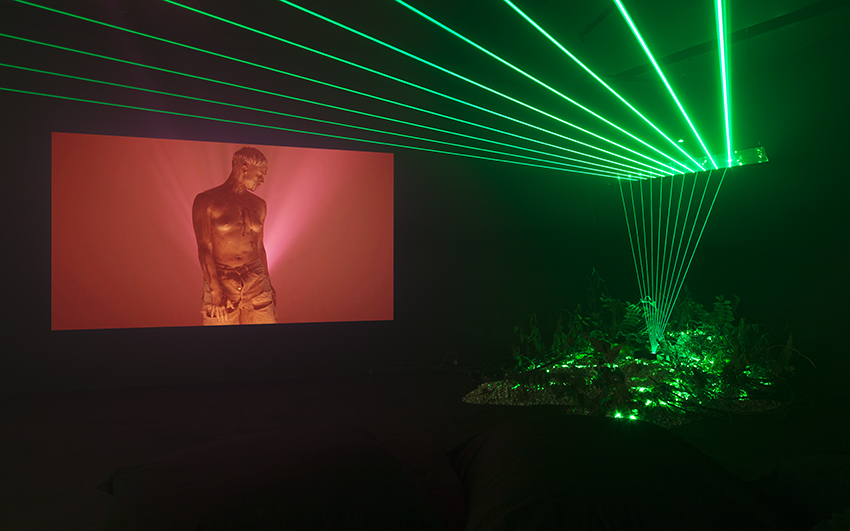
After making a surprisingly emotional journey from the entrance at Arsenale -- a bombardment of the senses -- until arriving at the press room, one installation completely captivated me: a 31-minute 2018 short film on three screens entitled No history in a room filled with people with funny names 5 by Korakrit Arunanondchai in collaboration with Alex Gvojic, which I think is a masterpiece. There are women playing light beams like strings on a harp... Remember the dramatic Thai Cave Rescue with the soccer boys and their coach trapped in a cave? That has something to do with it, too. And the mesmerizing movements of the performance artist, Boychild... I don't have enough time to adequately describe it, so here is a summary from the International Film Festival Rotterdam:

Opening with the myth of spirits summoning projectionists to initiate an outdoor film projection, artist Korakrit Arunanondchai’s dynamic film is charged with the idea of community – among humans and non-humans – in Thailand’s contemporary moment of instability. Boys trapped in a cave trigger a reflection on the geopolitics of the region and the fragility of its history.
Arunanondchai was born in Thailand in 1986 and lives and works in New York and Bangkok; Alex Gvojic was born in 1984 in the USA and lives and works in New York. Although you can enter in the middle of the film, it is much better to watch it from the beginning. There are plenty of cushions so you can relax in the same "outdoor setting" as the audience seen in the film, but I was so riveted by Boychild's dancing that I stood the entire time. 

48 War Movies by Christian Marclay (2019) Photo: Cat Bauer
From what I've seen so far, this year's Biennale is one of the most accessible and enjoyable that I can remember, and other attendees I've spoken to share my view. At this morning's press conference, President Paolo Baratta spoke about "the visitor as a partner" and said "It's work to encounter a work of art." 

It may be work, but it's also fun. Tomorrow, Giardini!

Ciao from the Venice Art Festival,
Cat Bauer
Venetian Cat - The Venice Blog

Thursday, April 18, 2019

The Battle Between Carnival and Feast - Adrian Ghenie at Palazzo Cini Gallery in Venice

Adrian Ghenie, Figure with Dog, 2019, Oil on canvas, 250×200 cm (98,4 x 78,7 in)
Courtesy Galerie Thaddaeus Ropac, London· Paris, Salzburg
© Adrian Ghenie
(Venice, Italy) The new season at Palazzo Cini Gallery kicks off with the celebrated Romanian artist Adrian Ghenie, the "darling of international curators and auction houses," whose paintings not only engage with the history of painting, but also with "painting the texture of history."

Ghenie's rise in the art world has been meteoric. Born on August 13, 1977, the son of a dentist had his first group show in 2006. Ten years later, in February 2016, his "Sunflowers of 1937" sold at a Sotheby's auction in London for a whopping £3,177,000. In October 2016, his "Nickelodeon" sold at Christie's for £7.1 million(!).

As did painters before him, Ghenie fuses grand themes and narratives with contemporary figures and current events. The Battle Between Carnival and Feast, curated by Luca Massimo Barbero, presents nine recent paintings, some painted specifically for this exhibition. The paintings focus on the conflict and turmoil caused by today's geo-political issues united by the theme of water. Here are the titles:

  • The Wall (2019)
  • The Raft (2019)
  • The Drowning (2019)
  • Figure with Dog (2019)
  • Self-Portrait with Animal Mask (2018)
  • Self-Portrait with iPhone (2018)
  • Untitled (2018)
  • Untitled (2019)
  • Untitled (2019)

The Raft by Adrian Ghenie - Photo: Cat Bauer
The Raft, the largest painting in the group, reveals a floating life raft surmounted by a mass of "vulnerable, naked legs and feet, set against a tumultuous sea and sky." It reminds us of the images we see in today's news of the perilous journeys that refugees are forced to make to escape conflict.

The subject of the three Untitled paintings is easily recognizable...

Untitled 2018, 2019, 2019 by Adrian Ghenie - Photos: Cat Bauer
The Palazzo Cini Gallery in Dorsoduro was once the house of the 20th century industrialist and philanthropist Vittorio Cini (1885-1977). The second floor, where you will find Adrian Ghenie, is devoted to exhibitions and cultural events. The first floor recreates the charm of Cini's residence and a glimpse into his private collection.

Adrian Ghenie The Battle Between Carnival and Feast runs from April 19 to November 18, 2019, and is free to residents of Venice on April 25. Please go to the Giorgio Cini Foundation for more information.

Ciao from Venezia,
Cat Bauer
Venetian Cat - The Venice Blog

Tuesday, April 16, 2019

Rare Chance to see Leonardo da Vinci's "Vitruvian Man" at Gallerie dell'Accademia in Venice 2019

Vitruvian Man by Leonardo da Vinci (1490)
(Venice, Italy) One of the most famous drawings in the world, Vitruvian Man by Leonardo da Vinci (1452-1519), whose home is the Gallerie dell'Accademia in Venice, is rarely put on display because of its fragile nature. Now, to celebrate the 500th anniversary of Leonardo's death, the Accademia has mounted an exhibition entitled Leonard da Vinici. Model Man of the World, which features the delicate ink on paper drawing.

Leonardo da Vinici. L'Uomo Modello del Mondo - Photo: Cat Bauer
The exhibition showcases drawings by Leonardo that once belonged to the collection of the artist and writer Giuseppe Bossi (1777-1815), which was purchased in 1822 by the Gallerie dell'Accademia, the owner of the largest public drawing archive in Italy. The Accademia has 25 of Leonardo's folios, ranging from his early pieces made in Florence to his final works in France. The exhibition allows the visitor to get up close and personal with the genius of Leonardo, down to every stroke of his pen.

The focus of the show is Leonardo's study of human proportions, which culminates in the Vitruvian Man, "a superb combination of art and science, the fruit of an unparalleled summary of the harmonious representation that symbolizes the classical perfection of the body and mind, and a human microcosm that reflects the entire universe."

Head of Christ with crown of thorns by da Vinci (1500) - Photo: Cat Bauer
Leonardo came to Venice in March 1500, accompanied by his good friend, the mathematician Luca Pacioli, where they rubbed shoulders with the likes of Giorgione, Jacopo de'Barbari and Albrecht Durer. Putting on his hat as an engineer, Leonardo even created a defense system to ward off the threat of a Turkish invasion, which was never built.

Eleven original drawings are also on loan from the Royal Collection at Windsor Castle, the Fitzwilliam Museum in Cambridge and the National Gallery of Art in Washington, as well as seven by Leonardo's students, a sculpture and volumes documenting his research.

LEONARDO DA VINCI. L'UOMO MODELLO DEL MONDO is curated by Annalisa Perissa Rorrini and Valeria Poletto, and runs from April 17 to July 14, 2019. Go to the Gallerie dell'Accademia for more information.

Ciao from Venezia,
Cat Bauer
Venetian Cat - The Venice Blog

Sunday, April 14, 2019

Looking Far to the Future: San Marco - The Basilica of Venice in the Third Millennium

Sala del Maggior Consiglio - Great Council Chamber - Photo: Cat Bauer
(Venice, Italy) Power. Glory. Wealth. The sheer magnificence of the Great Council Chamber inside Palazzo Ducale is overwhelming. The immense hall was where the noblemen of the Great Council of the Venetian Republic convened, the 1,000 to 2,000 aristocrats who composed the most important political body of Venice and who were the guardians of the laws of State. The Great Council met for the first time in the Sala del Maggior Consiglio in 1423.

After a fire on December 20, 1577, the structural damage was quickly restored and the gilded room was decorated by the greatest artists of the time, such as Veronese, Palma il Giovane, Francesco Bassano and Jacopo and Domenico Tintoretto, whose gigantic Il Paradiso is one of the world's largest paintings. On the walls, historic battles and triumphs bombard the eyes with the glorification of Venice. Portraits of the first 76 Doges run in the frieze under the ceiling.

Great Council Chamber - "San Marco - The Basilica in the Third Millennium" Photo: Cat Bauer
Yesterday, April 13, 2019, nearly 600 years after the Great Council first met in the Sala del Maggior, a conference was held here to discuss the fate of an even more ancient Venetian structure: "San Marco - The Basilica in the Third Millennium." With the Tintoretto Il Paradiso as the backdrop, the setting for the conference shows the importance that Venice still places today on the condition of St. Mark's Basilica, which was first built in 832, rebuilt in 978 after it was burned in a rebellion, and whose current structure was consecrated on October 8, 1094. When you've got sacred architecture still standing for nearly a thousand years, the challenges that Venice will face far in the future, in the Basilica's third millennium, are not taken lightly.

Basilica of San Marco

According to John Julius Norwich:
"Nowhere in the Western world, not in Ravenna or Aachen or even in Rome itself, had so sumptuous a monument been raised to the Christian God..."
"La Basilica di San Marco di Venezia. Arte, storia, conservazione," a beautiful three-volume book published by Marsilio, was presented at the conference. It includes essays by more than 60 different experts written in a language accessible to a wide audience about "the splendor of a basilica suspended halfway between East and West which contains priceless treasures of faith and art." If the expert wrote their essay in Italian, as did most of the experts, Marsilio published it Italian. However, if the expert wrote in English, it was published in English, so you will find both languages in the books, in addition to exclusive photos.

With images that peek into the most secret corners of the Basilica, the book covers the history of thirty years of restorations, and is also a starting point for new ideas.  


Pala D'Oro & tomb of St. Mark on high altar of Basilica - Photo: Cat Bauer
The office of the Procurator, whose duties were to attend to St. Mark's Basilica, was established in the ninth century. These days the Procurators are still in charge of administering the Basilica under the authority of the Patriarch of Venice. Carlo Alberto Tesserin, the highest Procurator, was on the opening panel, as was Mons. Francesco Moraglia, the Patriarch of Venice, as well as representatives from the State -- Luigi Brugnaro, Venice's mayor, Gianluca Forcolin, the Vice-President of the Veneto Region, and Vincenzo Zoccano, the Undersecretary of State.

Climate change and the increasing frequency of acqua alta (high water) is one of the greatest challenges that the conservation of the Basilica faces. Another is mass tourism. In 2018, a whopping 5.5 million visitors entered the Basilica. Zoccano said, "Politics cannot divide such important issues. The government wants to be close to the Venetians and their city, which is a world heritage. We will not draw back from this responsibility." They also want to make it easier for private donations to receive greater tax deductions.

To me, one of the most fascinating speakers was the Byzantine scholar, Peter Schreiner, from the University of Cologne and Munich, who was on the round table held after the refreshing coffee break in the Sala dello Scrutinio. He spoke about the origins of the Basilica, and how Venice was influenced by Hagia Sophia in Constantinople. He said that it was important to remember that the Roman Empire in the East was Greek and pagan, not Latin, as in the West. I wrote an extensive post about Istanbul aka Constantinople in 2016, which gives more details about the long, complex history:

From Venice to Istanbul and Back


La Cappella Marciana - Photo: Cat Bauer
After an excellent Cocktail Dînatoire by Venetian stalwart Rosa Salva, again in the Sala dello Scrutinio, we went down to the courtyard and through the door that connects Palazzo Ducale to the Basilica of San Marco. Inside, we were treated to the heavenly voices of La Cappella Marciana conducted by Marco Gemmani, a vocal chorus directly descended from the more than five-century-old cappella of the Doge. It is considered the oldest professional music group that is still active. Here is a taste. Listen:


On the evening before Palm Sunday, the voices of the chorus filled the Basilica with the music of the angels. The Pala D'Oro beamed its golden wisdom. The mosaics on the walls and the domes and the apses whispered their ancient stories. The deep spirituality of the Republic of Venice washed over me, and lifted my spirits.

Afterwards, I said to a Venetian friend, "I feel... clean."

"Purified," she replied in English.

"Yes. Purified is the word."

For the sake of the planet, the Basilica of San Marco must prepare for its Third Millennium. 

Ciao from Venezia,
Cat Bauer
Venetian Cat - The Venice Blog

Monday, April 8, 2019

La Biennale Dance 2019 & Paolo Baratta's Profound Remarks

President Paolo Baratta & Director Marie Chouinard - Photo by Cat Bauer
(Venice, Italy) ON BEcCOMING A SmArT GOd-dESS is the title of the 2019 La Biennale di Venezia International Festival of Contemporary Dance, directed by the effervescent Marie Chouinard. It runs for 10 days, from June 21-30, with 29 shows by 22 choreographers and companies from all over the world in venues throughout Venice.

Towards the end of the press conference today, President Paolo Baratta made some profound remarks about the nature of La Biennale itself, which I will attempt to paraphrase.

This institution, La Biennale, is relevant for the life of a society. We are all challenged to have have an existence between the order that is necessary and the undisciplined part of us that art represents. The arts can have a radical impact when the established order becomes too hardened. Art challenges excessive order.

The World of Art is the inner voice, the undisciplined part of us. It might be seen from time to time as an enemy. In fact, it is an enemy that fights against the established order.

This is our job.

It is very interesting that La Biennale is a public institution created by the State. We are part of the establishment. This is, perhaps, European.

We are here... this permanent revolution... this permanent remembrance...

That is just the gist of what I could compile together from my scribbled notes -- President Baratta was much more eloquent. But if you think about it, how astonishing is it that a governmental organization of the Arts is in place to constantly challenge the established Order of society?

In 1893, the Venice City Council passed a resolution to establish a biennial exhibition of Italian art to celebrate the silver anniversary of the Italian King and Queen, Umberto I and Margherita di Savoia. The First International Art Exhibition of the City of Venice opened on April 30, 1895. Throughout the decades, two World Wars, student revolutions and other disruptions, the organization constantly evolved to arrive at what it is today, a thriving cultural institution. These days, the president of La Biennale is appointed by the Minister of Culture of the Republic of Italy. Paolo Baratta has been its President since 2008, and before that from 1998 to 2001.

For a general overview of the different sectors of this "cultural colossus with a conscience," you can read my LUXOS article, A Biennale for all the Senses.

And for more information about the exciting Dance program that was presented in Venice today, please go to Biennale Danza 2019.

Ciao from Venezia,
Cat Bauer
Venetian Cat - The Venice Blog