Monday, November 26, 2012

Glass in Venice - Pino Signoretto & Bertil Vallien - Lightning on Earth

Bertil Vallien
(Venice, Italy) The prestigious Glass in Venice award was presented on Thursday, November 22 at the Veneto Institute of Science, Letters and Art to two distinguished glass sculptors, Pino Signoretto and Bertil Vallien.


Palazzo Franchetti is a magificent palace on the Grand Canal where the the Istituto Veneto di Scienze, Lettere ed Arti is located. It was erected in 1565,  nearly 450 years ago, and contains all sorts of magical information gathered by the wizards of Venice, France and Austria over the centuries. So, receiving the Glass in Venice award is sort of like getting a special recognition  from Hogwarts. 

PINO SIGNORETTO

Pino Signoretto
Pino Signoretto was born in 1944 in Favaro, a small town in the Veneto. At the age of ten, he started working in a glass factory, apprenticing under such masters as Alfredo Barbini, Livio Seguso, Ermanno Nason and Angelo Seguso, rapidly rising to level of master himself.

Throughout his long career, Pino Signoretto has developed an international reputation in sculpting hot glass. Amazed audiences all over the globe have witnessed his unique ability to create with molten glass, and his mastery over the fiery material.

On his second visit to Japan, he performed in the presence of the Imperial Family. His sculptures are on permanent display at the Museum of Venetian Art in Otaru. He has produced sculptures for Dale Chihuly in Seattle, Washington and taught in many schools of glass and universities throughout the United States. 

Signoretto has the energy of hot glass coursing through his blood. He's wrestled the fiery liquid under control, and tamed it enough to be able to produce magnificent Earthly objects, down to the smallest detail. 

BERTIL VALLIEN

Bertil Vallien was born in 1938 (which I find astonishing, since he has the energy of a man a decade or two younger) in Sollentuna, a small suburb north of Stockholm. Raised in a devoutly religious home,Vallien  felt conflicted and restricted by the faith being imposed upon him. His spiritual quest is reflected in the profound emotion contained in his sand-casted glass sculptures.

When asked, Why work in glass?, Vallien admitted it was a difficult material to work with, but "glass has qualities that no other material has." Vallien said he wanted to express what was in his head and his heart with his hands, but since it is impossible to touch liquid glass, he creates negative molds made out of sand, which gives him control. 

When accepting the Glass in Venice award, he said, "how touched and pleased I am to receive this prestigious prize. All over the planet when you talk about glass you say: Venice, Venice."

After the ceremony, I wandered around the Bertil Vallien exhibition, Nine Rooms, inside Palazzo Franchetti and was overwhelmed. I had the same emotion I felt when I first saw the work of the video artist, Bill Viola, many years ago. Both artists grasp something deeply spiritual and universal, and put their own essence of that understanding into their work. 

It has been a long time since I fell in love with a contemporary artist, but I fell in love immediately with Vallien. He has the magic touch.


As I passed through the Nine Rooms, I longed to touch the glass sculptures, but forced myself to resist. Then, in Room 5, where the glass boats were, an older man stroked his hands across a boat. I was pleased to see I was not the only one who wanted to stroke the glass.

So I did.

Pendulum
Room 7 was filled with tall, heavy glass pendulums that almost reached to the ceiling. They were still. I wanted to start them all swinging. 

I was alone, so I pushed them into action. 

The glass was heavier than I expected, and the frames supporting the glass less sturdy. For a few moments, I was concerned that I was going to topple them all; that the entire glass pendulum room might go crashing to the floor—or even worse, knock over the Murano glass chandelier hanging perilously from the ceiling. But they stood tall, swinging to the rhythm of the Earth. I thought they looked much better in motion.

PENDULUM
The pendulum, the glass, the decadence, and then, the water rises. 
A giant-like pendulum hangs above Piazza San Marco.
The pendulum invalidates time.
It is independent of the Earth's rotation.
Time is beyond life's landscape.
Eternity.

On my way out, I ran into Bertil Vallien. I told him that I wanted to stroke the glass, and that I did do it after I saw another man do it, and asked if that bothered him. (I didn't tell him about the pendulums:)

He said, no, it didn't bother him; that it was okay. 

I said, it's strange, isn't it? That I wanted to stroke the glass, and so did all the others? 

He said, it's because it's tactile. 

I said, yes, but I've never had such a great yearning -- when it comes to marble, for example -- it is not the same. 

Anyway, it was a great honor to meet Vallien, and I told him so. And I am pleased that there is a Glass in Venice award from the Istituto Veneto di Scienze, Lettere ed Arti, an Institute of the highest degree. It is like an award for working with Lightning on Earth.

Ciao from Venezia,
Cat Bauer


Sunday, November 18, 2012

Venice Playwright CARLO GOLDONI IN THE SPOTLIGHT - Attention Scholars!

Carlo Goldoni statue in Campo San Bortolomeo - Photo: Nino Barbieri
(Venice, Italy) If you have ever been to Venice, you will know that the statue in the center of Campo San Bortolomeo at the foot of the Rialto Bridge is of Carlo Goldoni (1709-1792), whom Voltaire called, "the Italian Molière." Goldoni's farcical plays about the Venetian society in which he lived reflected the dying days of the great Republic -- a republic that had lasted more than a thousand years.

According to tradition, Venice was born in 421 AD. The Republic of Venice was conquered by Napoleon in 1797 -- just five years after Goldoni's death.

To say that Goldoni has recently made a comeback is an understatement. After receiving rave reviews in London, one of his plays just closed to critical acclaim on Broadway.

Which play was that? It was The Servant of Two Masters, which has been zapped into the 21st century under the title of One Man, Two Guvnors.

From Wikipedia:

Photograph: Cindy Ord/Getty Images
One Man, Two Guvnors is a play by Richard Bean, an English adaptation of Servant of Two Masters (Italian: Arlecchino servitore di due padroni), a 1743 Commedia dell'arte comedy play by the Venetian playwright Carlo Goldoni.

The play replaces the Italian period setting of the original with Brighton in 1963. The play opened at the National Theatre in 2011, toured in the UK and then opened in the West End in November 2011, with a subsequent Broadway opening in April 2012
.

Here is a clip starring James Corden before he was JAMES CORDEN.


From Playbill.com:

 Blimey, It's a Hit! Broadway's One Man, Two Guvnors Recoups Its Investment

Bob Boyett and the National Theatre of Great Britain said on Aug. 22 that their acclaimed Broadway production of One Man, Two Guvnors, which won star James Corden the 2012 Best Actor Tony Award, recouped its $3.25 million capitalization in the week ending Aug. 19.

The Complete Comedies of Carlo Goldoni (1830)
With all the renewed interest in the great Venetian playwright comes a new scholarly quaderni annuali produced by top experts in the field.

Promoted by the Civic Museums Foundation of Venice - Carlo Goldoni's House, in collaboration with prestigious institutions such as the CISVE - Inter-university Centre for Studies Veneti, the National Edition of the Works of Carlo Goldoni, Teatro Stabile del Veneto and the Universities of Venice and Padua, the new "Studi Goldoniani" are divided into studies and reviews which offer scholars a chance to stable critical debate, and to ensure readers a detailed and updated review of the "stato di lavoro."

According to the brochure, "the journal aims to complement and animate the permanent laboratory for philological and historical-critical investigation represented by the Edizione Nazionale delle Opere di Carlo Goldoni, and the newly created Edizione Nazionale delle Opere di Carlo Gozzi: thus participating fully in reviewing tested but hitherto unproductive historiographical paradigms, and radically redesigning the features of the theater world (and others) of the 1700s."

Studi Goldoniani
To order a subscription of the beautifully-bound Studi Goldoniani and/or the online subscription, please visit LIBRA web, the online platform of the publisher, Fabrizio Serra Editore.

In times like these, when the world reaches a critical pitch, mankind has learned that sometimes the best thing to do is just laugh.

"Painter and son of nature," wrote Voltaire, at that time the arbitrator and the dispenser of fame in cultured Europe, to Carlo Goldoni, then a rising dramatist, "I would entitle your comedies, 'Italy liberated from the Goths.'"

From The Comedies of Carlo Goldoni, edited with an introduction by Helen Zimmern, published 1892 by David Stott, London.

Ciao from Venezia,
Cat Bauer
Venetian Cat - The Venice Blog

Sunday, November 11, 2012

Venice High Water in November 2012 - Similar to Venice High Water in November 2008


(Venice, Italy) High tide was exceptional here in Venice today, with seventy percent of the city flooded. Venetians and shopkeepers were caught off-guard, as the tide was predicted to rise only to 120 centimeters. Instead, it rose to 149 centimeters, or nearly five feet.

This is not the first time this has happened. We had a very similar situation in November and December 2008, four years ago when Barack Obama first won the US presidency. He has just won a second term, and I am very pleased about that, as is most everyone else who cares about the Earth and all the creatures who live upon it. We are all much wiser now, and this time things were not as dramatic as they were four years ago. You can read what I wrote about that here, and keep clicking "Older Post" at the very bottom on the right if you would like to read the acqua alta reports that led up to this particular post:

What is Aqua Alta and is it Dangerous?

Photo: Jonathan Ulman
Since a picture is worth a thousand words, this year I've decided to pull some news stories together for you so you can just click on the headlines to read more. This evening, over by Rialto all the street lights were still out around 9PM, otherwise things are pretty much back to normal.

Near the end of this post is an amateur video of those tourists in the top photo swimming to their table in the middle of Piazza San Marco.

From the Huffington Post:


Venice Flooding Fails To Discourage Tourists, While 200 Evacuated After Heavy Rain In Tuscany

Meanwhile in Venice ‘acqua alta’ or high water season, has been one of the highest ever recorded, with some parts of the city submerged under five feet of water.

From The Guardian:

Photo: Marco Secchi-Getty Images

Venice 'high water' floods 70% of city

Venetians direct anger at forecasters after 'exceptional and unpredictable' rise in sea waters floods homes and businesses

Tourists attached plastic bags to their legs or stripped off to take a dip in St Mark's Square in Venice on Sunday as rising sea waters surged through the lagoon city. High water measuring 1.49 metres (5ft) above the normal level of the Adriatic sea came with bad weather that swept Italy at the weekend, causing floods in historic cities including Vicenza as well in the region of Tuscany 250 miles further south.

From the Daily Mail

The Floating City: Heavy rains flood Venice and reach the sixth highest tide level in 150 years


  • 70 per cent of central Venice underwater today reaching 59 inches
  • Tourists waded through waters in wellington boots and donned swimwear
  • Iconic St Mark's Square flooded leaving normally bustling square deserted


  • It may be known as the Floating City of love.
    But romance was cast aside today as gondolas were swapped for wellington boots and swimwear.
    High tides and heavy rain flooded Venice's dry streets, leaving tourist hotspots virtually deserted.
    Tourists chose to wade through the waters in boots, with one group donning swimwear to sit at a table in the iconic submerged St Mark's Square.

    And here's that amateur video of the tourists going for a swim in Piazza San Marco:


    Ciao from Venezia,
    Cat
    Venetian Cat - The Venice Blog

    Saturday, November 3, 2012

    Extreme Weather - Venice, the USA and the Europe Winter Forecast from AccuWeather

    Photo: Manuel Silvestri/Stringer/Reuters
    (Venice, Italy) The high water, or acqua alta in Venice has been overshadowed by the news of Hurricane Sandy. But at about the same time the United States was being bombarded by extreme weather, here in Venice, we, too, had heavy winds, rain and flooding. The water rose to a little over 140 centimeters, or just under five feet. 

    In Venice, we have long stopped expecting any help from the State. All the shops clean up the mess themselves; residents pull on high-water boots and tourists are forced to invest in a pair of "wellies." Then life goes on. 

    The Venice Marathon went on as usual on Sunday, October 31, 2012, with the runners actually competing in the extreme weather.

    27th Venice marathon Philemon Kisang and Emebt Bedada won in severe weather conditions

    Venice, October 28, 2012 – Rain, wind and  high tide didn’t stop the 27th Venicemarathon who saw  winners the Kenyan Philemon Kipchumba Kisang (2h17’00”) and the Ethiopian Emebt Etea Bedada (2h38’11”).


    Click HERE to read the story at the Venice Marathon official website.


    I get a lot of press releases, guest blog requests and other information from companies looking to promote themselves on Venetian Cat - The Venice Blog, and refuse most of them. But this one from AccuWeather.com is so unique -- a private American company forecasting the European winter, and written by a Meteorologist by the name of Meghan Evans --that I've decided to share it with you in its entirety.

    Plus I think it's cool that AccuWeather.com somehow discovered Venetian Cat - The Venice Blog!

    Apparently, AccuWeather is a for-profit weather service that competes with the National Weather Service in the United States, and whose owner, Joel Myers, is "a frequent contributor to Republican candidates," according to Wikipedia.

    We will follow up in the spring and see just how accurate AccuWeather turned out to be...

    AccuWeather News

    Europe Winter Forecast: Not as Harsh as Last Year's Deep Freeze 

    November 2, 2012 -- State College, PA -- While cold shots blast portions of western and northern mainland Europe at times, stormy weather may hit southern Spain, the Mediterranean region and southeastern Europe.


    Meteorologists expect Siberian cold to reach portions of western and northern mainland Europe, especially during the middle to latter part of winter. Much of the United Kingdom, Denmark, the Netherlands, Belgium, Poland, Germany, Switzerland, France, Spain and Portugal will have below-normal temperatures for the season.

    "January to February will be the best chance for cold air coming out of Siberia," AccuWeather.com Senior Meteorologist Alan Reppert said.


    Left: The seafront is frozen in the Adriatic coastal town of Senj, Croatia, Tuesday, Feb. 7, 2012, in the midst of a deadly cold wave. (AP Photo/Darko Bandic)

    However, the cold will not last as long or be as harsh as the deep freeze of last winter, Reppert emphasized. During the second half of January and early February 2012, bitterly cold air originating from Siberia killed hundreds of people across Europe.

    RELATED: Europe's Deadly Deep Freeze of January and February 2012

    Well to the north of the active storm track expected this winter, near- to slightly below-normal precipitation is in store for the U.K., Ireland and Scandinavia.

    "London will be mild to start [this winter]. Then it will be turning colder for the end of the winter. That could be there best chance for any snowfall late January and February," Reppert said.


    Farther south, a storm train will be in place for much of the winter from southern Spain, the Mediterranean region and southeastern Europe. Above-normal water temperatures of the Mediterranean Sea will help storms to strengthen as they move across the region, enhancing rainfall.


    Italy, Greece, former Yugoslavia, Romania, Bulgaria and Turkey are all included in the zone that could receive above-normal precipitation for the winter season. The active winter storms will keep temperatures close to normal for the season in this zone.

    The above-normal rainfall predicted from southern Spain to Italy and southeastern Europe will be beneficial for drought-stricken areas. Severe to exceptional drought conditions are gripping portions of Portugal, Spain, Italy and eastern Europe.

    The drought impacted agriculture, including a significant hit to grapes that will cause higher wine prices.

    Meanwhile, snowfall for places like Rome, Italy, which received rare snow last winter, is less likely this season.


    One exception to unusual snow occurrences this winter may be the French Riviera.

    "The French Riviera is like Jacksonville, Fla. It typically gets snow once every five years or so," AccuWeather.com Expert Senior Meteorologist Jason Nicholls explained. "There might be a cold outbreak in France, especially late in season, during February, for southern areas that may allow snow to fall."

    Paris may also receive a snowfall during the latter part of the season.


    On the northern edge of the storm train, more snow than usual is forecast in the Pyrenees Mountains, the Alps and Balkan Mountains. With above-normal snow and temperatures that will be cold enough to sustain heavy snow pack, a good ski season is anticipated.

    Across Germany, above-normal snowfall is forecast from Frankfurt on south. Berlin may receive near-normal snow.

    By Meghan Evans, Meteorologist

    If you have questions or want to speak with a meteorologist, please contact our 24-hour press hotline at (814) 235-8710 or email miless@accuweather.com.

    This is a commercial message from AccuWeather, Inc.
    385 Science Park Road | State College, PA 16803


    Ciao from Venezia,
    Cat
    Venetian Cat - The Venice Blog

    Wednesday, October 31, 2012

    All Hallows' Eve - All Saints' Day - All Souls' Day - Venice Blog

    Flames from Burning Candles by: Photos8.org
    (Venice, Italy) This evening is All Hallows' Eve, better known as Halloween, the evening before Hallowmass, better known All Saints' Day. This year, the full moon a few days ago caused All Sorts of Havoc, contributing to extreme storms All Over the Earth, including Hurricane Sandy, which devastated the East Coast of the United States of America.

    CREDIT: NASA GOES Project
    Here in Venice, we have been experiencing acqua alta on and off. Today happens to be an "on" day with rain and extreme high water expected this evening.

    The ancient Celts believed that during this time of year the veil between this world and the Otherworld became thin, allowing spirits -- both dark and light -- to pass through more easily. So, tomorrow, Wednesday, November 1, we have All Saints' Day for the saintly spirits, and the day after, on Thursday, November 2, we have All Souls' Day for everybody else. Some say that the Venetian gondola resembles a boat on the River Styx...

    Gondola Ride on the River Styx
    I have written about this time of year before, an "evergreen" piece back on Sunday, October 31, 2010, which I will share with you again:

    The Island of the Dead - Venice, Italy

    Gods' aid, let not my bones lie in a public location
    With crowds too assiduous in their crossing of it;
    For thus are tombs of lovers most desecrated.
    May a woody and sequestered place cover me with its foliage
    Or may I inter beneath the hummock
    of some as yet uncatalogued sand;
    At any rate I shall not have my epitaph in a high road.
    ---from Homage to Sextus Propertius by Ezra Pound

    (Venice, Italy) That image is of the Island of San Michele, where Venice buries her dead. November 1 is All Saints' Day and November 2 is All Souls' Day, or the Day of the Dead, here in Italy. There is a free shuttle vaporetto out to San Michele and back so everyone can tend to the tombs. The American poet Ezra Pound is buried here in Venice on the Island of the Dead, and also happened to die here in Venice, most remarkably, on the Day of the Dead, two days after his 87th birthday on October 30, 1972.

    Ezra Pound grave - Venice, Italy - Photo by Cat Bauer - Venice Blog

    Today is October 31, or Halloween, which has been one of my favorite holidays ever since I was a child. When I lived in Los Angeles, I would spend a good week decorating my house with dead bodies and skeletons, and setting up a proper graveyard under the white birch tree. I attracted kids from miles around, and some adults, too.

    In fact, the first year I moved into the house in Los Feliz, back in 1988 before it was properly furnished, my sister and I decorated every room with a different spooky theme: the coffin room, the fortune teller room, etc. and threw a huge party complete with sound effects and lighting -- I even got the Frankenstein monster from Universal Studios to come, since he was a friend of mine. It was all in good fun, and there was certainly nothing religious about it, more like a Disneyland Haunted Mansion theme. To me, any holiday that can inspire Serious White Men to get creative, dress up in costumes and loosen up a bit is providing a service to mankind. One of my favorite costumes was worn by a fellow who was normally very... uptight. He dressed all in white and carried a big black felt marker, calling himself "Graffiti Man," and had people sign his clothes all night.

    To me, Halloween in the States is more similar to Carnival in Venice than it is to the Day of the Dead.
    When I first arrived in Venice in 1998, I had one of the few carved pumpkins around, and there were no celebrations except a small one in Campo Santa Margherita with the students. Halloween has been slowly growing more popular, with shop windows filled with cobwebs and witches.

    This is what the Catholics think about that:

    Please click HERE to continue reading Venetian Cat - The Venice Blog - The Island of the Dead.

    Ciao from Venezia,
    Cat
    Venetian Cat - The Venice Blog

    Friday, October 26, 2012

    The Encyclopedic Palace Inspires the 2013 Venice International Exhibition of Contemporary Art

    Marino Auriti
    Encyclopedic Palace of the World
    ca. 1950s
    American Folk Art Museum
    Photo by Gavin Ashworth
    (Venice, Italy) Thanks to his loving grandchildren, self-taught Italian-American artist Marino Auriti's dream of a palace to house all worldly knowledge, bringing together the greatest discoveries of the human race -- from the wheel to the satellite -- lives on, inspiring the title for the 55th Venice Biennale Contemporary Art Exhibition.

    Mario Auriti, a whimsical inventor and self-taught artist, was born in 1891 in Guardiagrele, a town in central Italy. He eventually settled in Kenneth Square, Pennsylvania with his family, where he built a huge garage and set up an auto-body shop and "artistic framing" business. In the garage, he painted with oils, copying old masters and photos clipped out of National Geographic. It was also where he created his ultimate dream, a large model for the Encyclopedic Palace, which, in his fantasy, would become a national monument for knowledge, a skyscraper in Washington, D.C. After his death 1980, his dream ended up in storage, where it slowly decomposed until resurrected by the American Folk Art Museum in 2004.

    Auriti's granddaughter, B.G. Firmani, has written a poignant memorial about the efforts of the family to ensure that his dream did not die. From FORTE E GENTILE, a post entitled, Io Vivo! The Encyclopedic Palace Rises Again:

    ...But it was after my grandfather retired, in the 1950s, when he set to work on his pièce de résistance, the Encyclopedic Palace.  This one wasn’t just a model, though. 

    It was a design for a museum, a national monument. He filled notebooks developing its concept; in his statement of purpose, in my stiff translation from his Italian, he called it “…an entirely new concept in museums, designed to hold all the works of man in whatever field, all discoveries made and those that may follow.”  He wanted it built on the mall in DC – and if built at the time, at 136 stories, it would have been the tallest skyscraper in the world.  With its surrounding piazza it would take up 16 city blocks.  He built the model, at a scale of 1:200 meters, out of wood, brass, plastic, and tiny celluloid windows on which he drew mullions; for the tiny balustrades, he cut down hair combs.  And this time, so no one could scoop him, he secured a patent for his creation.  

    Continue reading at FORTE E GENTILE.

    Massimiliano Gioni (Busto Arsizio, 1973), the curator for the 2013 Venice Biennale Contemporary Art Festival, chose the title Il Palazzo Enciclopedico/The Encyclopedic Palace, explaining, "...on November 16, 1955 Marino Auriti filed a design with the US Patent office depicting his Palazzo Enciclopedico... Auriti's plan was never carried out, of course, but the dream of universal, all-embracing knowledge crops up throughout history, as one the eccentrics like Auriti share with many other artists, writers, scientists and prophets who have tried -- often in vain -- to fashion an image of the world that will capture its infinite variety and richness."

    I love this theme! Imagine that instead of the world's tallest skyscraper, Auriti's dream comes true in the sprawling Biennale International Contemporary Art Exhibition, each pavilion filled with art inspired by knowledge unique to that country. Paolo Baratta, the President of La Biennale, stated, "Each [pavilion] has its own history and style. It may certainly be said that in them the countries reveal the role attributed to contemporary art as messenger of their present and their cultural wealth. But the pavilions also provide revelations on more profound realities and riches than those of the usual official and stereotyped images or pretexts."

     
    US Pavilion
    Yesterday, October 25, 2012, Paolo Baratta and Massimiliano Gioni met the representatives of the participating countries at Ca' Giustinian, Biennale headquarters. There are eight countries participating in the art festival for the first time: the Bahamas, the Kingdom of Bahrain, the Republic of Kosovo, Kuwait, Maldives, the Republic of Côte d'Ivoire (Ivory Coast) & Nigeria, participating with the African countries, and Paraguay, participating with the IILa (the Italo-Latin America Institute). The vice-president of the promotional committee for the Holy See's participation at Biennale Arte 2013 was also present.


    La Biennale
    Imagine, the Biennale in Venice, a city that contains all sorts of libraries, churches and palaces stuffed with ancient knowledge, adding eight new countries to its ever-expanding contemporary universe, inspired by the dream of an Encyclopedic Palace created by an Italian immigrant out back in a Pennsylvania garage!

    The 55th Venice Biennale International Contemporary Art Exhibition will run from June 1 to November 25, 2013, with previews on May 29, 30 and 31.

    Ciao from Venezia,
    Cat
    Venetian Cat - The Venice Blog


    Monday, October 22, 2012

    Cleaning Day in Venice


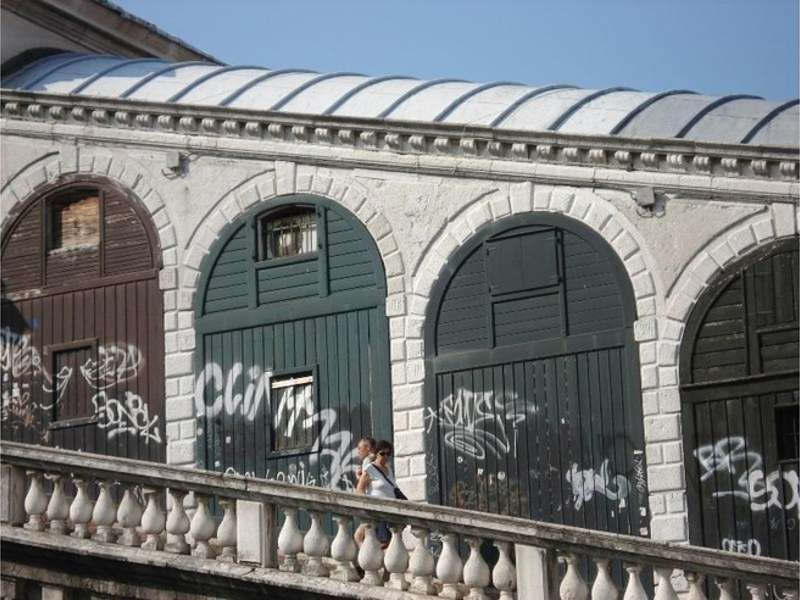
    (Venice, Italy) Venice, the most romantic city in the world, has a dirty little not-so-secret: it is covered with graffiti, most of which is "tags." On Sunday, October 21, 2012, a group of concerned citizens in Venice participated in an anti-graffiti Cleaning Day, organized by Milan, joining cities throughout Italy in a national effort to clean up the country on the outside. At the same time, the Italian government fights to clean up the corruption on the inside with an anti-graft bill. 

    From Reuters, Italy Moves Closer to Passing Anti-Corruption Law:

    To accelerate passage of the draft law, which has languished in parliament for two years, Prime Minister Mario Monti called a confidence vote, which curtails debate and ends voting on individual amendments.

    ... "A serious law against corruption is a fundamental factor for Italian activities and international investment in order to unblock the country's growth," Monti told local government representatives at a conference in Bologna as voting took place.

    Monti's unelected government is pushing hard to get the law passed quickly to shore up confidence in the political system and show that something is being done to stem graft.

    In an economy of about 1.7 trillion euros, corruption siphons off 60 billion euros (48.7 billion pounds) a year out of the public coffers, according to the country's audit court, a body of magistrates which overlooks public finances.

    Stories of extravagant corruption as Italians suffer in a deep recession have become a mainstay of the media.

    For example, they have been reporting prosecutors' allegations that an official in the regional government of Lazio, which includes Rome, siphoned off millions of euros of public campaign financing to holiday in the French Riviera, dine on oysters and champagne at exclusive restaurants, and buy a BMW 4x4 when it snowed in the city.


    Graffiti on Rialto Bridge
    As the Italian government struggles to pass its anti-graft law, Italian citizens are fighting back, too, with an anti-graffiti effort. The Facebook group "I nostri masegni puliti e splendenti" or "Our Stones Clean and Bright" met in Campo San Leonardo to clean up a wall of graffiti. Masegni are stones that Venetians have been using for centuries for pavement and construction.

    From Venipedia:

    Masegni stones are the most prevalent paving stone in Venice, in fact they make up over 70% of all Venetian pavement. There are two types of masegni stones used in paving Streets. Traditional masegni have been used since 1676 and hold great historical value to the city. Newer masegni stones are used in some Street Pavement and are used to replace unusable traditional stones. Both stones are made from quarried Trachyte from the Euganean Hills.

    The wall before the cleaning
    When we arrived, we were handed an outfit that resembled a gauzy spacesuit to protect our clothing, a paint brush and a bucket of paint. Some of the group were professionals, but others, such as myself, were novices, including some children. The atmosphere was festive and light, and soon attracted a crowd that observed our efforts. Care was taken to prepare the area so that we didn't splatter the pavement with our good intentions. Reporters came by; we were on the local news, and even made the front page of the local paper, la Nuova Venezia, today.


    After the wall (and the Telecom phone booth in front of it), was cleaned, the workers celebrated with prosecco and snacks sent over by local businesses. Everyone agreed the wall would look even better after the paint dried.

    Photo: Venice Human Archipelago
    While we were painting the wall in the historic center, over on the Lido another group polished up the Teatro Marinoni located inside the old hospital complex, getting ready for the new season. The Marinoni Theater was bequeathed to the residents of Venice by Mario Marinoni, and has been part of yet another ongoing struggle between the Venetians and private development, who want to turn the former hospital into a luxury complex. To me, there is no reason for one project to negate another. There is plenty of room for all.

    Also, yesterday, was the FAI marathon, part of another national effort to rediscover treasures right in front of our eyes. If you missed it, you can find the Venetian Cat - Venice Blog post at The Wells of Venice - FAI Marathon.

    As the world struggles to find its balance between creation and destruction, honesty and corruption, if we all just make some small efforts, the dark forces will be balanced by the light.

    The Wall - Before and After
    Ciao from Venezia,
    Cat
    Venetian Cat - The Venice Blog


    Monday, October 15, 2012

    Venice - Ancient City Young at Heart - Guggenheim, La Biennale & Premio Venezia at Teatro La Fenice Focus on Youth

    Frank Stella - Gray Scramble -
    Hannelore B. and Rudolph B. Schulhof Collection

    (Venice, Italy) Hennelore B. and Rudolph B. Schulhof were passionate collectors of Italian, European and American art of the decades after 1945. They felt they were kindred spirits of Peggy Guggenheim.

    Upon her death this past February, Hennelore bequested 83 works to the Peggy Guggenheim Collection, including those by Afro, Alberto Burri, Alexander Calder, Giuseppe Capogrossi, Eduardo Chillida, Tony Cragg, Ellsworth Kelly, Willem de Kooning, Lucio Fontana, Jean Dubuffet, Jasper Johns, Donald Judd, Anish Kapoor, Mark Rothko, Frank Stella, Cy Twombly and Andy Warhol, enriching the Peggy Guggenheim Collection with art dating up to the 1970s and 80s. 

    When I saw pieces from new collection, which were deftly integrated into the existing art, I had the same feeling of wonder that I'd had on a class trip I took to the Museum of Modern Art in New York City when I was 13-years-old and witnessed modern art for the first time. The Schulhof Collection blends perfectly into the Peggy Guggenheim Collection.

    Biennale International Festival of Contemporary Music

    Sound Garden by Architettura Sonora
    The Biennale's International Festival of Contemporary Music finished on an exciting note this year: attendance by students was way up -- over 20% of the audience was young people and students. Paolo Baratta, President of La Biennale, said that it was encouraging to look out over the audience and not only see a sea of white-haired heads. "We have reaped the rewards after spending a long time laying the ground work to attract young people.

    Ivan Fedele, the new Director of the Music Sector, performed with presence and passion. The result is a turning point for the Music Sector of the Biennale, which will attach increasing importance to the dissemination of knowledge of music and supporting new talent, further strengthening the program and the Biennial Educational College." Ivan Fedele countered and said that even if someone has white hair, they can still be young at heart.

    Premio Venezia National Piano Competition


    Also doing their part to encourage the musical youth of Italy, the Fondazione Teatro La Fenice di Venezia and the Friends of La Fenice Foundation held their annual Premio Venezia National Piano Competition this past week. Saturday night, October 13, the two finalists competed against each other. This year, two young women ended up in the top slots: Martina Consonni, a 15-year-old from Como, and Giulia Rossini, a 19-year-old from Milan. 

    The program:

    Martina Consonni

    Trenta due Variazioni in do minore sopra un tema orginale Wo0 80 by Ludwig van Beethoven
    Scherzo n.2 in si bemolle minore op. 31 by Fryderyk Chopin 
    Mephisto-Walzer n. 1, S. 514 by Franz Liszt

    Martina Consonni - Second Place

     Giulia Rossini

    Scherzo n. 3 in do diesis minore op. 39 by Fryderyk Chopin
    Sonata n. 1 in fa minore op. 1 by Sergej Prokof'ev 
    Sonata n. 2 in sol minore op. 22 by Robert Schumann 

    Giulia Rossini - Winner Premio Venezia
    Giulia made a striking figure at the piano, with long blond tresses held back with a crimson headband and matching crimson gown, looking a bit like Sleeping Beauty come to life. Martina chose an elegant, sophisticated black classic look. Both young women were excellent, poised and confident, playing with passion and grace.

    During the intermission while the jury voted as the audience sipped prosecco, both girls ventured into the foyer, and it was evident that they had each other's support. Giulia won the top prize, which includes a plethora of cash and concerts, as does second place, so there really is no "winner" and "loser" if a young pianist reaches the finalist slot. I've written about the prize before: 

    Friends of The Phoenix - Amici della Fenice - Premio Venezia


    The other three 2012 finalists were:

    Antonino Fiumara, born in Messina in 1993
    William Greco, born in Nardò in 1987
    Serena Valluzzi, born in Gioia del Colle in 1994

    Congratulations to everyone! 


    Photo: Comune di Venezia
    On another note, Giorgio Orsoni, the Mayor of Venice himself attended the protest on Saturday, October 13, 2012 against the attempted grab of Arsenale by Consorzio Venezia Nuova, a group of private construction companies. From the Consorzio Venezia Nuova website:

    The Consorzio Venezia Nuova consists of a group of Italy's leading construction companies of international importance and local cooperatives and firms with considerable experience of operating in the lagoon. 

    To carry out its work as State concessionary responsible for studies, experimental activities, projects and works, the Consorzio Venezia Nuova has developed a structure able to plan, organise, manage and control the safeguarding measures during the various phases of implementation, while at the same time acting as the operational interface between the granting administration (the Venice Water Authority) on one hand and those carrying out the work on the other (designers, experts responsible for studies and experiments and companies carrying out the work). 

    Giorgio Orsoni - Photo: Comune

    This summer, after fighting the State for decades, the Comune of Venice had finally gotten control of Arsenale, an enormous section of Venice where the renowned Venetian ships were once built. Apparently Consorzio Venezia Nuova tacked a clause onto another piece of legislation and reversed the decision. Maybe they thought no one would notice...


    Ciao from Venezia,
    Cat Bauer
    Venetian Cat - The Venice Blog